
10 TEVET
Inner Transformation on Asara b’Tevet — Full Recording & Teaching
LEAN MORE:
For Torat HaTzeva workshops, teachings, and seasonal practices:
www.kavconnect.com/breathpainting
⸻
Support This Work
🤍 To sponsor or donate for this workshop or future Torat HaTzeva offerings
please PM +1 917 376 5029
Inner Transformation
on Asara b’Tevet
י׳ בְּטֵבֵת · מֵהֶסְתֵּר לִבְהִירוּת
From inner constriction to clarified seeing
Asara b’Tevet is a quiet fast day — inward, compressed, and easily misunderstood.
In Torat HaTzeva, we approach this day not as one of punishment or deprivation, but as a day of discernment, inner listening, and return. It is a day that asks us to notice where constriction has entered our seeing, our reactions, and our relationship to ourselves.
Part of the inner framing of this teaching is inspired by a teaching of Rabbi Yakov Labinsky, who explains that the avodah of the 10th of Tevet is not to deny or suppress separation — פֵּרוּד · pirud — but to meet it honestly in order to transform it.
Pirud does not only appear between people or nations.
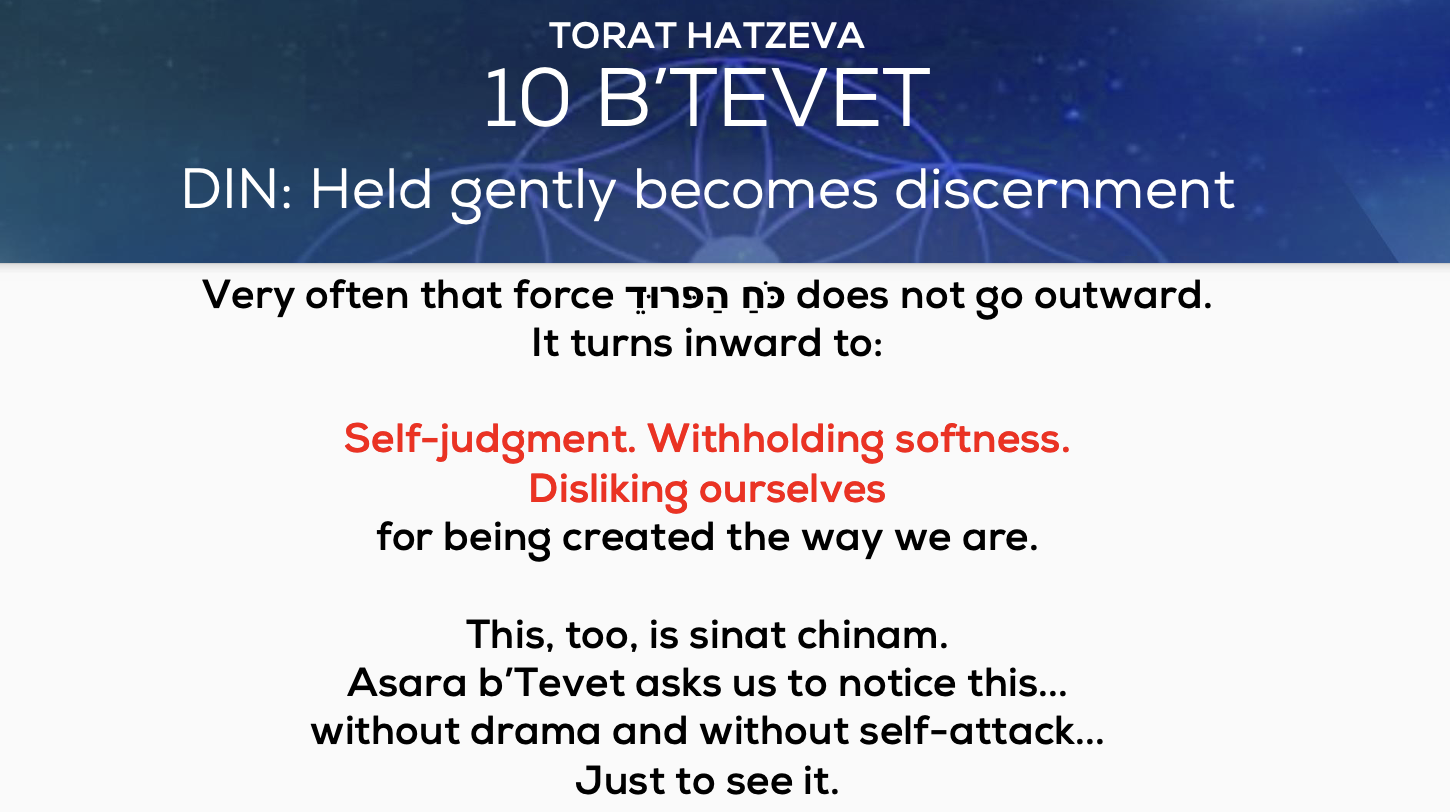
It often turns inward.
It can show up as self-judgment, tightening, withholding softness, or rejecting parts of ourselves for being the way they are. This inner pirud quietly blocks flow, clarity, and presence.
Asara b’Tevet invites us to see this separation without drama and without self-attack — not to fix it immediately, but to bring gentle awareness to it, so it can begin to soften and return to יִחוּד · yichud, inner connection.
This is a Torat HaTzeva lens on Asara b’Tevet — weaving breath, body, color, and awareness into a fast-day practice that supports inner coherence, grounded clarity, and action that flows from alignment rather than reactivity.
Asara b’Tevet: A Day of Din as Discernment
Asara b’Tevet is a day of דִּין · din — but not din as punishment.
Here, din means discernment.
The ability to pause.
To separate truth from noise.
To see clearly without rushing to judgment.
The Navi teaches:
“טוֹב אֶרֶךְ אַפַּיִם מִגִּבּוֹר”
“Better one who is long of breath than a mighty warrior.”
— Mishlei / Proverbs 16:32
The phrase אֶרֶךְ אַפַּיִם · erech apayim literally means long of breath.
True strength, the pasuk teaches, is not force —
it is the capacity to stay present inside pressure.
Asara b’Tevet trains this strength.
From External Fast to Inner Avodah
The fast of Asara b’Tevet is not an end in itself.
It creates a quieter field —
less stimulation, less noise —
so perception can slow and deepen.
This is a day to practice:
• pausing before judging
• breathing before deciding
• seeing before naming
This is the avodah of עַיִן · ayin — the inner eye.
Tevet is a month of low light.
When light is low, perception must mature slowly.
Rushed clarity in low light becomes distortion.
Held clarity becomes wisdom.
Pirud, Ratzon & the Inner Turning Point
The deeper work of Asara b’Tevet happens at the level of רָצוֹן · ratzon — inner desire and orientation.
Not what we say we want.
But what is actually moving us from within.
Pirud often lives here.
When desire is split —
when one part wants closeness
and another is bracing for disappointment —
inner separation takes hold.
This is why Asara b’Tevet is a day of inner teshuva:
not teshuva for failure,
but teshuva for self-rejection.
Each of us carries:
חֵלֶק אֱלֹקָא מִמַּעַל
A living Divine spark.
That spark has not been damaged.
Asara b’Tevet is a day to want to return to that knowing.
The Body Holds the Work: The Liver and Inner Pressure
Torat HaTzeva works through the body, because perception does not live only in the mind.
Chazal teach:
“הַכָּבֵד כּוֹעֵס”
“The liver generates anger.”— Berakhot 61a
The כָּבֵד · kaved (liver) is heavy.
It carries blood, momentum, and drive.
Anger is not evil.
Anger is energy seeking direction.
Asara b’Tevet does not ask us to remove anger.
It asks us to hold it long enough for discernment to emerge.
Through breath, grounding, and somatic awareness, pressure can soften into clarity.
From Ohr Makif to Ohr Pnimi
Chanukah has passed, but its light has not disappeared.
It has moved inward.
From אוֹר מַקִּיף · or makif — surrounding light
to אוֹר פְּנִימִי · or pnimi — indwelling light
Asara b’Tevet teaches us how to receive that inner light gently, without force, so it can actually stay.
This is not a day of pushing.
It is a day of נוֹכְחוּת · nochachut — embodied presence.
Torat HaTzeva: Optical Patience
In Torat HaTzeva, we call this practice optical patience.
Not psychological patience.
Not restraint.
Patience of the eye.
In color work, a color is never seen alone.
Its meaning changes depending on relationship, tone, value, and saturation.
So too in life.
Asara b’Tevet trains us to:
let perception settle
allow relationship before judgment
lower inner contrast before deciding
This is din held wisely.
Toward Yichud and Geulah
When inner pirud softens into yichud, action becomes clean.
Not rushed.
Not reactive.
Not defensive.
This is how inner work prepares for גְּאוּלָה · geulah —
a world where strength serves life,
and clarity flows from coherence.