
Thriving in Intensity: On Living at the Edge and Discovering It May Be the Center
Sound Arriving Like a Distant Lion
From my home next to the Ari mikvah, the question is no longer theoretical.
“What we call the edge is not always where life breaks apart. Sometimes, it is where it gathers.”
“From a child in a sandbox first hearing that ‘people like us’ were once hunted in the “Holocaust”… to children in Tzfat gathering around the remnant of a טיל / rocket—something in the Jewish neshama does not move away. It moves closer.”
“The sound may arrive like a distant lion—but the center is always closer than the roar.”
Is this a pattern of living on the edge? Or running toward the center of the circle? When do we stop running?
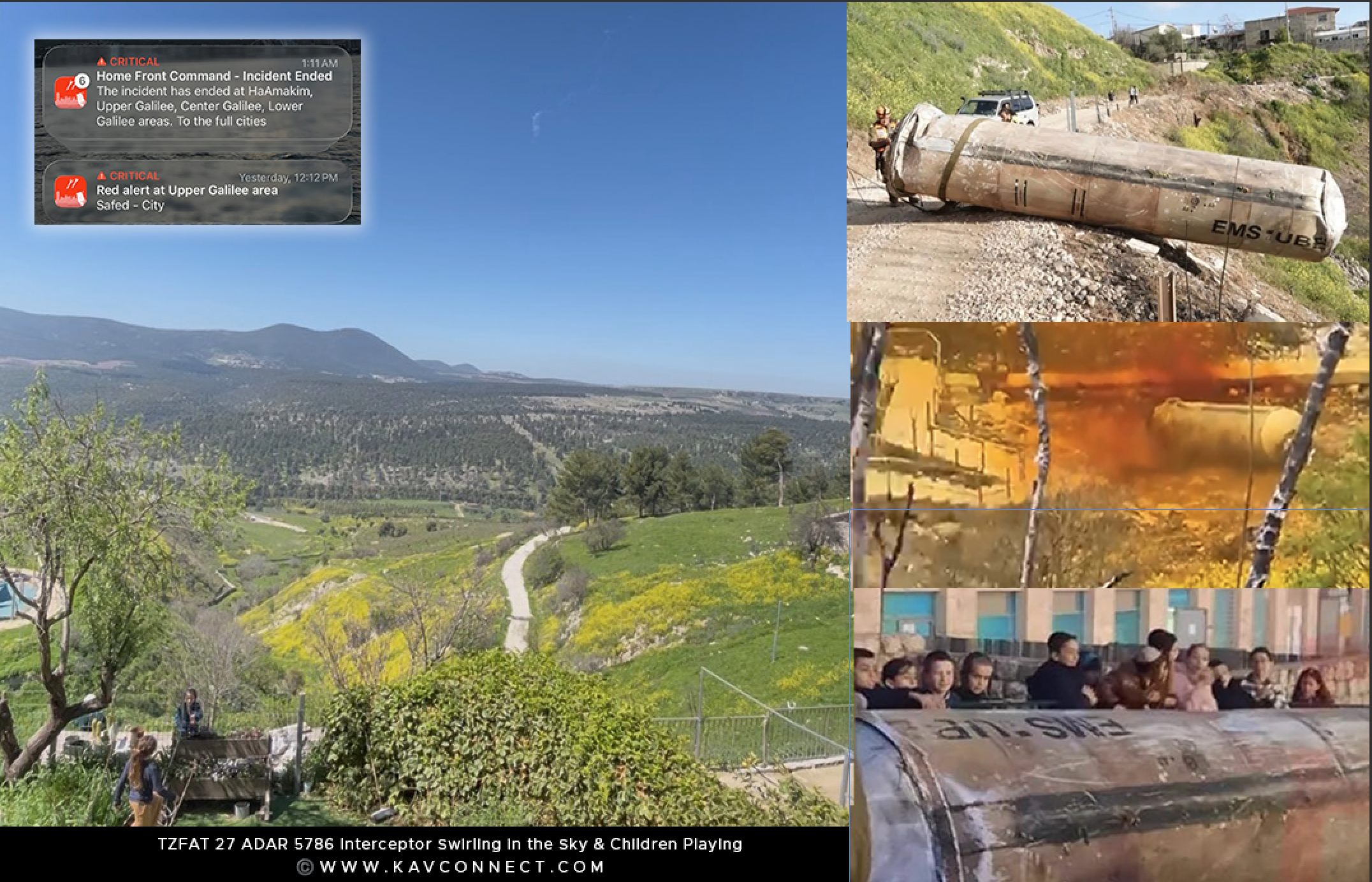
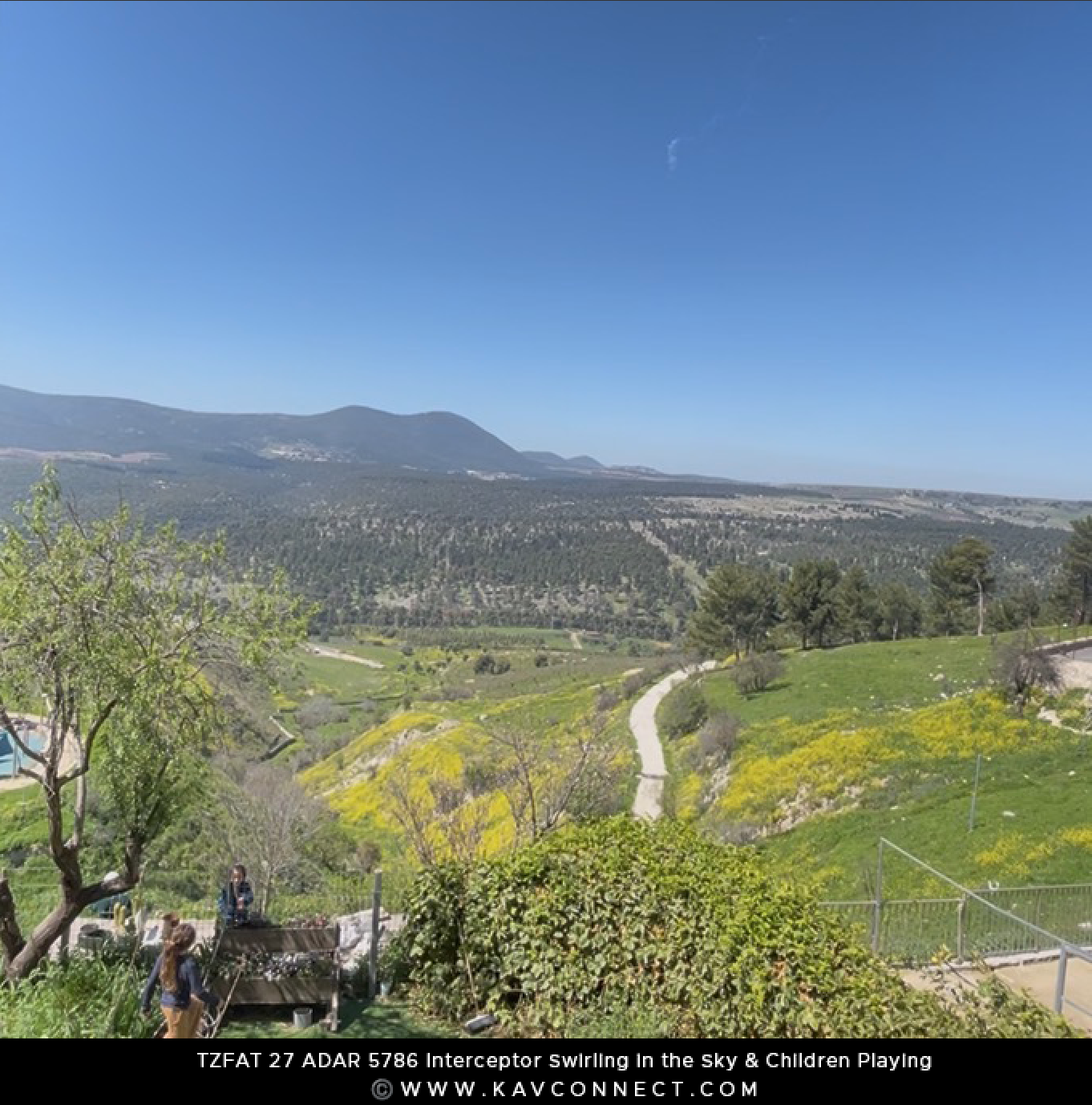
Yesterday, as I was on my way to a Bat Mitzva, a rocket fell approximately 800 meters from my home next to the Ari mikvah. Not somewhere distant, not as a headline or a report, but here, down the hill, in the valley between Tzfat and Meron that I look at every single day. I sit and look out my window as if it were my everything screen. I watch the colors change, the clouds gather and dissolve, the light shift over Har Meron. These days of war, I see smoke stacks after the missiles, where pieces of rockets fall in the valley between Tzfat and Meron. The landscape that once seemed only beautiful has become charged with a second language.
Later, I saw a photograph that I could not stop returning to, not because I was choosing to return to it, but because it had already engraved itself as an enigmatic impression in my mind. This does not feel like writing as much as it feels like remaining with something that has imprinted itself within me, an attempt to give space to the tension it revealed, to let it speak before I try to understand it. This itself feels like the cause of this entire piece, something closer to a kind of therapy than expression, an attempt not to resolve what I am seeing and feeling, but to stay with it long enough for something more honest to emerge.
A group of small chassidish children had gathered around the remnant of that very טיל / rocket. What struck me was not the object itself, but their faces. They were not afraid. They were not recoiling. They were leaning in—curious, alert, even animated. There was a kind of aliveness there, an unmistakable draw toward the very place that, by all logic, should have pushed them away. And that is what unsettled me. Because if this is what it means to live on the edge, then why is the movement not outward into fear, but inward, toward the very place of impact? Why are they not stepping back? Why are they gathering?
Perhaps its the same movement brought me back to ground zero daily after 9/11 happened. I was under the towers on that morning. Why am I being drawn to the center of the explosions? Here I am again.
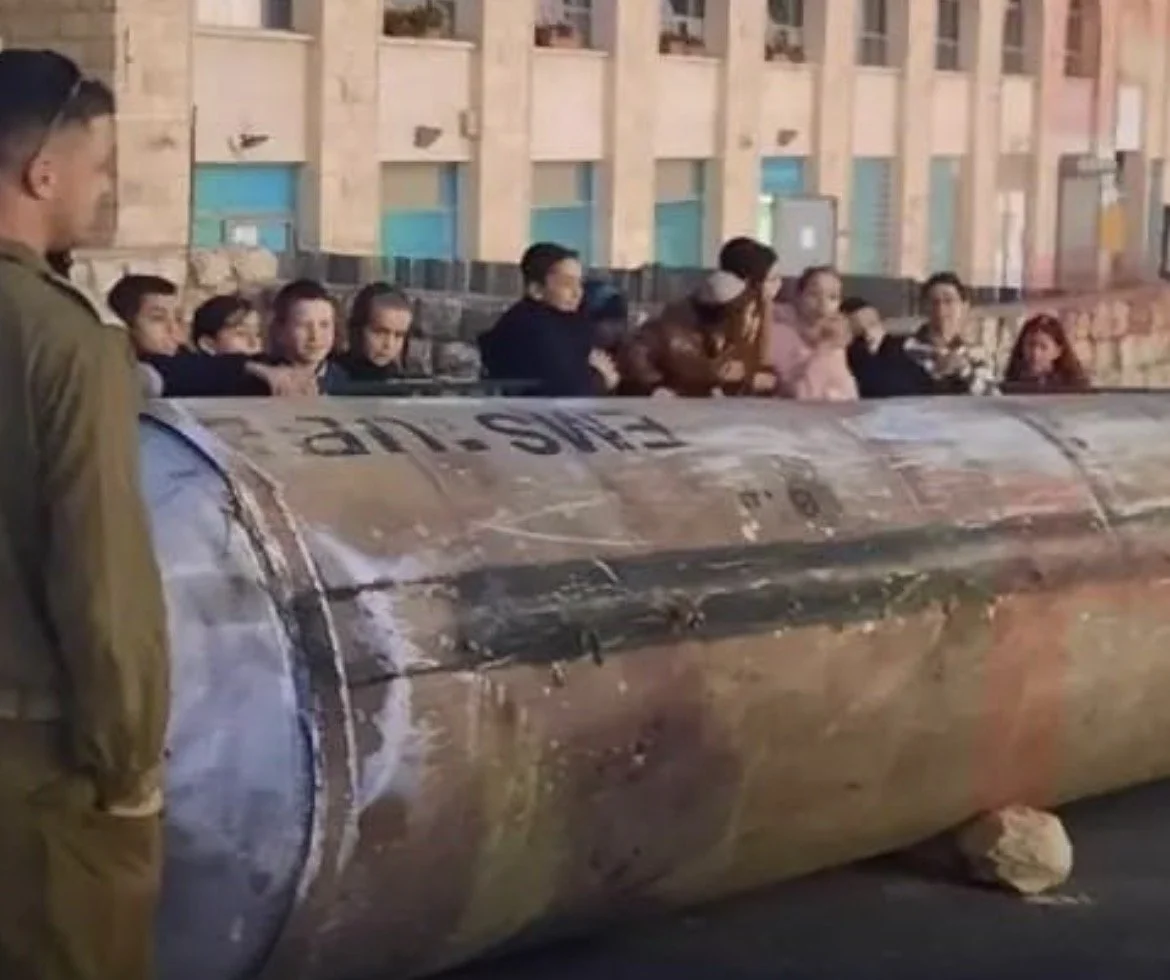
And something in me recognized that immediately. Because perhaps this is the deeper truth I am living inside: what we call the edge is not always where life breaks apart. Sometimes, it is where it gathers. Toward the center.
It happened yesterday. I was getting ready to go out to a bat mitzvah. Life was moving in its usual rhythm—getting dressed, preparing, stepping into a moment of simcha / joy, of continuity, of החיים / life unfolding as it does.
This morning, my friend asked me,
“How was your night? Did you see the picture yesterday of the טיל / rocket that fell outside the Ari mikvah? Baruch Hashem it didn’t explode.”I responded: “Boker Ohr ✨ Baruch Hashem, we had a relatively peaceful night. Only one warning at 1:11 am.
Yes… I saw. I feel like I’m detached from fear, like I look at it and I don’t feel anything. I don’t know if it’s spiritual bypassing or what it means.”
התכנסות / Hitkansut — The Movement Inward
There is a language for this movement. Not retreat. Not withdrawal. Not escape. התכנסות / hitkansut. A gathering inward. Not the kind that comes from fear, but the kind that comes from recognition.
There is a difference between running toward something and being drawn into something. Running has tension in it. It leans forward. It is searching, proving, escaping, reaching. Even when it looks spiritual, it can still carry a subtle restlessness: maybe the next place, maybe the next depth, maybe the next experience. התכנסות / hitkansut is different. It is not driven. It is drawn. It does not move outward across distance. It gathers inward toward a point. And that shift is very quiet. You do not notice it because life becomes calmer. You notice it because you become still—even when life is not.
So when do we stop running? Not when the place changes. Not when the intensity quiets. Not even when the questions are answered. We stop running when the movement itself changes. When we no longer need the outer edge to access the inner point. When Manhattan or Tzfat, intensity or quiet, sirens or silence, no longer determine how close we feel. When the נקודה פנימית / inner point is accessible without changing location, something reverses. You are no longer moving toward the center. The center is living through you.
And then even standing next to a fallen טיל / rocket, or hearing the distant roar in the sky, does not pull you outward into reaction and does not require you to detach to cope, because you are already positioned inside. From there, the question softens. Am I living on the edge, or am I at the center? And the answer becomes clear: the center is not a place you arrive to. It is a place you stop leaving.
A Sound That Arrives Later
At the bat mitzvah, someone said something, as if explaining a natural phenomenon. When the interception happens high in the atmosphere, you don’t hear it right away. It takes time. Several minutes. And then the sound arrives. A deep reverberation. A roar.
Like a lion.
And something in me recognized that immediately, not just as sound, but as קול / kol, as בת קול / bat kol—an echo. Not the original event. But its reverberation. The after-sound. The way something that has already happened above continues to travel until it reaches you.
And suddenly everything rearranged. Because what I had been hearing was not the event itself. It was the echo. The resonance. A sound arriving from something that had already taken place beyond my direct perception. And I began to wonder—how much of what we experience in life is not the הדבר עצמו / the thing itself, but the reverberation of something that has already occurred above us? How much of what we call fear, or intensity, or drama, is actually an echo? And what would it mean to live not inside the echo, but closer to the מקור / source?
Reva Emunah said, “A בת קול / bat kol is not the thing itself. It is what remains, what continues, what arrives afterward.” The reverberation matters. The echo matters. But it is not the whole event. And perhaps much of what we live inside, especially in times like these, is not always the moment itself, but the after-sound that reaches us later and shakes the ground beneath our feet.
From Quiet Circles to Inner Resistance
There was a time when the world felt quiet. A quaint New England town where mornings opened gently and nothing in the air demanded attention. Life moved in wide circles there—predictable, soft, contained.
My father a”h had a phrase he would return to often, especially when asked how things were in his little town. “Nothing’s ever new in Millis.” He did not say it with frustration. Quite the opposite. There was a kind of settled contentment in it, almost a quiet pride. For him, sameness was not stagnation. It was stability. A life that did not need to be shaken in order to feel meaningful.
For him, “nothing’s ever new” was a place of rest. Everything was as it should be. He loved the rhythm of that world. The small consistencies that shaped a day. Stepping outside in the morning air, tending to the yard with quiet focus, trimming the shrubbery with care, feeding the birds who came back again and again as if they too trusted the steadiness of it all. There was no urgency to change things. No need to disrupt what was already enough.
He settled easily into the rhythm of what was. He experienced stillness as completion. And it was true. The days passed without interruption. The sky remained only sky. The ground did not tremble. Life held itself in a kind of reliable stillness.
And yet, something in me moved differently. Where he found peace in sameness, I felt something in me quietly refusing it. For me, “nothing’s ever new” did not feel like rest. It felt like the beginning of a question. Not rebellion. Not dissatisfaction. Something more subtle. A sensing. As if something in me was always aware that beneath what appeared to repeat, something else was trying to emerge.
He was content where life circled. I was already being pulled toward the center.
That difference revealed itself in the most ordinary moments. When my father a”h would come to visit me in Manhattan, he could not sleep. The sounds of the city—the firetruck sirens, the constant movement of the street, the hum of life pressing in from every direction—kept him awake. It was too much, too alive, too unpredictable. I, on the other hand, barely heard it.
But when I returned to his home, the opposite unfolded. The quiet was not restful to me. It was loud in its own way. The stillness carried its own kind of intensity. I would lie awake listening to the orchestra of crickets outside, each small sound amplified in the absence of everything else.
The same world. Two completely different nervous systems. Two different relationships to stillness and sound.
For him, quiet was ease. For me, quiet was something to move through.
And maybe that is why I found myself here—in a land where sound is never just sound, and even the sky has something to say.
The News Was the Sky
My father a”h used to sit every evening watching the news. The Milford Daily News in his hand, the television flickering, events happening somewhere far away. But here, the news is not on a screen. The news is happening in the sky. My mother a”h watched soap operas. Drama contained. Structured. Predictable.
And here—my life is the drama.
Am I creating drama? As a life coach, as someone who guides others, am I drawn to this? Or is this not drama at all, but something more real?
When I go back to suburbia in the United States for a visit, why does it feel fake and phony and not alive? Everything is in place. Lawns are trimmed. Streets are quiet. The choreography of normal life continues exactly as it should. And yet something in me experiences it as distant, almost staged. Not because it is false, but because it feels buffered from the rawness of reality. Here, the distance between event and witness has collapsed. We do not turn on the television. We look out the window.
Holocaust — Before I Had Language for It
I remember playing in the sandbox in my huge backyard.
I was five. My best friend Linda was eight.
“You know there was a Holocaust?”
“What’s that?”
“You know where Jews were killed.”
“Like us? We are Jewish?”“Yes, like us.”
IIs living on the edge, this pull toward intensity, toward authenticity, toward something unfiltered and real, connected to that root conversation?
I have begun to wonder if that early conversation did more than introduce information. Perhaps it introduced a fracture in the assumed safety of the world. A subtle awareness that beneath the surface of what appears stable, something else exists—something unpredictable, something that cannot be controlled or fully understood.
Before that moment, my world was whole. Contained. Coherent. There was no contradiction between what I saw and what was true.
After that moment, something shifted. Something broke.
Was it the eating of fhe eitz haDaas Tov v Ra?
Not consciously. Not in a way I could articulate. But something in me began to sense that reality has layers. That what appears on the surface is not the full story. That there is always something underneath.
I lived a perfect post-depression life, in the shadow of World War II. My father a”h was in the army saving the US from Japan. I guess for him he was seeking a quiet existence, shielded from the Holocaust, not showing his Jewish “horns.” We assimilated. We were like everyone else. I was a Jewish princess with all my heart’s desires materially. But my soul was longing. I didn’t know what a soul was. Rabbi Miller in Hebrew School never talked about that.
And perhaps this is where the search began. Not a search for danger. But a search for what is real. Because once the illusion of complete safety is quietly disrupted, even if only for a moment, the neshama no longer settles easily into surfaces. It begins, almost instinctively, to move toward depth. Toward truth. Toward places where the external and internal align.
In that sense, what might appear from the outside as “living on the edge” may not be a desire for intensity at all. It may be a refusal to live in a world that feels partial. A refusal to remain at the perimeter. A longing to touch something that is fully alive.
And vulnerability becomes part of that movement. Because to live closer to what is real requires openness. It requires a willingness to encounter life without the protective layers that once made everything feel predictable.
And perhaps that is the thread. From a child hearing, “people like us,” to a woman standing in a land where history is not past, but present, where the distance between then and now collapses, where what was once unimaginable becomes visible—not in order to create fear, but in order to live closer to truth.
Boredom
I never remember being bored. That realization itself surprised me when we were discussing what “boring” even means. I searched my memory and could not find it—not as a child, not as a teenager, not even in moments that externally might have appeared empty. Even as a child, I grew up alone in a big house and was always creating—making mud pies, building imagined Barbie doll houses, Secret Gardens in the forest, enchanted houses, entire worlds built out of nothing, talking to the birds. I was self-contained, alive from within, not waiting for something to happen.
Looking back, I wonder if this is a soul type. In IFS terms—Self energy. In Torah—דבקות / deveikut.
I never remember being bored because there was always some inner movement already underway. Even as a child, I was always creating—not only making mud pies or building imagined Barbie doll houses, but constructing what I thought of as Secret Gardens in the forest, enchanted houses, entire worlds built out of nothing. These were not casual games. They were inner landscapes. Places of aliveness. I spoke to the birds as if they understood me. My first “job” was painting garbage cans, drawn instinctively to beautify what others overlooked, as if there was already some part of me that could see beyond the surface of things.
I was self-contained. Alive from within. Not waiting for something to happen. Already living from some inner place of connection.
Looking back now, I wonder if this is not simply temperament, but a type of neshama. In IFS language, it might be called Self energy—a state of internal coherence, where creativity, curiosity, calm, and connection arise naturally. In Torah language, perhaps it is something even deeper: a natural orientation toward deveikut, toward attachment, toward quiet relationship with source.
Because boredom may not be lack of activity.
Maybe it is lack of connection.
Maybe the opposite of boredom is not entertainment.
Maybe it is deveikut.
And maybe what I experienced as a child was not constant stimulation, but constant relatedness. Not always consciously. Not with language. Not with theology. But with a lived sense that life was already happening, that the world was already speaking, that there was always something more to enter.
Returning to the Children
And I return to the children.
Standing around the rocket.
Not afraid.
Not retreating.
Gathering.
Alive.
Maybe they are not living on the edge.
Maybe they are already living at the center.
And perhaps that is the part I am only now beginning to understand.
The center is not a place you arrive to.
It is a place you stop leaving.
And wherever you go—New England, Manhattan, Tzfat—is no longer the edge of your life. It is simply where the circle is unfolding.
And perhaps it was always the same movement. From a child sitting in a sandbox, hearing something she could not yet understand, to a life shaped by quiet assimilation, where nothing needed to be questioned, to a subtle, persistent longing that had no name, to being drawn, step by step, into a land where nothing remains distant, until one day, something falls from the sky close enough that the question is no longer theoretical.
And still, the movement continues. Not outward. Inward. Toward that same נקודה פנימית / inner point that was already present then, even before it was known. Not something new. Something that was always there. Waiting. For me to stop circling it. And begin living from it.
And I think again of those children. How they did not step back. How they gathered. How something in them moved closer, not away. As if they were already living in that movement—not running, but gathered—inside a quiet התכנסות / hitkansut toward the center. As if they already knew: the sound may arrive like a distant lion, but the center is always closer than the roar.
And from this same window next to the Ari mikvah, I am beginning to understand—the edge was never where I was living. It was where I was being drawn inward all along.