
Yom HaAtzmaut
🇮🇱 Yom HaAtzmaut — A Respite from Sirens
A Gift of Being Here
This year, Yom HaAtzmaut did not arrive with noise.
BChasdei Hashem, it arrived with quiet.
No sirens.
No missiles.
No interceptors in the air …
Just a stillness that felt almost unfamiliar
and because of that, even more precious.
For about 6 weeks before (since Feb 28 when this war started), I found myself standing by my window, looking out. The grass had already begun to grow, soft and green. Red poppies were opening across the fields. There was so much beauty, so much invitation — and yet I stayed inside. Not because I didn’t want to go out, but because I needed to remain close, within reach of a safe room. Within thirty seconds.
I would look with רצון / desire. I would notice the movement of the wind across the grass, the color of the flowers, the openness of the land — but I could not touch it. I could not lie down in it. I could not fully enter it.
And then, on Yom HaAtzmaut, something shifted.
This year, we were given a simple, almost startling gift: the ability to be here, on this land, without interruption. To breathe without bracing. To step outside and feel that nothing needed to be held off for a moment.
We were in the north, into the countryside, near the kever of Rabbi Tarfon.
Not for anything dramatic. Just to be in the simplicity / temimut.
We spread a blanket on the ground and lay down. No rush, no agenda. Just lying on the earth, feeling its presence beneath us. There is something that happens when you stop standing above the land and allow yourself to rest on it. You begin to feel that it is not just something you walk on — it is something alive that holds you back.
Rabbi Tarfon, in Pirkei Avot, says:
“לא עליך המלאכה לגמור, ולא אתה בן חורין ליבטל ממנה”
“It is not upon you to complete the work, but you are not free to withdraw from it.”
Lying there, that teaching felt different than it does on a page. The work is not only what we build or fix or carry. Sometimes the work is simply to be present enough to receive what is already here. To not withdraw from life, even in its quiet moments.
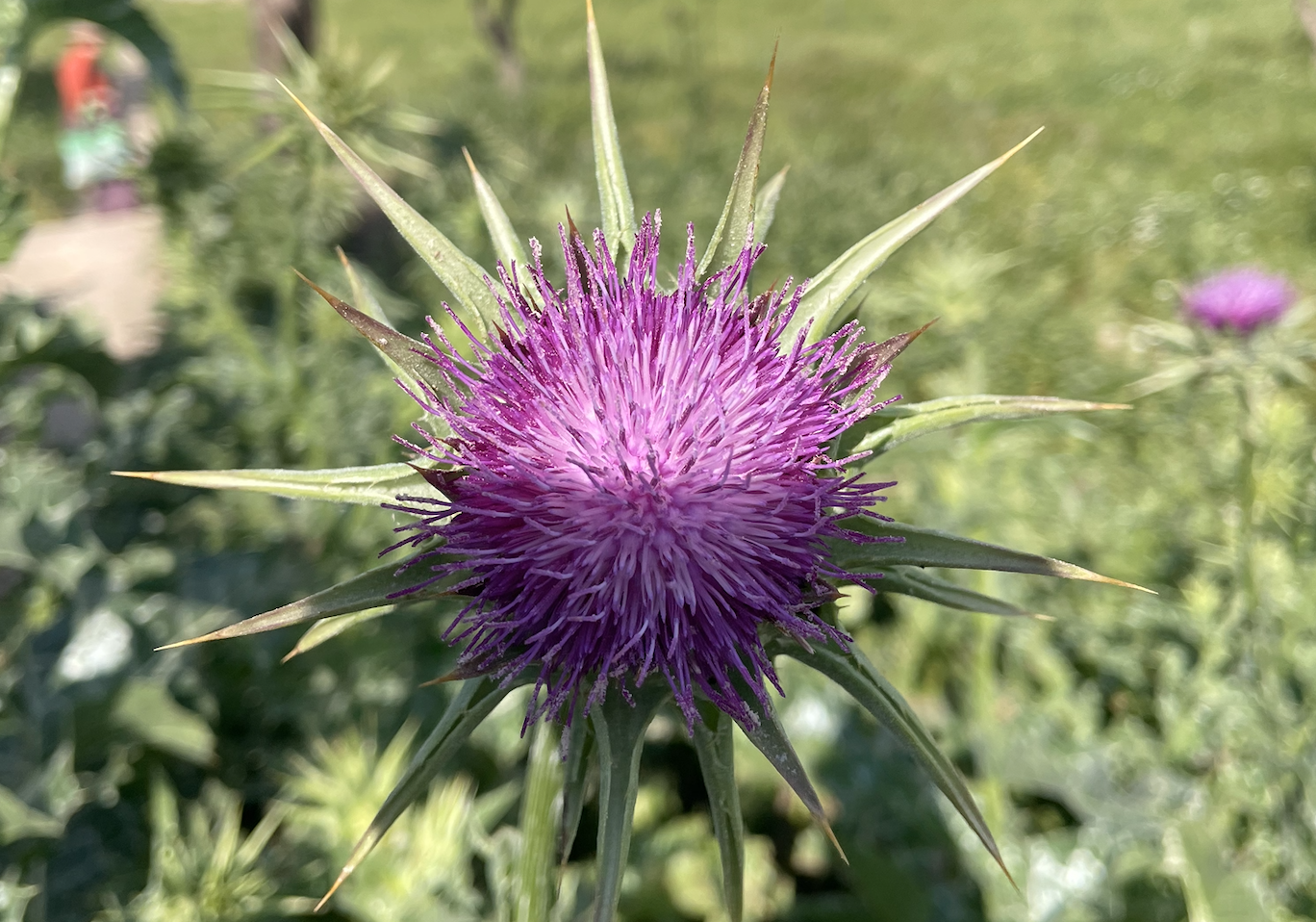
Around us, the land was speaking in its own language. Rolling hills layered in endless shades of green. Thistles and thorns growing freely, chaotically… unapologetically. Sheep grazing slowly. Cows scattered across the fields. Nothing arranged, nothing curated — just life, unfolding as it is.
Rabbi Nachman teaches that the land is alive, that every blade of grass has its own song. And lying there, it didn’t feel like an idea. It felt real. There was a kind of conversation happening — not in words, but in presence. The wind moving across the grass, the quiet movement of animals, the stillness of the hills — all of it carried something that could be felt if you slowed down enough to listen.
We breathed with it.
Not trying to take anything from the moment, just allowing ourselves to be part of it. To recognize what it means to be on this land, in this time, in a way that is so simple it almost goes unnoticed. And in that simplicity, something opened.
This is the month of Iyar, and its chush / sense is hirhur / הרהור … the movement of emotions circling in the mind, disguised as thoughts. Most of the time, we experience that movement as something that carries us. Thoughts come, and before we realize it, we are already inside them — pulled into worry, into memory, into imagined futures or unresolved pasts. Hirhurim tend to move quickly, and we move with them, almost without noticing.
But lying there, something in that pattern softened.
The thoughts did not disappear. They were present, as they always are. But they no longer had the same hold. They passed more lightly, without pulling me away from where I actually was. There was space between the thought and the experience, and in that space, something else could be felt.
Maybe this is a quieter, more honest understanding of Atzmaut / עצמאות… Not only independence in the outer sense, but a kind of inner steadiness — the ability to notice a hirhur / thought without being carried by it. To recognize it as Hashem creating the movement, not identity. There is simply a staying — a gentle refusal to leave the present for something less real.
And for the first time in weeks, I was not looking at the land from a distance, through a window or through longing. I was on it, resting into it, breathing with it.
From that place, gratitude felt different. Not something to say, but something that naturally arose. A quiet recognition, almost simple in its clarity: we are here. After everything, after all the running and returning movement and uncertainty, we are here … able to touch the land, to lie on it, to feel its life / chius moving through us.
And to share that with friends… who understand that these moments are not small, and not to be taken for granted. These glimmers of Olam Haba not as a place you arrive at, but as a quality of presence that appears when nothing is pulling you away from the moment you are in.
Yom HaAtzmaut, in that space, did not feel like a statement. It felt like a reality.
Not something to prove.
Not something to explain.
Just something to stand inside of.
And to be grateful for.
🇮🇱 Day 20. Yesod shbTiferet Yom HaAtzmaut
Iyar: Carrying the quality of Chol HaMoed:
A continuous field of Ziv/ Radiance.
The month of Iyar is not simply a transition between Pesach and Shavuot. It is a precise inner process in which the light that opened in Nissan begins to take form.
Each day becomes a potential moed, but only to the degree that it is lived consciously. The celebration is not given. It is built.
We are living in a time that cannot be understood only on the surface. The Ramban describes this entire period as carrying the quality of Chol HaMoed … an extended moed, a continuous field of subtle illumination… Chodesh Ziv/ Radiance.
Something began, and now it must be built. Yom HaAtzmaut emerges specifically within this time.
As a recent Oleh, this special day is relatively new to me and to understand its depth, I draw from the teachings from Rabbanit Benyamin, as we collectively move beyond the historical lens and enter the pnimiut dimension of what this day is … in connection to the cusp of what is unfolding.
The Arizal teaches that the days of Sefirat HaOmer are a structured process of refining the 7 middot through inter-inclusion. This is not only an individual avoda. It is also taking place within klal yisrael, within the collective unfolding of a people returning to form.
Rav Kook explains that the return to Eretz Yisrael is not merely political or national.
It is a gilui / revelation of the neshama of klal yisrael expressing itself once again in physical reality. He describes this stage as the beginning of geula / redemption … not complete, not perfected, but real.
Going deeper, this can be understood as the rebuilding of Malchut / receiving Shechina presence … the dimension that embodies and reveals.
Malchut does not generate its own light. It receives and expresses. After a long galus, where expression was fragmented, the return to land, language, and shared structure is the reformation of a kli / vessel.
And this is exactly why it happens in Iyar… The expansive light of Nissan now requires containment. Without gevura, light dissipates. With gevura, it becomes livable. What begins as inspiration must now become form.
Why does Iyar, positioned between two great revelations, contain no explicit Yom Tov in the Torah?
Nissan is filled with moadim, and Sivan culminates in Matan Torah. Yet Iyar appears, at least on the surface, without a fixed day of celebration. This absence is not incidental. It reveals the very nature of the avoda of this time.
The Ramban explains that the entire period between Pesach and Shavuot carries the status of Chol HaMoed,
not as an interruption, but as a continuous field of sanctity. Iyar is therefore not lacking a moed. It exists within a concealed moed, where the light is present but not fully revealed. The avoda is no longer to receive illumination, but to build the vessel that can hold it. Nothing arrives complete. Everything requires participation.
The Arizal deepens this further, describing the 49 days of the Omer as a precise system of inner refinement through the sefirot. Each day carries a distinct color / light, but that light is not accessed passively.
It must be revealed through awareness, through counting, through engagement.
This has been our process in creating a Journal / Sketchbook of experiencing our sefirot through journaling and painting.
SEE MORE: https://www.kavconnect.com/omerbook
In this sense, Iyar transforms the definition of a Yom Tov. Each day becomes a potential moed, but only to the degree that it is lived consciously. The celebration is not given. It is built.
This creates a fundamentally different relationship to time. Instead of waiting for a day that arrives complete, we are invited into a process in which the day itself is shaped through our presence. The light is hidden within the structure, and the structure must be entered for the light to emerge. Iyar becomes a workshop of becoming, where the vessel is formed slowly, deliberately, and often without the feeling of revelation.
It is precisely within this concealed structure that Yom HaAtzmaut appears. Not as an exception to the system, but as a revelation from within it. Rav Kook teaches that the unfolding of geula often emerges through partial forms, through processes that appear incomplete, yet carry within them something profoundly real. The return of klal yisrael to its land, to its language, and to shared life is not the completion of redemption. It is the beginning of Malchut taking form within reality.
Yom HaAtzmaut, in this light, is not a finished moed. It is a moed in formation. A revealed point emerging from within a concealed field. It does not arrive with the clarity of Pesach or the completion of Shavuot. It carries complexity, tension, and movement. And this is precisely its depth. It reflects the system of ratzo v’shov / running and returning, the rhythm through which all growth unfolds. It is not a celebration of arrival, but a recognition that something real has begun to stand.
Here in Eretz Yisrael, this becomes tangible. The land itself responds. The blooming, the rebuilding, the return to shared life — all of this reflects a deeper system unfolding. What appears external carries within it a spiritual movement that requires refined perception to recognize.
And we are part of it. The structure described by the Arizal is not theoretical. It is lived through connection.
As we go from Tiferet she BYesod today, to Tiferet she b Malchut… Yesod / connection becomes the channel through which life flows, and Malchut / embodiment becomes the place where that life is expressed.
The tikun / refinement of these days is ultimately about relationship.
How we relate to ourselves, how we relate to others, and how we remain connected to HaKadosh Baruch Hu within the process.
Yom HaAtzmaut, in its pnimiut, is not only about independence. It is about the capacity to stand as a kli. To receive. To hold. To express. A standing that is not detached, but rooted in relationship.
This is why the avoda of counting continues through this day. We count not to mark time, but to build awareness of time. Each day is held, each day is integrated. Because geula is not a single moment. It is a process of becoming.
🎨 Torat HaTzeva Meditation — Yom HaAtzmaut
Pause and notice where you are in this time.
Not as an observer, but as someone living inside the process.
Bring awareness to your guf / body, to your breath, to your presence.
Now visualize the colors of this day.
White — expansive, open, surrounding light.
A field of possibility.
Blue — deep, steady, grounding.
A presence that holds and contains.
Allow the white to expand gently around you.
Then allow the blue to settle within it.
Blue within white.
Feel yourself as a kli.
Receiving. Holding. Expressing.
Now turn inward and say:
“Ribono shel Olam, help me see what is unfolding here.
Help me recognize that I am part of this building.”
Let that settle.
Something is forming.
Something is becoming real.
And you are part of the process.
This is the pnimiut of this day.
Hashem allow me to open my vision
Not only what I see,
but what I am becoming.
Women Sharing & Supporting each other in the Wellsprings of Pnimius Torah https://chat.whatsapp.com/ETfGVQDAgqp39KoVMS7Ahq
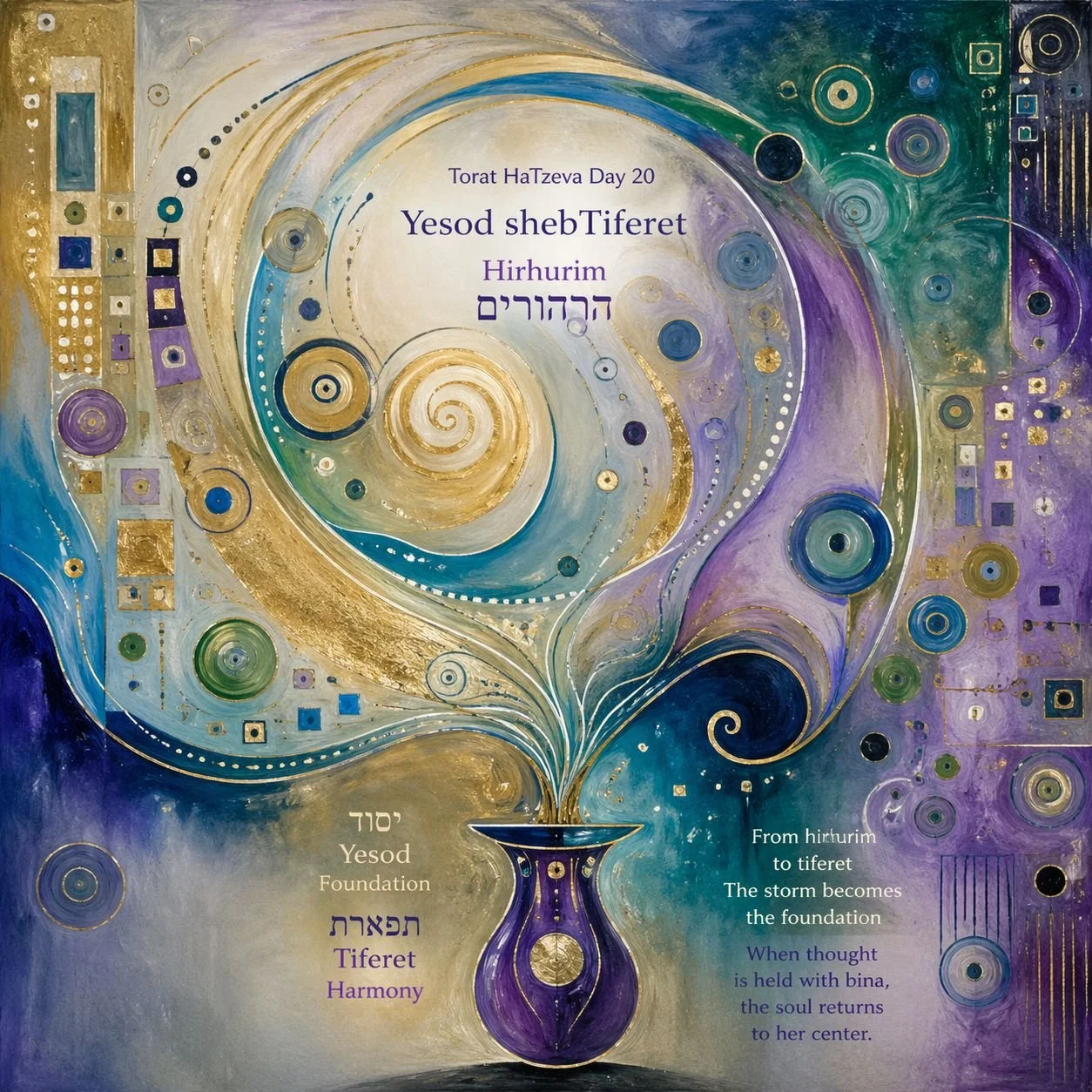
DAY 20 The month of Iyar, the sense of Hirhur / הרהור, & the Inner Meaning of Atzmaut
The outer story speaks of national sovereignty.
The inner story asks a more intimate question...
What is Atzmaut / עצמאות?
Where is my Atzmaut in this moment?
Is it independence from something…
or a RETURN to something deeper within?
As we progress into Iyar, and specifically into Tiferet she’b’Yesod, we arrive at a deeper question that lives beneath the calendar itself. On 5 Iyar, Yom HaAtzmaut, we speak about "independence".
What am I truly independent from?
And what am I still dependent on?
The sense / chush / חוש is hirhur / הרהור.
And here lies a hidden layer of Atzmaut.
Because so much of what we experience as “self” is actually entangled in hirhurim / הרהורים.
Patterns of thought that loop.
Emotions-disguised-as-conclusions... Inner narratives that quietly define our reactions, our relationships, even our sense of identity. (ie I am shameful, not enough, abandoned, etc)
Often, we are being moved...
Moved by old patterns.
Moved by inherited shame.
Moved by פחד / fear, by subtle constriction, by stories that have not yet been brought into light.
So what is Atzmaut / עצמאות on the level of the neshama?
It is not separation.
It is not disconnection.
*It is the capacity to see the hirhur…*
*and not be ruled by it.*
The Rav Tzadok HaKohen of Lublin teaches that a person’s deepest identity is rooted in their פנימיות / inner essence, not in the passing movements of thought. Hirhurim may pass through us, but they are not who we are.
True Atzmaut is the gentle disentangling from automatic identification.
“I am experiencing this thought”
is very different from
“I am this thought.”
And this is the koach to tap into today to mitaken this for the whole year of Tiferet she’b’Yesod!
Yesod / יסוד is connection, bonding, the place where inner and outer meet.
Tiferet / תפארת is harmony, truth, the balanced center.
When harmony enters connection, something begins to refine.
Our relationships become mirrors.
Our attachments become teachers.
We begin to notice where we are relating מתוך חירות / from inner freedom…
and where we are relating מתוך תלות / from dependency
And often, that dependency is not on the other person.
It is on our hirhurim about the other person!
On the story.
On the interpretation.
On the emotional loop that keeps circling in our mochin / repeating itself.
This is a subtle but profound shift.
We are not only asking,
“What is happening between US?”
We are asking,
“What is happening within me as I relate?”
The Arizal describes how unrefined inner movements circulate until they are met with awareness and integrated into the Kli / vessel. Until then, they return again and again as hirhurim!✨
So Atzmaut is not the absence of movement.
It is the ability to stay present within the movement.
Not to collapse into it.
Not to run from it.
But to hold it with Bina / בינה—understanding, patience.
This is why the key is savlanut / סבלנות.
Patience to notice the pattern.
Patience to breathe inside it.
Patience to not demand immediate resolution.
Because yeshua / ישועה comes b’hesech hada’at / בהסח הדעת.
When we loosen the grip.
When we allow something deeper than the mind to emerge.
The Netivot Shalom writes that true cherut / freedom is not the removal of challenge, but the transformation of one’s relationship to it.
The external may remain complex, but the פנימי / inner stance becomes anchored!!!
And this is where a new kind of independence is born.
Not independence from connection…
but independence within connection.
Not detachment…
but clarity.
“I can be in relationship…
without being controlled by my hirhurim about it.”
“I can feel…
without being overtaken.”
“I can remain connected…
while rooted in my פנימיות / inner truth.”
This is Atzmaut / עצמאות.
And from this place, a quiet ziv / זיו / radiant light begins to shine.
A radiance that is not reactive.
Not dependent on outcome.
But emerging from a deeper alignment.
🎨 Torat HaTzeva Kavana for DAY 20 s Yom HaAtzmaut / 5 Iyar
Sit for a moment and notice a recurring hirhur.
Not the content alone…
but the pull of it.
Where does it take you?
What does it ask you to believe?
Now gently step back inside yourself.
Breathe.
And say:
“This is a hirhur / הרהור.
An emotion arising as thought
It is passing through me…
but it is not me.
I recognized you.
Breath
Feel your body.
Feel your grounding.
Imagine the hirhur
softening into a color.
Notice its color(s)
Its movement
Paint it on canvas or in your mind...
See them soften
From sharp lines and shapes
into a beautiful painting!
From סערה / stormy thoughts
into תפארת / harmony.