
Yom HaShoah
Yom HaShoah in a Time of Sirens: From Memory to Consciousness
27 Nissan 5786 · Day 12 of the Omer — Hod she’b’Gevura / הוד שבגבורה
A Country Pauses
At 10:00 a.m. this morning, a siren sounded across Eretz Yisrael. For two minutes, the country stood still. Cars halted on highways, pedestrians paused mid-step, and conversations fell away into a shared silence. It was the annual moment of collective remembrance for the six million Jews murdered in the Holocaust.
This morning’s siren was different from the warning sirens we have come to know so intimately over the past two and a half years. It is a קול / sound that carries memory rather than urgency / זִכָּרוֹן ולא דחיפות. It does not rise and fall. It does not send the body running. It holds, steady and unbroken, asking not for movement, but for presence.
And yet, this year, the distinction is not so simple.
When Sirens Become Daily Language
Since Shabbat Parashat Zachor, February 28, communities across the north have been living with near-daily missile sirens. In cities like Tzfat, the sound that once belonged to national memory has become part of daily reality. The הגוף / body responds instantly: movement toward shelter, a quickened breath, a whispered pasuk, a hand reaching for a siddur or Tehillim. There is no deliberation in these moments. The response precedes thought.
For those not living within this rhythm, it is difficult to convey the layering of the experience. A moment before, there is ordinary life—children playing, coffee being poured, a quiet exchange—and then the air shifts. The siren is not only heard; it is felt. It registers in the chest, in the breath, in a subtle contraction of awareness. It carries with it the immediate knowledge that there are those who seek to harm us—not abstractly, but personally, presently, as Jews.
And within that contraction, something else has quietly taken root: a reflex of תפילה / prayer.
Words that might once have belonged to routine now emerge with clarity and necessity. שמע ישראל ה׳ אלקינו ה׳ אחד is no longer recited as a distant declaration, but as a present reliance. Each siren becomes, in its own way, an act of מסירות נפש / self-offering—a turning toward HaKadosh Baruch Hu in the most direct sense. פסוקים from Tehillim surface almost involuntarily: Hashem ro’i lo echsar; אל תרחק ממני; אל תסתר פניך ממני. The moment compresses, and within it, the relationship becomes immediate.
Every siren I run to my saferoom and say שמע ישראל.
Every siren I am in מסירות נפש / self-offering, giving my life to Hashem.
Every siren I recommit to living על מנת להשפיע / for the sake of giving.
Every siren I devote myself again to Am Yisrael.
Every siren I say Tehillim, or think it quietly.
It is within this lived context that the Yom HaShoah siren enters.
Memory Meets the Present Moment
What is meant to call us into memory now enters a body already conditioned by present threat. The past and the present converge—not as abstraction, but as embodied awareness. The question arises quietly: what is the difference between the siren of memory and the siren of now?
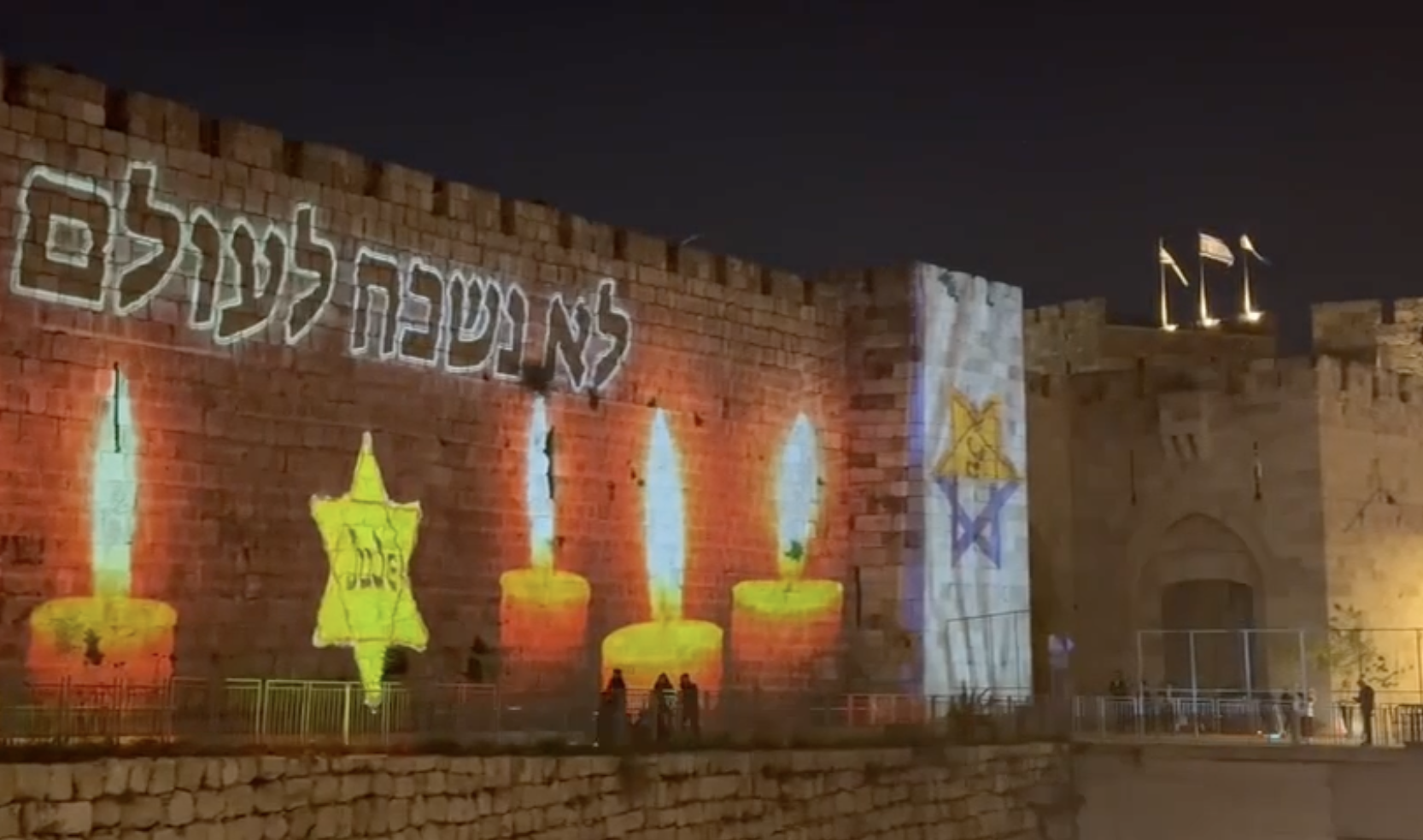
The night before, on the walls of the Old City in Yerushalayim, a striking image was projected. The yellow patch marked “Jude”—once forced upon Jews in ghettos and camps—appeared alongside the blue Magen David of the Israeli flag. Across the ancient stones were the words לא לשכח לעולם — never to forget.
The juxtaposition is powerful precisely because the form has not changed. The same symbol that once marked degradation and vulnerability now stands as a sign of continuity, presence, and return. What has shifted is not the outer shape, but the inner אור / light that it carries.
A Mark of Degradation Transformed into Netzach / Enduring Presence
I contemplate this image carefully, allowing its layers to unfold beyond the immediate visual impact.
What was once a סימן / mark of degradation—imposed externally, intended to isolate, diminish, and define the Jew through the lens of persecution—has, in another context, become a סימן / sign of sovereignty. Not because the symbol itself has changed, but because the inner reality it reflects has undergone a profound transformation.
The same form remains recognizable. Yet it now carries a completely different אור / light. What was once a כלי / vessel for shame has become a כלי for presence, continuity, and netzach / endurance. The imposed identity of galus has not disappeared; rather, it has been reoriented, integrated, and ultimately reclaimed.
This shift is subtle, but essential. It does not erase the past, nor does it attempt to reinterpret suffering. Instead, it reveals that meaning is not fixed solely by external forces. The same external structure can hold an entirely different פנימיות / inner content when the source of identity moves from outside to within.
And here, an additional layer emerges. The word סימן / sign itself begins to transform. In galus, a סימן is something placed upon a person—defining them from the outside. In geula consciousness, a סימן becomes an expression of what is already true within. It is no longer an imposed label, but a revealed alignment.
This is the movement from galus mentality to geula consciousness. Not political, but ontological. It is a transition in the very way existence is experienced. In galus, identity is reactive, shaped by circumstance, defined by what is done to a person or a people. In geula consciousness, identity emerges from connection to HaKadosh Baruch Hu, from an awareness of נשמה / soul that precedes and transcends external conditions.
The image on the walls of Yerushalayim does not simply juxtapose two historical moments. It reveals a דרך / path of transformation—one in which form remains, but meaning is elevated. One in which memory is not only preserved, but integrated into a deeper, more rooted awareness of who we are.
It is, in essence, a movement from imposed shame to embodied netzach / enduring presence. From a mark that once signified vulnerability to a sign that now carries continuity, resilience, and an unbroken line of existence.
In that recognition, the image becomes not only a statement about the past, but an invitation in the present: to examine where identity is being sourced from, and to allow even the most painful סימנים / marks to be re-held within a consciousness of אור / light.
From My Window in Tzfat
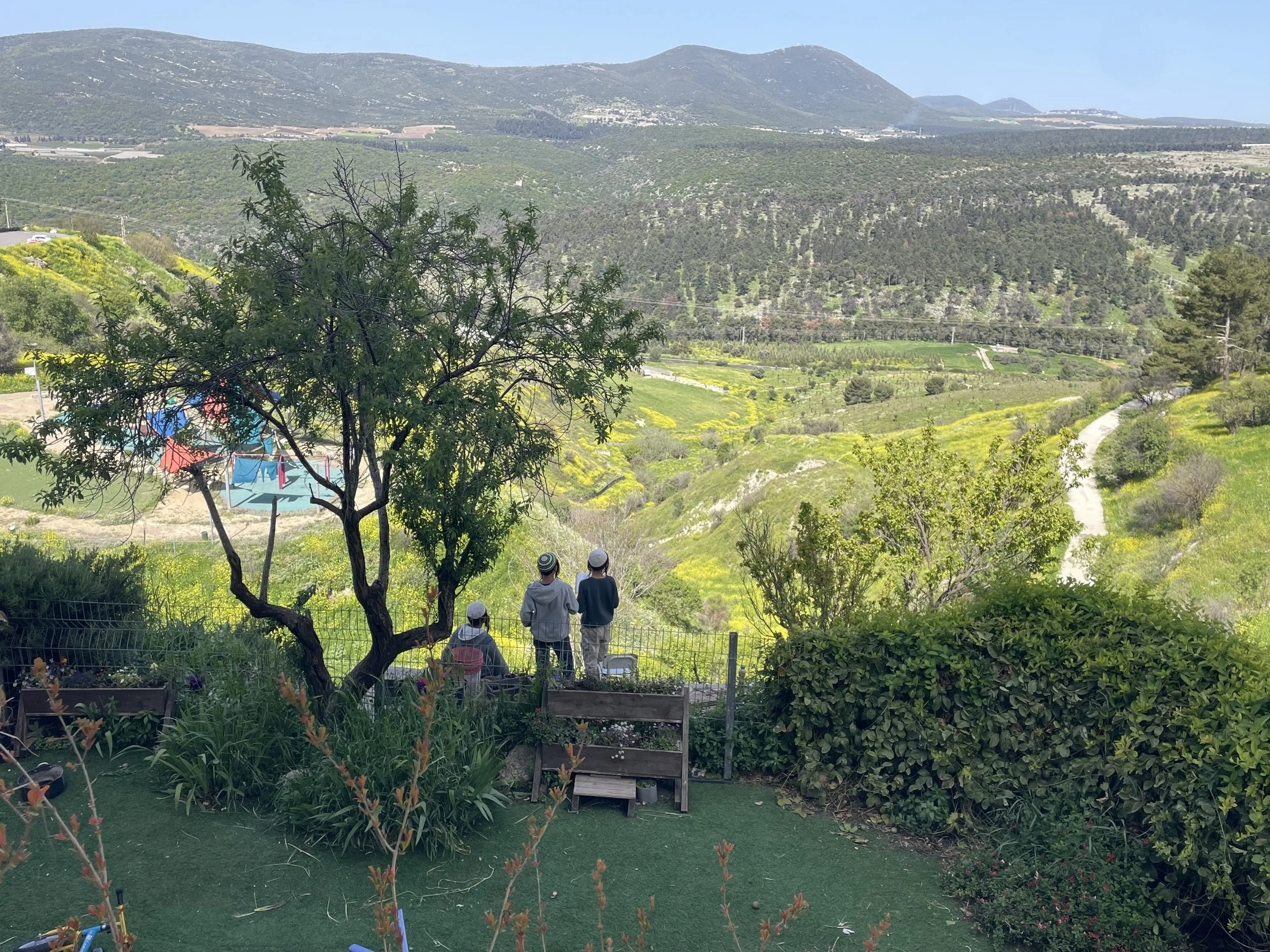
From my window in Tzfat this morning, overlooking the hills that stretch toward Meron—the resting place of Rashbi—I watch three young boys standing during the siren, siddurim in their hands. They do not move. They do not run. They simply stand.
If you were standing here, you would first notice the quiet. The kind of quiet that rests gently on the mountains. The valley opens wide, green and breathing, the light soft against the stone. It is almost disarming in its calm.
And then you would feel it—the layer beneath.
The memory of sirens that came yesterday.
The awareness that another could come at any moment.
The subtle alertness that never fully leaves the body.
These boys are standing in that space. Not removed from it, not protected from it, but בתוך זה / within it.
For someone observing from afar, it might look like a simple, composed moment. But from within, it carries something else entirely: a quiet courage, a learned stillness, and an emunah / faith that does not announce itself, but holds.
This is what it means to live here now.
What Do We Do in the Siren?
What, then, is one meant to do in the moment of the siren?
There is no single prescribed response. Some recite Tehillim. Some stand in silence. Some whisper personal tefillot. Yet beneath these variations lies a shared inner movement: to remain present, to resist the impulse to flee inwardly, and to allow the moment to be fully felt and directed upward.
שמע ישראל ה׳ אלקינו ה׳ אחד
A return to unity within fragmentation.
Hod she’b’Gevura: Yielding Within Strength
In this sense, the alignment with the Omer becomes striking. Today is Day 12—Hod she’b’Gevura, yielding within strength.
Gevura establishes structure, boundary, and containment. It is the capacity to remain, to endure, to hold form even under pressure. Hod introduces acknowledgment, humility, and the ability to yield without collapsing. Together, they form a posture that is both firm and responsive—a strength that can hold tension without becoming rigid.
This is precisely the posture that the current moment demands. There is a need for גבורה / strength—to stay, to continue building life, to remain present within the land despite ongoing threat. At the same time, there is a need for הוד / yielding—to acknowledge vulnerability, to feel what is arising, and to turn inward rather than escape.
There are moments when one wants to run. To leave the battlefield entirely.
But deeper awareness reveals: this is not abandonment. This is invitation.
The Emergence of True Prayer
In the language of pnimiut / inner Torah, this space gives rise to תפילה אמיתית / true prayer.
Not the prayer of habit, but the prayer that emerges when a person recognizes they cannot help themselves. When the רצון לקבל / will to receive asserts itself—seeking comfort, avoidance, self-protection—it resists any movement toward על מנת להשפיע / living for the sake of giving. The avoda can feel heavy, even obscured, as though one is moving through צבעים שחורים / shadowed colors.
Then something shifts.
A person says, with clarity: only Hashem can help me.
This is תפילה אמיתית / true prayer.
Because it is real.
Because it is necessary.
Because the Creator has arranged reality in such a way that I cannot help myself without turning to Him.
This is the formation of a כלי / vessel.
Because no אור / light can be received without a vessel prepared to hold it.
The Inner Work of These Days
The days of the Omer trace this process with precision.
Pesach introduced אור / light as a gift—beyond our capacity. And now begins the work: integration, refinement, building.
Through fragmentation.
Through צבעים / colors.
Through concealment.
This refinement unfolds through fluctuations—clarity and concealment, עליות וירידות / ascents and descents. At times, one feels aligned and open; at others, distant and resistant. There are moments when the instinct is to withdraw, to leave the battlefield—externally or internally.
Yet deeper awareness reframes even this. What appears as distance, what is called הכבדת הלב / the hardening of the heart, is not rejection but construction. Like a mother stepping back to allow a child to walk, the concealment creates the conditions for independent movement—for the emergence of true תפילה.
From Sound to Inner Call
In a time when sirens sound both for memory and for warning, presence itself becomes avoda. Each siren is no longer only an external signal, but an inner point of decision: will I remain in reaction, or will I enter into relationship? Will I contract inward, or will I turn upward?
In that turning, something subtle but significant occurs. The siren is no longer only an external sound. It becomes an inner call—a movement from reaction to relation, from fragmentation to connection.
This is the quiet work of these days. Not dramatic transformation, but steady attunement. Not escape from reality, but deeper entry into it.
To Remember Is to Become
To remember is to internalize. To allow what was to shape how one stands now.
In a time when sirens are both memorial and immediate, this dual awareness becomes unavoidable. The past and present meet in the body, in the breath, in the רגע / moment itself.
And from that meeting point emerges a question—not theoretical, but deeply personal:
How do I live now?
The answer, perhaps, lies in small, precise shifts. To pause. To notice. To allow even a brief moment of recognition that everything—every sound, every פחד / fear, every interruption—is part of a larger orchestration.
To turn, even for a second, toward that awareness.
רק השם
Only Hashem.
Never to Forget, Never to Remain the Same
As the words projected on the walls of Yerushalayim declare: לא לשכח לעולם — never to forget.
But alongside remembrance, there is also becoming.
A gradual, often demanding shift—from identity shaped by what has been done to us, to identity rooted in who we are in relationship withHaKadosh Baruch Hu.
From the yellow patch to the Magen David.
From imposed identity to chosen connection.
From galus to geula.
Not as a distant destination, but as a consciousness that can begin now—within the span of a single breath.
קול בתוך קול / Sound within Sound
Yom HaShoa: 2 Minutes & A Lifetime
For 2 minutes
Israel chose
not to move
for this siren
cars stilled mid-road
feet suspended mid-step
voices dissolved
before their endings
and silence
not empty, but full
rose to speak
6 million נשמות / souls
gathered
into one full breath
This was the only siren we heard today
This siren was different
and yet…
difference sometimes clarifies
because
WE know sirens
we have learned their language
in our individual and collective
body
in our pulse
in our breath
This morning’s siren
did not chase us
did not command the body to run
did not get intercepted
with fractured booms in the the air
we did not see unbroken lines
drawn across the blue sky
it was a קול / sound
that carried memory
rather than urgency
זִכָּרוֹן ולא דחיפות
and still…
we have been hearing sirens every day
so our body
no longer asks
“what kind?”
Our body
only answers.
Each Siren becomes
a living reminder
they are still trying
to exterminate
me, a Jewess
now, in this moment
Each Siren becomes
a movement
toward the saferoom
Each Siren becomes
a Listening inward
toward שמע ישראל
Each Siren becomes
מסירות נפש mesirut nefesh
my life
placed again
in the hands of Hashem
Each Siren becomes
a recommitment
to live על מנת להשפיע
on the frontline
beyond and greater
than self
Each Siren becomes
Tehillim
spoken or unspoken
when the mouth quiets
and the heart speaks
Hashem ro’i lo echsar
Hashem, do not go far from me
Hashem, do not hide Your face from me
The siren symbolizes
the patch
illuminated on the wall of Yerushalayim
transitioning from
the yellow “Jude” patch
to the Magen David
from imposed identity
to chosen connection
what was once a סימן / sign
pressed onto the body
as a mark of degradation
has become a סימן
arising from our depths
the same form
shining a completely different אור / light
from galus
to geula
the siren shifts
from a warning
to
a calling
Each Siren transforms us
from reaction
to relation
Each Siren transforms us
from fragmentation
to connection / deveikus
two minutes
and a lifetime
contained within them
the country stands still
for this siren
by choice
together
and something within us
moves quietly
precisely
expanding
❤️R.L. Weiman
Tzfat 5786
Note:
Kol Betoch Kol / קול בתוך קול
A קול בתוך קול / voice within a voice is not just one sound—but a layered reality of sound, a simultaneous unfolding of outer vibration and inner awakening. The outer קול / voice is what is heard physically…
the siren, the vibration in the air, the signal that stops the world.
The inner קול / voice is what is awakened within… the memory, the fear, the tefilla, the turning, the awareness of Hashem. It is the moment when a single sound holds two dimensions at once: what is happening outside of you and what is being activated inside of you.
A קול בתוך קול / voice within a voice is when the external reality becomes a doorway to פנימיות / inner consciousness. The siren is not only heard... it reveals.
It becomes a call within the call,
a remembrance within the sound,
a relationship within the moment itself.
It is where sound becomes awareness, and awareness becomes connection.
קול בתוך קול / Sound within Sound
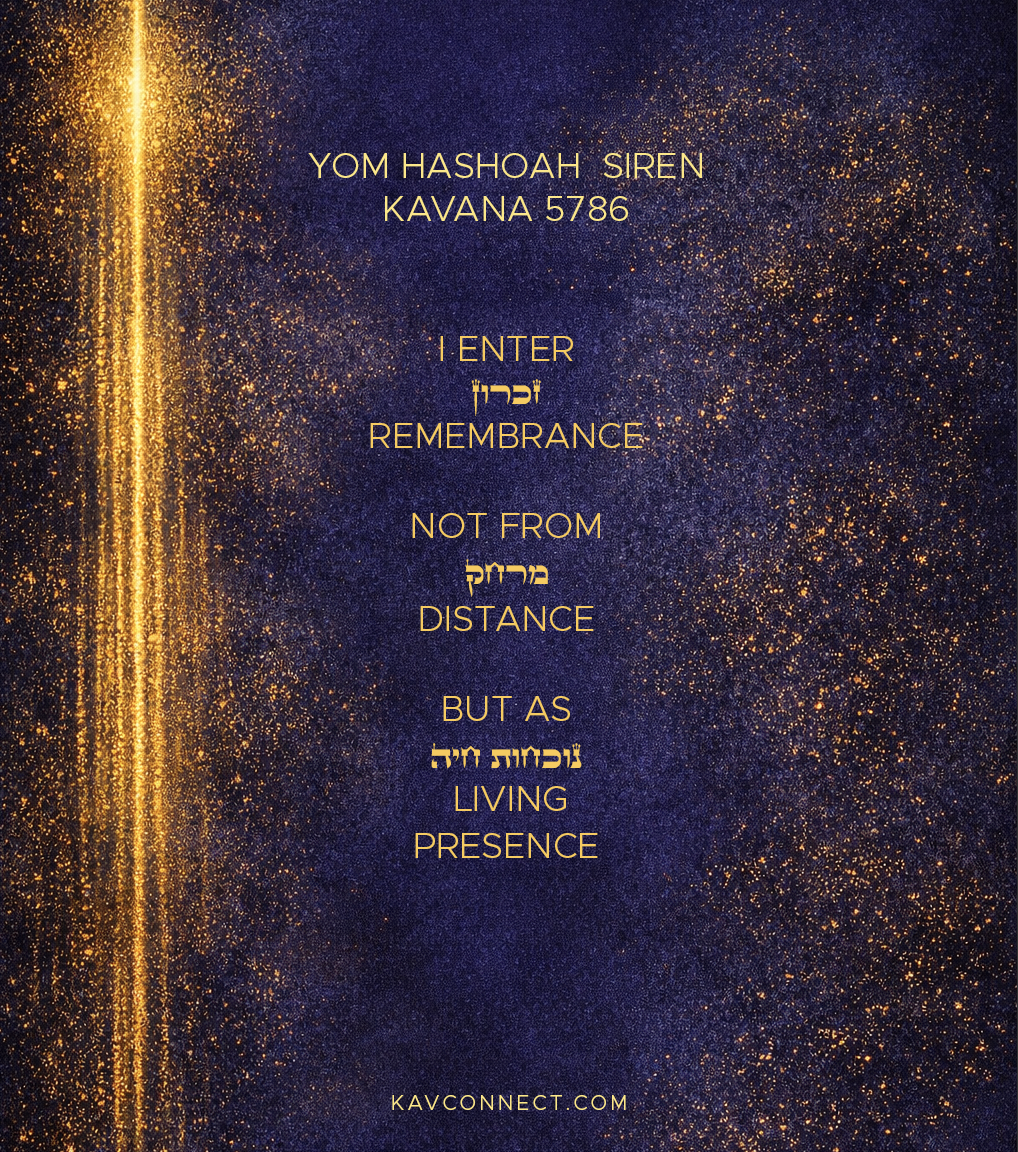
FYOM HASHOAH — INNER SIREN MEDITATION
כוונה / intention
I am not remembering from distance
I am entering
into זכרון / remembrance
as a living space
I allow the קול / voice of the siren
to arise within me
דמיון / imagination — hear the siren
Close the eyes softly
Imagine the sound
A long, unbroken קול / sound
stretching across the land
Let it move through your body
Not outside you
through you
גוף / body — become a pillar
Stand, or sit upright
Feel your feet
or your base
connecting to the ground
Eretz Yisrael beneath you
Let the spine rise
עמוד / pillar
Not rigid
present
נשימה / breath — receive the sound
Inhale
as if the קול / sound is entering
Exhale
as if you are making space for it
Do not control
Let the breath be shaped
by what you feel
זכרון / remembrance — let it touch
Do not force images
But do not block
Let one אמת / truth land:
There were lives
There were פנים / faces
There were עולמות / worlds
Pause
Let the body register
לב / heart — allow contact
Notice what arises
tightness
heaviness
numbness
movement
All of it is allowed
This is לא בריחה / not escaping
This is נוכחות / presence
עמידה / standing — with Am Yisrael
Feel beyond yourself
A collective גוף / body
standing
silent
together
Let this awareness settle:
אני עומדת עם עם ישראל
I am standing with Am Yisrael
נשמה / soul — quiet holding
Gently bring to mind:
נשמות ישראל / the souls of Israel
No fixing
No explaining
Only כבוד / honoring
If words arise softly:
תהא נשמתם צרורה בצרור החיים
May their souls be bound in the bond of life
המשכיות / continuation — I am here
Feel your breath
your pulse
your weight
This living גוף / body
is part of the continuation
Let it land in simplicity:
אני כאן / I am here
סיום / closing — do not rush
Let the imagined siren fade
Stay one more breath
One more רגע / moment
Whisper inside:
זוכרת / remembering
חיה / living
No performance
No distance
The קול / sound
is carried inside
And you
are standing within it