
Yom HaZikaron
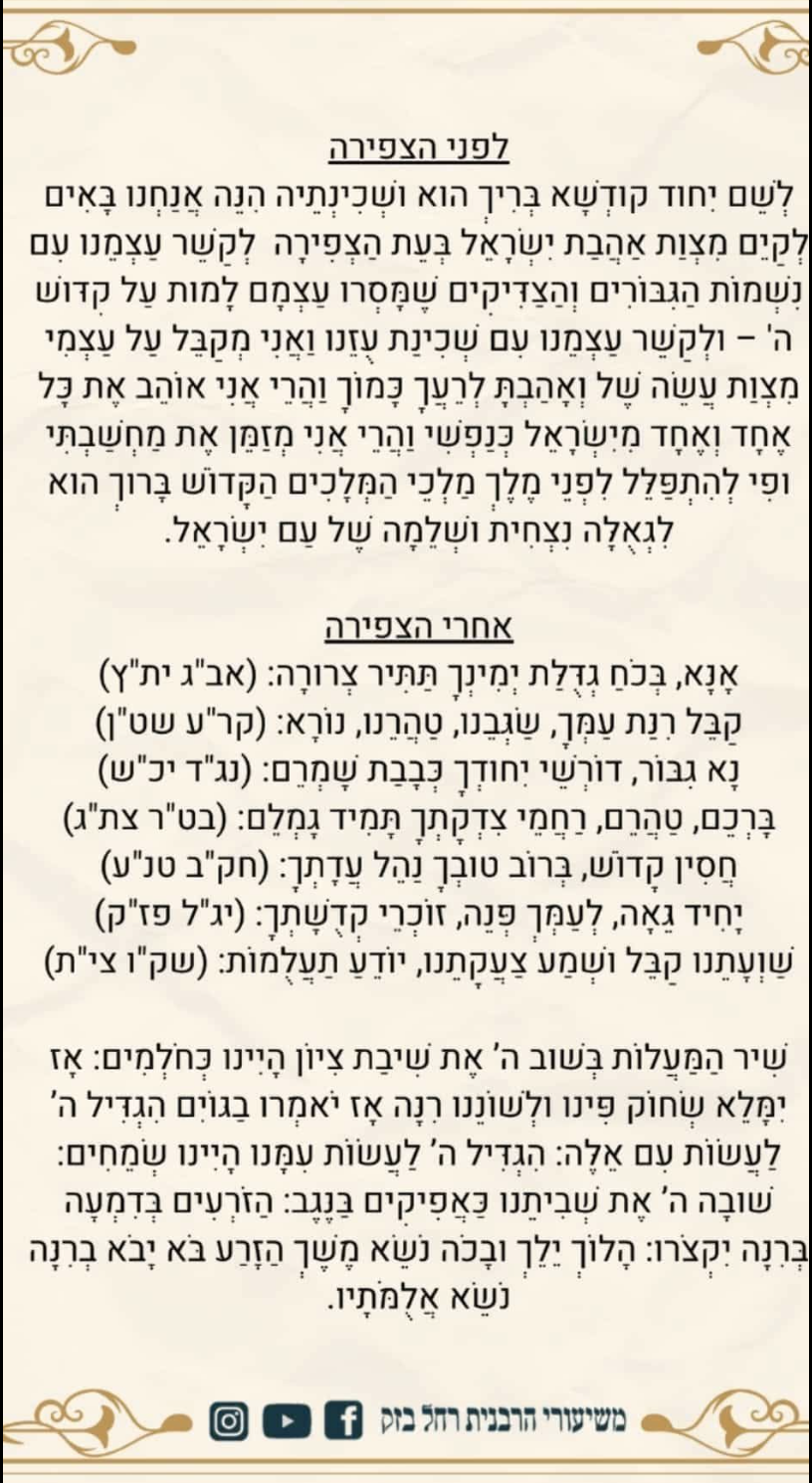
TEFILLA BEFORE THE SIREN
WRITTEN BY RABBI SHMUEL ELIYAHU
It is very worthwhile to say a special prayer so that in the minutes of silence we will be in the appropriate intention.
The siren in the gematria is the Shekhina.
צפירה בגימטריה זה שכינה
This is the tefilla before the siren:
Here we come to fulfill the Mitzvah of Ahavat Yisrael. At the siren, to connect ourselves with the soldiers, the souls of the tzadikim who sacrificed themselves to die al kiddush Hashem – to connect ourseves with the Shechinat Uzecha.
And I accept upon myself the Mitzva Asei of VAhavta LReyecha Kamocha to love every person of Israel as my soul. May my thoughts and my mouth praise before the King of kings, the Holy One, blessed be He, for the eternal geula and peace of the people of Israel.
Am Yisrael are silent for two minutes, all together. The gates of heaven are open. Pray whatever is necessary for the people of Israel.
May we be blessed with good and happy days.
–Rabbanit Rachel Bazak
Millions of נשמות / souls standing together.
One field. One presence.
שערים / gates open.
As we enter this evening, Yom HaAtzmaut… we do so with preparation and כוונה / intention — with courage, with inner strength, and with a deep awareness that the שכינה / Shechina is present within every קול / SIREN we may hear.
May we be held within that presence in all the moments to come, and may we be granted the clarity, protection, and unity to stand together within it.
צפירה בגימטריה שכינה
Siren shares the same Gematria as Shechina
At certain moments, a צפירה / siren transcends its function.
It is no longer merely a signal, an alert, or a marker in time.
It becomes an experience. A presence that is felt, not only heard.
In the language of Torah, there are times when hidden connections reveal deeper layers of meaning. One such connection emerges through gematria — the system in which Hebrew words share numerical values that hint to an inner relationship. When two words carry the same numerical value, it suggests that they may be pointing to a shared root or revealing a deeper resonance beneath the surface.
Here, something striking appears:
צפירה בגימטריה שכינה / The siren shares the same numerical value as the Shechina
צפירה / siren = 385
שכינה / Shechina = 385
This is not simply a mathematical curiosity. It is an invitation.
It suggests that the sound of the siren, when received consciously, has the potential to open a space of presence — a moment in which the שכינה / Shechina can be felt.
Today, the sirens are not only alerts or memorial markers.
They are binding us.
Holding us within one shared field of awareness.
Connecting bodies, breath, memory, and longing into one collective Kli / vessel — a shared inner space capable of holding awareness and presence.
And tonight, we are holding both realities at once.
⛔ UNILATERAL CEASEFIRE EXTENSION EXPIRES TONIGHT FOR IRAN AS IRAN REMAINS SILENT AHEAD OF DEADLINE / 🕑 April 21, 2026 | 11:45 PM
⚠️ The extension of the ceasefire was announced unilaterally and not agreed to by Iran. From Tehran’s perspective, its commitment to the ceasefire is set to end tonight at 3:00... Security forces are preparing for all scenarios as the deadline approaches, with the situation remaining fluid.
So the question becomes:
How will we hear the next siren?
Will the body collapse into fear?
Or will we remember what we touched today?
Last night, I was on a bus traveling along the highway. I knew that Yom HaZikaron was approaching, but I was not expecting the sound to arrive so suddenly. Without warning, the צפירה / siren pierced the air. The bus slowed to a stop and the doors opened. In that first moment, there was a reflexive surge of fear within me. A question flashed through my body before it reached words: Should I run? Should I get off the bus? But as quickly as the fear arose, it dissolved. I looked around and saw that no one was moving. There was no panic, no urgency. Only stillness. In that split second, awareness settled in. This was not a siren of war. This was the siren of זיכרון / memory.
My breath softened. My body reorganized itself from within. Together with everyone around me, I stood quietly on the side of the highway. Cars had stopped in every direction. People stepped out and stood beside their vehicles, heads slightly lowered, held in a shared, unspoken understanding. What filled that space was not silence alone, but a collective tefilla that did not require words. The meaning of that sound was too vast to articulate. It carried within it layers of pain and resilience, loss and belonging. It was a moment of התכללות / inclusion and התקשׁרות / deep inner bonding, not only with those physically present, but with the entirety of Am Yisrael spread across Eretz Yisrael. In that moment, something became undeniably clear: we were not standing alone. We were being held within a field of shared awareness, a living connection that transcended individuality.
A quiet tefilla arose within me: ריבונו של עולם / Master of the World, please never take away this longing — that all of Your children come home. There was no contradiction in the feeling that followed. Alongside the ache was a subtle שמחה / inner joy, not of circumstance, but of connection. Today, the siren did not feel threatening. It felt held. It felt protected. And I recognized the זכות / privilege of sitting here in Eretz Yisrael, able to experience this sound not as fear, but as presence.
There are different kinds of sirens, and each one carries a distinct קול / voice that moves through the body in a different way.
The sirens of war are not neutral sounds. Their tone rises and falls in urgent waves — up, down, up, down — a pulsation that enters the nervous system and activates instinct before thought. The body does not analyze this sound; it reacts. Muscles tighten. Breath shortens. Attention narrows. This is a קול / voice of Gevura in its most immediate form — a call to move, to protect, to respond. Its rhythm does not allow for הרחבה / expansion. It compresses experience into the עכשיו / immediate now.
In contrast, the siren of זיכרון / memory — קול הזיכרון / the voice of memory — carries a completely different איכות / quality. Its tone is steady, unwavering, like a continuous line that does not fluctuate. It does not enter the body as urgency, but as holding. This is the sound we hear on Yom HaZikaron and Yom HaShoah. It does not demand movement. It suspends it. It creates a contained space in which time itself seems to pause. The body, instead of contracting, begins to gather inward. There is room for נשימה / breath. Room for הרגשה / feeling. It calls us not to run, but to stop. Not to escape, but to stand. Not to react, but to be present within what is.
And then there is the קול / voice of the שופר / shofar. Unlike the steady line of the siren of memory, the שופר / shofar breaks the sound open. The תרועה / teruah is fragmented, trembling, almost like a cry. It does not hold the same stillness; it disturbs it. It penetrates the layers of habit and certainty and cracks something open in the לב / heart. This is a קול / voice that does not leave us where we are. It calls us forward. It awakens longing. It stirs movement toward שינוי / transformation and toward geula. Where the siren of memory gathers inward, the שופר / shofar sends that inner awakening outward into becoming.
Each of these קולות / voices carries its own frequency.
Each one expresses a different movement of the נפש / inner being.
Each one holds a different צבע / inner color and invitation in the language of Torat HaTzeva.
And today, we are standing within the steady tone.
The קול / voice that gathers inward.
Because:
צפירה בגימטריה היא שכינה
צפירה / siren = 385
שכינה / Shechina = 385
This is not simply a numerical equivalence. It is a revelation of potential.
As taught in the inner language of the Isaac Luria, time itself is not empty — it is built as measured vessels, precise containers through which אור / light is revealed. Each defined moment, when entered consciously, becomes a Kli capable of holding presence.
And perhaps there is something even deeper hinted here.
The word צפירה / siren shares a root resonance with ספירה / sefira, as in ספירת העומר / Sefirat HaOmer. Both emerge from the shoresh / root ספר, which carries meanings of counting, expressing, illuminating, and making something visible. A ספירה / sefira is not only a number; it is a measured revelation of אור / light entering into form, a refinement of inner middot / qualities through awareness and repetition.
So too, the צפירה / siren is a kind of ספירה / counting.
For two minutes, we are held within a defined measure of time.
A גבול / boundary.
A precise container.
Just as we count each day of the Omer — not rushing, not skipping — but entering each יום / day with awareness, so too the siren gives us a measured moment to enter fully.
A lived ספירה / counting.
A collective Kli / vessel — a shared, held space that allows something deeper to be felt and revealed.
In that contained זמן / time, something is revealed.
Not through words, but through presence.
Held Time — A Vessel for Presence
Because when a moment is truly held — not rushed through, not bypassed, but entered with כוונה / intention — it becomes something more than time passing. It becomes a Kli / vessel, a structured inner space that can receive and hold awareness. And within a vessel that is steady, defined, and consciously inhabited, the שכינה / Shechina can dwell. This is not automatic. It is not created by the sound alone, nor by the external structure of the two minutes. It is formed through our פנימיות / inner participation — through the way we arrive, the way we stand, the way we allow ourselves to be present within the moment without escaping it.
The connection here is not technical, nor linguistic. It is not that צפירה / siren and ספירה / sefira are the same word or system. The connection is experiential, lived, and deeply embodied.
As expressed in the teachings of Abraham Isaac Kook, there are moments when the collective neshama of Am Yisrael awakens together — not through planning, but through a shared inner stirring. Such moments reveal the presence of the שכינה within the klal, within the living unity of the people.
ספירה / sefira teaches us how to enter time. Through Sefirat HaOmer, we learn to relate to each day as a defined container, a measured revelation, a space that can hold awareness, refinement, and presence. We are trained, slowly and precisely, to stop passing through time unconsciously and instead to inhabit it.
צפירה / the siren gives us a moment to live that knowing together.
What we practice individually through ספירה / counting, we are suddenly placed into collectively through צפירה / the siren. A nation is given a shared גבול / boundary of time. A shared stillness. A shared opportunity to transform time into presence. And in that alignment — when inner awareness meets an outer container — the moment is no longer empty.
It becomes filled.
It becomes alive.
It becomes a dwelling place for שכינה / Shechina.
For two minutes, the world pauses. Movement ceases. Speech quiets.
And what remains is presence.
A field in which the שכינה / Shechina can be felt.
As hinted in the Zohar, קול / voice has the capacity to awaken פנימיות / inner depth, stirring layers within the נפש that often remain hidden beneath the movement of daily life. Yet the teaching goes further: it is not only the sound itself that carries power, but the silence that follows it. That silence is not absence. It is a held space, receptive and alive, capable of containing a deeper revelation. In this way, the צפירה / siren is transformed. It is no longer experienced merely as an external signal, but as a threshold — an opening into stillness, into awareness, into presence.
This is the avoda.
Not simply to stand in quiet, but to enter those moments with כוונה / intention — to allow the external קול / voice to guide us inward, to gather our awareness, and to consciously inhabit the space that has been created. In doing so, the moment itself becomes elevated, no longer a pause between actions, but a living encounter with the שכינה / Shechina that rests within the stillness.
Before the siren, we prepare ourselves by shifting gently from reaction into קשר / connection. We say:
הנה אנחנו באים לקיים מצוות אהבת ישראל
Here we come to fulfill the mitzvah of אהבת ישראל / love of Israel
לקשר עצמנו עם החיילים, נשמות הצדיקים
To bind ourselves with the soldiers, the souls of the righteous
ולהתפלל לפני מלך מלכי המלכים הקדוש ברוך הוא
And to stand in tefilla before Melech Malchei HaMelachim / the King of all kings
לגאולה נצחית ושלמה של עם ישראל
For a complete and eternal geula for Am Yisrael
And then, the sound begins.
Notice what happens within you.
The external קול / voice is strong and defined, like a line of Gevura — clear, structured, undeniable. And within that clarity, something else emerges. A softening. A stillness. A gathering inward. This is the movement of Hod — a resonance of הכנעה / yielding and הודאה / acknowledgment. The breath slows. Awareness widens. The Kli / vessel becomes still enough to receive.