
Vayahel Pikudei: When Disagreement Arise During Stressful Times
Sometimes that small opening is enough to let something higher enter the space between you. Like the space between the keruvim / כרובים. Where the Divine voice begins to speak.
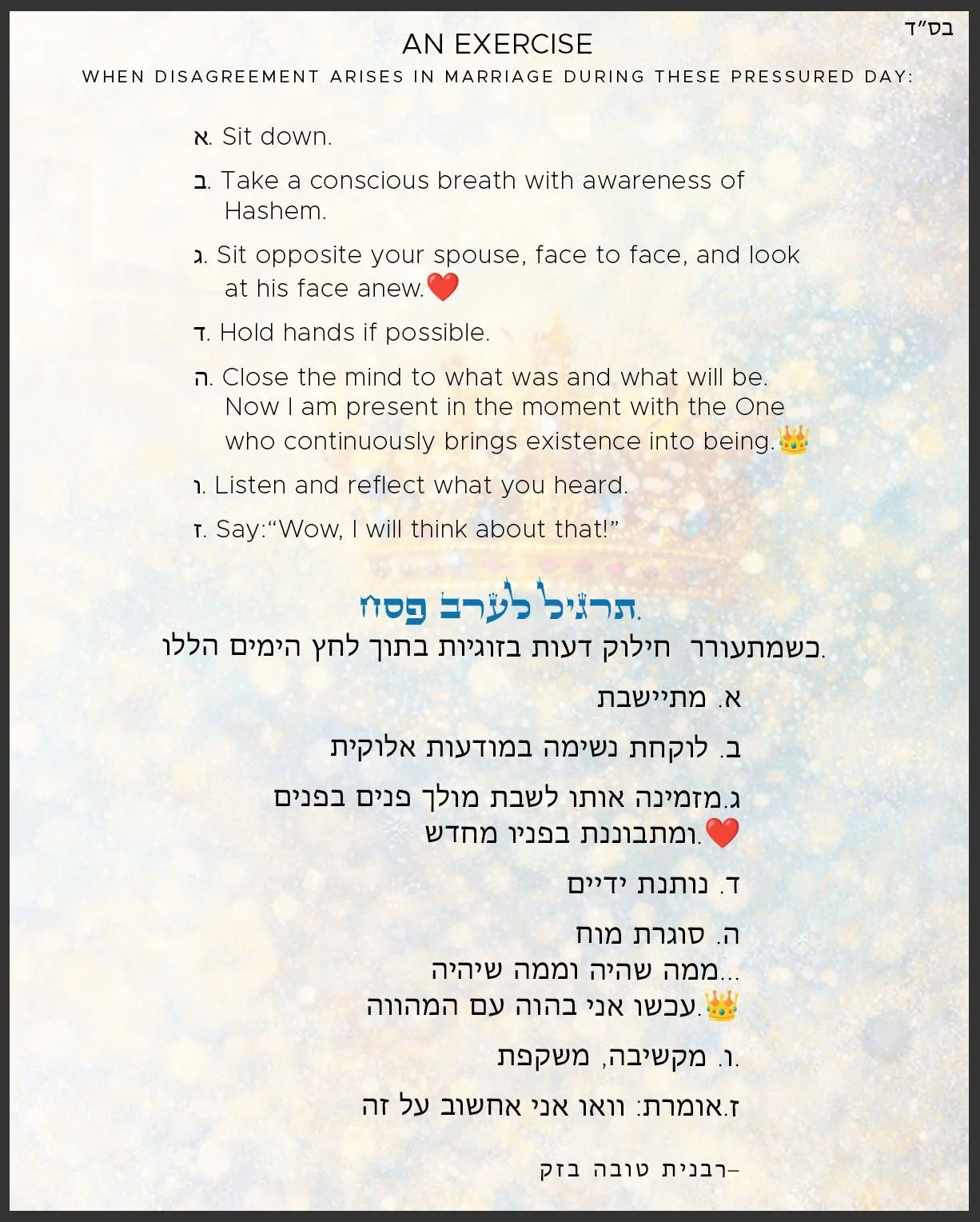
When a disagreement appears between husband and wife:
1. Sit down.
2. Take a conscious breath with awareness of Hashem.
3. Sit opposite your spouse, face to face, and look at his face anew.❤️
4. Hold hands if possible.
5. Close the mind to what was and what will be.
Now I am present in the moment with the One who continuously brings existence into being.👑
6. Listen and reflect what you heard.
7. Say:“Wow, I will think about that!”
Vayahel Pikudei: When Disagreement Arise During Stressful Times
Sometimes that small opening
is enough to let something higher enter the space between you.
Like the space between the keruvim / כרובים.
Where the Divine voice begins to speak.
Achdut does not erase differences.
_It allows different voices to form one harmony._
Rav Kook writes, “There are two ways of seeing the world”
“שתי השקפות עולם הן – זו המפרדת וזו המאחדת*
Two worldviews exist: one that separates, and one that unifies.
The separating vision sees everything as disconnected — people standing apart, ideas competing, identities defending themselves.
The unifying vision sees the deeper root where everything belongs together.
The word רע (ra – evil) hints to this.
Its root suggests something broken, fragmented, disconnected from its divine source and disconnected from others.
This is exactly the voice that appears at the very beginning of human history.
When Chava explains what happened with the snake, she says:
*“הנחש השיאני” the nachos misled*
One way to hear that word השיאני is: he made me think there is an “אני.”
He convinced me that the self stands alone
The moment the “אני” becomes something separate and self‑contained, we enter what the Zohar calls עלמא דפירודא Alma DPiruda a world of separation.
Against that fragmentation comes the call of the Jewish people.
In Megillat Esther, when the nation faces danger, Mordechai tells Esther:
*“לך כנוס את כל היהודים” Go and gather all the Jews*
The healing begins with כינוס — gathering.
Because the אור ה׳ Ohr Hashem reveals itself on
**כנסת ישראל דווקא כשהיא באחדותה*
when Knesset Yisrael stand in Achdut
What is כנסת ישראל?
• It is Sefirat Malchut **ספירת המלכות*.
• It is the כינוס נשמות ישראל בשורשן the gathering of all Jewish souls in their root.
• It is השכינה, the vessel through which the Shechina rests and reveals itself in the world.
But a vessel must be whole to hold light.
For divine light to flow strongly into the world,
the vessel must be unified and integrated
When the vessel fractures, the light scatters.
Chazal hint to this idea in a fascinating passage in Sanhedrin 98b, discussing the name of Mashiach.
Each בית מדרש suggests a different name:
• In the בית מדרש of Menachem they said: Menachem is his name.
• In the בית מדרש of Rabbi Shila they said: Shiloh is his name.
• In the בית מדרש of Rabbi Yannai they said: Yinon is his name.
• In the בית מדרש of Rabbi Chanina they said: Chanina is his name.
Each בית מדרש seems to say: אנא אמלוך my perspective should reign.
That dynamic echoes the mystical idea of שבירת הכלים, the shattering of the vessels before creation, when divine sparks scattered because the vessels could not hold the light.
But when we step back and look deeper, we see something beautiful.
Take the ראשי תיבות — the first letters:
מנחם
שילה
ינון
חנינא
Together they spell: משיח.
Each perspective holds a piece of the truth.
Only when the pieces come together does the full name appear.
That is how harmony works in the higher worlds as well. Chazal describe the angels in heaven:
*“כולם מקבלים זה מזה ונותנים רשות זה לזה להקדיש ליוצרם בנחת רוח.”*
Each receives from the other, giving space to the other to sanctify the Creator.
Achdut does not erase differences.
It allows different voices to form one harmony.
And this begins in the most intimate spaces of life.
Learning to step out of my own certainty for a moment.
Learning to listen to your דעת as well.
Before Pesach we clean the house from חמץ*
But the deeper חמץ is the swelling of the אני the ego that insists: I know. I decide. Don’t challenge me.
That inner חמץ traps us inside our own מיצרים our narrow places.
Pesach invites us to leave that inner Mirzraim. And our parashaes us a powerful image for this work.
The כרובים keruvim that stood above the Aron.
Chazal say the word כרוב comes from כְּרַבְיָא like children.
In Aramaic, רביא means a child.
It is a vulnerable image.
Two childlike figures facing each other above the Aron.
In a way, that is all of us!
Two children who wandered through the forest of life, carrying wounds from childhood
*יושבים על שברי הלוחות של פצעי הילדות*.
Often we try to survive those wounds through control.
“I know.” / “I’ll decide.”
“Don’t shake my certainty.”
But Pesach asks something radical.
*צאו מדעתכם* step outside the prison of your own daas
Clean the חמץ of ego.
Because*שאר + חמץ* together equal in gematria עץ הדעת the Tree of Knowledge.
And now we prepare the house for Pesach.
What do we eat instead? מצה is תמצית / essence
It represents נשמה, ענוה, simplicity, openness to the infinite.
One of the deepest forms of humility is the ability to say:
*“איני יודע.”* I don’t know
From that place we can look again at the כפורת Kaporet where the keruvim כרובים face each other.
We can clean our vision. And begin to see the פנימיות the inner face of the person sitting in front of us.
Then the verse becomes real:
*“אז נדברו יראי ה׳.”*
Hashem speaks מהדביר from the inner chamber… when two people become truly present with one another.
When they agree to listen.
To make space.
To speak gently together.
This is not only a nice suggestion for marriage.
*It is essential for something much larger.*
*For the Achdut of Am Yisrael!!!*
For the ייחוד קודשא בריך הוא ושכינתיה the yichud of the Holy One and His Presence.
For revealing in the world the declaration: ה׳ אחד.
Against the forces of עלמא דפירודא the world of separation — represented by Amalek, Haman, and the nachos.
So here is a small practice for Erev Pesach, especially in these pressured days when tensions can easily arise.
When a disagreement appears between husband and wife:
1. Sit down.
2. Take a conscious breath with awareness of Hashem.
3. Sit opposite your spouse, face to face, and look at his face anew.❤️
4. Hold hands if possible.
5. Close the mind to what was and what will be.
Now I am present in the moment with the One who continuously brings existence into being.👑
6. Listen and reflect what you heard.
7. Say:“Wow, I will think about that!”
-Based on a teaching by Rabbanit Tova Bazak