
SHELACH
From Meraglim Consciousness to Kalev Consciousness
The Journey from Toxic Shame to the Illuminating Neshama / הַנְּשָׁמָה הַמְאִירָה
MERAGLIM CONSCIOUSNESS
interprets awareness of limitation as proof of inadequacy. Rav Kook interprets awareness of limitation as evidence of illumination. Kalev responds to that illumination with courage.
by Rachel Leah Weiman
Based on a shiur by Rav Osher
Remembering who you are.
The deepest avoda is allowing the years of layers of fear, shame, and constriction to fall away so that the illuminating neshama can be seen more clearly.
Over the years, through walking alongside others and myself in our deep inner journeys, I have encountered a theme of shame that returns again and again. I have listened to the painful inner hirhurim / recordings that seep into our consciousness:
Because of the way I was treated.
Because of the way I was shamed by my parents, teachers…
Because of what happened to me.
Because of mistakes I have made.
And beneath these stories, there is often an even deeper voice:
I am not enough.
I am not worthy of love.
I am fundamentally flawed.
Something is wrong with me.
You may already be familiar with the concept of toxic shame through books on the subject, therapy, healing work, etc. Yet as I sat with Rav Kook's teaching this week, I found myself wondering whether he was illuminating something even deeper.
Not merely how shame develops, but how it shapes consciousness. Not merely where the story came from, but what allows us to STOP believing it.
Every year when we arrive at Parashat Shelach, our attention is naturally drawn toward the meraglim. We debate what they saw, where they traveled, and why they failed. We analyze the frightening report, the giant inhabitants, and the nation’s collapse into despair. Yet Moshe Rabbeinu’s retelling of the story in Sefer Devarim suggests that the true drama of the parasha may have had very little to do with the Land itself. The decisive moment occurred not in the hills of Eretz Yisrael but within the consciousness of the generation that stood poised to enter it. Long before they turned away from the Land, they had turned away from a deeper trust in themselves, and eventually from a deeper trust in Hashem.
This shift becomes apparent the moment we compare the 2 versions of the story.
1. In Sefer Bamidbar, the Torah describes the mission itself. The meraglim travel through the Land, observe its strengths and challenges, and return with their report.
2. In Sefer Devarim, however, Moshe is no longer interested in recounting geography. He is uncovering pnimiut. He is revealing the inner process through which an entire generation came to reinterpret its RELATIONSHIP with Hashem. The turning point appears in a startling declaration that is easy to read quickly but difficult to fully absorb:
וַתֵּרָגְנוּ בְאָהֳלֵיכֶם וַתֹּאמְרוּ בְּשִׂנְאַת ה׳ אֹתָנוּ הוֹצִיאָנוּ מֵאֶרֶץ מִצְרָיִם
You murmured in your tents and said: Because Hashem HATES us, He brought us out of the land of Mitzrayim.
-Devarim 1:27
One almost stops breathing when reading those words!!!
This is the generation that witnessed Yetziat Mitzrayim, crossed the Yam Suf, stood at Har Sinai, ate the mahn, drank from the Be’er of Miriam, and lived beneath the protection of the Ananei HaKavod. How could such a generation arrive at the conclusion that Hashem hated them?
This nekuda is both simple and profound The primary cheit/sin of the Meraglim was not that they reported difficulty. The Land was difficult. The cities were fortified. The military challenge was real. Moshe does not deny any of this. The tragedy emerged when the challenge itself became evidence. Instead of understanding the obstacles as part of the path into the Land, the people interpreted them as a revelation of Hashem’s intentions.
Difficulty became proof. Fear became interpretation. The challenge was no longer a challenge; it became a statement about their RELATIONSHIP with Hashem. This is the meaning of Because Hashem hates us בְּשִׂנְאַת ה׳ אֹתָנוּ. The obstacle itself was transformed into their belief system.
How often do we do something remarkably similar in our own lives? We feel drawn toward greater growth, deeper Torah, a more authentic expression of our gifts, a healing we have postponed for years, or a creative offering I long to bring into the world. Then resistance appears. Fear appears. Meniot / blocks / obstacles appear. Almost immediately, the mind begins constructing a narrative around those obstacles. Maybe this is not meant for me. Maybe I am not capable. Perhaps I am too late. Perhaps I am not enough… What began as a challenge, gradually becomes a story about identity.
This week while I was learning our parsha Shelach along with a remarkable teaching from Rav Kook with my teacher in Tzfat, Suddenly, I found myself seeing the story of the meraglim through an entirely new lens. And I thought maybe this is a Torah insight on “Healing the Shame That Binds You”. Rav Kook seems to transform the entire conversation. Toxic shame says, "I am damaged." Rav Kook asks us to consider a radically different possibility.
What if the very awareness of what still seeks refinement is not evidence of defectiveness, but evidence that the neshama is becoming more illuminated? What if the pain is not arising because we are becoming more distant from our true selves, but because we are beginning to glimpse who we truly are?
Suddenly, the meraglim, Kalev, Rav Kook on teshuva me'ahava and the illuminating neshama seemed to converge into a profound Torah response to one of the most painful inner struggles of our generation.
I could not help hearing an echo within the story of the meraglim. The meraglim did not merely encounter giants. They did not merely encounter challenge.
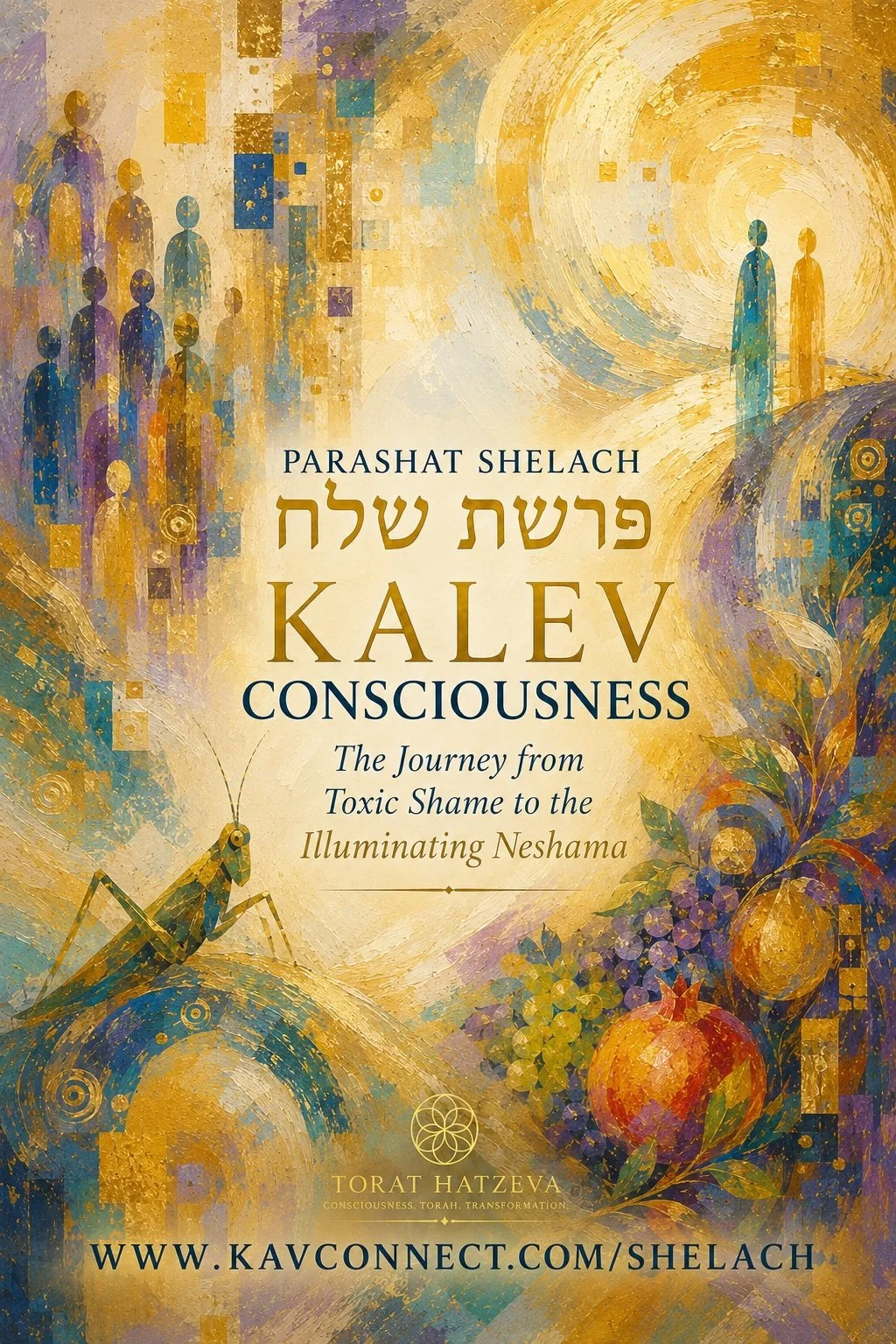
They transformed challenge into identity ie. Grasshoppers! They transformed difficulty into a story about themselves and ultimately into a story about Hashem Himself.
בְּשִׂנְאַת ה׳ אֹתָנוּ
Because Hashem HATES us?!
Perhaps this deserves our deep collective kavana…
as a tikkun of our individual and collective spiritual shame?
What if the meraglim had become so trapped within a consciousness of katnut / קטנות / constriction that they could no longer perceive the truth of who they were?
To be clear, this perspective does not dismiss the reality of childhood wounds, painful experiences, family dynamics, trauma, therapy, or the deep healing work that so many courageous people undertake. These things matter. The stories we carry did not arise in a vacuum. Many of us received messages about our worth long before we possessed the maturity, language, or inner resources to question them. Some of those messages came from parents who were themselves carrying wounds. Some came from teachers, communities, relationships, or life experiences. The pain is real, and the healing is real.
Contemplating Rav Kook's teaching Orot HaTeshuvaטז:ד, I thought maybe the Torah is inviting us NOW in our generation… to ask a question that goes beyond how the story began. Not only, "Who gave me this story?" but also, "What consciousness am I living from today?"
The chidush / new insight here, is that the tragedy of the meraglim was that they came to believe the story that fear was telling them. They stood surrounded by countless expressions of Hashem's love! and clear hashgacha pratit /guidance, yet interpreted reality through a lens of inadequacy, rejection, and constricted consciousness.
Kalev, however, looked at the very same landscape and inhabited a different consciousness entirely. He did not deny the giants. He did not deny the challenge. He simply refused to allow the challenge to become his identity.
Perhaps this is one of the deepest gifts hidden within Rav Kook's teaching on the illuminating neshama / הַנְּשָׁמָה הַמְאִירָה. Healing is not only about understanding the origins of our pain. It is also about recovering our relationship with the deeper truth of who we are. It is about loosening the grip of the old recordings, the inner dinim, the קליפת ברזל that can keep the mind trapped within an inner Mitzrayim of limitation and self-judgment.
Kalev represents the possibility of an entirely different consciousness: the capacity to remain connected to the truth of the neshama even while standing before limitation. Teshuva me’ahava is not merely the correction of what is wrong, but the remembrance of what is right. Rav Kook’s illuminating neshama offers a path from Meraglim consciousness to Kalev consciousness, from toxic shame to illumination consciousness, from constriction to expansion, and from forgetting who we are to remembering who we have been all along.
It is precisely here that Rav Kook enters the conversation with his teachings in Orot HaTeshuva. Many sincere mevakshim / seekers assume that spiritual growth should produce an increasing sense of mastery and confidence. Yet anyone who has genuinely entered the path of pnimiut avoda knows that something far more paradoxical often occurs…
The closer a person moves toward kedusha, the more aware she becomes of the places within herself that still require refinement.
What once seemed insignificant suddenly feels meaningful. What once passed unnoticed now touches the conscience. A person who begins paying deeper attention to her life may find herself becoming more aware of impatience, missed opportunities, subtle forms of self-concern, moments of distraction, or ways in which she is not yet fully aligned with the deepest truth of her neshama.
At first this can feel discouraging, almost as though the deeper searching and the growth itself has created a new problem. Rav Kook insists that the opposite is true.
הַצַּעַר שֶׁמַּרְגִּישִׁים בְּעֵת שֶׁנְּגָשִׁים אֶל כָּל דָּבָר שֶׁבִּקְדֻשָּׁה, הֲרֵי הוּא בָא מִתּוֹךְ שֶׁאָז הַנְּשָׁמָה הִיא מְאִירָה יוֹתֵר
The sorrow one feels when approaching a matter of kedusha comes because the neshama is becoming more illuminated…
and discovers in it the plan of ultimate perfection, and thus sees from within it the emptiness of its limitation and narrowness, and it resents everything that causes it to be weak and dull. And this is the true foundation of the teshuva from love, which is seen in every person, accepting this bitter emotion with joy and good heart, and then this depth of sorrow is transformed into a form of oneg elyon / supreme joy, in which the overflowing of the Edanim of kedusha is revealed.
Notice how radically different Rav Kook’s perspective is.
He does not begin with the flaw. He begins with the light.
The DISCOMFORT is not evidence that the neshama has become more distant. It is evidence that the neshama has become more AWAKE!
The SADNESS emerges because the neshama has caught a glimpse of something larger. For a brief moment it sees the possibility of greater shleimut, greater alignment, greater dveikut, and in that illumination it simultaneously becomes aware of the gap between what is and what could be.
The pain is real,
but it is born from
vision rather than failure.
The neshama is not collapsing.
The neshama is awakening!!!
TOXIC SHAME
For some people, however, this distinction is extraordinarily difficult to perceive. A person carrying what has been explained to me as TOXIC SHAME often interprets every awareness of imperfection as confirmation of inadequacy. Instead of hearing, “There is something in my life that can be refined,” s/he hears, “There is something fundamentally wrong with me.” The difference is subtle, yet it changes everything!
Teshuva from Love directs attention toward a behavior, a choice, or an area of life that seeks greater alignment with the truth of the neshama.
Toxic shame turns that awareness into a judgment about identity itself.
One says, “There is something I need to work on.” The other says, “I am the problem!”
This is precisely why Rav Kook’s teaching is so revolutionary. The sorrow that emerges when approaching kedusha is not evidence that a person is becoming more defective. It is evidence that the neshama is becoming more illuminated.
The illuminating neshama does not discover that it is worthless. It discovers that it is capable of more. The pain comes not because the neshama has lost sight of its value, but because it has begun to glimpse its own hidden greatness.
This is why Rav Kook continues:
הַנְּשָׁמָה הַמְאִירָה, כָּל פְּגָמֶיהָ גְּלוּיִים לְפָנֶיהָ
The illuminating neshama has all of its pegamim / blemishes revealed before it.
-Orot HaTeshuva 16:5
Suddenly we begin to understand something remarkable about our lives. The more illuminated the neshama becomes, the more refined its perception becomes.
What appears insignificant to another person becomes meaningful. A subtle trace of gaavah. A missed opportunity for chesed. A moment of bitul zman. A failure to offer proper kavod. Not because an enlightened neshama possesses more flaws, but because s/he possesses more light.
Rav Kook explains that the greater the illumination, the greater the precision. The issue is not that they are more broken. The issue is that they are seeing with extraordinary clarity. The הַנְּשָׁמָה הַמְאִירָה illuminating neshama becomes exquisitely sensitive to every place where life can become more aligned with ratzon Hashem, with hashvaat hatzura / affinity of form.
And here Rav Kook reveals something astonishing. This awareness is the very foundation of תשובה מאהבה.
The sadness is real. But it is not the sadness of despair. It is the sadness of longing.
THE SADNESS of a neshama that has glimpsed a larger life.
THE SADNESS of realizing that one was created for more.
THE SADNESS that emerges when a person begins to sense her own hidden greatness.
This is why Rav Kook writes:
הַתְּשׁוּבָה אֵינָהּ בָאָה לְמָרֵר אֶת הַחַיִּים כִּי־אִם לְהַנְעִימָם
Teshuva does not come to make life bitter,
but rather to make it pleasant.
-Orot HaTeshuva 16:6
What an extraordinary statement! How many people associate teshuva with heaviness, guilt, and self-criticism?
Rav Kook insists that authentic teshuva ultimately leads in the opposite direction.
The temporary bitterness is only the beginning of the process!
If a person remains connected to the illumination that gave rise to it, the bitterness gradually transforms into sweetness, the constriction transforms into expansion, and the pain transforms into renewed life.
This is the transition from teshuva from fear to love;
Teshuva meYira / תשובה מיראה to Teshuva meAhava / תשובה מאהבה.
Teshuva miyirah remains preoccupied with the flaw.
Teshuva me’ahava becomes captivated by the possibility of transformation.
Teshuva miyirah asks, “What is wrong with me?”
Teshuva me’ahava asks, “What greatness is trying to emerge through me?”
And this brings us back to the Meraglim…
The generation standing at the edge of Eretz Yisrael experienced the discomfort of growth. They were being asked to leave the consciousness of shibud / slavery and enter the consciousness of responsibility.
They were being asked to become a nation capable of inhabiting its destiny. Yet instead of understanding the discomfort as evidence of growth, they interpreted it as evidence of rejection.
That was their tragedy!!!!!
THEY MISTOOK EXPANSION FOR DANGER.
They mistook invitation for abandonment.
They mistook the pain of becoming for proof that they could not become.
ONLY KALEV SAW DIFFERENTLY!
When everyone else looked at the challenge and saw impossibility, Kalev saw a nation standing at the threshold of its own greatness!
He understood that the question was never whether the obstacles existed.
The question was what story would be told about those OBSTACLES.
Would they become proof of inadequacy?
Or would they become an invitation to grow?
This is why Kalev rises and declares:
עָלֹה נַעֲלֶה וְיָרַשְׁנוּ אֹתָהּ כִּי יָכוֹל נוּכַל לָהּ
We shall surely ascend and inherit it, for we are surely able.
-Bamidbar 13:30
These words are not merely a military strategy. They are a state of consciousness!
What I am calling KALEV CONSCIOUSNESS.
KALEV CONSCIOUSNESS IS THE CAPACITY TO
stand before challenge without allowing challenge to define identity.
feel fear without allowing fear to become my identity.
recognize limitation while remaining connected to greatness / Malchut: breembodied dignity and purpose
hear the voice of the הַנְּשָׁמָה הַמְאִירָה illuminating neshama even when the voices of the (inner parts / and outer people) Meraglim are shouting.
THIS, my dear soul sisters… daughters, mothers, sisters, wives, leaders… is the avoda of our generation.
To remember:
that the same illumination that reveals our limitations also reveals our greatness.
that the same neshama that sees the flaw also sees the possibility.
that growth often feels (like pain and suffering; constriction and triggers) uncomfortable precisely because something beautiful is being born.
that Hashem is not leading us toward the Land because He hates us.
He is leading us there (to the Land; to dveikut; to Eretz Yisrael (higher consciousness) because He knows who we are capable of becoming.
And perhaps the deepest response to the voices of the Meraglim is still the simple declaration of Kalev:
עָלֹה נַעֲלֶה.
We shall surely ascend.
PRACTICE: Kalev Consciousness Meditation
From Toxic Shame to the Illuminating Neshama
Close your eyes.
Allow the breath to deepen naturally.
Feel the weight of your body supported beneath you.
You do not need to fix anything right now.
You do not need to prove anything right now.
You do not need to become anyone else right now.
Simply arrive.
Allow yourself to feel held by the earth beneath you and by the breath moving through you.
Take a slow breath in.
And a slow breath out.
Again.
And again.
Now gently bring to mind an area of your life where you feel resistance.
A place where something larger is calling you.
A healing process.
A relationship.
A move.
A creative offering.
A deeper level of Torah.
A dream.
A place where growth is asking something of you.
Simply notice what arises.
No judgment.
Only awareness.
Now listen carefully.
Notice the voices that gather around this place.
The doubts.
The fears.
The old stories.
Maybe they sound familiar:
I am not enough.
I am too late.
I am too broken.
I am not worthy.
I always fail.
Something is wrong with me.
I will never change.
Hashem must be disappointed in me.
Do not argue with these voices.
Do not fight them.
Simply notice them.
These are the voices of the meraglim.
The old hirhurim / inner recordings.
The consciousness of katnut / קטנות.
The consciousness that encounters challenge and immediately turns challenge into identity.
Take a slow breath.
And remember.
The meraglim saw giants.
The giants were real.
The challenge was real.
The uncertainty was real.
The mistake was not seeing the giants.
The mistake was believing the story they told about themselves because of the giants.
Breathe.
Now notice the difference.
This challenge is real.
But it is not my identity.
This wound is real.
But it is not my identity.
This fear is real.
But it is not my identity.
This place that seeks healing is real.
But it is not my identity.
There may be something that seeks repair.
There may be something that seeks refinement.
There may be something that seeks teshuva.
But I am not the mistake.
Pause.
Let those words enter slowly.
I am not the mistake.
Again.
I am not the mistake.
Now allow your awareness to move deeper.
Beneath the fear.
Beneath the shame.
Beneath the stories.
Beneath the voices that were placed inside you
before you knew how to question them.
There is another place.
A deeper place.
The illuminating neshama.
הַנְּשָׁמָה הַמְאִירָה
The part of you that remembers.
The part of you that knows.
The part of you that remains connected to truth even when the mind forgets.
The part of you that has never been reduced to your wounds.
Never been reduced to your mistakes.
Never been reduced to your fears.
Rest there.
Breathe there.
Receive there.
The Torah describes Kalev:
וְעַבְדִּי כָלֵב עֵקֶב הָיְתָה רוּחַ אַחֶרֶת עִמּוֹ
But My servant Kalev, because a different spirit was with him…
-Bamidbar 14:24
Pause with those words.
רוּחַ אַחֶרֶת.
A different spirit.
A different consciousness.
The giants were the same.
The landscape was the same.
The uncertainty was the same.
What was different?
רוּחַ אַחֶרֶת.
Kalev consciousness.
The capacity to remain connected
to the truth of the neshama
while standing before limitation.
Pain, fear, diminishment, trigger
The capacity to feel fear
without becoming fear.
The capacity to encounter difficulty
without becoming difficulty.
The capacity to experience uncertainty
without turning uncertainty into identity.
Breathe into that possibility.
What would it feel like to inhabit רוּחַ אַחֶרֶת?
A different spirit.
A different story.
A different consciousness.
Feel the movement from katnut / קטנות to gadlut / גדלות.
From constriction to expansion.
From self-condemnation to rachamim / רחמים.
From Meraglim consciousness to Kalev consciousness.
From inner Mitzrayim to inner Eretz Yisrael.
From תשובה מיראה to תשובה מאהבה.
Teshuva from Fear to Teshuva from LOVE
Now allow Rav Kook’s Torah to enter your body.
The awareness of what seeks refinement
is not proof that I am defective.
The awareness of what seeks refinement
may be evidence that my neshama is becoming more illuminated.
The discomfort is not proof of failure.
The discomfort may be evidence of awakening.
The sadness or deparession is not necessarily despair.
The sadness may be longing.
Longing for greater alignment.
Longing for greater truth.
Longing for greater dveikut.
Longing for the life my neshama knows is possible.
Breathe.
What if this awareness is not here to destroy me?
What if it is here to awaken me?
What if Hashem is not revealing this place because He rejects me?
What if Hashem is revealing this place because He trusts the neshama He placed within me?
Pause.
Receive that possibility.
The obstacle is not punishment.
The obstacle may be invitation.
The challenge is not rejection.
The challenge may be initiation.
Now feel your feet.
Feel your legs.
Feel your spine.
The place of movement.
The place of walking.
The place of Kalev.
The place that continues forward.
Hear Kalev’s voice arising from within.
Not just as positive thinking.
As quiet emunah.
As the voice of my illuminating neshama.
Hear the voice inside
עָלֹה נַעֲלֶה
We shall surely ascend.
Again.
עָלֹה נַעֲלֶה
We shall surely ascend.
Not because there are no giants.
Not because there are no wounds.
Not because there is no fear.
But because the giants do not define me.
The wounds do not define me.
The fear does not define me.
The obstacle does not define me.
the illuminating neshama הַנְּשָׁמָה הַמְאִירָה
is deeper than all of them.
Feel these words entering the heart.
עָלֹה נַעֲלֶה
Because I am more than the story fear is telling.
עָלֹה נַעֲלֶה
Because I am more than the old stories / thoughts / recordings.
עָלֹה נַעֲלֶה
Because the neshama remembers what the fear forgets.
עָלֹה נַעֲלֶה
Because a different spirit is with me.
רוּחַ אַחֶרֶת עִמּוֹ.
Breathe deeply.
Receiving.
Softening.
Remembering.
And when you are ready, place both feet firmly on the ground.
Feel the body here.
Feel the breath here.
Feel the next step becoming
Accessible
And quietly whisper one final time:
עָלֹה נַעֲלֶה
We shall surely ascend.