
Bein HaMeitzarim
Between Ashes and the Play-Ground
22 Tamuz 5786
- Rachel Leah Weiman
Dedicated to the Refua Sheleima of
Maayan Bat Devorah Hadassa on her 18th Birthday
מִן־הַמֵּצַר קָרָאתִי יָהּ
From the Narrow Place to Expansivenessמִן־הַמֵּצַר קָרָאתִי יָהּ, עָנָנִי בַמֶּרְחָב יָהּ.
“From the narrow place I called to Hashem; He answered me with expansiveness.”
— Tehillim / תְּהִלִּים 118:5
This year, כב /22 Tamuz / Bein HaMeitzarim arrived not only through the pages of my sefer, but through the window of my home in Tzfat.
Sometimes the deepest avodah is not to escape the narrow place, but to stay present within it. Today was כ״ב תמוז / 22 Tammuz. The small כ / kaf whispers that true strength is not found in becoming larger, but in becoming spacious enough to hold what is here. The ב / bet, whose very form is a bayit / בית, a home, reminds us that two can dwell together.
Joy and sorrow.
Destruction and rebuilding.
Breath and silence.
The part of me that trusts and the part of me that trembles.
This is the avodah of בין המצרים / Bein HaMeitzarim: not to erase our inner exiles, but to welcome them into the Presence of Hashem.
A burnt willow standing beside an almond tree still alive
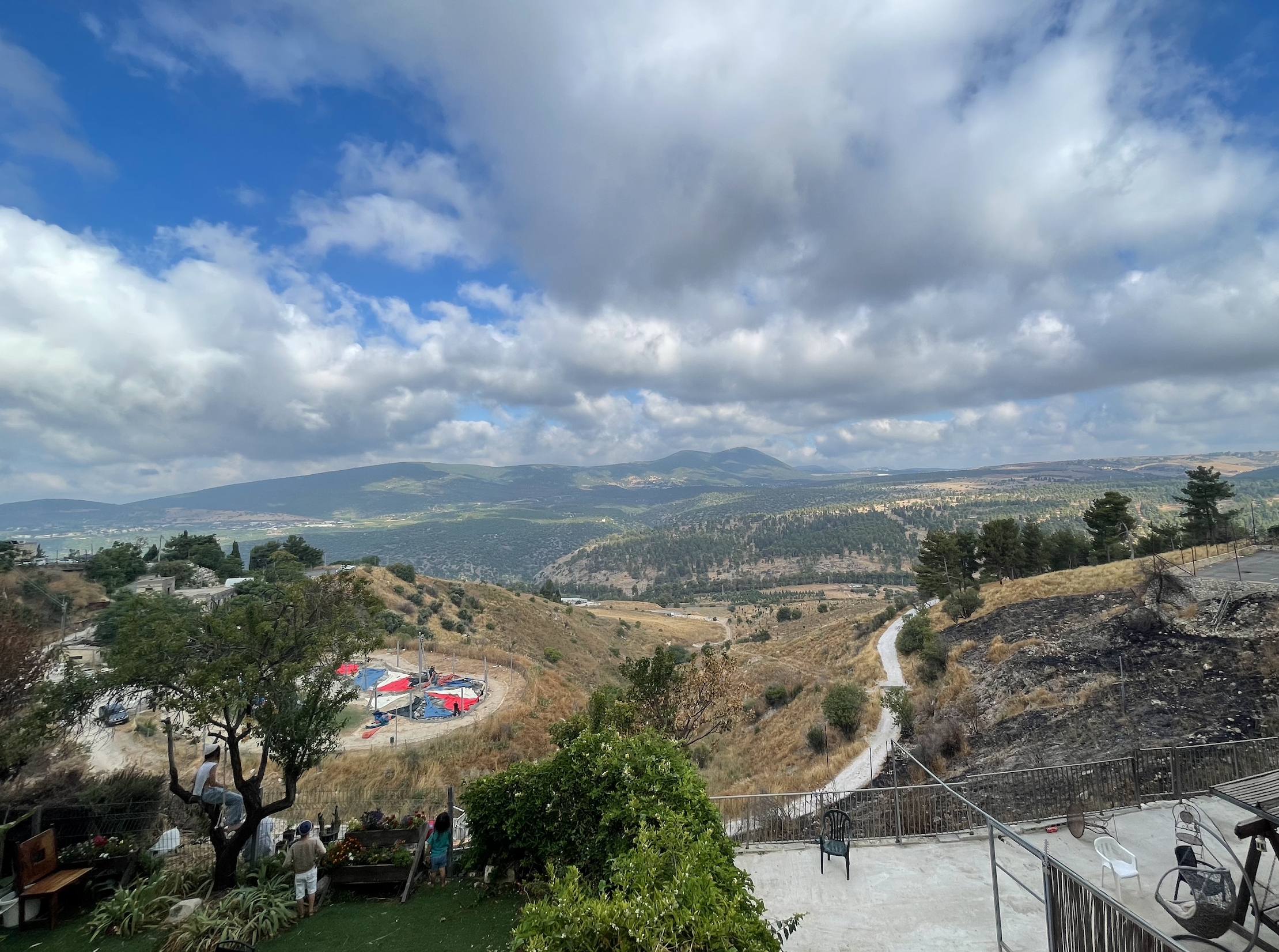
A blackened mountainside still carrying the memory of wildfire stood beside active construction of a children’s playground.
Between the lingering scent of smoke and the expectancy of new laughter, the Land itself began revealing a Torah I had never seen before.
*
I stood there for a long while.
The charred mountain on my right.
The newly construction of the playground on my left.
The waiting children.
The lingering scent of smoke.
The quiet breath of the Land.
Nothing asked to be resolved.
Everything invited relationship.
The mountain no longer appeared divided between black and color, destruction and rebuilding. It had become one living landscape, revealing that churban /חֻרְבָּן and geula are not always separated by history. Sometimes they stand beside one another, quietly unfolding within the same moment. The hidden work of Hashem is often already underway long before our eyes are refined enough to perceive it.
As I slowly stepped away from the window, I realized I was not leaving the teaching behind. I was carrying it within me. Every conversation would become another opportunity to choose relationship over separation. Every moment of constriction another invitation to whisper:
מִן־הַמֵּצַר קָרָאתִי יָהּ.
Every quiet expansion:
עָנָנִי בַמֶּרְחָב יָהּ.
The Land had become my mashpia / מַשְׁפִּיעָה.
The ashes had become Torah.
May the One Who continuously renews creation teach us to recognize the first green shoot while it is still hidden beneath the ashes.
הרה״ק מרוז׳ין זיע״א שבג׳ השבועות של בין המצרים יש קדושה יותר גבוהה מאשר בשלש הרגלים, כי שלש רגלים הם זכר ליציאת מצרים, ואילו ג׳ השבועות יהיו לעתיד לבא ימים טובים בבחי׳ ג׳ הרגלים זכר לגאולה העתידה. ומי שזוכה מרגיש בג׳ שבועות אלו של ימי בין המצרים את האור הגדול הטמון בתוך החושך. / ובתשעה באב הוא בחי׳ קוסטא דחיותא המביאה לצמיחה חדשה, לענני במרחב י־ה בביהמ״ק בב״א.
–Netivot Shalom:
The Rebbe of Ruzhin teaches that the Three Weeksof Bein HaMeitzarim possess an even higher kedusha than the shalosh regalim. How can this be?
The shalosh regalim are זֵכֶר לִיצִיאַת מִצְרַיִם—a remembrance of the Exodus from Egypt. They commemorate the geula that has already been revealed.
But the days of Bein HaMeitzarim belong to another redemption. They belong to the geulah ha’atidah / גְּאֻלָּה הָעֲתִידָה, the redemption yet to come. These days will one day become yamim tovim / יָמִים טוֹבִים, festivals of joy, corresponding to the shalosh regalim themselves.
The hidden light of the future is already concealed within these days!
Who is zoche / זוֹכֶה to perceive it?
The one who is willing to remain present within the darkness long enough to discover the ohr hagadol hatamun / הָאוֹר הַגָּדוֹל הַטָּמוּן, the great light hidden within concealment.
On Tishah B’Av / תִּשְׁעָה בְּאָב, it is the aspect of the kusta d’chiuta / קוּסְטָא דְחִיּוּתָא, the indestructible remnant of life from which entirely new tzemichah / צְמִיחָה begins.
זִבְחֵי אֱלֹקִים רוּחַ נִשְׁבָּרָה; לֵב־נִשְׁבָּר וְנִדְכֶּה אֱלֹקִים לֹא תִבְזֶה.
“The sacrifices of God are a broken spirit; a broken and crushed heart, Hashem, You will not despise.” (Tehillim 51:19)
When a Yehudi / יְהוּדִי comes before Hashem with a lev nishbar / לֵב נִשְׁבָּר, a broken heart, this is not destruction for its own sake. This is the he’eder / הֶעְדֵּר that precedes the buildingbinyan / בִּנְיָן. It is the movement from yesh / יֵשׁ to ayin / אַיִן, the gentle and mature bitul / בִּטּוּל of one’s ego before Hashem.
There is a brokenness that leads only to despair and churban / חֻרְבָּן. And there is a brokenness that becomes the womb of new creation. This is the he’eder shel binyan / הֶעְדֵּר שֶׁל בִּנְיָן, the constructive absence.
The heart becomes empty enough to receive. The ego becomes quiet enough to listen. The seed appears to disappear, yet the kusta d’chiuta / קוּסְטָא דְחִיּוּתָא remains alive within it. From that hidden point begins tzemichah chadashah / צְמִיחָה חֲדָשָׁה.
__
Every year, the days of Bein HaMeitzarim / בֵּין הַמְּצָרִים invite us to remember the breached walls of Yerushalayim, the destruction of the Beit HaMikdash / בֵּית הַמִּקְדָּשׁ, and the long journey of galut. Yet this year,, the Land itself becomes my teacher. I found myself standing quietly at the window of my home in Tzfat, gazing upon a landscape that seemed to hold the entire mystery of these days.
Only a few days earlier, a wildfire had swept across my back yard, the mountainside before my home. The familiar shades of green had disappeared beneath a blanket of black ash. The scent of smoke still lingered in this Holy City of Ruach / air, and the earth bore the unmistakable imprint of fire.
Yet just beyond the charred hillside, workers were assembling a brand-new children’s playground. Bright circles of red, white and blue were rising from the ground while several young children stood nearby, quietly watching with anticipation. They could not yet climb, swing, or laugh within it. They simply stood and waited. Between the blackened mountain and the playground still under construction, I sensed that Hashem was inviting me to see through different eyes.
As I remained at the window, another layer of the landscape quietly revealed itself. At first, my eyes were drawn to the bright shade canopies rising above the new playground. Red. White. Blue. Their colors seemed almost to dance against the dark mountainside. Then, almost unexpectedly, the workers added a fourth color… completing the landscape. Black.
Suddenly, the entire scene became a living teaching.
Rabbi Chaim Vital zt”l describes the four colors through which the Ohr Ein Sof / אוֹר אֵין סוֹף, the Infinite Light, becomes perceptible within Creation. White corresponds to Chochmah / חָכְמָה, the first flash of undifferentiated light. Red reveals Binah / בִּינָה, where that light is received, expanded, and given form. Green, or the blue-green radiance of Tiferet / תִּפְאֶרֶת, harmonizes the flow between them, drawing heaven and earth into relationship. Finally comes black, Malchut / מַלְכוּת, the place that appears to receive no light of its own, yet becomes the very kli / כְּלִי through which all the higher lights are revealed within the world.
Standing before the mountain, these were no longer abstract teachings. White, red, blue, and black rose from the playground, speaking of life, possibility, and what was already being built. What initially was a tattered weather-beaten playground clearly illustrated Elokut / G-dliness.
Juxtaposed next to the burned trees and black ash, Malchut / מַלְכוּת. The fertile earth that receives everything. The place that carries the ashes. The place that holds the hidden seed. The place of he’eder / הֶעְדֵּר from which the hidden spark of life, the kusta d’chiuta / קוּסְטָא דְחִיּוּתָא quietly begins its journey toward growth / צְמִיחָה.
The playground and the charred mountain were no longer two separate scenes. Together they had become a prism through which the Ohr Ein Sof / אוֹר אֵין סוֹף was quietly refracting across the landscape. The colors of Creation were not merely before my eyes. They were revealing the inner movement of Bein HaMeitzarim itself: the Infinite Light descending through every level until it reaches the black earth of Malchut / מַלְכוּת, where what appears most concealed becomes the very birthplace of renewal.
The longer I remained at the window, the more the landscape began revealing itself as Torah. My eyes instinctively wanted to divide what I was seeing into opposites: destruction and rebuilding, death and life, yesterday and tomorrow, churban and geulah. Yet the mountain quietly resisted such simple distinctions. The playground was already becoming while the ashes were still warm. The children were not disturbed by the black hillside. Somehow they were able to stand within the unfinished moment, trusting a future they could not yet enter. Their waiting carried no anxiety. It possessed the quiet confidence that new life was already on its way.
As I watched, another teaching surfaced… from the chochma of the Land itself. Farmers have long understood that fire is not always the final chapter. After certain controlled burns, the ash returns precious minerals to the soil. Dormant roots remain alive beneath the surface. Hidden seeds begin awakening long before the first green shoot appears. What seems barren to the eye may already be filled with unseen vitality. The deepest work is taking place precisely where nothing appears to be happening.
In that moment, the teaching of the Netivot Shalom emerged with entirely new clarity. Reflecting on the verse מִן־הַמֵּצַר קָרָאתִי יָהּ, he reveals one of the deepest patterns woven into creation itself:
הֶעְדֵּר קוֹדֵם לַהֲוָיָה.
Absence precedes new Being.
Before every authentic new growth / צְמִיחָה, there is he’eder / הֶעְדֵּר. Before every birth, there is concealment. Before every revelation, there is hiddenness. He compares this to a seed planted in the earth. Outwardly, it appears to decay completely. Yet within that apparent dissolution remains what he calls the kusta d’chiuta / קוּסְטָא דְחִיּוּתָא, the tiny remnant of life-force that never departs. It is not waiting outside the darkness. It is quietly abiding within it. From that hidden point, the entire future tree will emerge.
Standing before the black mountain, I realized I was no longer looking at destruction. I was witnessing he’eder / הֶעְדֵּר. The earth was not empty. It was becoming. The ashes were not merely what remained after the fire; they had become the quiet garment protecting the hidden kusta d’chiuta / קוּסְטָא דְחִיּוּתָא until the moment of its awakening. The landscape itself had become a living commentary. The narrow place is not simply where life feels absent. It is often the very place where Hashem is preparing its deepest hitchadshut / renewal.
At that moment, I understood that I was no longer simply looking at the Land.
The Land was looking back at me.
The Hidden Landscape Within
The Land had become a mirror, gently revealing places within me that still carried the memory of fire.
Only a few days earlier, a wildfire had swept across the mountainside before my home. The familiar shades of green had disappeared beneath a blanket of black ash. As a young girl, I was haunted by recurring nightmares of fire sweeping through my backyard. Again and again, I would awaken with the terrifying image of flames drawing ever closer to my home. Looking back, I now recognize that those dreams did not arise in a vacuum. Night after night, my father sat watching the evening news as images of the Vietnam War filled our living room. Fire. Explosions, etc. I was too young to understand what I was seeing, yet those images became part of the inner landscape of my childhood, the imagery of war became deeply woven into my body.
Last week, for the first time in my life, those childhood images unfolded before my own eyes. Flames rose in my backyard, nearly reaching my window. Yet something extraordinary happened. Before the fire began, we had been told to anticipate controlled burns along our street and just shut all our windows. My eyes saw towering flames. After almost 3 years of war, here in the North of Israe, my body was immunized of a lifetime of fearful images. My nervous system remained completely quiet. There was no panic. No terror. No impulse to flee. I simply continued on with my work meeting, until my husband said, “We need to leave. Now!”
Only afterward did I recognize the magnitude of that moment. Hashem had rewritten something deep within me. My eyes saw fire, yet my body rested in menuchat hanefesh / מְנוּחַת הַנֶּפֶשׁ. The old imprint no longer governed my response. The place where fear had once lived had become spacious enough to hold a different experience.
RADICAL SEEING
During Bein HaMeitzarim, we often imagine the meitzar / מֵצַר, the narrow place, as something that belongs to our collective history: the breached walls of Yerushalayim, the destruction of the Beit HaMikdash / בֵּית הַמִּקְדָּשׁ, the pain of galut / גָּלוּת. Yet Dovid HaMelech speaks in the present tense. The cry is immediate, intimate, and profoundly personal. מִן־הַמֵּצַר קָרָאתִי יָהּ. The narrow place is not only where our ancestors once stood. It is every place within us where life has become constricted, where breath catches in the throat, where words remain unspoken, where longing has quietly withdrawn into exile.
How often do we spend our lives trying to escape these places? We distract ourselves. We become busy. We search for certainty. We move quickly past what feels uncomfortable. Yet the Netivot Shalom invites us into a radically different orientation.
The purpose of these days is not to flee the meitzar / מֵצַר, but to discover what Hashem has hidden within it. The apparent emptiness is not the opposite of life. It is the quiet chamber in which life is preparing to emerge. The he’eder / הֶעְדֵּר is not punishment. It is hachanah / הֲכָנָה, preparation. The darkness is not the end of the story. It is the place where the hidden kusta d’chiuta / קוּסְטָא דְחִיּוּתָא patiently awaits its moment of gilui.
Over the years, I have come to recognize that many of the places we experience as exile are not abandoned places at all. They are protected places. Somewhere along the journey, parts of ourselves quietly learned to stand guard over wounds that once felt impossible to bear. They protected us through distraction, through productivity, through perfectionism, through withdrawal, through endless doing. Rather than judging these protectors, I have begun to listen to their voices. They have carried burdens we often did not even know we were carrying. They have remained faithful long after the original danger had passed.
Perhaps the invitation of Bein HaMeitzarim / בֵּין הַמְּצָרִים is not to force open the gates of these hidden places, but to approach them with anavah / עֲנָוָה, humility, patience, and compassion. Healing rarely begins with force. It begins with relationship. Before we can encounter the exile within, trust must first be born between the one who protects and the one who longs to heal.
Before tzemichah / צְמִיחָה, there is he’eder / הֶעְדֵּר. Before revelation, there is quiet waiting. Before the first green shoot breaks through the earth, something hidden has already been unfolding for a very long time.
Since the fire, I have noticed something quietly changing within me.
Each day, as I walk past the neighboring house that was almost completely consumed by the flames, I feel my disgust and feelings of uncomfort, but… I no longer find myself looking away. In the beginning, I wanted to pass quickly. Now I find myself slowing down. I stop. I breathe. I simply stand there for a few moments.
I don’t need to fix the churban / חֻרְבָּן. I don’t need to explain it. I just let myself be with it.
I am learning … The places I once instinctively turned away from, I now find myself sitting beside a little longer. Breathing with them. Listening to them. Holding them with rachamim / רַחֲמִים instead of trying to ignore or change them. They no longer feel like problems to solve. They simply long to be witnessed.
אֶשָּׂא עֵינַי אֶל־הָהָר.
I lift my eyes to the mountain.
At first all I could see was black. Now I find myself looking differently as I know what is happening beneath the surface. The earth is receiving the ashes. The hidden kusta d’chiuta / קוּסְטָא דְחִיּוּתָא is already at work.
Life is quietly preparing itself long before it becomes visible.
I breathe with the mountain. I let its rhythm become my own.
Then I look at the distant patches of burnt trees standing in the landscape in front of my home, completely burned after flaming debris from the Iron Dome fell among their branches. Today, they are bursting forth with new life! Tender green shoots are emerging from wood that only yesterday appeared lifeless.
I find myself smiling. The Land is showing me something my mind could never have taught me. Life is already returning long before my eyes have learned to recognize it.
This is why the verse does not conclude with the cry. It continues:
מִן־הַמֵּצַר קָרָאתִי יָהּ, עָנָנִי בַמֶּרְחָב יָהּ.
“From the narrow place I called to Hashem;
He answered me with expansiveness.”
The expansiveness, the merchav / מֶרְחָב, is not merely the disappearance of constriction. It is the emergence of a heart that has become spacious enough to hold what it once believed it could not bear. The narrow place may still be present, yet something within us has changed. We begin to discover that Hashem has been present there all along, quietly nurturing the hidden point of life beneath the ashes.
Perhaps this is the deepest invitation of these 22 Days. Not simply to mourn what was destroyed, but to become intimate with the hidden places where Hashem is already preparing renewal. For it is often within our deepest meitzar /מֵצַר that the first whisper of geulah / גְּאֻלָּה has already begun.
Learning to See Through the Eyes of the Land
I realized that I was not only being invited to contemplate the landscape before me. I was being invited to contemplate the landscape within me. The mountain and my own heart were speaking the same language. The black earth, the unfinished playground, the waiting children, the lingering scent of smoke, the hidden seeds beneath the ash… all of them belonged not only to the Land, but to the inner world each of us carries.
Perhaps this is why the Torah is never merely information. Torah is Torat Chayim / תּוֹרַת חַיִּים, the Torah of living. It asks us to move beyond learning about reality and into becoming transformed by it. The Land is not simply a backdrop upon which our lives unfold. Eretz Yisrael is constantly teaching those who are willing to slow down long enough to receive her wisdom. Every season, every flower, every mountain, every valley, every fire, every rainfall becomes another expression of Hashem’s conversation with us.
I found myself filled with hakarat hatov / הַכָּרַת הַטּוֹב. Not gratitude for the fire itself, but gratitude that Hashem had slowed me down enough to remain at the window until the landscape began to speak. I was grateful to my chavusa, as we learned at the break of dawn, to process the scene before my very eyes. Had I hurried on with my day, I might have seen only a burnt mountain and a newly constructed playground. Instead, I was invited to witness something entirely different. I was watching the mystery of he’eder / הֶעְדֵּר becoming visible.
I was watching the quiet confidence of children who already trusted the future. They were not measuring the unfinished playground by what was still missing. They were already living in relationship with what was becoming. Their waiting was not passive. It was filled with expectancy. Without realizing it, they were embodying the wisdom of the mountain itself. They trusted that unseen work was moving toward completion.
What might change if we approached our own lives in the same way? What if we could meet our unanswered questions, our lingering grief, our relationships still under construction, with the same patient trust? What if, instead of concluding that nothing is happening, we remembered the hidden kusta d’chiuta / קוּסְטָא דְחִיּוּתָא resting beneath the surface? What if we believed that Hashem is always at work, even when our eyes have not yet learned to recognize His quiet unfolding?
This is the invitation waiting for each of us as we journey through these days, not merely to remember what once was, but to refine our vision until we can perceive what is already becoming. In that seeing, the Land once again becomes our teacher, our hearts become more spacious, and the narrow place itself begins to open into merchav / מֶרְחָב.
There is something profoundly hopeful about this realization. We often imagine that geula arrives only when everything has visibly changed. Yet the rhythm of Creation teaches otherwise. The first movement of geulah is almost always hidden. Long before the eye can perceive new growth, life is already stirring beneath the surface. Long before reconciliation becomes visible, something softens within the heart. Long before the first blossom appears, unseen roots have already begun drawing nourishment from the earth. The deepest transformations often unfold in silence.
This is why these days are called Bein HaMeitzarim / בֵּין הַמְּצָרִים—between the narrow places. We are living between what has already been burned and what has not yet fully blossomed. We stand between memory and promise, between grief and hope, between concealment and gilui. These weeks do not ask us to choose one over the other. They invite us to cultivate the inner spaciousness to hold them both.
The Quiet Beginning of Geula
This teaching transforms the way we experience Bein HaMeitzarim / בֵּין הַמְּצָרִים. These are no longer merely weeks in which we remember destruction. They become weeks in which we learn how to perceive. The invitation is not only to mourn the absence of the Beit HaMikdash / בֵּית הַמִּקְדָּשׁ, but to cultivate eyes capable of recognizing the hidden movements of renewal already unfolding within our generation, within our Land, within our relationships, and within our own hearts. The outer rebuilding and the inner rebuilding are not separate journeys. They are reflections of one another.
How often we stand before our own unfinished places and see only what is missing. We look at a relationship that has not yet healed, a longing that has not yet been fulfilled, a prayer that still awaits its answer, and we conclude that nothing is happening. Yet the Land whispers another possibility. Beneath the surface, where our eyes cannot yet see, roots are deepening. The work of hachanah / הֲכָנָה is already underway. What appears motionless may be filled with hidden movement. What appears silent may already be singing beneath the earth.
The seed is not anxious because it cannot yet see the tree. The earth does not despair because winter still lingers. The Land trusts the rhythm of its Creator. This is one of the deepest invitations of these weeks: not to force geula, but to become companions with emunah to its quiet unfolding. To remain present. To remain receptive. To continue cultivating ratzon / רָצוֹן, emunah / אֱמוּנָה, and oneg / pleasure, even when the landscape still bears the marks of fire.
As I turned away from the window, I realized that I would never again see that mountainside in quite the same way. The black earth had become more than the memory of what had burned. It had become a living testimony that Hashem never abandons His creation. Even within apparent absence, He is already preparing presence. Even within concealment, He is already nurturing gilui, precisely in the place where we once believed everything had been lost.
Becoming a Living Beit HaMikdash
Every generation in which the Beit HaMikdash has not been rebuilt is considered as though it were destroyed in that generation. This is an invitation to consciousness! The Beit HaMikdash was never merely a structure of stone. It was the place of Hashra’at HaShechinah / הַשְׁרָאַת הַשְּׁכִינָה, where heaven and earth encountered one another, where the finite became a dwelling place for the Infinite. During Bein HaMeitzarim / בֵּין הַמְּצָרִים, the question is not only, What was destroyed? The deeper question is, What am I building?
This is our avodah / עֲבוֹדָה during these days. Every encounter becomes another opportunity to build a dwelling place for Hashra’at HaShechinah. Every conversation. Every disappointment. Every moment of constriction. Trigger. Every place where the meitzar /מֵצַר appears within us becomes an invitation to choose relationship over separation, humility over ego, presence over reaction. The rebuilding of the Beit HaMikdash begins long before stones are laid. It begins each time the human heart becomes spacious enough to welcome Hashem.
וְתֶחֱזֶינָה עֵינֵינוּ בְּשׁוּבְךָ לְצִיּוֹן בְּרַחֲמִים.
“May our eyes behold Your return to Tzion with compassion.”Before our eyes behold the rebuilding of Tzion, our vision itself must be rebuilt. The Land does not need to change before we can begin to see differently.
The avodah of Bein HaMeitzarim / בֵּין הַמְּצָרִים is to refine our vision until we perceive the hidden beginnings already unfolding beneath apparent endings.
Returning to the Window
As evening slowly descended over the mountains of the Galilee, I found myself returning once again to the window. The workers had gone home. The children’s voices had faded into the quiet. The playground remained unfinished. The mountain remained black. Nothing in the landscape had visibly changed.
Everything within me had.
Ribbono Shel Olam…
Thank You for slowing me down long enough to receive the Torah that the Land was teaching.
During these days of Bein HaMeitzarim / בֵּין הַמְּצָרִים, may we merit to become people who linger a little longer before the landscape, before one another, and before our own hearts. May we cultivate eyes that perceive beyond appearances, hearts spacious enough to hold both longing and hope, and the humility to trust the hidden work that Hashem is always doing beyond the limits of our vision.
Meditation
Standing Between Ashes & New Life
If it feels comfortable, allow your feet to settle gently upon the earth.
Let your breath arrive without changing it.
Simply notice that Hashem has already been breathing life into you since the moment you were created.
Imagine yourself standing beside me at the window.
Before you stretches the mountain.
Do not rush to understand it.
Simply receive it.
Allow your eyes to rest upon the black earth.
Notice any place within you that immediately wants to turn away.
Notice any place that becomes afraid.
Notice any place that wants to fix what it sees.
Without judgment, simply witness.
Now allow your gaze to move slowly toward the children’s playground.
See the bright colors.
See the children quietly waiting.
Nothing is finished.
Nothing is complete.
Yet everything is already becoming.
Let your awareness move gently back and forth between the ash and the playground.
Between what has ended…
and what has not yet begun.
Notice your breath.
Notice the space between each inhale and exhale.
That quiet place of he’eder / הֶעְדֵּר.
Not emptiness.
Potential.
The hidden place where Hashem is already preparing new life.
Now gently bring your awareness into your own body.
Where is your meitzar / מֵצַר today?
Perhaps it lives in your throat.
Perhaps your heart.
Perhaps your belly.
Perhaps it is a quiet sadness you have carried for many years.
Perhaps it is fear.
Perhaps longing.
You do not need to change it.
Simply let it know:
“I see you.”
“Thank you for carrying what you have carried.”
If another part quickly appears…
A protector…
A distraction…
A voice that says, “Not now…”
Welcome that part as well.
It, too, has been serving you.
Quietly say:
“Thank you for protecting me.”
“When you are ready, I would like to know what you have been protecting.”
Without force.
Without agenda.
Simply relationship.
Now hear the words of the Psalmist arising from within your own heart:
מִן־הַמֵּצַר קָרָאתִי יָהּ.
From the narrow place I call to You, Hashem.
Allow yourself to remain there for a few breaths.
Not escaping.
Not fixing.
Simply turning.
Now gently receive the second half of the verse as though Hashem is speaking it directly into your heart:
עָנָנִי בַמֶּרְחָב יָהּ.
I answer you with expansiveness.
Notice that the narrow place does not need to disappear.
Instead…
Something within you becomes larger.
More spacious.
More capable of holding.
Like the small כ / kaf…
Not small because it is weak.
Small because it has made room.
Room for compassion.
Room for another.
Room for Hashem.
Now return once more to the mountain.
See the ash.
Remember the teaching of the Netivot Shalom.
Beneath the black earth rests the hidden kusta d’chiuta / קוּסְטָא דְחִיּוּתָא.
The tiny remnant of life that never disappeared.
Ask yourself gently:
Where is the hidden kusta d’chiuta within me?
What part of me appears silent, yet is quietly preparing to sprout?
There is no need to answer.
Simply listen.
As you prepare to leave this practice, allow your awareness to expand beyond yourself.
Feel the mountain.
Feel the Land.
Feel the breath of Am Yisrael / עַם יִשְׂרָאֵל.
May we become vessels spacious enough to hold our own grief without becoming overwhelmed by it.
May we learn to meet our inner exiles with compassion, trusting that Hashem has never abandoned the hidden point of life within them.
May the black earth of our hearts become fertile for tzemichah / צְמִיחָה, for geulah / גְּאֻלָּה, and for the rebuilding of the Beit HaMikdash / בֵּית הַמִּקְדָּשׁ.
And may we merit to discover, together, that beneath every place of he’eder / הֶעְדֵּר, Hashem has already planted the first green shoot of hope.
אָמֵן.
Then, before you open your eyes, bring to mind one relationship.
Perhaps with your spouse.
Perhaps with a child.
Perhaps with a friend.
Perhaps with someone from whom you have quietly become distant.
Notice what immediately arises within you.
Does your body become tight?
Do you feel the impulse to defend, explain, withdraw, or fix?
Simply notice.
Without judgment.
This is your invitation.
The Netivot Shalom teaches that before every new tzemichah / צְמִיחָה, there is he’eder / הֶעְדֵּר. Perhaps this moment of constriction is not the obstacle to the relationship. Perhaps it is the very place from which a deeper relationship longs to emerge.
Take one gentle breath.
Can you become just a little smaller?
Not smaller in worth.
Not smaller in dignity.
Smaller in anochiyut / אָנֹכִיּוּת, in the insistence that only your perspective exists.
Like the small כ / kaf, creating just enough space for another reality to enter.
Perhaps this is the deepest meaning of anavah / עֲנָוָה.
Not thinking less of ourselves.
Making more room for another.
Making room for Hashem.
Making room for the quiet voice beneath the noise.
Now imagine yourself walking gently across the black hillside.
You kneel and place your hand upon the ash.
At first it feels lifeless.
Yet beneath your fingertips the earth is quietly alive.
Hidden roots remain.
Dormant seeds are waiting.
The kusta d’chiuta / קוּסְטָא דְחִיּוּתָא has never left.
Now place that same gentle hand upon your own heart.
Can you believe that the same is true within you?
That beneath every disappointment…
Every grief…
Every unanswered prayer…
Every exile…
There remains a hidden point that has never stopped living.
Hashem has been guarding it all along.
Perhaps this is why we journey through Bein HaMeitzarim / בֵּין הַמְּצָרִים.
Not to become consumed by the memory of destruction.
But to learn how to perceive the hidden beginnings that are already germinating beneath the ashes.
As you breathe, imagine the black earth slowly receiving the first drops of rain.
Not enough to transform the mountain overnight.
Just enough.
Enough for one seed.
Enough for one root.
Enough for one tiny green shoot to begin pushing upward toward the light.
Transformation in Torah is rarely sudden.
Creation itself unfolded day by day.
The almond tree does not blossom because it hurries.
It blossoms because it faithfully receives each season that Hashem gives it.
So too with us.
Today we do not need to rebuild the entire Beit HaMikdash / בֵּית הַמִּקְדָּשׁ within our hearts.
We need only become available for the next small act of teshuvah / תְּשׁוּבָה.
The next gentle turning.
The next breath.
The next conversation entered with humility.
The next protector thanked for its faithful service.
The next galus quietly welcomed home.
Our inner children
never asked whether the playground would be finished.
They simply stood with expectancy.
Trusting what was not yet visible.
May we become children of such emunah / אֱמוּנָה.
May we learn to stand upon the black earth without despair.
During these precious days of Bein HaMeitzarim / בֵּין הַמְּצָרִים, may we be blessed with eyes that learn to perceive the hidden kusta d’chiuta / קוּסְטָא דְחִיּוּתָא within ourselves, within one another, and within our Land.
May we cultivate hearts spacious enough to hold our own narrow places with compassion, trusting that Hashem has never abandoned the hidden point of life within them. May we become a dwelling place for Hashra’at HaShechinah / הַשְׁרָאַת הַשְּׁכִינָה through every act of presence, every movement of anavah / עֲנָוָה, every quiet turning toward one another, and every turning toward Hashem