
Parashat Chukat | Torat HaTzeva
What Kind of Consciousness Is Required at the Threshold of Geulah?
Few episodes in Torah are as perplexing as the mystery of מי מריבה / Mei Merivah, the Waters of Strife. A nation is thirsty, a rock stands before them, Moshe Rabbeinu strikes the rock, water emerges, the people drink, and the immediate crisis is resolved. From the outside, it appears that the story has ended well. A נס / miracle has occurred. The nation has been saved. Yet precisely there, in the place where everyone else can move on, Hashem declares:
“יַעַן לֹא הֶאֱמַנְתֶּם בִּי לְהַקְדִּישֵׁנִי לְעֵינֵי בְּנֵי יִשְׂרָאֵל”
“Because you did not believe in Me to sanctify Me before the eyes of Bnei Yisrael” (Bamidbar 20:12).
Moshe and Aharon will not bring the people into Eretz Yisrael. The severity is staggering. Moshe Rabbeinu, who confronted Pharaoh, split the sea, ascended Sinai, received the Torah, carried the nation through rebellion, hunger, fear, and collapse, will not enter the Land because of this moment. The question that echoes through the generations is not only what Moshe did wrong, but what kind of consciousness is required at the threshold of גאולה / geulah.
Parashat Chukat is פרשת המעבר / the parashah of transition. Until now, the Torah has been unfolding the story of the generation that left Mitzrayim: the generation of the Meraglim, the generation of Korach, the generation still carrying the inner imprint of slavery. Then suddenly, almost thirty-eight years disappear from the narrative. A new generation stands at the edge of Eretz Yisrael, and the first event recorded is not the rock, not the thirst, not the conflict, but the death of Miriam:
“וַתָּמָת שָׁם מִרְיָם וַתִּקָּבֵר שָׁם”
“Miriam died there and was buried there” (Bamidbar 20:1).
The Gemara states:
“שלשה פרנסים טובים עמדו להם לישראל ואלו הן משה ואהרן ומרים”
“Three good sustainers arose for Israel: Moshe, Aharon, and Miriam” (Taanit 9a).
The Gemara continues:
“באר בזכות מרים”
“The well was in the merit of Miriam.”
Moshe drew down the מן / manna, Aharon drew down the ענני הכבוד / Clouds of Glory, and Miriam drew down the באר / well. Her leadership was not marginal. It was the hidden stream beneath the entire journey.
Water is never merely water in Torah. Water is תורה / Torah, חיים / life, שפע / flow, purification, mikveh, womb, and renewal. Water is the movement from concealment into revelation. Miriam’s entire life is bound to this mystery. As a child she stood by the Nile and watched over Moshe, seeing a redeemer where others saw only danger. When Amram separated from Yocheved in despair, Miriam told him:
“גזרתך קשה משל פרעה”
“Your decree is harsher than Pharaoh’s.”
Miriam saw beyond the visible surface. She saw what was becoming before it appeared. She saw the hidden future inside the basket, the hidden leader inside the infant, the hidden גאולה inside the decree. In the language of pnimiut, Miriam carried the consciousness of עלמא דאתכסיא / the hidden world, the realm beneath the surface where futures gestate before they become visible. Perhaps this is why the well was in her merit. She knew how to perceive the spring before anyone else knew it was there.
When Miriam dies, the well disappears.
“וְלֹא הָיָה מַיִם לָעֵדָה”
“There was no water for the congregation” (Bamidbar 20:2).
The people panic, and the old voice of גלות / exile-consciousness returns: Why did you bring us here? Why did we leave Mitzrayim? Why are we in this place without water? This is one of the deepest mistakes of גלות: to mistake concealment for absence, hiddenness for abandonment, delay for failure. The soul does this constantly. A person davens and nothing seems to change. A person works on herself and sees no movement. A person waits for healing, clarity, shidduchim, children, parnassah, peace, and the surface remains stone. The mind concludes, “There is no water.” Torah answers differently: the water is hidden. The spring is concealed. The process is unfolding beneath the surface. The Arizal describes the avodah of creation as בירור הניצוצות / the elevation of concealed sparks. The task is not to flee the world in order to find Hashem, but to reveal the Ohr Hashem hidden within the world itself.
This is the difference between גלות consciousness and גאולה consciousness.
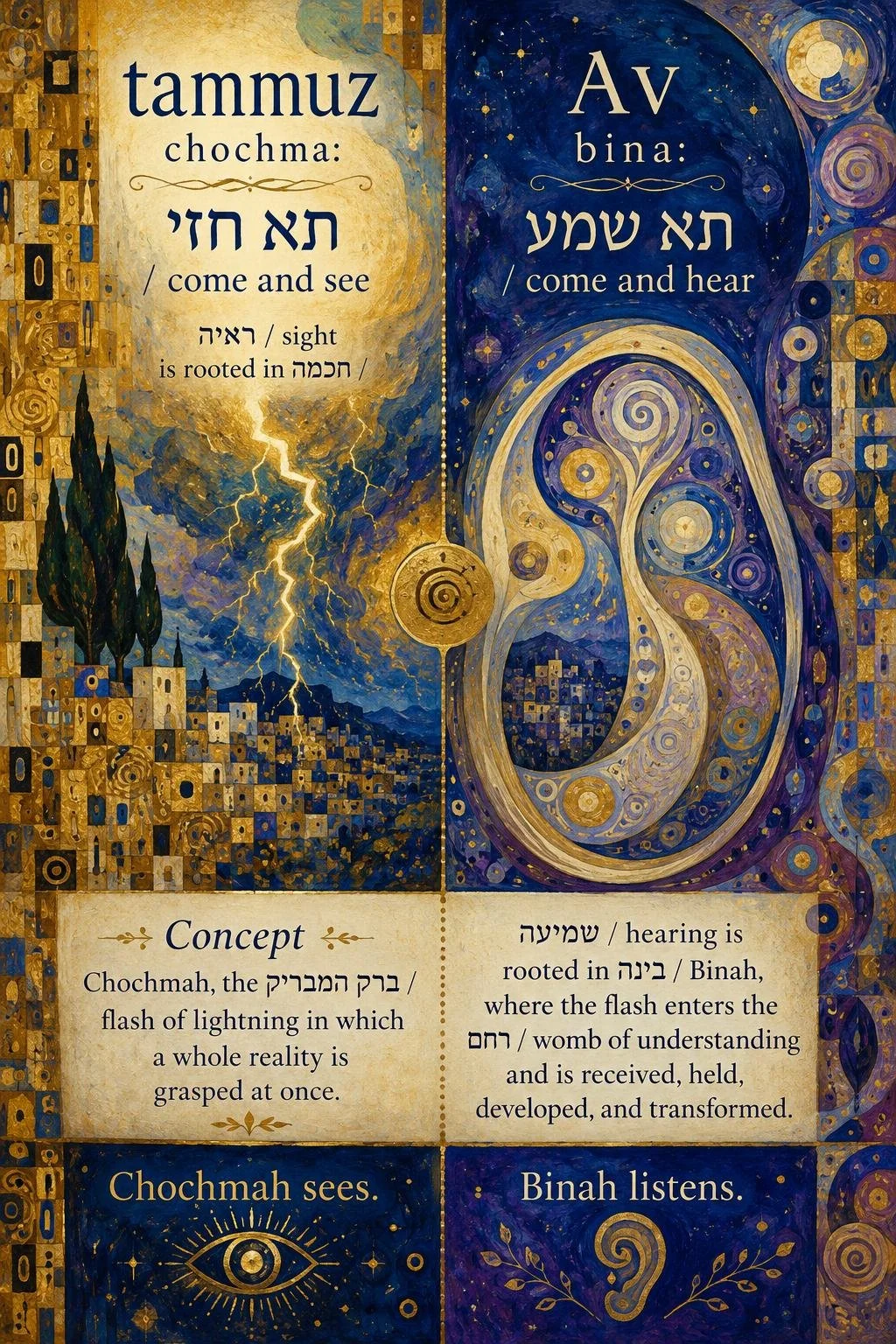
גלות says, “I do not see it, therefore it is not there.” גאולה says, “I do not see it yet, therefore I must learn how to see differently.” This is also the secret of Tamuz, whose chush is ראייה / seeing. Fallen seeing sees only the fragment, the wound, the outer event, the hard surface of the rock. ראייה מתוקנת / redeemed seeing perceives השלם הנסתר / the hidden whole concealed within what appears fragmented. The Meraglim looked at the Land and saw ענקים / giants; Kalev looked at the same Land and saw promise. They saw the same mountains, the same fortified cities, the same reality. What differed was not the landscape but the שדה התפיסה / field of perception. One gaze collapsed before the surface. The other perceived the hidden covenant beneath it.
Hashem tells Moshe:
“קַח אֶת הַמַּטֶּה”
“Take the staff,”
and then:
“וְדִבַּרְתֶּם אֶל הַסֶּלַע”
“Speak to the rock” (Bamidbar 20:8).
The question is unavoidable: if the avodah is speech, why take the staff? Why place the instrument of striking in Moshe’s hand? The staff belongs to an earlier stage of history. The staff belongs to Mitzrayim, to the מכות / plagues, to the splitting of the sea, to the breaking open of resistance. The Midbar is sustained through open ניסים / miracles: bread from Heaven, clouds of glory, water by נס. Eretz Yisrael, however, reveals a deeper secret. In the Land, the נס is clothed within דרך הטבע / the pathways of nature. Bread comes through plowing, planting, rain, waiting, harvesting, grinding, kneading, and baking. The Ohr Hashem is no less present, but it is drawn out through process. At the threshold of Eretz Yisrael, the staff must be carried but not used. Power must remain present, but it must mature. Force must become revelation. The task is no longer to break reality. The task is to reveal what reality is already carrying.
The rock is not empty. The rock is pregnant.
The rock is carrying hidden water, a future spring, a possibility not yet visible to the eye. This is the sod of speaking rather than striking. To strike the rock is to relate to reality as resistance. To speak to the rock is to relate to reality as concealment. One stance says, “This is blocking me.” The other says, “Something is hidden here.” One tries to smash the surface. The other seeks the water beneath it. Rabbi Akiva understood this when he saw water carving stone.
Avot D’Rabbi Natan tells that he asked:
“מי חקק אבן זו?”
“Who carved this stone?”
and the answer was:
“המים שתדיר נופלים עליה בכל יום”
“The water that constantly falls upon it every day” (Avot D’Rabbi Natan 6).
From this he learned that if soft water could carve hard stone, Torah could surely enter his heart. The path to greatness is not always quick, dramatic, or revealed in a single moment. Often it is the faithful, repeated movement of water over stone, the slow patience of גאולה unfolding קמעא קמעא / little by little.
The Zohar identifies the power of revelation through speech with Malchut:
“מלכות פה”
“Malchut is the mouth” (Tikkunei Zohar, Introduction, 17a).
מלכות / Malchut receives from the hidden worlds and brings them into expression. Speech is therefore not merely communication. דיבור / speech is revelation. Creation itself unfolds through:
“וַיֹּאמֶר אֱלֹקִים”
“And Hashem said.”
To speak to the rock is to stand in the avodah of Malchut, drawing hidden water into revealed flow. The mouth can either seal a person inside their קטנות / smallness or summon forth their גדלות / greatness. A word can strike, or a word can open a well.
This is why the phrase Moshe uses is so painful:
“שִׁמְעוּ נָא הַמֹּרִים”
“Listen now, rebels” (Bamidbar 20:10).
I first heard a powerful development of this idea in a shiur by Rabbi Anava several years ago, and it remained with me. The question is not merely whether the people were rebellious. The question is what reality a leader chooses to reveal through speech.
The Rambam, in שמונה פרקים / Shemoneh Perakim, Chapter 4, understands Moshe’s failing through the lens of anger, because the people would learn from Moshe’s emotional response and imagine that Hashem Himself was angry with them. A leader’s reaction becomes a teaching. The Ramban struggles with this, noting that נביאים / prophets often rebuke Israel sharply, yet even where rebuke is necessary, the Torah is teaching us the weight of language at the threshold of Eretz Yisrael.
The Ibn Ezra, on “המורים,” reminds us of their essence:
“והם בני אברהם יצחק ויעקב”
“They are the children of Avraham, Yitzchak, and Yaakov.”
Be careful how you speak about them. Be careful what name you place upon a soul.
Words create reality because words draw חיות / life-force. When someone is repeatedly named by their lowest behavior, they may begin to live inside that garment. A child called impossible learns to become impossible. A student called a failure begins to move through the world as one. A spouse seen only through deficiency becomes smaller beneath that gaze. The Baal Shem Tov teaches throughout his derech that where a person places מחשבה, דיבור ומעשה / thought, speech, and action, there he draws life-force. Speech does not simply report what exists; it nourishes what it names. This is why lashon hara is so severe even when it is “true.” A partial truth, spoken without the vision of the neshama, can imprison a person inside the fragment.
Rebbe Nachman writes in Likutei Moharan 282:
“דַּע כִּי צָרִיךְ לָדוּן אֶת כָּל אָדָם לְכַף זְכוּת”
“Know that one must judge every person favorably.”
He builds this on the pasuk:
“וְעוֹד מְעַט וְאֵין רָשָׁע וְהִתְבּוֹנַנְתָּ עַל מְקוֹמוֹ וְאֵינֶנּוּ”
“A little more and there is no wicked one; you will contemplate his place and he will not be there” (Tehillim 37:10).
The avodah is not denial. It is not pretending there is no wound, no failure, no rebellion, no hardness. It is the refusal to reduce a soul to its brokenness. One searches for the נקודה טובה / good point, the spark, the hidden spring, until the person can be lifted from the place where he has been trapped. The true mashpia is therefore a מיילדת הנשמות / midwife of souls. A midwife does not create the child. She helps reveal what is already there. A mashpia does not place greatness inside another person. She sees the מים חיים / living waters hidden beneath the stone and speaks until the other person can hear them flowing.
The heart of a mashpia becomes a mirror.
Not a mirror that reflects faults,
but a mirror polished enough to reveal essence.
“לֵב טָהוֹר בְּרָא לִי אֱלֹקִים”
“Create for me a pure heart, Hashem” (Tehillim 51:12).
This is not only a plea for innocence; it is a plea for a heart clear enough to reflect the Ohr Hashem concealed in another. Many people discover their strength because someone saw it before they did. A mother may see courage in a child who only feels stubbornness. A wife may see tenderness in a husband who imagines himself closed. A teacher may see leadership in a student who only knows confusion. A friend may see life in a place where the other sees only stone. This is not flattery. It is יילוד הנשמה / birthing the soul into revelation.
Tomer Devorah opens with the principle:
“ראוי לאדם להדמות לקונו”
“It is fitting for a person to resemble his Creator” (Tomer Devorah, Chapter 1).
The Ramak teaches the middot through which a person becomes a channel of rachamim, giving even where the recipient is not yet refined. In the language of pnimiut, receiving is never meant to remain closed within the self. The avodah is לקבל על מנת להשפיע / to receive in order to give. If a person has received Torah, sensitivity, healing, insight, or a clearer seeing, it becomes a responsibility to reveal water for others. Not through domination. Not through humiliation. Not by making another smaller. The leadership of Eretz Yisrael is the leadership that enlarges the vessel before it.
This brings us to the deeper question of Moshe himself. In Devarim, Moshe seems to connect his inability to enter the Land with the episode of the Meraglim:
“גַּם בִּי הִתְאַנַּף ה׳ בִּגְלַלְכֶם”
“Hashem was angry with me also because of you” (Devarim 1:37).
The אור החיים הקדוש asks why Moshe’s fate is connected there to the Meraglim when the decree appears in Bamidbar at Mei Merivah. One deep reading is that Moshe is not only being punished; he is bound to his generation. A head cannot abandon its body. The shepherd cannot abandon the flock. If the generation of the Midbar remains in the wilderness, Moshe remains with them. This is Moshe Rabbeinu — not only because he received Torah, but because he would not stop carrying his people, even when they complained, rebelled, misunderstood him, and did not thank him.
Here the parashah reveals the highest form of leadership. Korach wants leadership as position; Moshe reveals leadership as mesirut nefesh. Korach says, “I should stand in front.” Moshe says, “If my people remain behind, I remain with them.” The true leader is not always the one who crosses into the visible destination. Sometimes the true leader is the one willing to stay with the generation that cannot yet enter, so that in the end they, too, will rise. A parent knows something of this. A teacher knows something of this. A woman who has poured herself into another soul knows something of this. One gives, and the gratitude may not come. One guides, and the fruit may not yet appear. But if the work is truly לשם שמים / for the sake of Heaven, the deepest desire is not recognition. It is that another person should discover their חלק אלוקה ממעל ממש / a literal spark of Elokut from Above, as the Alter Rebbe writes in Tanya, Chapter 2.
This is the great principle of success hidden inside Parashat Chukat. Our nature is to be successful, not in the shallow language of achievement, but because the neshama comes from Hashem and carries a ratzon / will to reveal its purpose. Every person has a hidden treasure. Every person has a spring. Every person has a point that can become a doorway to Olam HaBa. The work of a mashpia, a mother, a teacher, a friend, is to become the kind of presence through which that treasure can be seen. Sometimes this means holding the tongue when the easy word would diminish. Sometimes it means naming the good before it is fully visible. Sometimes it means celebrating small movement, creating an atmosphere of gratitude, and becoming what might be called a holy billboard of possibility — a steady, living message that says: there is more in you than you can presently see.
This is also Torat HaTzeva. Techeilet is hidden within the chilazon.
Nature teaches slowly. Water does not panic before stone. It returns. The seed does not accuse the soil because growth is hidden. The sky does not abandon dawn because light begins gradually. Techeilet is hidden within the chilazon. Blue is hidden within what first appears dull and sealed. The soul is hidden within the story. The spring is hidden within the rock. Geulah is hidden within history. The feminine vessel, הכלי הנקבי / the feminine vessel, knows the wisdom of gestation: not everything true is immediately visible, and not everything concealed is absent. To speak to the rock is to honor the hidden process through which Hashem brings life into revelation.
Take a slow breath as you read this.
Feel the feet resting upon the earth.
Let the shoulders soften.
Bring to mind one rock in your life — a place that feels fixed, hard, unanswered, or resistant.
Notice the impulse to strike it: to force, to prove, to demand immediate change. Let the breath soften that impulse. Now ask quietly: What if this place is not empty? What if there is water concealed here? What if Hashem is already moving beneath the surface? What if the avodah is not to break the rock but to learn how to speak to it?
Bring to mind one person whose stone you often see before you see their water.
A child, a spouse, a student, a friend, perhaps even yourself.
Ask: What is the נקודה טובה hidden here? What spring has not yet emerged? What word would enlarge rather than diminish? What would it mean to become a mirror for their essence rather than their failure? Rest there for a breath. Listen not for the sound of stone, but for the sound of water beneath it.
☽ MEDITATION · SPEAK TO THE ROCK
Sit comfortably.
Feel your feet resting upon the earth.
Allow the body to settle.
Hands resting gently over one another at the heart.
Take a slow breath in.
And a slow breath out.
Again.
Bring to mind a rock in your life.
A place that feels hard.
A place that feels stuck.
A place that feels resistant.
Notice the impulse to strike it.
To force it.
To push it.
To demand immediate results.
Now hear the words:
“וְדִבַּרְתֶּם אֶל הַסֶּלַע”
“Speak to the rock.”
Imagine that beneath the surface of this rock there is water.
מים חיים / living waters.
Hidden.
Concealed.
Waiting.
Not absent.
Hidden.
Ask gently:
What if there is water here?
What if Hashem is already moving beneath the surface?
What if this process is unfolding even when I cannot yet perceive it?
No need to answer.
Simply listen.
Listen not for the sound of stone.
But for the sound of water.
The water that Miriam knew was hidden.
The water that Kalev knew was hidden.
The water that גאולה reveals.
May we be zoche to ראייה מתוקנת / redeemed seeing,
to perceive השלם הנסתר / the hidden whole beneath the fragment.
May we be zoche to שמיעה מתוקנת / redeemed hearing, to hear the spring before it appears.
May we be zoche to דיבור מתוקן / redeemed speech, to reveal rather than diminish, to open rather than strike.
May the zechut of Miriam HaNeviah awaken the hidden wells within us, may the Torah of Moshe Rabbeinu teach us leadership rooted in mesirut nefesh, and may we become women who know how to speak to the rock until all concealed waters rise.
“כִּי מָלְאָה הָאָרֶץ דֵּעָה אֶת ה׳ כַּמַּיִם לַיָּם מְכַסִּים”
“For the earth will be filled with knowledge of Hashem as waters cover the sea” (Yeshayahu 11:9).
שבת שלום.
–Rachel Leah