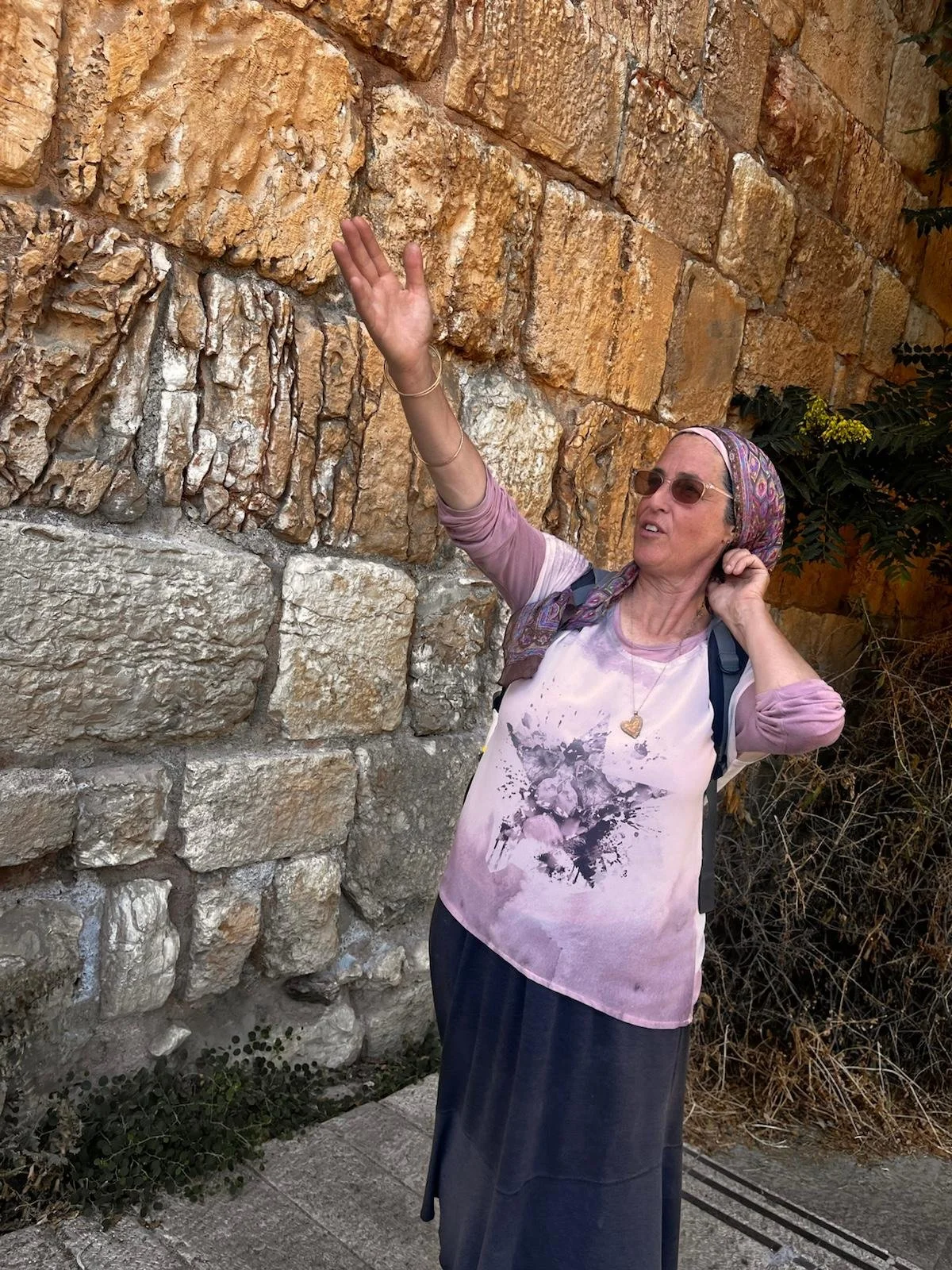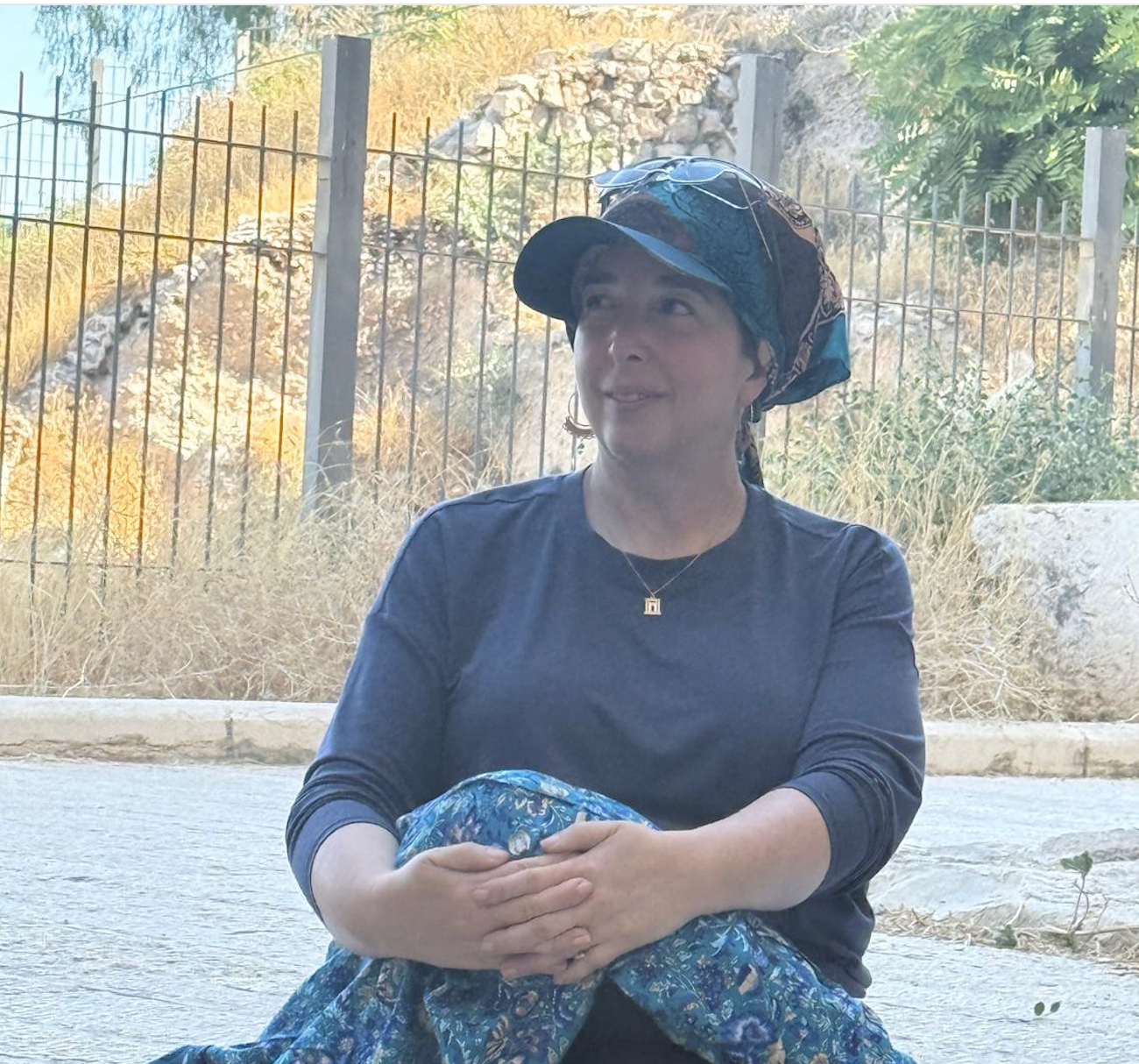
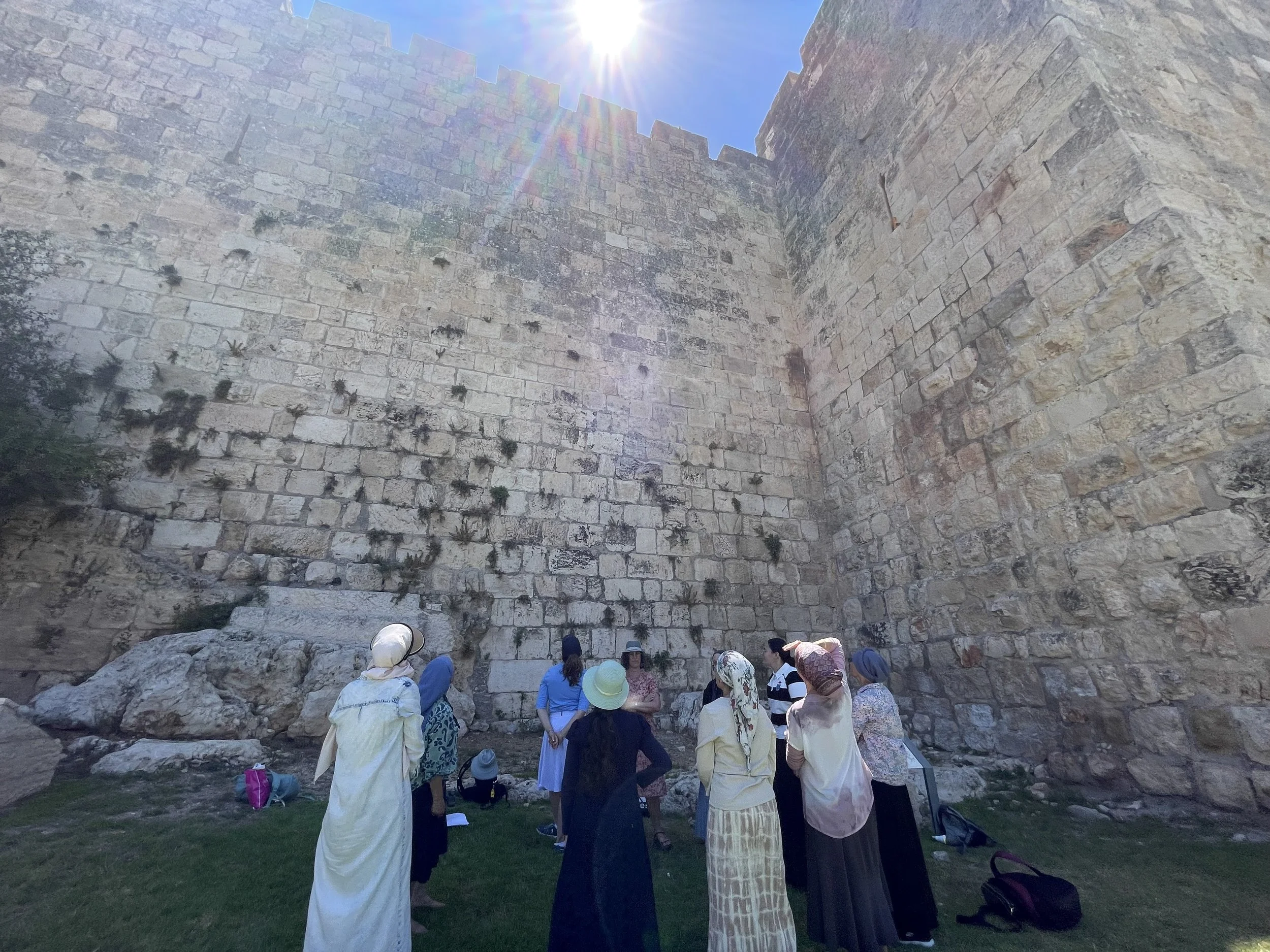
“Yerushalayim is not merely a place we visit. It is a landscape that slowly reshapes the one who walks through her with an open heart.”
More Than a Tour
A Women’s Yerushalayim Journey Through the Hidden and Revealed
Walls • Bridges • Valleys • Stones • Breath • The Living Landscape of Yerushalayim
Join Us on the Next Yerushalayim Journey
There are countless ways to visit Yerushalayim.
One can walk her streets, admire her breathtaking views, photograph her ancient stones, and leave carrying beautiful memories.
Or one can allow Yerushalayim to become a teacher.
That is the heart of the Ohr Pnimi Yerushalayim Journey.
This is not a conventional tour, nor is it simply a day of learning Torah. It is a carefully woven encounter where archaeology, Tanach, history, nature, breathwork, somatic awareness, contemplative practice, and Pnimiut Torah come together within the living landscape of Eretz Yisrael. Every stop along the route becomes an invitation—not only to understand Yerushalayim intellectually, but to experience her through the body, the heart, and the neshama.
Guided by Maskit Ben-Moshe and Rachel Leah Weiman, each journey follows the same ancient paths while remaining completely unique. The landscape never changes, yet every group discovers something entirely different. Sometimes the bridge becomes the teacher. Sometimes it is the valley. Sometimes a single stone held quietly in the palm of one’s hand becomes the doorway through which an entirely new conversation begins.
No previous experience is necessary.
Women of every background arrive carrying different stories, different questions, different hopes. Some come seeking inspiration. Others come searching for quiet after a difficult season. Some come because they love Yerushalayim. Others because they feel drawn by something they cannot yet explain.
Again and again, they leave describing something they had not expected.
Not simply that they learned something new.
But that they experienced Yerushalayim differently.
OUR PARTICIPANTS ARE SAYING
One participant wrote:
“This journey became so much more than a walk through Yerushalayim. It became a living experience of Presence. Through breath, movement, and gentle awareness, I discovered my own inner crossing. Every bridge, every tunnel, every ancient stone, and every shared breath became a doorway into a deeper awareness of Hashem.”
Another reflected:
“Full moon. Full heart. Grateful for this beautiful day together among the stones of Yerushalayim with my sisters. It was a magnificent day.”
Bracha Schoonover, who welcomed us into her home for the evening gathering, later shared:
“Thank you for all the time, effort, love, and care you invested to make the walls and stones come alive for us in such a palpable way.”
Perhaps those reflections express the journey more beautifully than any description ever could.
The Ohr Pnimi Yerushalayim Journey was created from a simple yet profound belief: that Eretz Yisrael continues to teach those who are willing to slow down enough to listen. The walls still speak. The valleys still remember. The bridges still invite us into trust. The stones still carry the prayers of generations. And the Shechina continues to reveal herself wherever hearts gather with openness, humility, and longing.
As we prepare each year for בֵּין הַמְּצָרִים / Bein HaMetzarim, we remember not only what was lost, but what is continually waiting to be rebuilt. The rebuilding of Yerushalayim begins long before stones are placed one upon another. It begins whenever separation gives way to connection, whenever fear softens into trust, whenever one human being truly sees another, and whenever we become willing to walk together toward something greater than ourselves.
If these words awaken something within you, perhaps Yerushalayim is already calling.
We would be honoured to walk with you.
Come meet the walls.
Cross the bridges.
Descend into the valleys.
Listen to the stones.
Discover the gateways.
And perhaps, somewhere along the way, you will discover that the Yerushalayim you have been seeking has quietly been seeking you all along.
Join us on the next Ohr Pnimi Yerushalayim Journey.
Walk the Land. Encounter Torah. Discover the Yerushalayim within.
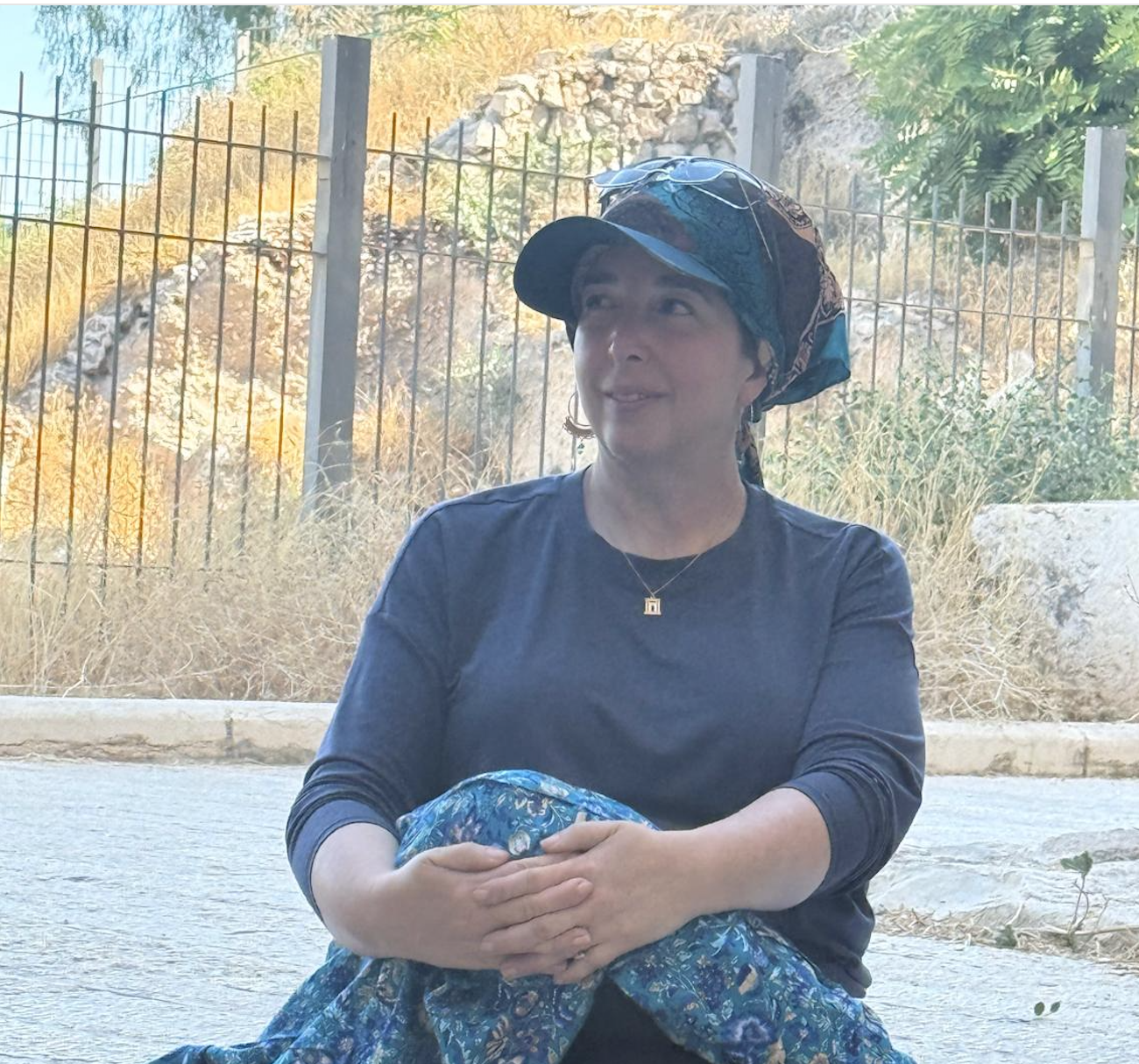
1
At the Gates: Becoming Dorshot Tzion / דּוֹרְשׁוֹת צִיּוֹן
There are countless ways to experience Yerushalayim. One can spend days wandering her alleyways, exploring archaeological sites, standing before the Kotel, and leaving with a camera full of photographs and a head full of history. Yet there is another way to encounter this city—one that asks us to slow our pace, soften our attention, and allow the Land itself to become our teacher. That was the intention behind our recent Women’s Yerushalayim Journey, an immersive day of walking, learning, breathwork, somatic awareness, history, and Torah as we prepared to enter בֵּין הַמְּצָרִים / Bein HaMetzarim.
Women arrived from across Israel and beyond, each carrying a different story. Some came seeking inspiration, others healing, others simply a day of connection. Many had never met before. Yet beneath our different backgrounds and life experiences was a shared longing: to encounter Yerushalayim not only as a city of stone, but as a living landscape that continues to shape the heart of Am Yisrael.
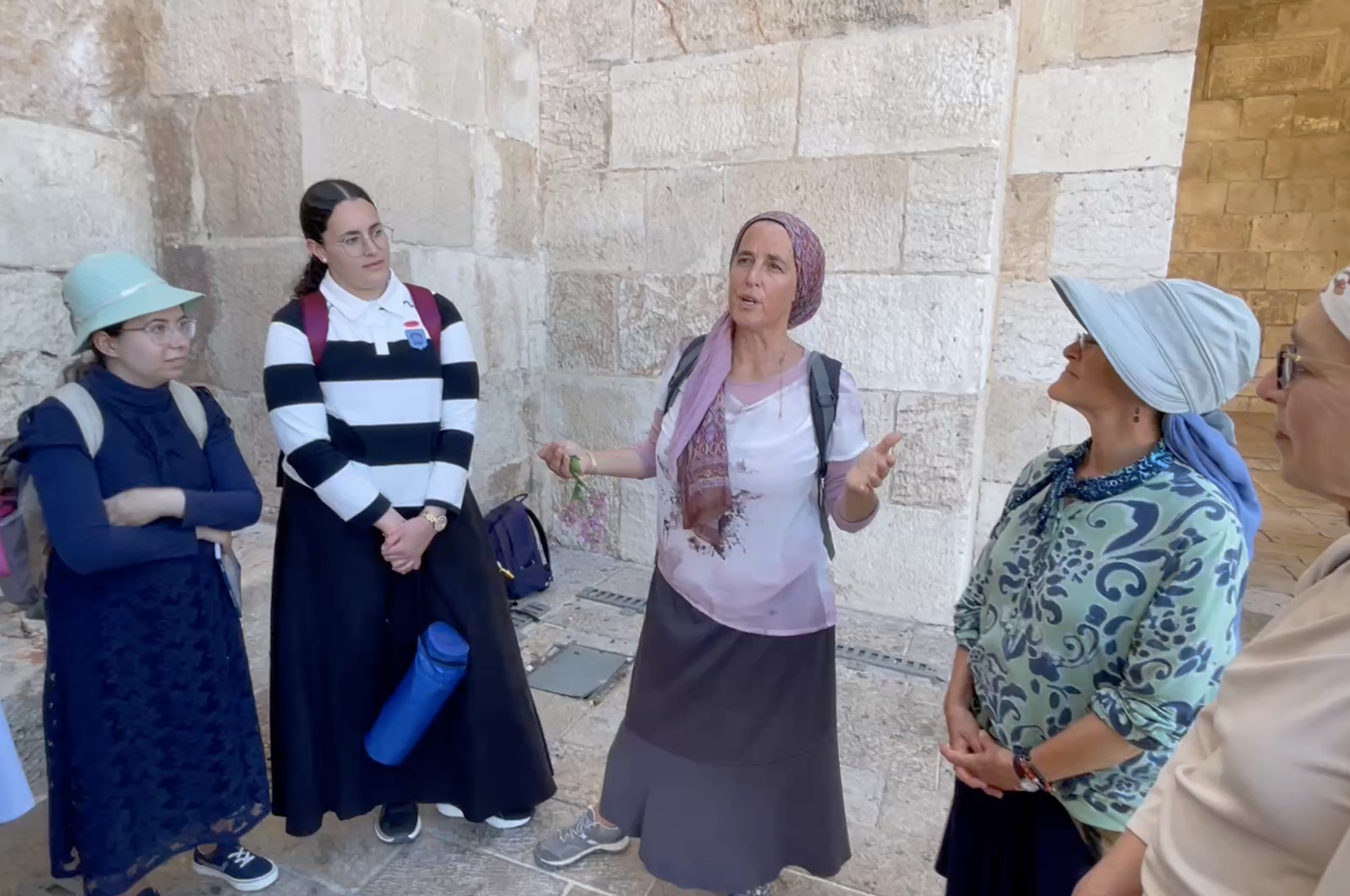
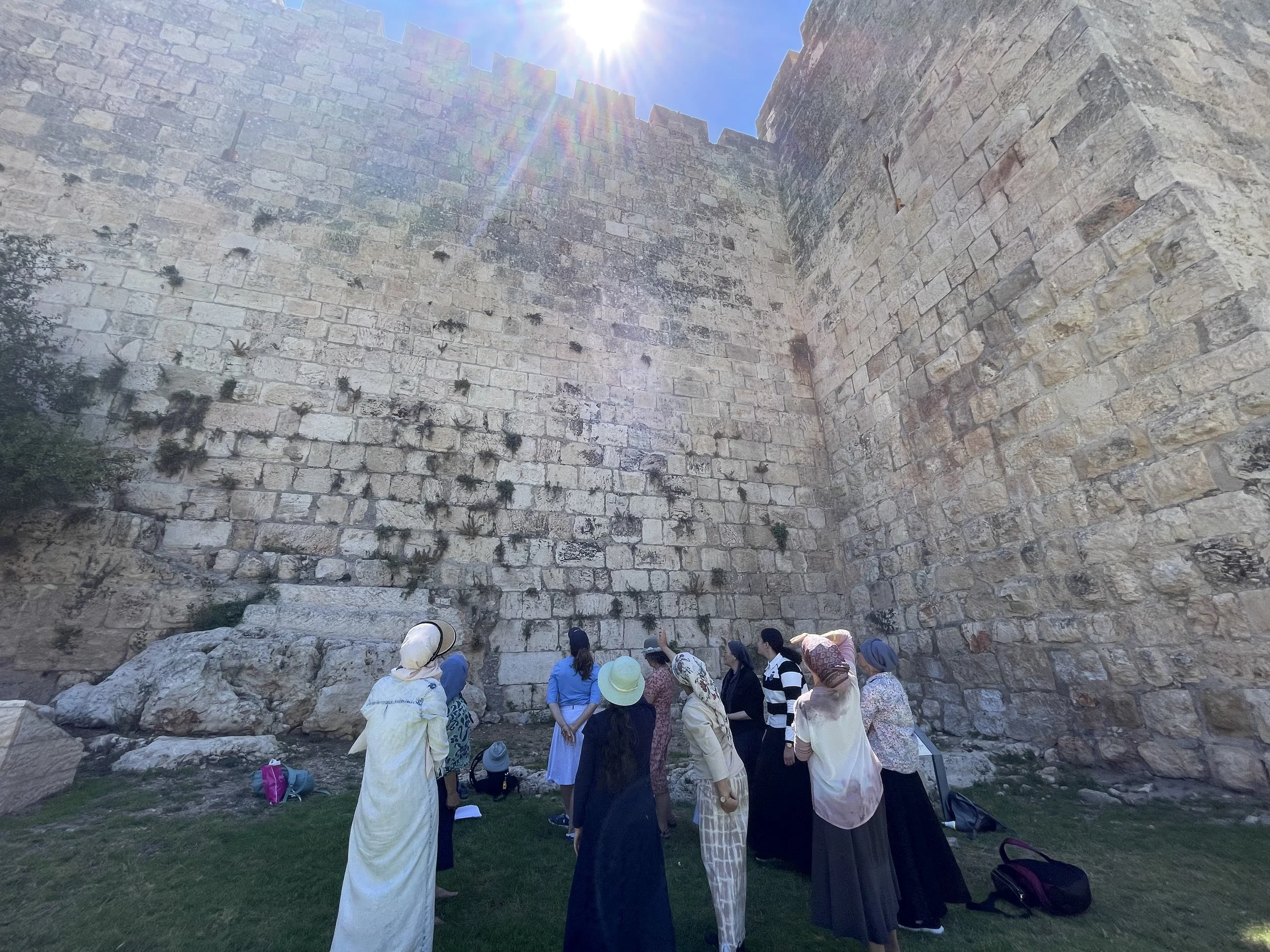
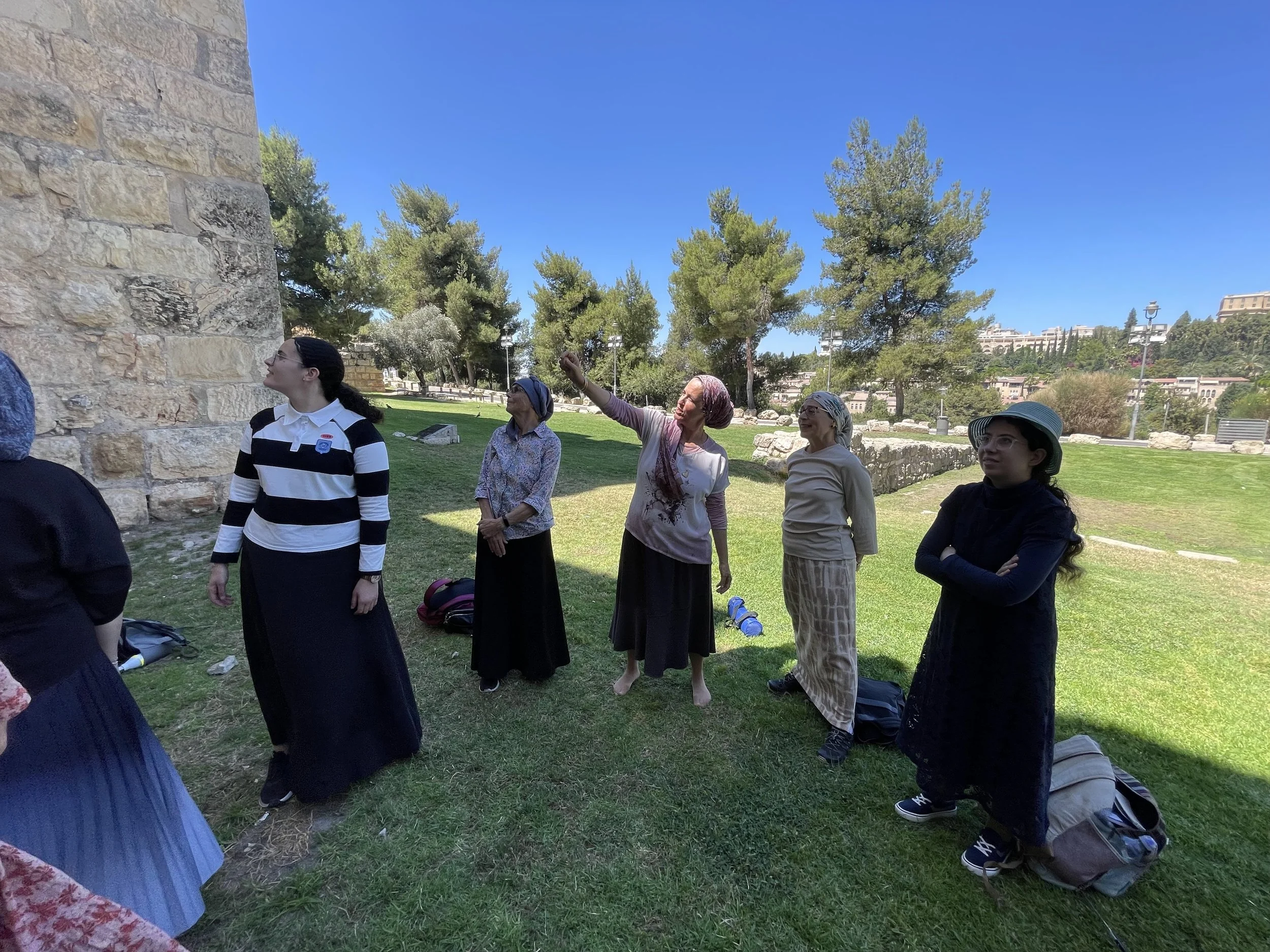
Our journey began at Sha’ar Yafo / שַׁעַר יָפוֹ (Jaffa Gate), where veteran Israeli tour guide and holistic healing therapist Maskit Ben-Moshe welcomed us into the story of the city. Rather than presenting history as something confined to the past, Maskit invited us to see every wall, pathway, and stone as part of an unfolding conversation spanning thousands of years. Here, archaeology is not separated from memory, nor history from hope. Every layer of Yerushalayim bears witness to destruction and rebuilding, exile and return, longing and Geula.
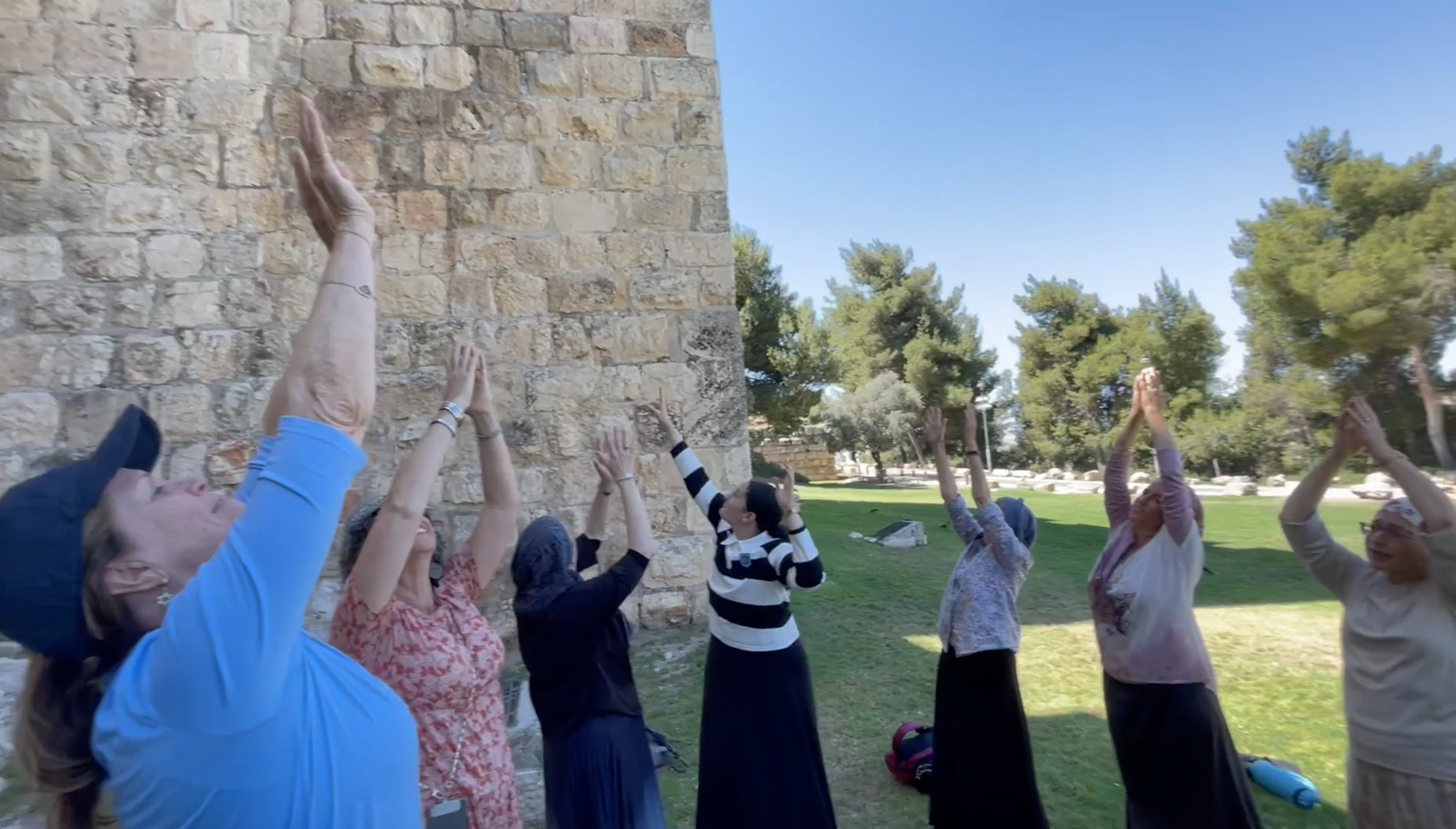
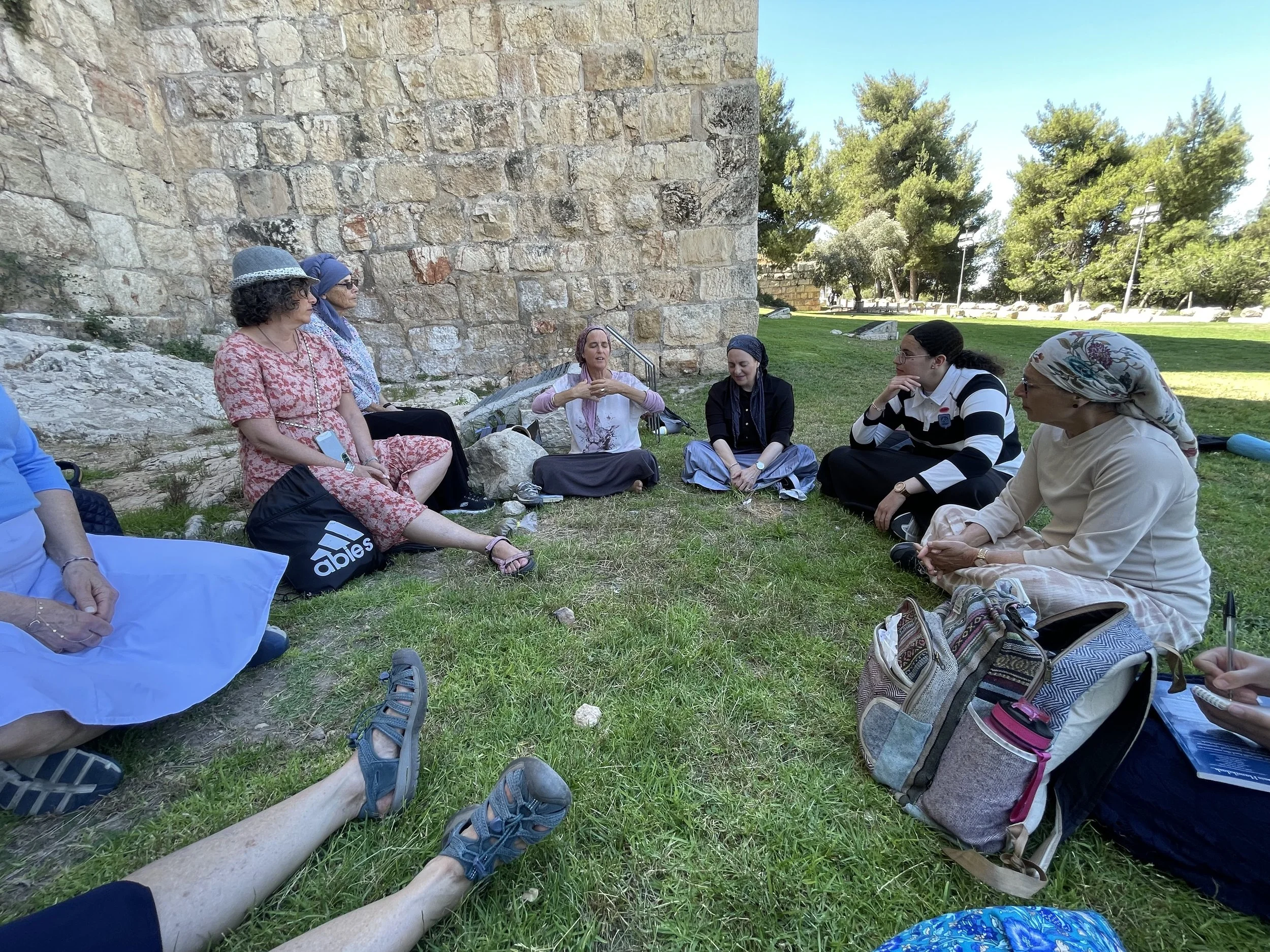
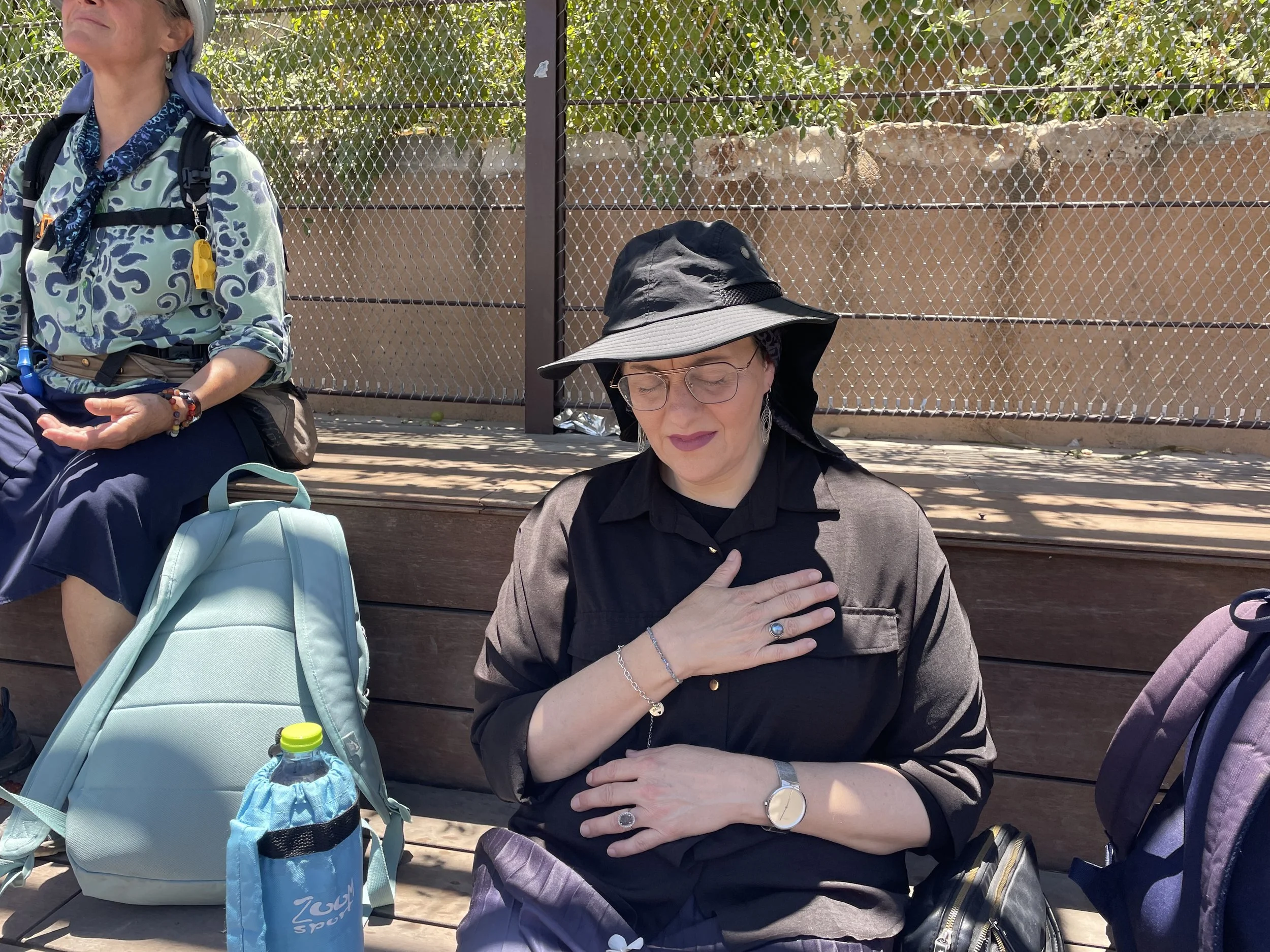
Before taking even a single step along the ancient walls, we gathered in a circle. There would be time later for walking, climbing, and discovering hidden corners of the city. First, we needed to arrive. Rachel Leah invited the women to place both feet firmly upon the Jerusalem stone, to become aware of the women standing beside them, to notice the warmth of the morning sun upon the walls, and to recognize that before entering the Yerushalayim of stone, we were first being invited to enter the Yerushalayim of the heart.
The timing itself gave the gathering a quiet depth. It was י״ד בתמוז / 14 Tammuz. The moon would be completely full that evening, radiating wholeness and completion. Yet only days later we would enter the narrowing days of בֵּין הַמְּצָרִים / Bein HaMetzarim, when Am Yisrael remembers the breaches in the walls of Yerushalayim and the destruction of the Beit HaMikdash. Fullness and brokenness stood side by side. Light and longing occupied the same moment. The day itself became an invitation to discover that these apparent opposites often live together within our own lives.
Drawing upon the teaching of Chazal that Tzion must be sought, Rachel Leah invited the group to become דּוֹרְשׁוֹת צִיּוֹן / Dorshot Tzion—women who actively seek Tzion. Not tourists passing through a holy city, but seekers willing to enter into relationship with her. Seeking, she suggested, is not simply looking for something that has been lost. Seeking is an expression of love. It is the willingness to continue turning toward that which continues to call us.
As the women stood quietly beneath the ancient walls, the atmosphere shifted almost imperceptibly. Conversations softened. The noise of the city receded. The walls that had watched generations of pilgrims, conquerors, dreamers, and mourners seemed once again to receive another circle of women arriving with open hearts.
No one yet knew that before the day was over we would descend into the ancient valley of Gei Ben Hinnom, cross Israel’s longest suspension bridge while singing the words of Rebbe Nachman, wander through hidden gardens bursting with new life, stand overlooking Har HaBayit from Har Tzion, rest our foreheads against the stones of the Kotel, and close beneath the full moon in a circle of song, Torah, and meditation.
For now, we simply stood together at the gate.
Because every meaningful journey begins long before the first step is taken.
It begins with the willingness to arrive.
2
אֶבֶן / Even — Stone: Building the Wall Together
As we began walking alongside the outer walls of the Old City, it became increasingly clear that this would not be a day of simply listening to history. Every stop would invite participation. Every landscape would ask something of us. Every encounter with Yerushalayim would become an encounter with ourselves.
Our first somatic practice began with something remarkably simple.
A stone.
Rachel Leah invited each woman to imagine herself as one of the stones of Yerushalayim.
Not an idealized stone.
A real one.
A stone shaped by years of sun and rain.
A stone that had endured seasons of rebuilding.
A stone that carried its own unique beauty precisely because of its imperfections.
One by one, the women stepped into the center of the circle.
“My name is…”
“I am a stone of Yerushalayim…”
One woman described herself as a smooth cream-colored stone that had been softened by years of weather. Another saw herself as a rough stone tucked quietly into the middle of the wall, unnoticed yet essential. One woman spoke of visible cracks that had become places where light now entered. Another felt herself to be a warm golden stone, carrying generations of tefillot within her.
After each woman shared, she added one simple movement that expressed how she was arriving that morning.
There was no choreography.
No performance.
Only presence.
Each sharing was received by the circle with the words:
“בְּרוּכָה הַבָּאָה דּוֹרֶשֶׁת צִיּוֹן.”
“Welcome, Seeker of Tzion.”
Slowly, something beautiful began unfolding.
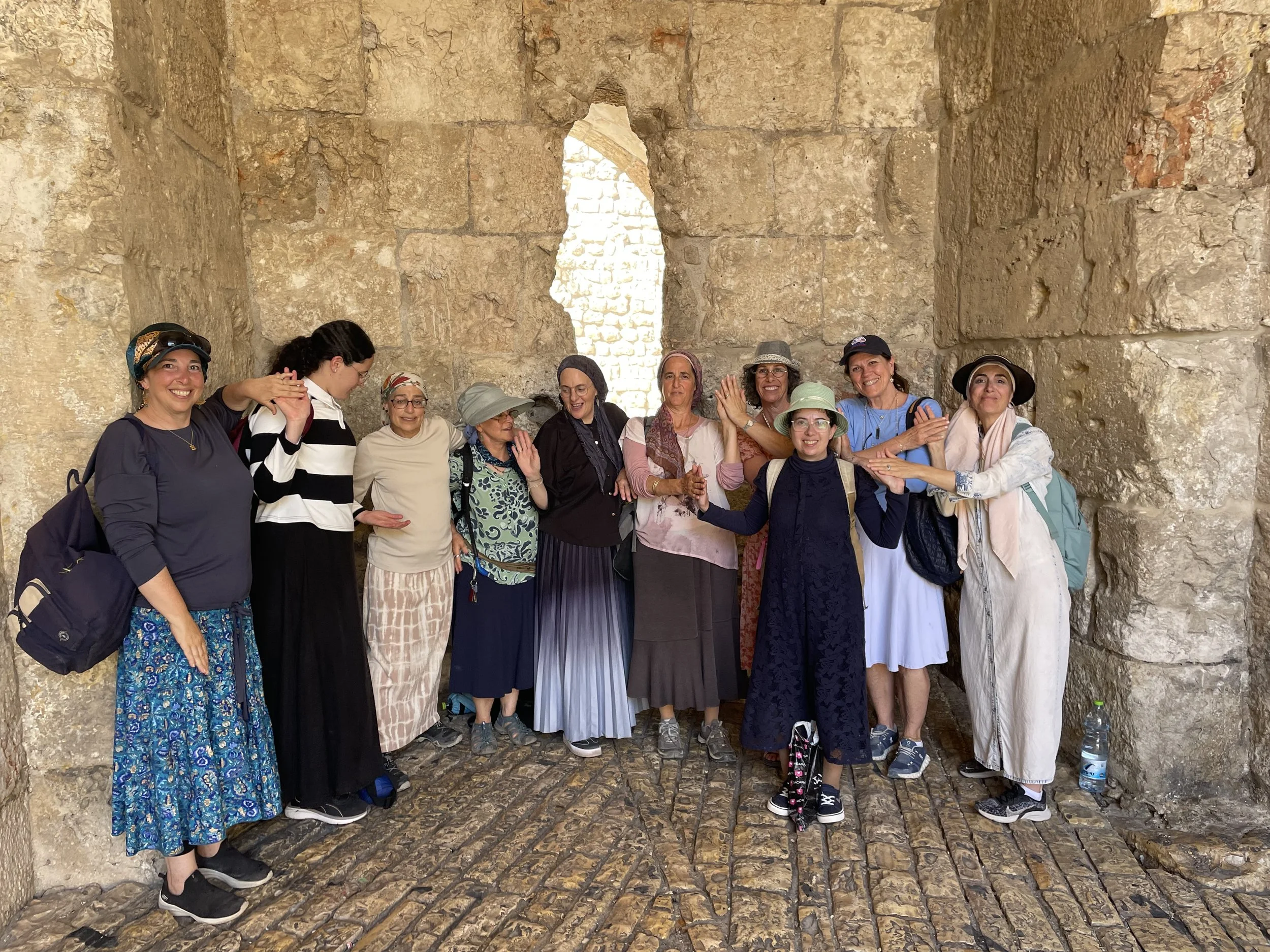
Without discussion, without planning, the women naturally stepped beside one another until the circle had quietly transformed into a living wall.
Looking across the group, it became impossible not to notice the diversity before us. Different ages. Different life stories. Different personalities. Different journeys. Like the stones surrounding us, no two women were alike.
And yet, standing together, they formed something entirely new.
Rachel Leah invited us to notice that Yerushalayim has never been built from identical stones. Some are smooth, others weathered. Some are hidden deep within the wall, while others catch the morning light. Some have remained intact for centuries, while others bear the visible marks of earthquakes, exile, and rebuilding.
Each one belongs.
That realization carried its own quiet power.
How often do we imagine that spiritual growth requires becoming someone else? Yet the walls of Yerushalayim suggest something very different. They are beautiful not because every stone is the same, but because every stone offers its own strength to the whole.
Standing there, the verse from Tehillim came alive in a completely new way:
“יְרוּשָׁלַיִם הַבְּנוּיָה כְּעִיר שֶׁחֻבְּרָה לָּהּ יַחְדָּו.”
“Yerushalayim is built as a city joined together.” (Tehillim 122:3)
“עִיר שֶׁמְּחַבֶּרֶת אֶת יִשְׂרָאֵל זֶה לָזֶה”
“the city that joins Israel one to another.” (Chagigah 3b)
Rather than merely studying those words, we were beginning to experience them.
The wall was no longer an ancient structure surrounding the Old City.
The wall had become us.
From there, the practice deepened.
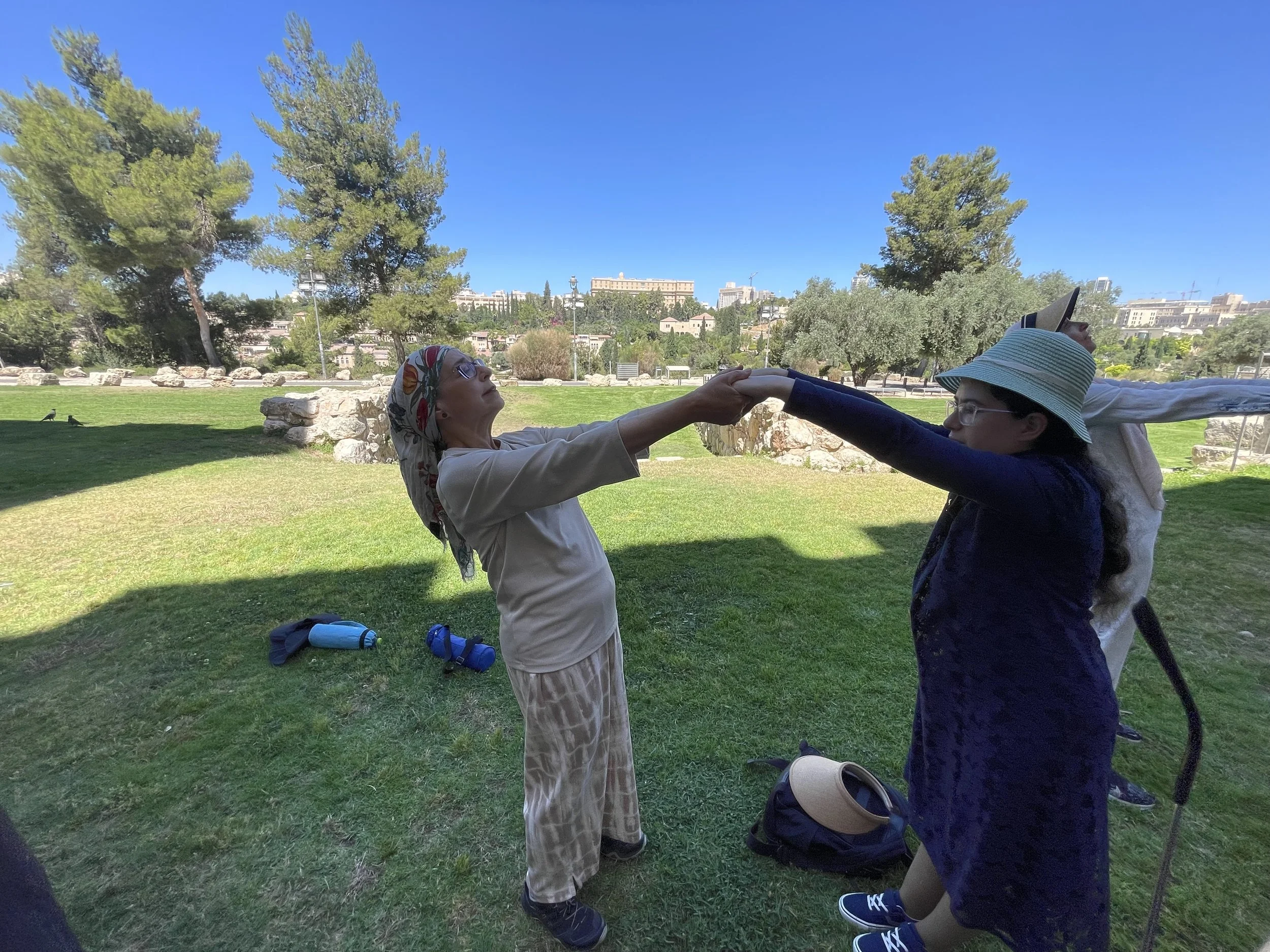
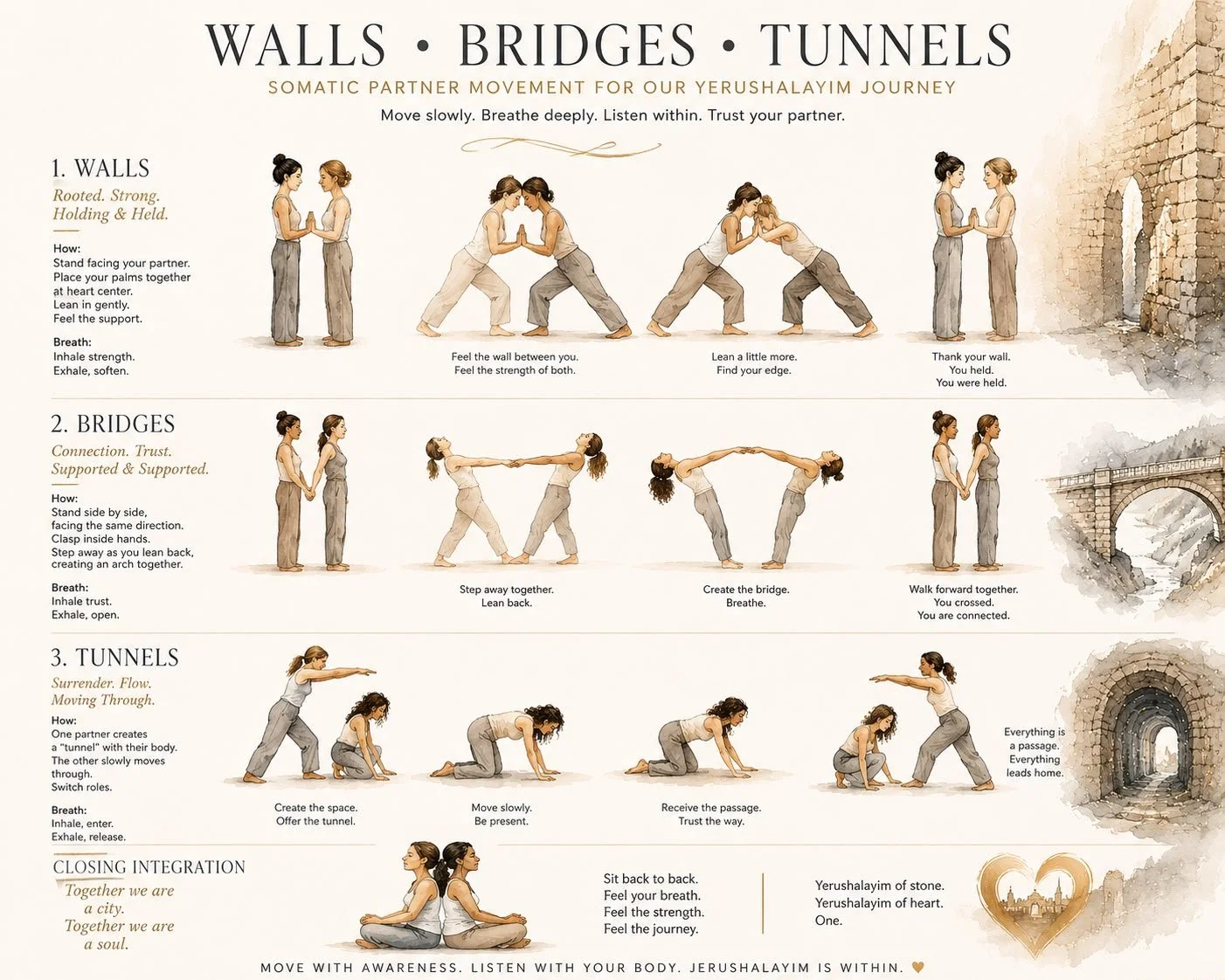
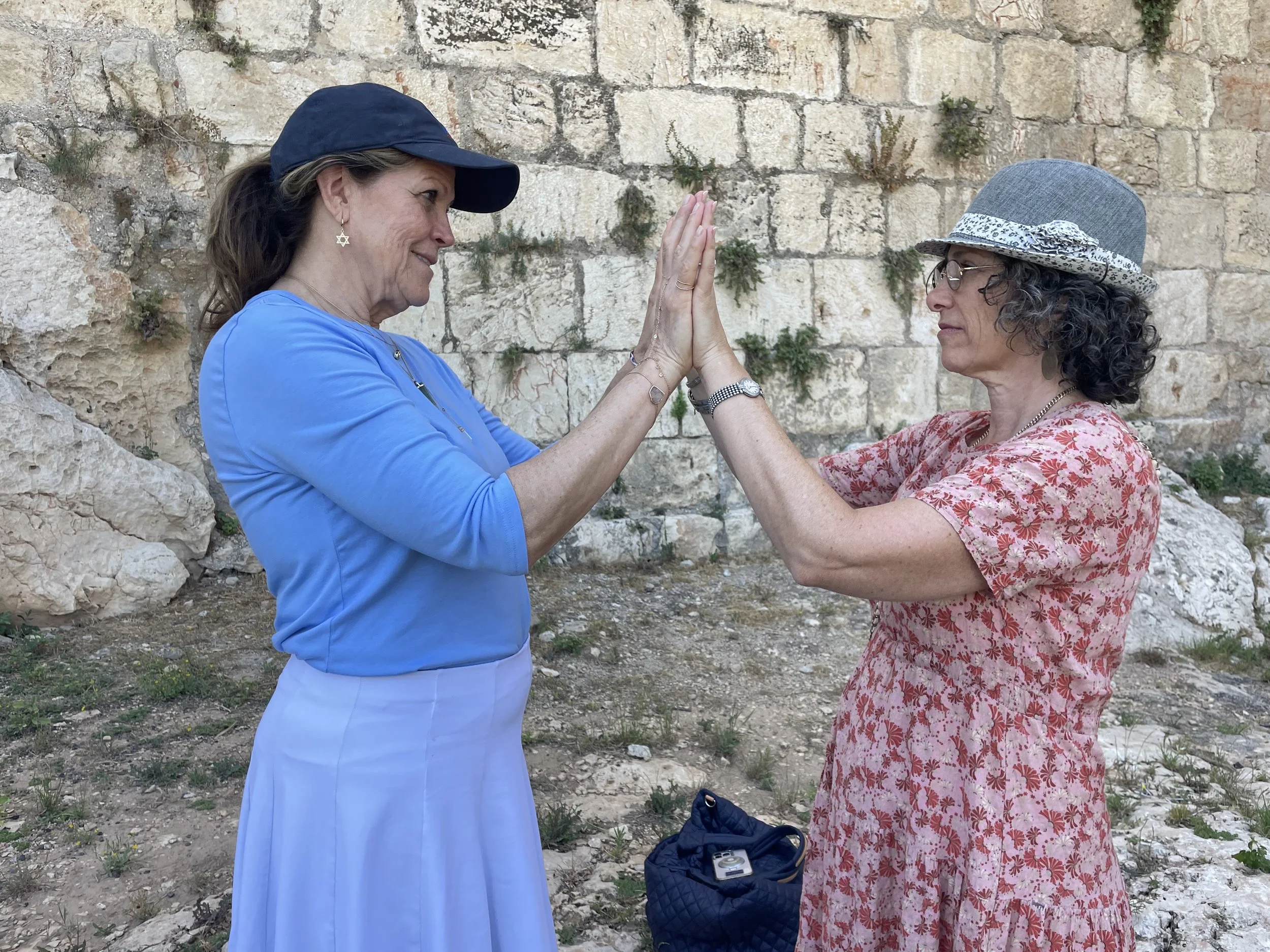
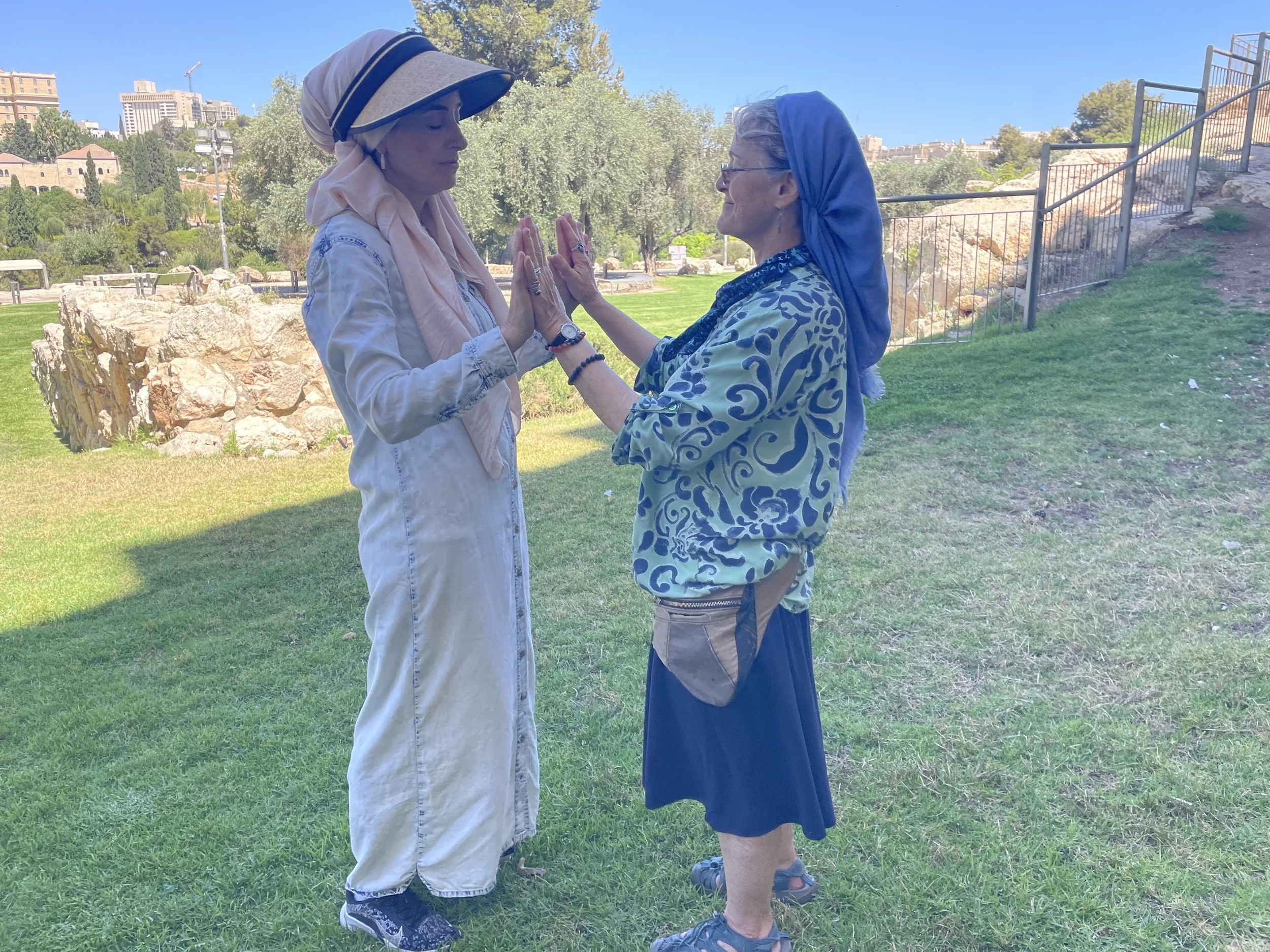
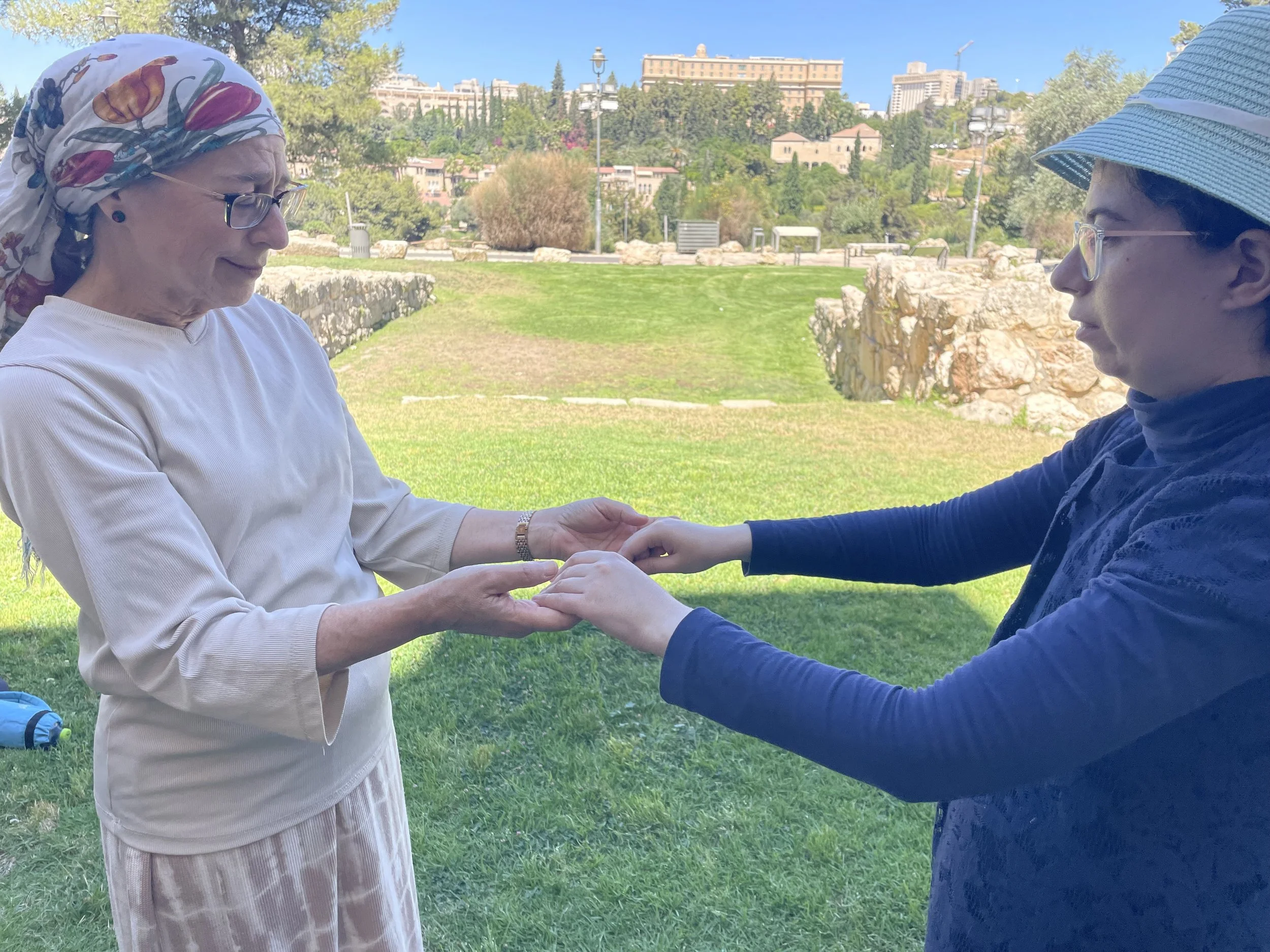
Working in pairs, each woman stood facing another. At first, we embodied a wall. We explored what it felt like to offer steadiness, to lean gently into one another, to feel both support and resistance. There was an invitation to notice our own boundaries—not as barriers that separate us, but as healthy structures that allow relationship to flourish.
Then something unexpected happened.
The wall softened.
Without losing its strength, it began to change shape.
Two women slowly opened space between them.
The wall became a bridge.
The bridge widened into an archway.
The archway became a שַׁעַר / Sha’ar—a gateway.
It was one of those rare moments when a teaching moved beyond words and settled directly into the body.
Later that evening, several women would say that this simple exercise remained with them throughout the entire journey. Every wall we encountered for the rest of the day—the ancient city walls, the supporting walls of Har HaBayit, even the walls we carry within ourselves—was now seen differently.
Perhaps, we reflected together, the purpose of a healthy wall is not to remain permanently closed.
Perhaps every wall carries within it the possibility of becoming a gateway.
It was a fitting way to begin our preparation for בֵּין הַמְּצָרִים / Bein HaMetzarim. During these weeks we remember breached walls and destroyed buildings, yet we are also invited to ask what is waiting to be rebuilt. Before we explored the walls of Yerushalayim, we first allowed the walls within us to soften—not by abandoning their strength, but by discovering how strength itself can become an opening.
Only then did we continue walking.
Ahead of us lay one of the city’s hidden treasures: a passageway carved through stone where the many names of Yerushalayim would illuminate our next stage of the journey.
3
מַעֲבָר / Ma’avar — Entering the Hidden
Leaving the openness of the outer walls, we stepped into one of Yerushalayim’s hidden passageways. It was as though the city herself was inviting us to move inward. Throughout the morning we had walked beside her walls, learning to see them not only as ancient fortifications but as symbols of belonging, protection, and relationship. Now the landscape shifted. We were no longer walking beside Yerushalayim. We were entering within her.
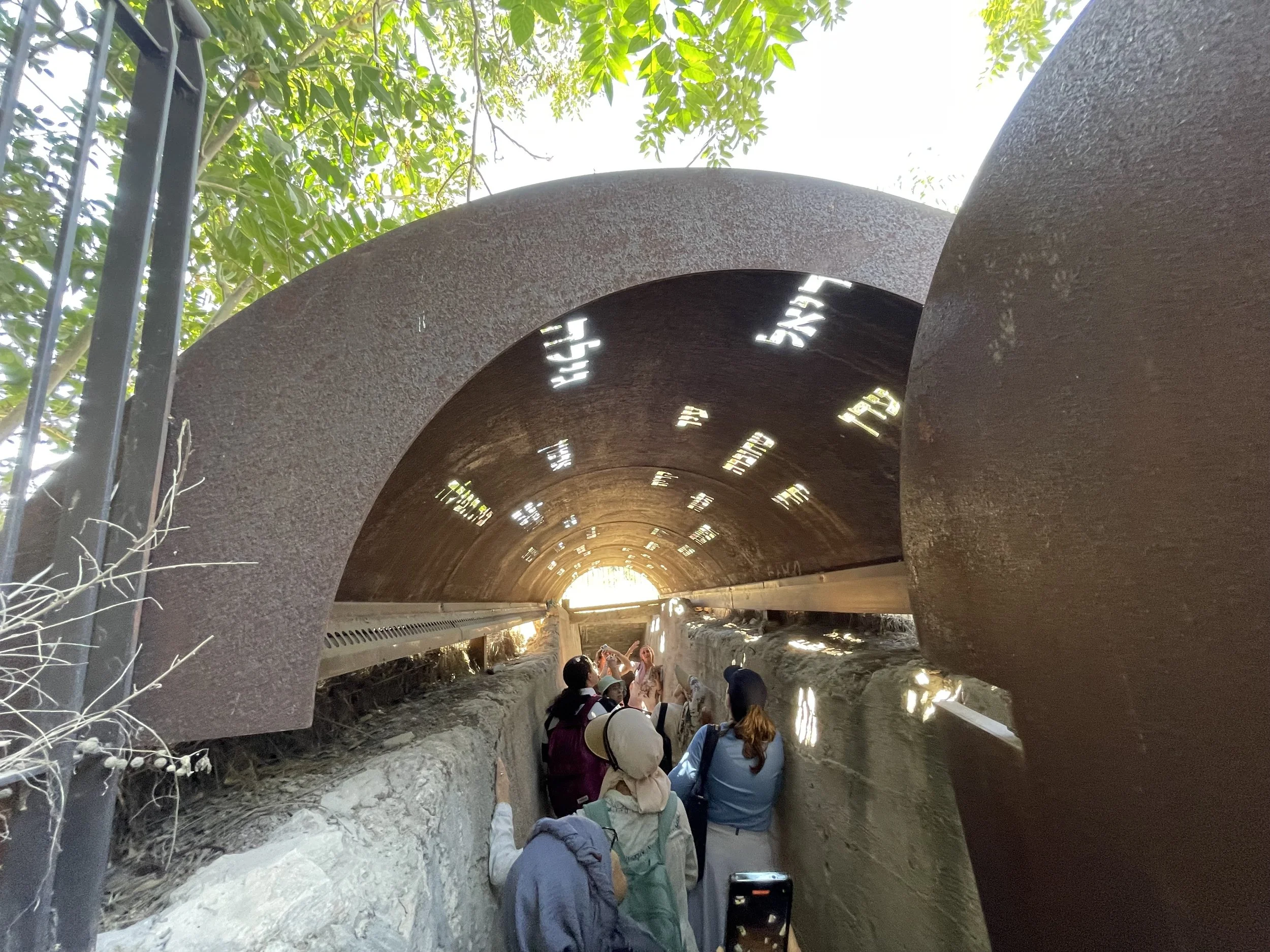
Maskit paused before we entered the passage and shared its history. During times of siege, this trench served as a protected route through which food, medicine, and hope could continue reaching the city. What had once been carved out of necessity has since been transformed into a place of beauty and remembrance. Today, natural light pours through carefully designed openings above, illuminating the many names of Yerushalayim carved into the stone walls.
The transformation itself became part of the teaching.
A place once associated with survival had become a place of illumination.
A passage once shaped by darkness now welcomed light.
We instinctively slowed our pace.
No one hurried ahead.
The sounds of the city faded behind us as shafts of sunlight danced across ancient limestone, bringing each carved Hebrew name gently into view. Hands reached out to touch the cool stone. Some women paused in silence before a particular name. Others simply stood and allowed themselves to receive the quiet that filled the passage.
Maskit reminded us throughout the day that the landscapes of Eretz Yisrael are never merely places to visit. They are living chapters in the unfolding story of Am Yisrael. Every pathway, every valley, every stone remembers. Every generation enters into an ongoing conversation that began long before us and, with Hashem’s help, will continue long after us.
The many names of Yerushalayim revealed something similar.
No single name can contain her.
She is צִיּוֹן / Tzion.
עִיר דָּוִד / Ir David.
עִיר הַקֹּדֶשׁ / Ir HaKodesh.
עִיר הַשָּׁלוֹם / Ir HaShalom.
Each name reflects another relationship, another פנים / panim, another way of encountering the city. Like the women walking together that day, Yerushalayim cannot be reduced to a single story. She continues revealing herself according to the openness of the one who seeks her.
שְׂדֵי יַעַר / Sedei Ya’ar.
Before there was a city crowned with walls…
before kings…
before the Beit HaMikdash…
there was simply a field.
A landscape carrying within it a future that had not yet become visible.
Standing there, surrounded by names that have accompanied Yerushalayim throughout her long history, it was impossible not to reflect on our own lives. How often do we find ourselves in seasons that seem unfinished? Seasons when the next chapter has not yet revealed itself? We long to understand where we are going, while the soul quietly continues its work beneath the surface.
Perhaps becoming always begins in hidden places.
Perhaps what appears incomplete is simply still unfolding.
Later, one of our participants, Leah Friedman, found words that beautifully expressed what many of us had been experiencing.
“The walls carried something ancient. Not only history. Presence. Something rebuilt again and again. Breakage and rebuilding. And still it stands.”
Her reflection captured something essential about Yerushalayim.
She does not erase her history.
She carries it.
Every conquest.
Every return.
Every destruction.
Every rebuilding.
Stone upon stone.
Generation upon generation.
The light filtering through those carved names did not hide what the passage had once been. Instead, it revealed one of the deepest qualities of Yerushalayim herself: the capacity to transform places once marked by constriction into places that reveal new light.
As we emerged once again into the bright morning air, we sensed that we had crossed more than a physical passageway.
Without realizing it, we had begun moving from the outer landscape into the inner one.
Ahead of us lay גֵּיא בֶן הִנֹּם / Gei Ben Hinnom, a valley whose name has long been associated with darkness and idolatry. Yet, as Maskit had gently hinted, we were about to discover that one of the greatest teachings of Eretz Yisrael is that even the places carrying the deepest memories of concealment can become places where new life quietly begins to grow.
4
גֵּיא בֶן הִנֹּם / Gei Ben Hinnom — Where the Valley Blossoms
Emerging from the quiet intimacy of the tunnel, we found ourselves standing once again beneath the expansive sky of Yerushalayim. The ancient walls that had accompanied us throughout the morning now receded gently behind us, while before us the landscape opened into one of the city’s oldest and most evocative valleys. The path curved downward toward גֵּיא בֶן הִנֹּם / Gei Ben Hinnom, inviting us to descend gradually into a place whose name has echoed through Tanach, Midrash, and the collective memory of Am Yisrael for millennia.
There is something profoundly different about learning history while standing within the landscape where it unfolded. The contours of the hills, the terraces carved into the slopes, the limestone cliffs catching the morning light, even the silence that settled naturally over our group—all of it seemed to dissolve the distance between past and present. Here, history is never merely remembered. It remains embedded within the earth itself, waiting patiently for those willing to slow their pace and listen.
Gathering beneath the generous canopy of an old tree, we formed another circle around Maskit. Throughout the day she possessed the rare gift of allowing the Land to speak before she did. Rather than overwhelming us with dates or historical details, she opened gentle windows through which the landscape gradually revealed its own story. Standing there, overlooking the valley below, she shared how this place had once become synonymous with one of the darkest periods in the spiritual history of Yerushalayim. Here, during the days of the First Beit HaMikdash, children were offered to Molech. Here, covenant gave way to idolatry. Here, a valley became a symbol of what can happen when a people lose sight of the relationship that has always defined them.
As we listened, our eyes continued wandering across the landscape before us.
Nothing we saw matched the images our minds had imagined.
Instead of desolation, there was abundance.
Instead of emptiness, there was movement.
Instead of silence born of abandonment, the valley pulsed gently with life.
The contrast was almost startling.
Children’s voices drifted upward on the breeze. Birds moved effortlessly between ancient olive trees whose roots had quietly embraced these hillsides for generations. Wildflowers emerged from the cracks between limestone rocks, while terraces that once lay neglected now overflowed with cultivated gardens. Every direction we turned revealed another expression of renewal, as though the valley itself had been patiently waiting to tell a different story.
Rachel Leah invited us simply to remain with what we were seeing.
“There is no need to rush toward an interpretation,” she said softly. “Just allow yourselves to notice.”
Sometimes the deepest teachings do not arrive through explanation.
Sometimes they arise when we are willing to let the landscape speak first.
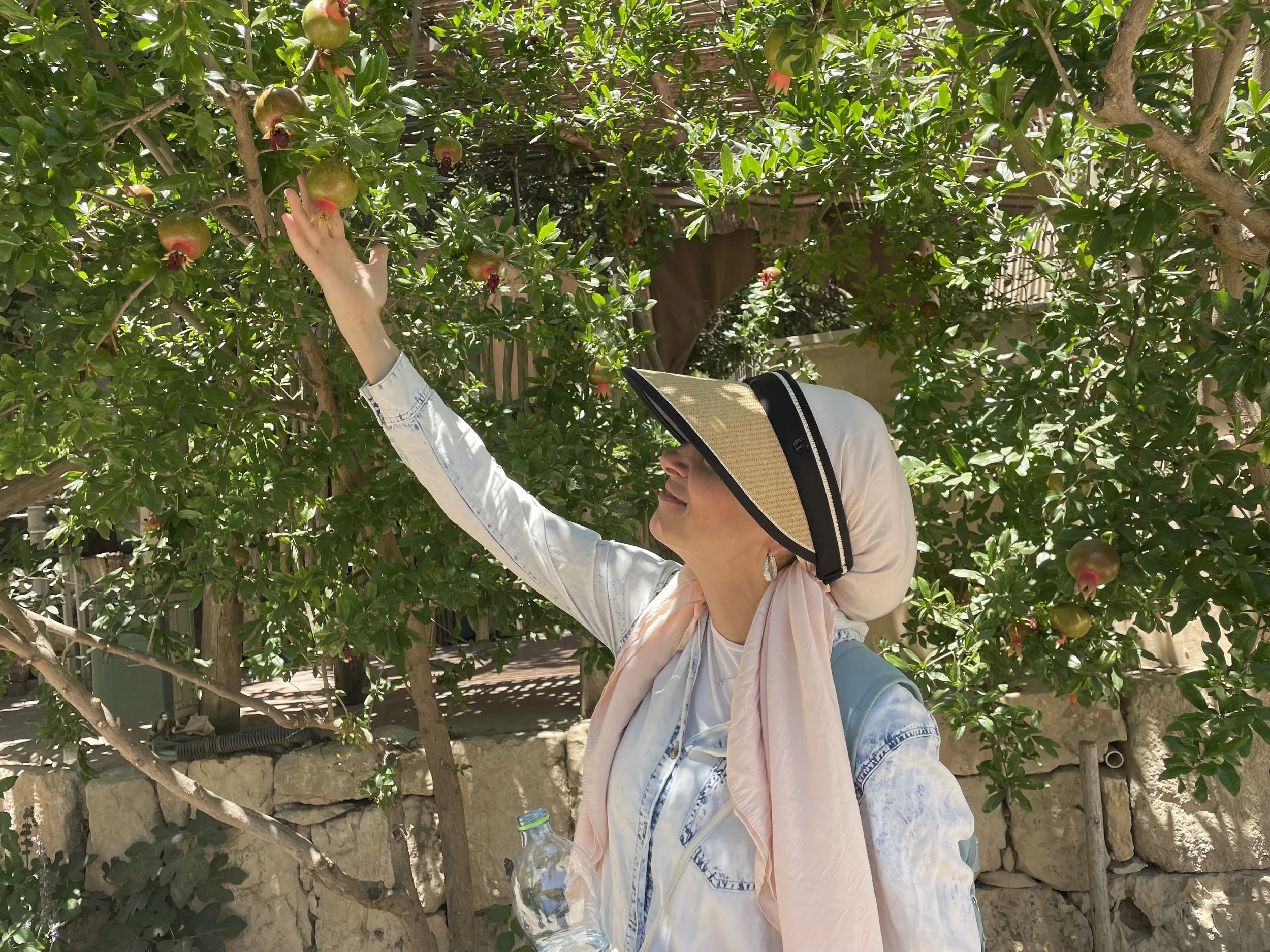
Continuing our descent, we entered a flourishing ecological garden nestled within the valley. Rows of vibrant strawberry plants stretched before us, their brilliant red fruit glowing against rich green leaves. Towering sunflowers turned gracefully toward the morning sun, while herbs, fruit trees, and ancient olive presses reminded us that this valley has always held the possibility of nourishment. Water flowed quietly through carefully restored channels, and shaded pathways invited us to linger rather than continue onward.
It was impossible not to marvel at the extraordinary juxtaposition unfolding before our eyes.
The very place that generations had associated with darkness had become a place overflowing with life.
Maskit paused again, this time not to recount ancient history but to share a memory of her own. Years ago, when she lived overlooking this valley from near Kever David HaMelech, Gei Ben Hinnom was almost unrecognizable from what stood before us today. Dense weeds covered the hillsides. The area felt neglected and unsafe, and few people chose to walk through it. Crossing the valley required both determination and caution, and it was difficult to imagine families ever wandering here for enjoyment.
As she spoke, many of us instinctively looked back across the landscape.
Children now wandered freely through the gardens.
Families explored the walking paths.
The hillsides had been lovingly restored.
And spanning the valley in elegant simplicity stood the suspension bridge we would soon cross together.
It was impossible not to feel that we were witnessing far more than urban renewal.
We were witnessing one expression of Geula.
Not as an abstract theological concept.
Not as a distant hope. But as something quietly unfolding within the very landscape of Eretz Yisrael.
One of the women turned toward the group, her eyes filled with wonder.
“We’re standing inside the story,” she whispered.
Her words settled over us with surprising depth. For a long moment, no one responded.
Nothing needed to be added. The valley itself had already become the teacher.
Rachel Leah gently offer one final reflection before we continued our walk.
“So often,” she said, “we imagine that healing means leaving our valleys behind. There is another possibility. The deepest transformations do not happen by escaping the valley, but by allowing Hashem to bring forth new life within it.”
Standing together in Gei Ben Hinnom, surrounded by gardens, flowing water, ancient stone, and the unmistakable signs of renewal, those words no longer felt like an idea.
They felt visible. Almost tangible.
Preparation for בֵּין הַמְּצָרִים / Bein HaMetzarim suddenly took on a different texture. We were not only remembering places that had once known destruction. We were standing in one such place, witnessing with our own eyes how Hashem continues to draw צְמִיחַת חַיִּים / Tzemichat Chayim, new life, from the very places where darkness once seemed to have the final word.
As we resumed walking, our eyes were gradually drawn upward. High above the valley, suspended gracefully between two hillsides, stretched Israel’s longest suspension bridge.
Some women smiled with anticipation. Others instinctively grew quiet. Without a word being spoken, we sensed that the next stage of our journey would not simply ask us to cross a bridge.
It would invite each of us to cross something within ourselves.
5
גֶּשֶׁר / Gesher — Between Heaven and Earth
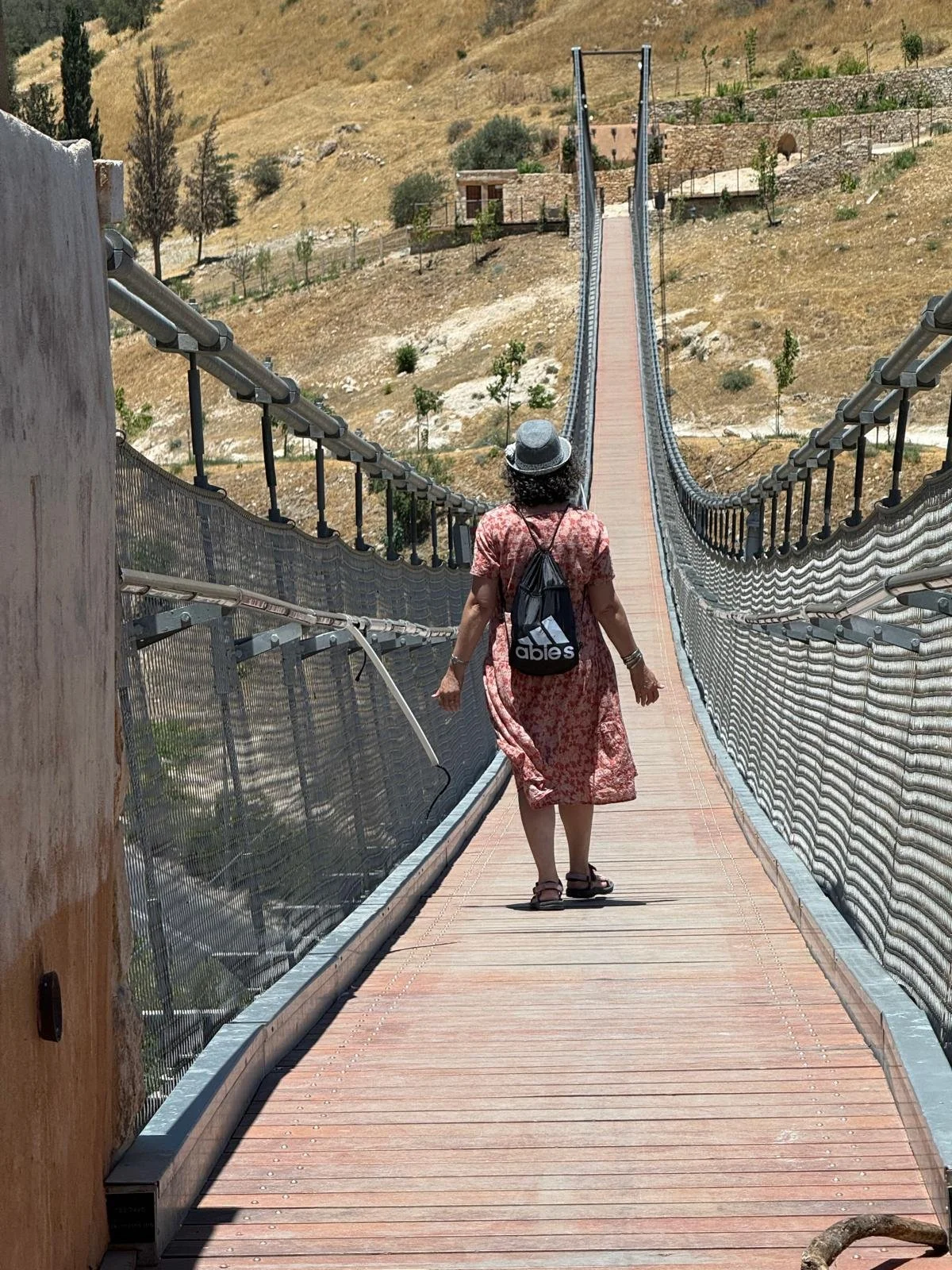
The suspension bridge did not suddenly appear before us. Long before we reached it, we found ourselves looking toward it, almost unconsciously. Suspended gracefully above גֵּיא בֶן הִנֹּם / Gei Ben Hinnom, it stretched from one hillside to the other with a remarkable lightness, as though floating between earth and sky. From a distance it seemed delicate, almost effortless. Only as we drew closer did its true scale become apparent. Nearly two hundred and twenty metres in length, Israel’s longest suspension bridge stood quietly before us, inviting each woman into a journey that would prove to be far more than a physical crossing.
The atmosphere within the group began to change almost imperceptibly. Conversation softened. Some women gazed ahead with excitement, eager to step onto the bridge, while others instinctively slowed their pace. A few admitted they had never crossed a suspension bridge before. Others quietly acknowledged that heights awakened something deep within them. Without anyone naming it, the bridge had already begun revealing what each woman carried long before she set foot upon it.
Rather than continuing straight ahead, Rachel Leah invited us to pause. Throughout the day, these moments of stopping became as important as the walking itself. Before every major transition, we first learned how to arrive. Standing together at the entrance to the bridge, we turned and looked back over the path we had already travelled. Behind us lay the ancient walls of Yerushalayim, the hidden passageway of the city’s many names, and the valley that had surprised us with its flourishing gardens and unmistakable signs of renewal. Ahead lay only the bridge, stretching into open space.
“We spend so much of life here,” Rachel Leah reflected gently, “between where we have been and where we are going.”
Her words settled naturally into the silence.
The bridge was no longer simply a structure connecting two hillsides. It had become a סַף / saf, a threshold. A place of מַעֲבָר / ma’avar, transition. The place where one chapter has ended, another has not yet begun, and we are asked to trust the space in between.
Rachel Leah then shared a memory from her freshman year as an art student in New York City. One of her professors had brought the class to the Brooklyn Bridge, asking them to cross it while reading Walt Whitman’s Crossing Brooklyn Ferry. More than forty years had passed, yet she still remembered the experience vividly. Certain crossings, she reflected, remain with us long after we have forgotten the details. Something becomes written into the body. The crossing itself quietly continues its work for years to come.
That memory opened the space for a different conversation.
“What happens,” she asked, “when fear appears?”
Not as a problem to solve.
Not as an obstacle to overcome.
Simply as another companion on the journey.
There was something profoundly liberating in the invitation. No one was asked to suppress fear in order to continue. No one needed to pretend to be courageous. Instead, we were encouraged to acknowledge whatever was present with tenderness and curiosity. If a fearful part of ourselves appeared, it too was welcome to cross the bridge.
Only then did we begin to walk.
Our footsteps settled into a gentle rhythm as the bridge responded almost imperceptibly beneath us. Suspended high above the valley, surrounded by the sweeping hills of Yerushalayim, we began singing together the familiar words of Rebbe Nachman:
“כָּל הָעוֹלָם כֻּלּוֹ גֶּשֶׁר צַר מְאֹד, וְהָעִקָּר לֹא לְפַחֵד כְּלָל.”
“The whole world is a very narrow bridge, and the essential thing is not to fear.”
How differently those words sounded while standing upon an actual bridge. They were no longer an inspiring teaching remembered from childhood. They became the cadence of our footsteps, the rhythm of our breathing, and the quiet reassurance we offered one another with every step forward.
Halfway across, the bridge offered us one of the day’s most unforgettable moments.
One of the women was working on facing her fear of bridges. Instantly, without discussion or instruction, the group responded. Women gathered gently around her, forming a close circle in the middle of the bridge itself. Arms reached toward one another. Voices continued singing softly. No one urged her to hurry. No one encouraged her simply to push through. Together we breathed. Together we stood. Together we waited until she herself felt ready to continue.
It was an extraordinary expression of what had been quietly growing among us since the opening circle beside the city walls. Earlier that morning we had learned that Yerushalayim is built from many different stones, each supporting the other. Now that teaching had become embodied. No woman crossed the bridge alone. The strength of the group became the strength of each individual within it.
Later, participant Leah Friedman would describe that moment with remarkable clarity.
“Perhaps,” she wrote, “I have never been afraid of bridges. Perhaps I have been afraid of transition. Of not knowing what holds me when the ground disappears.”
Her insight resonated deeply with the women who shared the journey. She continued:
“Sometimes Hashem’s help does not remove the fear. It holds us inside it.”
Those words captured something that no teaching could have conveyed so completely. The bridge had not eliminated uncertainty. It had revealed another possibility altogether—that fear and trust are not always opposites. Sometimes they walk together. Sometimes the deepest expression of emunah is not the absence of fear, but the willingness to continue taking the next step while discovering that we are being held.
As we reached the opposite side, almost everyone instinctively turned around. The valley had not changed. The bridge remained suspended exactly where it had always been. Yet something within us had shifted. We had crossed far more than the distance between two hillsides. Somewhere between our first tentative steps and our final ones, the bridge had quietly become our teacher, revealing that some journeys are measured not by the ground we cover, but by the consciousness we carry when we arrive on the other side.
6
הַר צִיּוֹן / Har Tzion — Looking Toward the Future
Stepping off the bridge, we did not leave the experience behind us. If anything, the crossing had quieted something within each of us. Conversation resumed gradually as we began the steady ascent toward הַר צִיּוֹן / Har Tzion, our footsteps following ancient pathways that have carried countless generations of pilgrims making their way toward one of Yerushalayim’s most cherished places.
The climb invited a different rhythm.
No longer suspended between earth and sky, we felt the firmness of the stone beneath our feet once again. Every few moments someone would pause, not from exhaustion, but because another breathtaking view demanded our attention. Behind us, the suspension bridge now seemed impossibly delicate, tracing a graceful line across the valley we had just crossed together. Before us, the rooftops of the Old City rose higher with every step, drawing our eyes toward the skyline that has shaped the dreams and tefillot of Am Yisrael for centuries.
Har Tzion has always occupied a unique place within the story of Yerushalayim. Maskit lead our jouney here with history and longing, side by side. Here, kings once walked, people coming for Shalosh Regalim ascended, and generations continued to face toward a place they could not always reach. The stones themselves seem to carry that quiet longing with remarkable dignity, never hurried, never diminished, simply waiting with the patience that only Yerushalayim seems to possess.
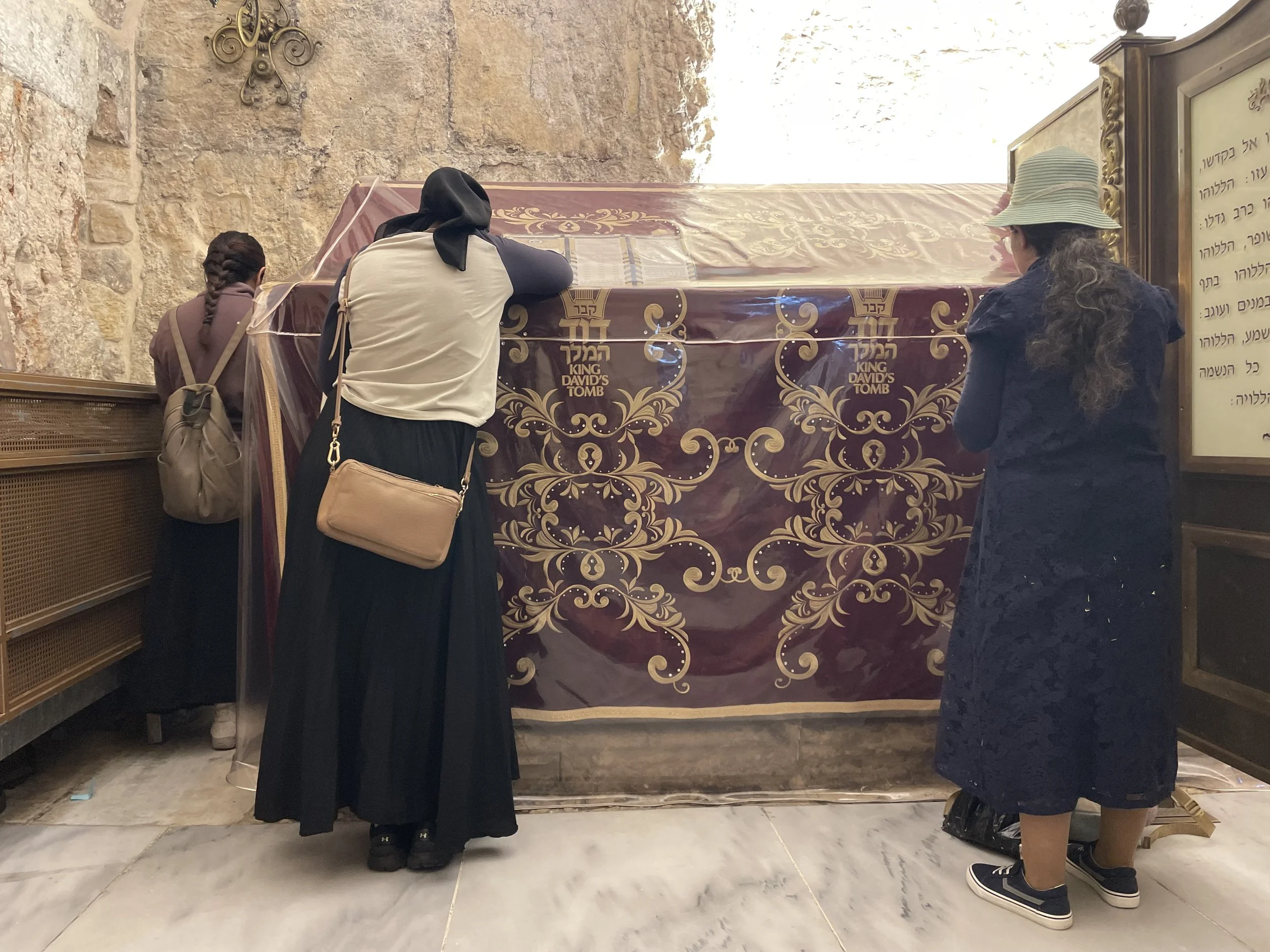
Standing near Kever David HaMelech, our attention naturally turned toward Har HaBayit. From this vantage point, the relationship between the two mountains becomes almost tangible. One does not simply look across a valley. One looks across history.
Rachel Leah shared a conversation she had once had with several elderly women of Yerushalayim. As young girls, they told her, their fathers and grandfathers would bring them to this very place. During the years when Har HaBayit remained beyond Jewish hands, they would stand here quietly, gazing across the distance toward the place their hearts never ceased yearning for. They could not enter. They could only look. Yet that looking itself became an act of emunah, an expression of hope passed faithfully from one generation to the next.
Then came 1967. Some women spoke of the overwhelming emotion they experienced when the Old City was reunited and Har HaBayit once again returned to the hands of Am Yisrael. Their memories were not told as historical milestones. They were shared as deeply personal moments, stories carried within families, where the dreams of grandparents became the lived reality of their children and grandchildren.
As we listened, the view before us changed.It was no longer simply beautiful. It became deeply personal.
Standing there, it was impossible not to feel ourselves woven into a story far larger than our own individual lives. We were looking upon the same hills, the same valleys, the same skyline that generations before us had looked toward with longing. The difference was that we stood there today able to witness what so many had only dreamed of.
One of the women quietly broke the silence. “I feel so grateful to be living in this generation.”
Several others nodded. Nothing more needed to be said. Gratitude has a way of silencing unnecessary words.
Throughout the day, Maskit had gently drawn our attention not only to what had happened in these places, but to what is continuing to happen. Geula is not experienced only through dramatic historical moments. It unfolds quietly, almost imperceptibly, in restored pathways, renewed neighbourhoods, flourishing gardens, children playing where previous generations feared to walk, and women from around the world gathering to study Torah while overlooking Har HaBayit.
Seen through those eyes, every step became an invitation to notice. Not only what has been rebuilt. But what continues to be rebuilt.
This, perhaps, is one of the quiet gifts of walking through Yerushalayim rather than simply visiting her. The city gently expands our field of vision. She teaches us to look beyond isolated moments and begin noticing the larger movement unfolding across generations. The view from Har Tzion is therefore not merely geographical. It offers perspective. It reminds us that Hashem’s story with Am Yisrael has always unfolded over time, inviting patience alongside hope, and longing alongside gratitude.
Before continuing, we remained there together for several more moments. No one reached immediately for a camera. No one hurried to the next destination. The view itself invited stillness.
It was as though Yerushalayim was quietly asking us to remember that Geula is not only something we anticipate.
Sometimes, if we are willing to pause long enough, we discover that we are already standing within it
7
אֶבֶן / Even — When the Stones Begin to Breathe
By the time we arrived at the Western and Southern supporting walls of Har HaBayit, something within us had already begun to slow. We were no longer moving through Yerushalayim as visitors making our way from one landmark to the next. The city herself had gradually become our guide. The walls, the tunnel, the valley, the bridge, and the ascent to Har Tzion had quietly reshaped the rhythm of the day, preparing us for this final encounter. Standing before these ancient stones, it became almost impossible to distinguish between archaeology and memory, between history and the living present. The supporting walls of Har HaBayit have borne witness to the unfolding story of Am Yisrael for thousands of years. They have watched kings and pilgrims, destruction and rebuilding, exile and return. They have absorbed whispered tefillot, silent tears, songs of gratitude, and the unwavering hope of generations who never ceased turning toward Yerushalayim. Standing before them, history no longer felt distant. It felt astonishingly alive.
Maskit’s extraordinary gift throughout the day had been her ability to allow the landscape to speak before offering explanation. Every stone, every pathway, every overlook became another layer in Yerushalayim’s unfolding story. Nothing felt like a lecture. Instead, the Land itself became the teacher, and we simply learned how to listen. Rachel Leah continued that same invitation, gathering the women together before speaking only a few quiet words. “There is nowhere else you need to be,” she said. “Allow the stones to introduce themselves.” It was such a simple suggestion, yet in one of the busiest places in the world it felt almost revolutionary. Rather than rushing toward the Kotel or reaching instinctively for our cameras, each woman wandered quietly until a single stone seemed to draw her attention. There was no need to choose the smoothest stone or the oldest one. Simply notice which stone seemed to be waiting.
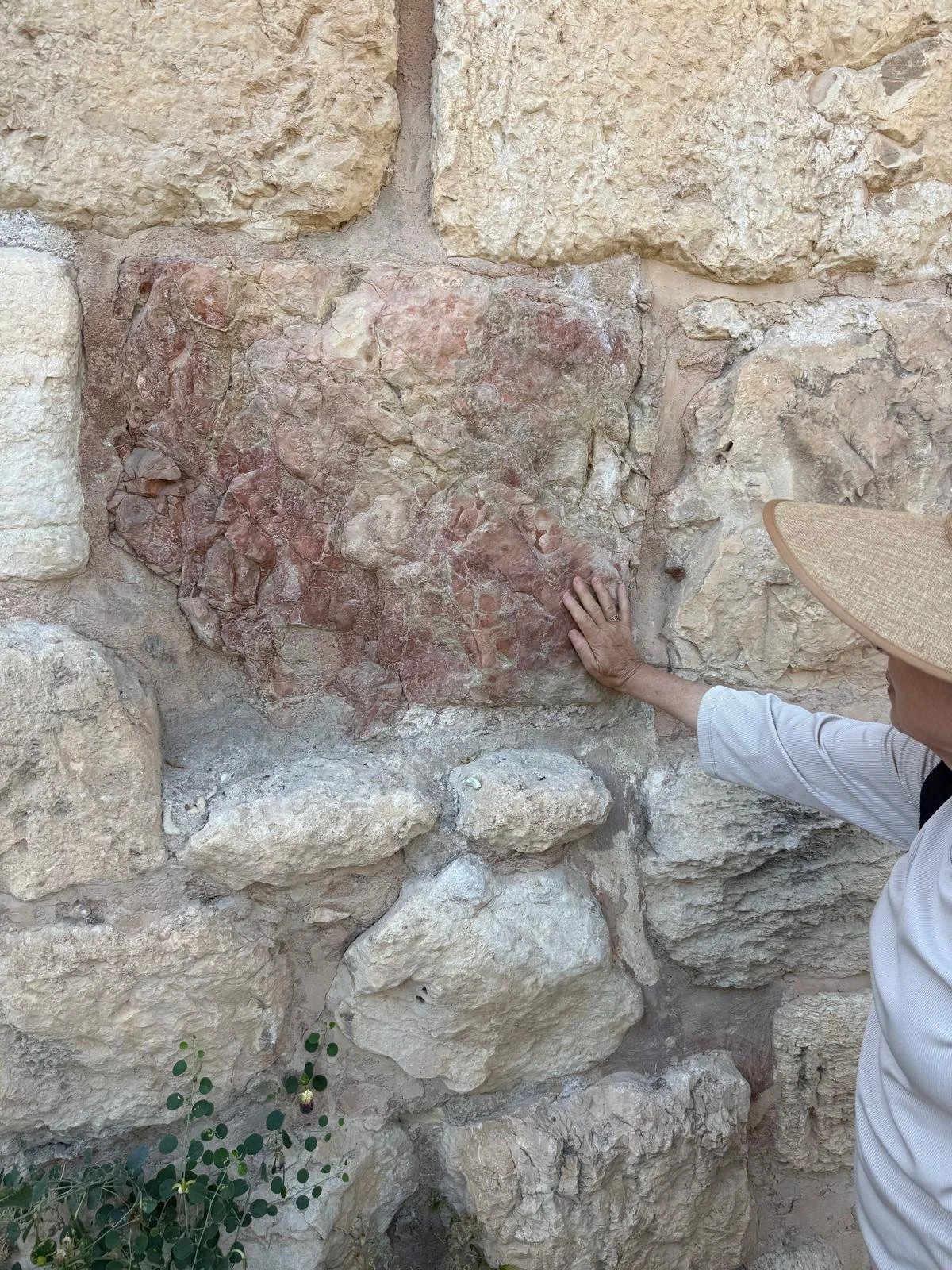
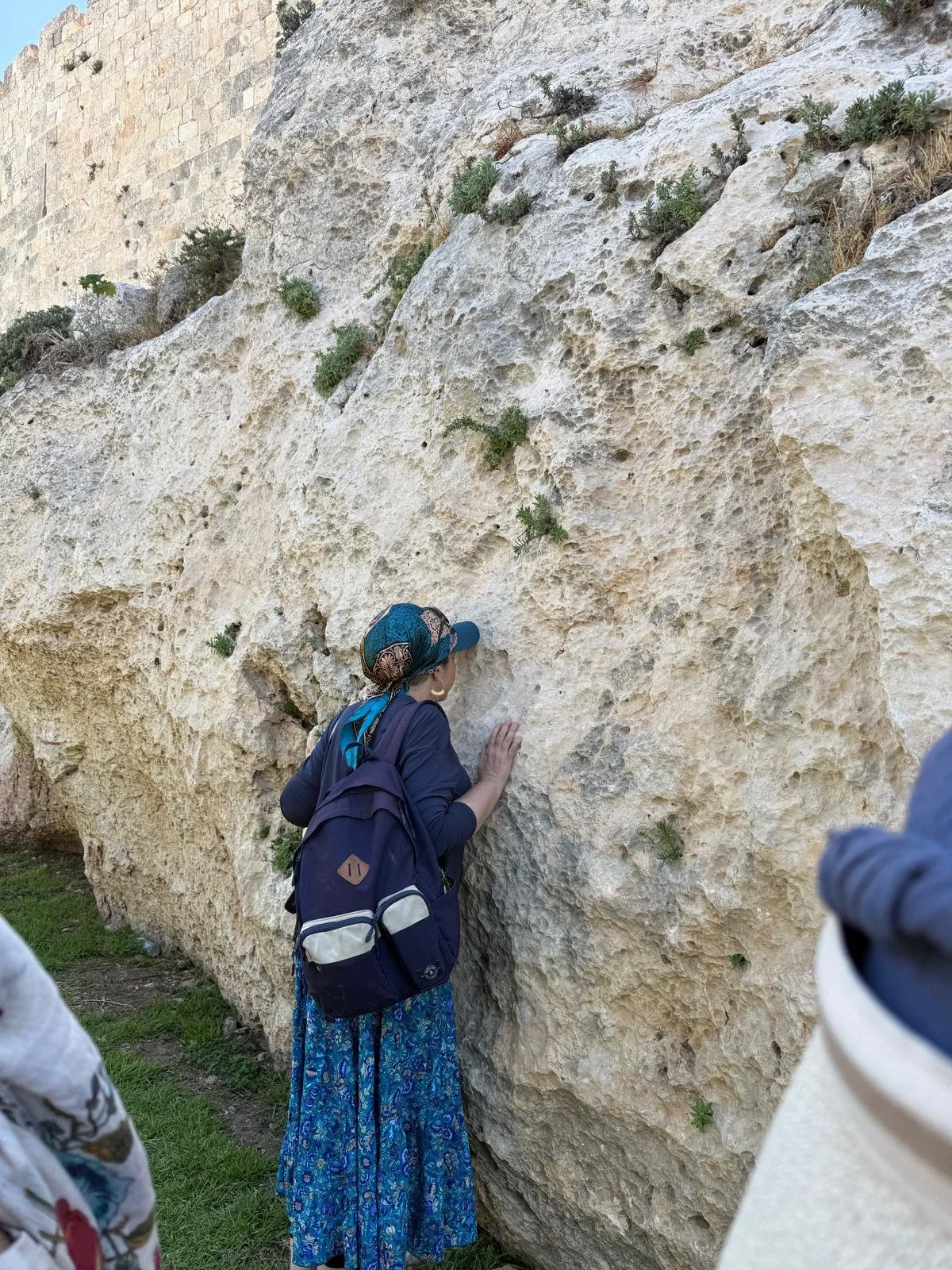
Some found their stone almost immediately, while others wandered slowly until something within them settled. Touching the stone gently with our hands, we began noticing details that would ordinarily escape our attention: their surprising weight, the coolness they retained despite the warmth of the afternoon sun, the subtle textures worn smooth by centuries of wind and rain, and the delicate shades of cream, honey, rose, and pale gold unique to the limestone of Yerushalayim. Tiny fossils rested quietly within the rock, reminders that these hills have carried memory far longer than any human lifetime. The longer we remained with them, the less these stones appeared ordinary. Each one possessed its own character, patiently shaped by time and faithfully remaining where it had always belonged.
Rachel Leah had shared a reflection:
“The stones remember. Not in the sechel / intellect. They remember differently. They remember within the guf / body.” Standing there, those words no longer felt poetic. Stones do not remember because they think. They remember because they remain. They witness what generations cannot. They endure where kingdoms rise and disappear. They receive without resistance and continue carrying the prayers entrusted to them. Perhaps this is why stones appear throughout Torah with such remarkable consistency.
Yaakov Avinu rested his head upon stones that became the place where heaven and earth met. Yehoshua raised stones as enduring witnesses to brit.
The Kohen Gadol carried precious stones over his heart, each engraved with the name of one of the tribes of Israel.
The world itself emerged from אֶבֶן הַשְּׁתִיָּה / Even HaShtiyah, the Foundation Stone. Again and again, Torah reveals that stone is never merely matter. It is memory. Covenant. Witness. Presence.
Rachel Leah then invited us to bring our stone gently toward our hearts. Smiling, she said,
“Perhaps the stone doesn’t need your heart. Perhaps your heart needs the stone.”
The invitation required nothing of us except presence. The stone simply remained what it had always been: steady, patient, enduring, utterly without pretence.
What had begun as an exercise in observation quietly became a conversation without words. One woman discovered resilience reflected in the stone she held. Another encountered hidden tenderness. Another recognized the quiet strength that had carried her through difficult years without ever drawing attention to itself. The stone had become less an object than a mirror, faithfully reflecting qualities that had been present all along.
Maskit then shared a stone that had long accompanied her own relationship with Yerushalayim. Rich veins of deep red flowed through soft white limestone, and she reflected on how those colours had become a teaching in themselves. The white spoke to her of the continual purification of the lev / לֵב, the heart. The red carried the courage to remain fully alive, fully feeling, fully present. Then she smiled as she uncovered another treasure hidden within the Hebrew language itself. אָב / Av and בֵּן / Ben together form אֶבֶן / Even. Father. Son. Stone.
Generation resting upon generation. Continuity becoming something solid enough to build upon. Standing before the supporting walls of Har HaBayit, the insight seemed to expand beyond language. We were no longer simply holding stones. We ourselves had become part of the living architecture of Am Yisrael, receiving from those who came before us and quietly carrying something forward for those who would come after us.
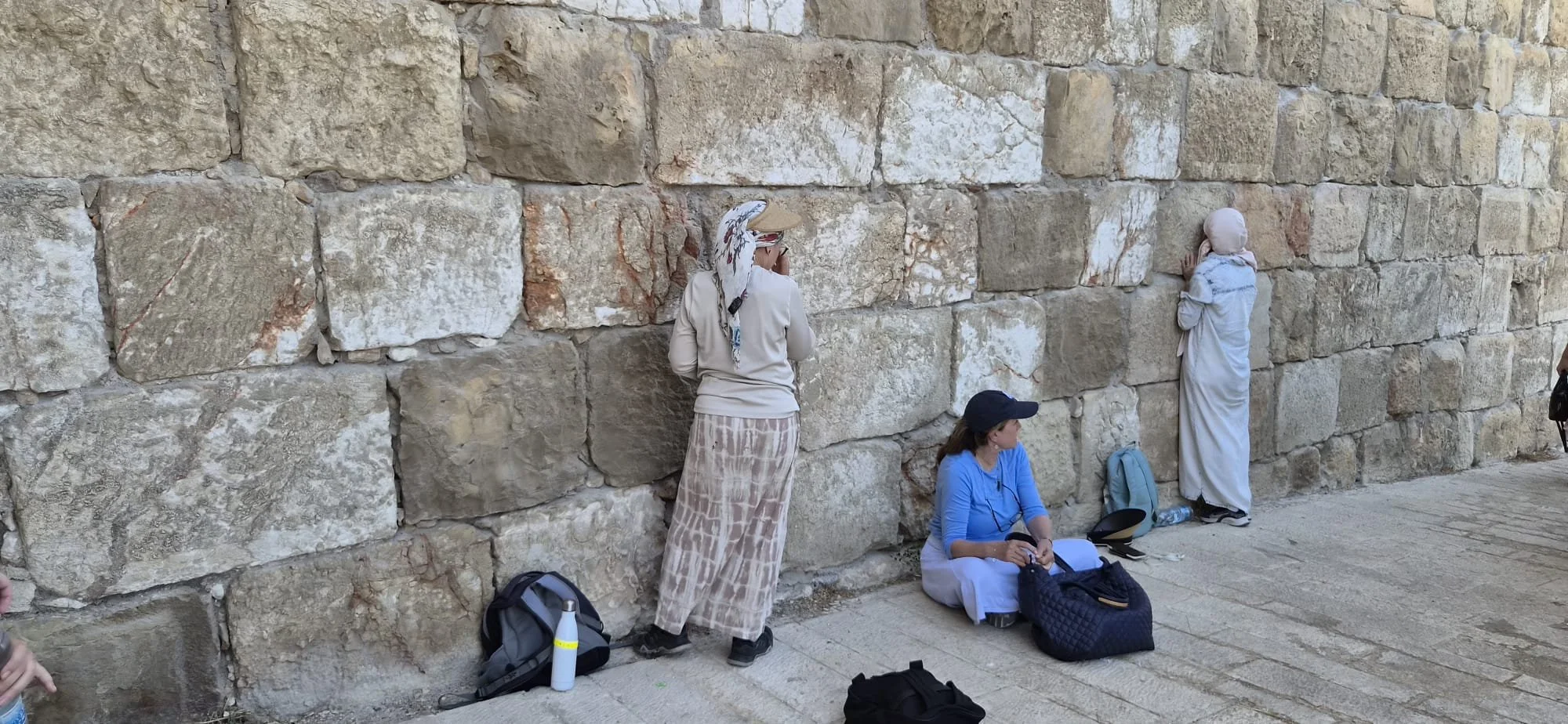
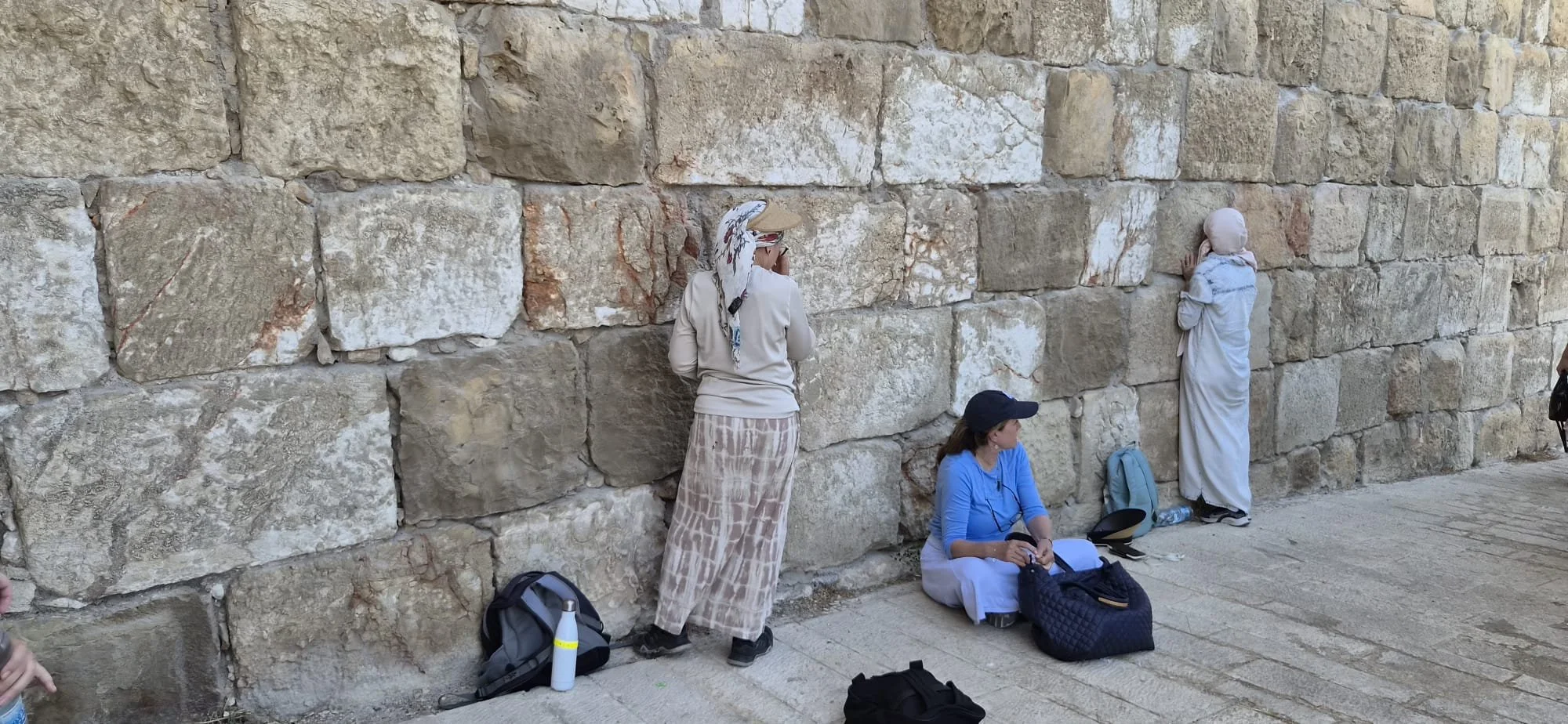
“Now let us receive from the living stones of Yerushalayim.” Together we approached the Walls of Yerushalayim, not hurriedly, not as visitors eager to arrive, but almost instinctively more slowly than before, allowing each step to complete everything the day had quietly been teaching us. Before anyone reached out to touch the Wall, Rachel Leah invited us to pause. “There is nothing you need to ask for right now. There is nowhere else you need to be. Simply arrive.” It was an unexpected invitation. So often we approach the Kotel carrying lists of names, hopes, worries, and requests. Today we were first invited simply to receive. To notice our breath. To feel our feet resting upon the stones of Yerushalayim. Everything had quietly led us to this moment.
Rachel Leah pointed out that the Hebrew words נְשִׁימָה / neshimah, breath, and נְשִׁיקָה / neshikah, kiss, emerge from the same Hebrew root. The women instinctively drew a deeper breath. “What if every breath has always been a kiss?” Not something we first offer, but something we first receive.”
Slowly, each woman stepped closer to the Wall. Some rested their foreheads against the ancient stones. Others placed gentle hands upon them. Some quietly pressed their lips against the limestone polished smooth by generations before us. There was no prescribed way to enter the moment. Only relationship.
Softly, Rachel Leah recited the opening words of Shir HaShirim:
יִשָּׁקֵנִי מִנְּשִׁיקוֹת פִּיהוּ
“Let Him kiss me with the kisses of His mouth.”
This kiss is רוּחַ בְּרוּחַ / ruach b’ruach, spirit meeting spirit, the breath Hashem first breathed into Adam continuing to meet the breath that sustains each of us in every moment.
As we breathed quietly beside the Wall, the gentle moisture carried upon every exhale resembled טַל / tal, dew. The Zohar associates dew with renewal, resurrection, and the promise of life continually returning. How extraordinary to realise that every breath we exhale carries its own hidden dew. Every inhale is a gift. Every exhale a kiss. Every breath a meeting between heaven and earth.
For several precious minutes no one moved. The city itself seemed to become still. There was nothing left to accomplish, nothing left to understand. Only breathing. Only receiving. Only returning. In that quiet, it became clear that the true pilgrimage had never been only toward the stones of Yerushalayim. It had always been toward the place within ourselves capable of meeting them. When we finally stepped back, the Wall looked exactly as it had when we first approached. The ancient stones had not changed.
We had.
8
אֶזְרַת יִשְׂרָאֵל / Ezrat Yisrael — Gathering the Journey
By the time we reached the Western and Southern supporting walls of Har HaBayit, the afternoon light had begun to soften. The brilliance of the midday sun gave way to the golden hues that seem to belong only to Yerushalayim, bathing the ancient limestone in warm shades of honey, amber, and rose. We had been walking together for many hours, yet no one appeared tired in the ordinary sense. If anything, the pace of the day had gradually slowed our inner rhythm. The conversations had become quieter. Our footsteps more intentional. Every stop along the journey had invited us not merely to learn another piece of history, but to become more deeply present to the place beneath our feet and to the women walking beside us.
Standing beside these enormous supporting walls evokes an entirely different feeling than standing before the Kotel. Here, one encounters not only the visible beauty of ancient craftsmanship but the hidden strength of foundations. Maskit explained that these immense stones, some weighing many tons, were placed with astonishing precision over two thousand years ago to support the sacred precincts of Har HaBayit above. Their sheer scale awakens a sense of awe, not only for the engineering that made such construction possible, but for the vision that first imagined building something worthy of carrying the aspirations of an entire people. Long before a structure can rise toward heaven, something unseen must first be prepared to bear its weight.
Throughout the day, Maskit had gently revealed the extraordinary relationship between landscape and memory. Here once again, archaeology became far more than the study of ancient stones. Every massive block of limestone bore silent witness to destruction and rebuilding, concealment and revelation, exile and return. Looking closely at the carefully fitted stones, one could almost sense the countless generations who had stood nearby, each carrying their own longing for Yerushalayim while adding another layer to her unfolding story. The supporting walls themselves became a quiet metaphor for the Jewish people. So much of what sustains us remains unseen. Foundations are rarely celebrated, yet without them nothing enduring can ever be built.
Rachel Leah gathered the women into one final circle before we concluded our time in the Old City. There were no lengthy teachings. No final meditation. No attempt to summarize everything we had experienced together. Instead, she offered an invitation remarkable in its simplicity.
“One word.”
“Just one word that you are carrying home from today.”
The circle grew still.
After an entire day of walking, breathing, listening, singing, touching stones, and crossing thresholds together, reducing the experience to a single word seemed almost impossible. Yet perhaps that was precisely the invitation. To listen beneath the many thoughts and discover the one word that had quietly remained.
The sharing began slowly.
One woman offered, “Belonging.”
Another said, “Trust.”
“Courage.”
“Softness.”
“Breath.”
“Home.”
“Connection.”
“Hope.”
“Presence.”
Each word emerged gently, without explanation or elaboration. There was no need to interpret what anyone meant. Somehow every woman understood. Every word carried an entire story within it. Listening around the circle, it became clear that although we had walked exactly the same paths together, no two women had experienced the same Yerushalayim. Each had encountered a different teaching. Each had crossed a different inner bridge. Each had discovered a different gateway within herself. And yet together those individual experiences formed something unexpectedly whole, like the many stones that together become a single wall.
It struck me then that this is one of Yerushalayim’s quietest miracles. She never reveals herself in exactly the same way twice. She meets each person precisely where they are, speaking through the same stones, the same streets, the same sky, while awakening something entirely unique within every heart that comes seeking her.
As the final woman shared her word, no one rushed to fill the silence that followed. The circle itself felt complete. Earlier that morning, each participant had introduced herself by saying, “I am a stone of Yerushalayim.” At the time, we stood as individuals, each carrying our own stories, hopes, and questions. Now, after a full day of walking together, something had quietly changed. Those individual stones had become a living structure. Not simply a wall, but a community. A vessel. A circle of women who had witnessed one another with tenderness, supported one another through moments of vulnerability, and discovered that the deepest journeys are rarely meant to be travelled alone.
Standing beside the supporting walls of Har HaBayit, I found myself reflecting that perhaps this, too, is part of what these ancient stones have always been teaching. Great things are never built by a single stone standing alone. Every stone supports another. Every hidden foundation carries something greater than itself. The beauty that eventually rises into view is possible only because countless unseen stones quietly remain faithful to their place.
As the afternoon slowly gave way to evening, some of us made our way to the kotel. The formal walking tour had come to an end, but no one felt as though the journey itself was over. There was a shared sense that Yerushalayim had more to say, that the experiences of the day needed space to settle more deeply into heart and body. Under the rising full moon of Tu B’Tammuz, we would gather once more—not to walk through the landscape of Yerushalayim, but to discover how profoundly the landscape had already begun walking through us.
9
ט״ו בְּתַמּוּז / Tu B’Tammuz — Full Moon Circle
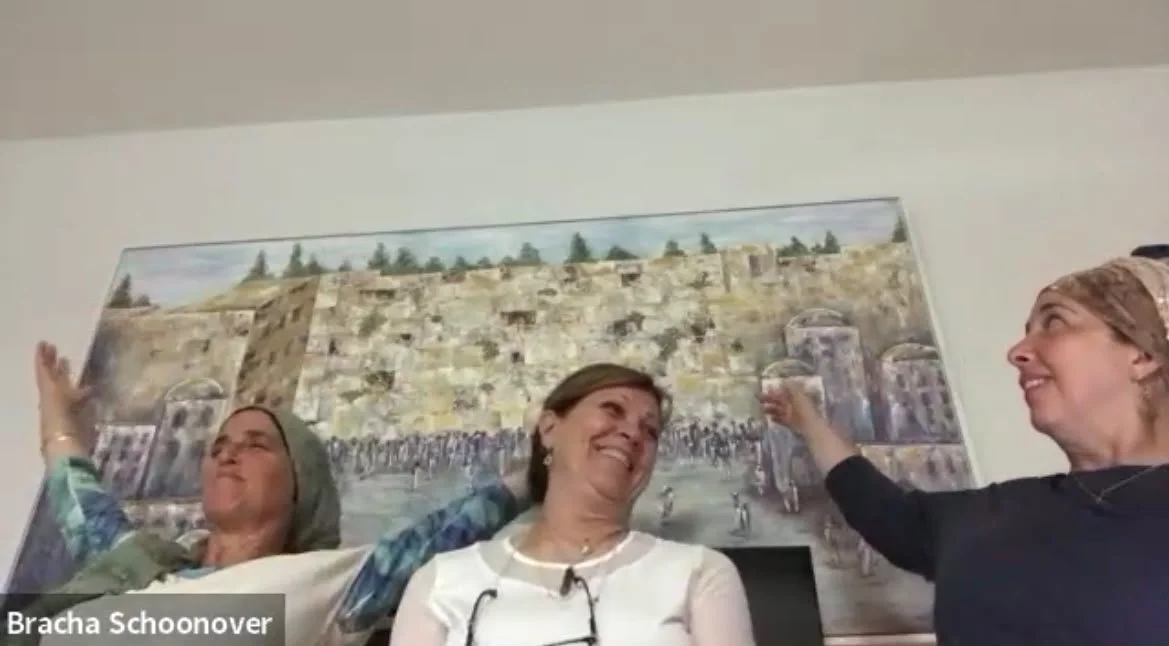
As evening settled gently over Yerushalayim, the journey found its final expression not on a mountain, beside an ancient wall, or overlooking a breathtaking valley, but within the warmth of a home. After a full day immersed in the living landscape of the city, we gathered once more, this time in the home of Bracha Schoonover, where the full moon of Tu B’Tammuz shone quietly over Yerushalayim. It felt like the most natural continuation imaginable. Throughout the day we had encountered the outer Yerushalayim. Now we were invited to discover the Yerushalayim awakening within us.
There was a noticeable difference in the women who entered Bracha’s home from those who had first gathered that morning at Jaffa Gate. Faces were softer. Conversations unfolded more gently. The hesitancy that naturally accompanies a group of strangers had quietly dissolved somewhere between the walls, the tunnel, the valley, the bridge, and the stones. What remained was something rare—a circle of women who had shared not only a journey through the city but an experience of walking one another home.
Bracha welcomed us with the same warmth and generosity that filled every corner of her home. As candles flickered and the evening breeze drifted through the open windows, the city outside seemed to grow quieter, allowing another kind of listening to emerge. Before any words were spoken, she began singing Tehillim. David HaMelech’s ancient melodies, rising from the very city he loved, seemed to gather every experience of the day into a single current of longing and gratitude. There was nothing performative about the singing. Voices joined one another naturally until it was impossible to distinguish one woman’s prayer from another’s. The melodies carried us gently from the outer journey into the inner one.
Following the singing, Bracha guided us through a meditation that invited the experiences of the day to settle more deeply into heart and body. Maskit then lovingly gathered together the many threads we had been weaving since morning. The walls, the bridge, the valley, the stones, the breath, and the encounters between us gradually revealed themselves as parts of one continuous movement. Nothing had been accidental. Every place we visited had quietly prepared us for the next.
Rachel Leah then invited the women to stand once again. “This morning,” she began softly, “we became stones.”
Immediately smiles appeared throughout the circle as everyone remembered our opening exercise beside the walls of the Old City, where each woman had introduced herself as a stone of Yerushalayim before joining the others to form a living wall.
“We became a חוֹמָה / chomah.”
She paused, allowing the memory to settle.
“And now I wonder…” “What if every healthy wall carries within it the possibility of becoming a שַׁעַר / sha’ar?”
The invitation was beautifully simple.
Each woman allowed her body to become a wall. Arms gently crossed over the heart. Shoulders softened inward. Instantly, everyone recognized the wisdom held within that posture. Walls are not enemies. Walls protect what is precious. They preserve life. They allow healing to take place. Every woman could feel the intelligence of the walls she had built at different moments throughout her own life.
Then, just as gently, Rachel Leah invited us to soften. The arms slowly unfolded.
The chest opened. The gaze lifted. Without force, without striving, the wall gradually became a doorway.
The transformation was almost imperceptible, yet every woman could feel it within her own body. Protection slowly gave way to openness. Self-preservation became relationship. What had once felt like separation quietly revealed itself as the possibility of encounter.
Working in pairs, one woman embodied the wall while the other became the מְבַקֶּשֶׁת / mevakeshet, the seeker. The seeker approached one slow step at a time, pausing whenever the wall needed space. Nothing was rushed. Nothing was expected. When the moment felt right, the wall gently opened, creating a living gateway through which the other woman could pass. Then they exchanged roles, each discovering both the wisdom of healthy boundaries and the profound courage required to welcome another into the heart.
Watching the room, it became impossible not to recognize how faithfully the human body had been echoing the landscape of Yerushalayim all day long. We had begun among ancient walls. We had passed through hidden passageways. We had crossed bridges suspended above valleys once associated with darkness and now overflowing with life. We had touched stones that remembered generations. Now those same movements were revealing themselves within us. The geography of Yerushalayim had quietly become the geography of the human heart.
Gathering once more into a single circle, Rachel Leah offered one final invitation.
Complete this sentence:
“The gateway that opened for me today is…”
The answers arose…
“The gateway that opened for me today is trust.”
“For me… receiving help.”
“Softness.”
“Belonging.”
“Courage.”
“Listening.”
“Hope.”
Each response was only a few words, yet every woman recognized that behind those few words lived an entire journey. No two gateways were identical, just as no two stones had been the same that morning. Yet together they formed something remarkably complete. The individual experiences did not compete with one another. They enriched one another, becoming many colours within the same living tapestry.
As the sharing concluded, each woman turned toward the person beside her and offered a bracha. Some blessings were spoken through tears. Others through quiet smiles. Some were only a sentence long. Yet after walking side by side for an entire day, every bracha carried a depth that could never have been manufactured. They arose naturally from having witnessed one another honestly, gently, and without judgment.
Looking around the circle, it became clear that the day had quietly fulfilled its deepest intention. We had come seeking Yerushalayim. Instead, Yerushalayim had been patiently shaping us all along.
Before closing the evening, Rachel Leah offered one final reflection as we prepared to enter בֵּין הַמְּצָרִים / Bein HaMetzarim.
“So often,” she reflected, “we imagine these weeks are only about remembering what was destroyed. But perhaps they are equally about remembering what is waiting to be rebuilt.”
“The rebuilding of Yerushalayim begins long before stones are placed one upon another. It begins whenever a heart becomes capable of greater connection. Whenever fear gives way to trust. Whenever a wall becomes a gateway. Whenever we choose to truly witness another human being. Every act of connection becomes another stone in the rebuilding of Yerushalayim.”
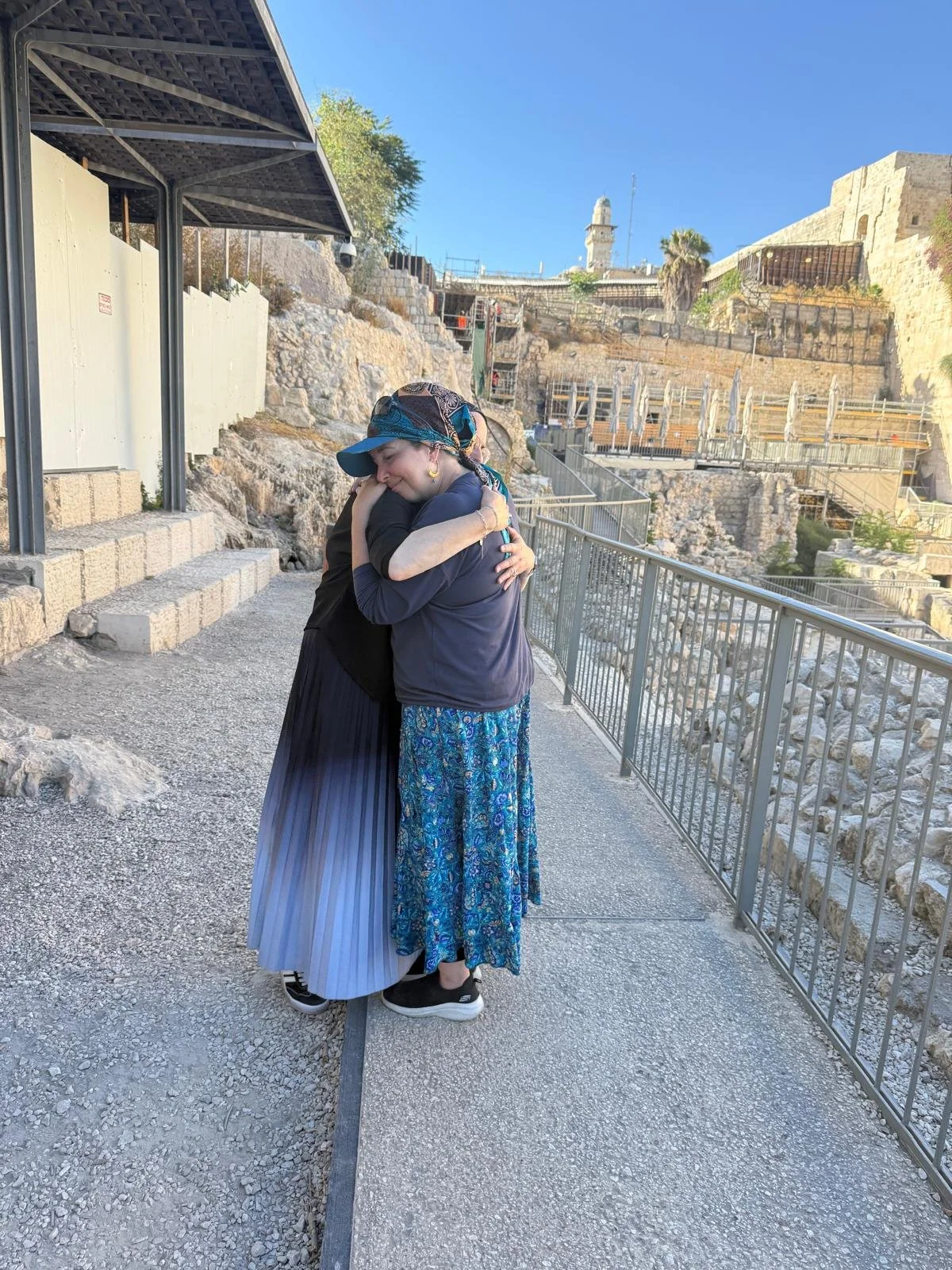
As we stepped back into the cool Yerushalayim night, the full moon illuminated the streets with a quiet radiance. No one hurried to leave. Small conversations continued along the sidewalks. Embraces lingered. New friendships had been formed. Something of the circle remained intact even as we began walking in different directions.
The journey through Yerushalayim had come to its natural conclusion. Yet the true journey had only just begun.
The walls, the valleys, the bridges, the stones, and the songs would continue living within us long after the footsteps of that remarkable day had faded from the streets of Yerushalayim. And perhaps that is the city’s greatest gift. She never asks us simply to remember where we have been. She quietly teaches us how to walk differently wherever we go next.
10
רְשִׁימוּ / Reshimu — What We Carried Home
Some journeys end when we return home.
Others continue unfolding long after the final step has been taken.
In the days that followed our Yerushalayim Journey, messages began arriving from the women who had shared the experience. They were not simply describing a beautiful day or thanking one another for meaningful moments. Again and again, their words revealed something deeper. The journey had continued. The walls, the bridge, the valley, the stones, and the conversations had become part of an inner landscape that was still quietly unfolding.
Those words travelled through our group almost like a quiet ripple. They expressed something that no formal teaching could have conveyed. The deepest transformation had not come from eliminating uncertainty, but from discovering that uncertainty no longer needed to be carried alone. Somewhere between the singing of Rebbe Nachman’s words, the circle that formed instinctively in the middle of the bridge, and the gentle support of women walking beside one another, fear itself had become another doorway into connection.
The bridge had become a living expression of קוֹחַ הַמּוֹשֵׁךְ / koach haMoshech, drawing hidden potential gently into lived reality. What had begun as an ordinary walk across a suspension bridge had quietly become a collective experience of Hashra’at HaShechinah / השראת השכינה, not through extraordinary events, but through women choosing to remain fully present with one another.
Rachel Leah described witnessing a woman cross the bridge as resembling the avodat hakodesh, holy work, of accompanying a woman through childbirth. Anyone who has stood beside a labouring mother recognizes that there comes a moment when everything feels impossible, when the intensity reaches its greatest point. Yet experienced midwives know that this moment is not a sign that something is wrong. It is often the unmistakable sign that new life is about to emerge.
“So it was on the bridge,” she reflected.
“No one crossed alone.”
“We all crossed together.”
That image remained with many of the participants. The bridge had ceased being an individual achievement. It had become a shared birth into a different way of walking through life, one in which vulnerability was no longer something to conceal but something capable of drawing genuine connection.
Other reflections revealed how differently the same journey had been experienced.
One woman wrote with gratitude for the extraordinary way Maskit’s love of Eretz Yisrael had opened the landscape before us, allowing valleys, bridges, tunnels, and ancient stones to become living teachers rather than historical monuments.
Another thanked Rachel Leah for creating what she described as “such a gentle and safe vessel,” where breath, movement, and somatic awareness made it possible to meet whatever arose with compassion rather than judgment.
Several women reflected that what moved them most was not only the beauty of Yerushalayim itself, but the tenderness with which complete strangers had become companions, witnessing one another with remarkable generosity throughout the day.
Perhaps one of the most touching responses came from someone who had not even been physically present. Reading the reflections shared by the participants, she wrote:
“I wish I could make Aliyah this moment and join you all. What beautiful neshamot work together in this space. I am awed by your tender yet dynamic neshama rainbow. Your colours flow toward me across deserts and seas, unfurling like a shimmering sea of light.”
Her words became a reminder that authentic encounters have a way of extending far beyond those who were physically present. The circles we create continue expanding long after the gathering itself has ended.
Looking back over the journey, one realization became increasingly clear. The day had never been about visiting beautiful sites in Yerushalayim, remarkable though they were. It had been about learning how to encounter them differently. The walls had taught us belonging. The tunnel had taught us hidden possibility. The valley had revealed that places once associated with darkness can blossom with life. The bridge had invited us into trust. The stones had taught us remembrance. The Kotel had become a meeting place of breath and Presence. Each stop along the way quietly mirrored a movement already unfolding within our own lives.
This is what makes walking through Yerushalayim so different from simply seeing her. The city does not merely preserve history. She participates in our own.
She meets us where we are, gently inviting us into deeper relationship—with the Land, with Torah, with one another, and ultimately with Hashem. Long after the footsteps fade and the photographs are tucked away, something of Yerushalayim continues walking beside us.
That lingering impression is what the mekubalim call a רְשִׁימוּ / reshimu—an imprint that remains after the moment itself has passed. It cannot be measured or photographed, yet it quietly continues shaping the heart. It returns unexpectedly in the middle of an ordinary day. It rises again with a familiar melody, the touch of a stone, or the memory of women standing together on a bridge, singing above a valley that has become a garden.
And perhaps that is the greatest gift of the Yerushalayim Journey.
Not that we spent a day walking through the city.
But that, in ways we are still discovering, Yerushalayim continues walking through us.
Meet Your Guides
-
![]()
Maskit Ben Moshe
Official Israeli Tour Guide
With a vision for building something meaningful, Maskit brings a blend of big-picture thinking and hands-on experience. -
![]()
Rachel Leah Weiman
Torah Guide
Rachel Leah is all about building strong relationships and helping women connect to the Land, Hashem, each other and them selves.