
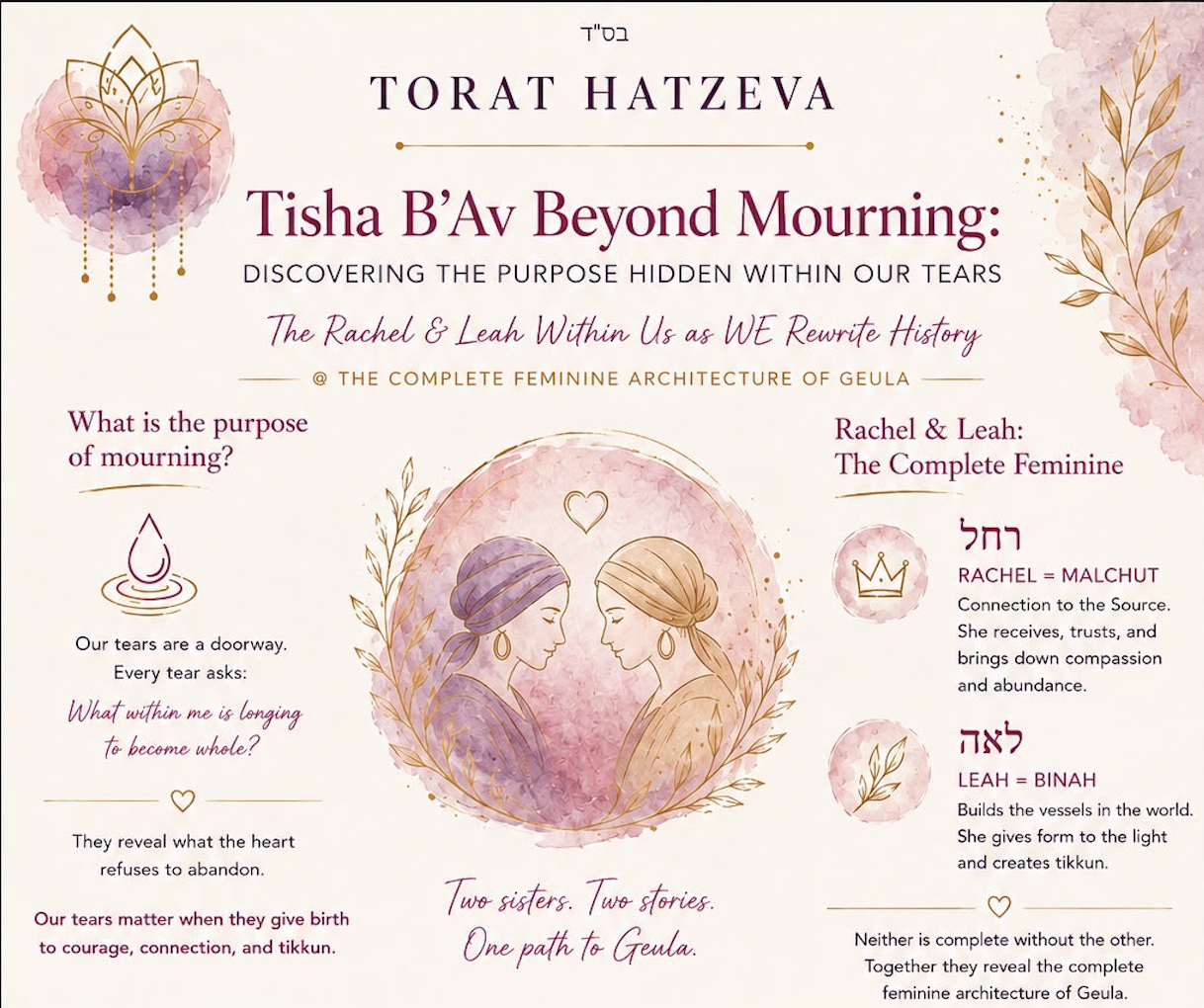
Rachel & Leah reveal the complete feminine architecture of Geula.
Tisha B’Av 5786
Beyond Mourning:
Discovering the Purpose Hidden within Our Tears
The Rachel & Leah Within Us as WE Rewrite History
Scroll Down for EICHA: Journey of the כ Kaf… From וְלִבְכֹּתָהּ to כְּאַלְמָנָה to כְּאוֹיֵב
Every year on Tishah B’Av we sit on the floor and enter the world of tears:
✔️We read Eichah / אֵיכָה.
✔️We mourn the churban / חֻרְבָּן
✔️We watch videos that make us sad
✔️We ate eggs and bread dipped in ashes
✔️We observed the laws of mourning these past 9 days / 3 weeks
NOW lets ask: What made Rachel's TEARS powerful enough that Hashem Himself responded?
Why is רחל Rachel Imeinu/ Kever Rochel our the eternal collective image of mourning?
Yirmiyahu HaNavi reveals to us that the purpose of mourning / aveilut / אֲבֵלוּת is something far greater than sadness‼️... inviting us BEYOND MOURNING itself, toward discovering the purpose hidden within our tears:
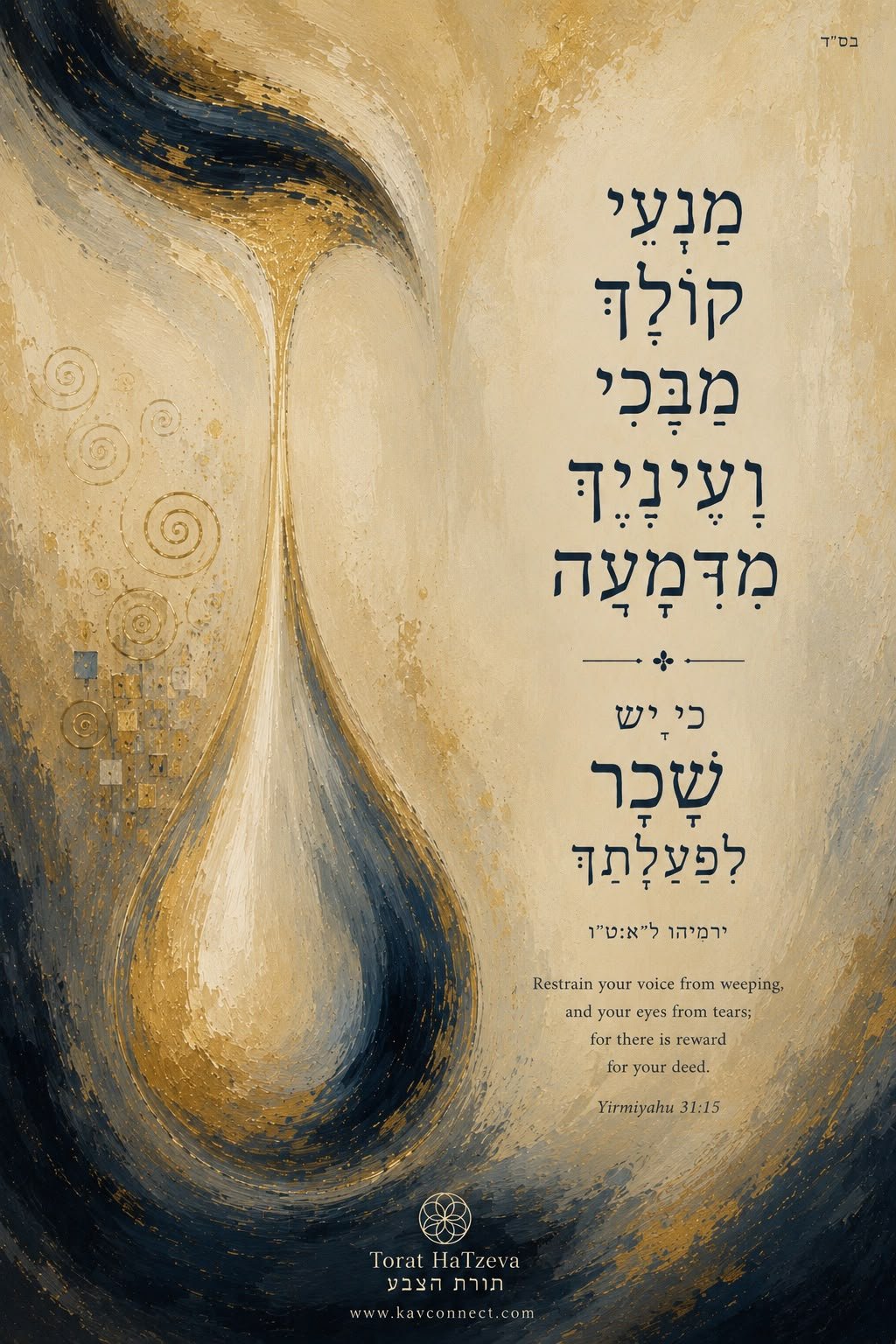
מִנְעִי קוֹלֵךְ מִבֶּכִי
וְעֵינַיִךְ מִדִּמְעָה
כִּי יֵשׁ שָׂכָר לִפְעֻלָּתֵךְ נְאֻם ה׳
וְשָׁבוּ מֵאֶרֶץ אוֹיֵב׃
“Restrain your voice from weeping,
and your eyes from tears,
for there is reward for your deed, declares Hashem,
and they shall return from the land of the enemy.”
וְיֵשׁ תִּקְוָה לְאַחֲרִיתֵךְ נְאֻם ה׳
וְשָׁבוּ בָנִים לִגְבוּלָם׃
“There is hope for your future, declares Hashem,
and your children shall return to their border.”
(Yirmiyahu 31:15-16)
Eichah Rabbah (Petichta 24) opens a remarkable shaar /doorway and connection to TODAY...
The Midrash refuses to separate Rachel’s tears from Rachel’s actions לִפְעֻלָּתֵךְ. It teaches that when Hashem responds, כִּי יֵשׁ שָׂכָר לִפְעֻלָּתֵךְ, He is pointing us back to the night Rachel handed Leah the סימנים / signs / simanim.
Rachel’s tears possess the power to redeem because they flow from a ❤️heart that had already transformed betrayal into rachamim / compassion.(ie darkness to light)
Before we follow Rachel’s tears, let us pause 💓and notice our own tears.
Breath
Slower breath
Calm breath
Breath Into your 👁️ right eye
Breath Into your 👁️ left eye
Now Focus on the corners of your eyes
on your tear ducts,
Where your tears emerge
The Arizal teaches that tears emerge from the element of 💦 water, one of the ארבעה יסודות / 4 elemental forces within the human being.
*Water is the element of חסד / chesed, relationship, longing, and love.*
Breath
Feel your water element
Chesed
Tears are not just emotional release.
They reveal what the heart refuses to abandon.
The Gates of Tears שַׁעֲרֵי דִּמְעָה
אַף עַל פִּי שֶׁשַּׁעֲרֵי תְּפִלָּה נִנְעֲלוּ, שַׁעֲרֵי דִּמְעָה לֹא נִנְעֲלוּ. (בבא מציעא נ״ט ע״א)
“Although the gates of tefilla were closed after the destruction of the Beit HaMikdash, the gates of tears were never closed.”
-Gemara
Yet tears are never the goal.
They are a doorway.
Every tear asks:
What within me is longing to become whole?
On Tishah B’Av we are invited to follow our tears all the way back to their hidden source.
Lets begin by following the story back to the source of Rachel’s tears ...
Rachel sat alone on her wedding night.
She had done the unimaginable.
Knowing her sister would face unbearable humiliation, she gave Leah the סימנים / signs/ simanim.
✔️In one act she saved her sister.
❌In the same act she lost the future she had imagined.
❌She became the victim of Lavan’s deception.
She was genuinely wronged. The deceiver was Lavan.
But Lavan is much more than this... His very name means “white.” The Sfat Emet teaches that there is a false whiteness, a counterfeit purity that conceals manipulation beneath the appearance of innocence.
Lavan never attacks openly. He twists reality until everyone begins believing his version of the story.
This is the inner Lavan... the part that lives within US.
The voice inside every one of us that continually rewrites reality to justify itself:
“I am right.”
“They are wrong.”
“I know exactly what happened.”
“There is only one perspective.”
Our Inner Lavan lives wherever relationships become trapped inside a single story.
Rachel could have remained there forever. She could have lived the rest of her life as the woman betrayed on her wedding night. She had every reason.
Instead, she elevated the story ... She erased (מְחִיקָה) the identity that Lavan had written for her.
❌Not the memory.
❌Not the pain.
✔️The script! (In her lower mochin / mind)
Years later the Torah invites us into a glimpse back to that very wound through the story of the דודאים / duda’im.
Leah cries out:
הַמְעַט קַחְתֵּךְ אֶת אִישִׁי…
_“Was it not enough that you took my husband?”_
Suddenly ...we hear Leah’s pain! All these years Rachel believed she had lost Yaakov.
Now she discovers that Leah believed exactly the opposite. Leah believed Rachel had taken him from her.
✔️2 sisters.
❌Both wounded.
❌Both convinced they were the victims.
❌Both carrying stories written by Lavan.
Rachel could have defended herself. Instead she answers with an extraordinary word:
לָכֵן. / Therefore
A transition. לָכֵן is the movement from inner understanding to embodied action. The movement into BINAH CONSCIOUSNESS.
It is the moment when בינה / Binah (Leah / upper ה) descends into מלכות / Malchut (Rachel / lower ה)
✔️Understanding becomes choice.
✔️Compassion becomes action.
✔️Connection becomes reality.
Rachel is saying:
“I now see something I could not see before.
*Therefore לכן*…
we will no longer repeat the past.”
*לָכֵן* יִשְׁכַּב עִמָּךְ הַלַּיְלָה.
“Therefore he shall lie with you tonight.”
For the second time Rachel gives Leah to Yaakov.
❌The first time she had no choice.
✔️The second time she freely chooses.
✔️This time there is no deception.
✔️This time there is love.
❌Rachel has erased ✏️ her victimhood.
✔️ Not because history changed. Because SHE DID!
❌She refused to let the wound define her identity.
✔️She rewrote history.
Now imagine Leah...
Years earlier she entered Yaakov’s tent hidden beneath a veil.
✔️Every embrace carried uncertainty.
✔️Every silence carried SHAME.
✔️She knew Yaakov had expected Rachel.
*How many years did she live beneath that shadow?*
Now everything changes. She walks out to meet Yaakov openly.👑
אֵלַי תָּבוֹא.
_“You shall come to me.”_
✔️No veil.
✔️No disguise.
✔️No deception.
Leah is saying
_“This time you will receive the woman you thought you were receiving all those years ago. This time it is truly me._👑
_*This time there is no Lavan standing between us.”*_
❌Leah has erased the burden she carried.
❌Rachel has erased the burden she carried.
✔️The sisters release one another from Lavan’s story.
✔️Together they rewrite history.
This is the deeper relationship between Rachel and Leah...
👑Rachel represents Malchut / connection to the Creator / Boreh, the source from which all shefa / abundance flows. She fills vessels with light. Her movement is compassion, relationship, and trust that every lack can ultimately be fulfilled only by Hashem.
🌱Leah represents the Binah / the created world / hitbonent. She builds the vessels. She embodies what Rachel has already received. Dveikut with Hashem. Light becomes form.
Neither is complete without the other.
❌Rachel without Leah becomes disconnected from the Source.
❌Leah without Rachel remains unembodied.
✔️Together they reveal the complete feminine architecture of Geula ✨
That very night Yissachar is conceived. Leah names him:
נָתַן אֱלֹקִים שְׂכָרִי…
_“Hashem has given me my reward…”_
Centuries later Yirmiyahu uses precisely the same language.
Hashem answers Rachel:
מִנְעִי קוֹלֵךְ מִבֶּכִי… כִּי יֵשׁ שָׂכָר לִפְעֻלָּתֵךְ.
_“Restrain your voice from weeping… for there is reward for your deed.”_
❌Not reward for your tears.
❌Not reward for your suffering.
✔️Reward for your deed.
Rabbi David Fohrman explains: (https://www.alephbeta.org/content/power-of-rachels-tears?episode=rewriting-history)
*The reward promised to Rachel echoes the reward surrounding the birth of Yissachar.*
The Navi is teaching us exactly why Hashem answered Rachel.
❌Not because she cried.
✔️ Because she fixed what she could fix!
At the rawest, most painful place in her own life, she reached beyond herself... and saw her sister.
✔️She chose compassion over being right.
❌She refused to let Lavan’s story become the final story.
We usually read this navua / prophecy as though Hashem were saying:
“Rachel, I hear your tears.”
Perhaps He is saying something much deeper:
“Rachel, I hear your tears because I remember your heroism.”
Your tears matter because they emerge from a heart ❤️ that transformed pain into compassion. I see all your actions... avoda kedosha!!!
That is why they possess the power to redeem a nation!!!
“Being a hero doesn’t mean never getting into a fight.... It means having the strength to get out of one once you’re in it.”
-Rabbi David Fohrman
✔️Conflict is inevitable.
Between spouses.
Siblings.
Children.
Friends
Neighbours.
Communities.
❌The question is not whether conflict comes.
✔️The question is whether we can become heroines.
At the very moment we feel most hurt, can we pause?
Can we ask:
“What does this situation look like from the other person’s perspective?”
“What pain are they carrying?”
“What story has their inner Lavan been telling them?”
“Is my perspective the whole picture?”
✔️That curiosity is heroism.
✔️That curiosity begins dismantling galus.
❌Galus (exiled parts in IFS) begins whenever two people (parts) become trapped inside separate stories.
✔️Geulah begins when one person becomes courageous enough to cross the divide.
✔️Rachel did.
✔️Leah did.
✔️Together they rewrote history.
TORAT HATZEVA
Allow the colors, shapes, and movement to emerge without judgment.

✨Paint a single color for Rachel.
✨Paint a single color for Leah.
✨Add a tear (s)
✨Paint the loneliness of בָּדָד.
✨Paint the moment of לָכֵן,
    when the heart opens to another perspective.
✨Allow the 2 colors to merge creating a completely new creation‼️
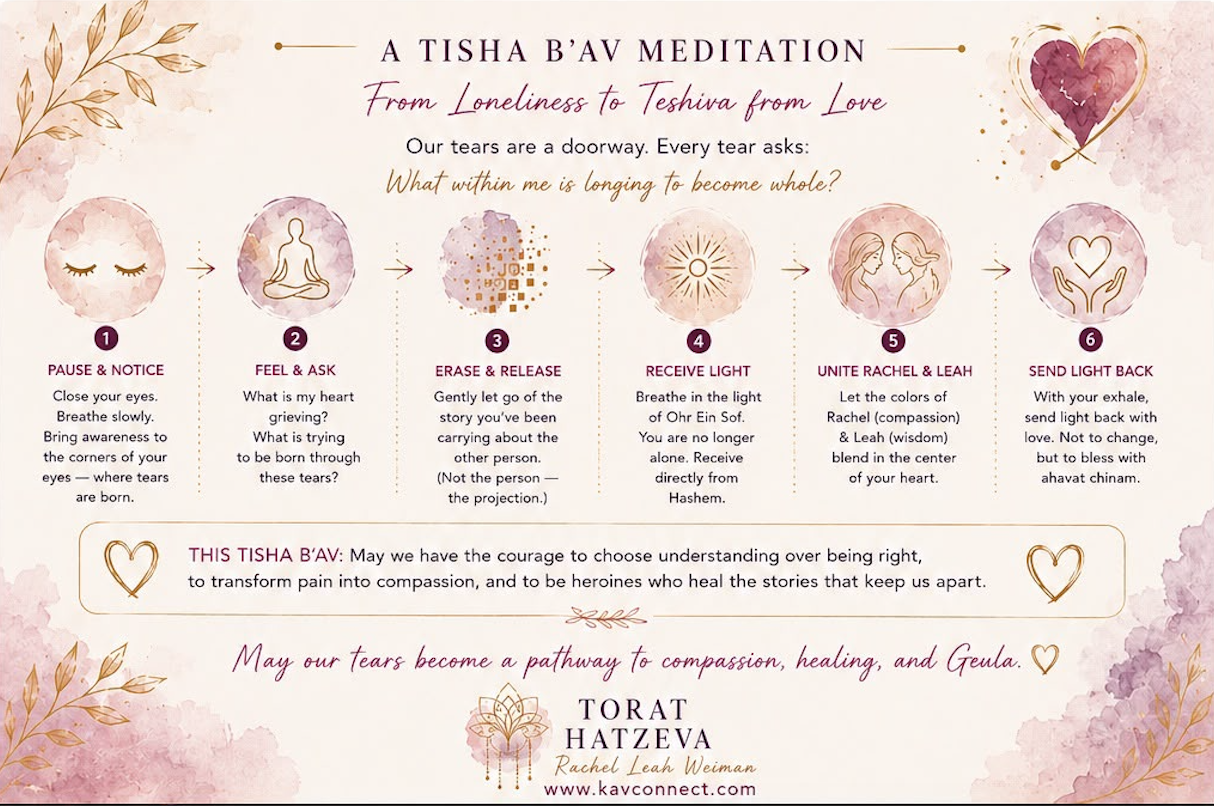
✨*A TISHA BAV MEDITATION:
From בָּדָד Lonliness to Teshiva from Love*
The Echo Project →
Close your eyes.
Allow your breath to slow.
Inhale gently.
Exhale completely.

Again.

Bring before you someone with whom you are in conflict.

Notice your body.
Where is there contraction?
Where do you still feel lack?
Where do you still need something from them?
Approval.
Justice.
Recognition.
Understanding.
Love.

Simply notice.

Now imagine a gentle illuminating white light אור אין סוף / Ohr Ein Sof surrounding you.

A limitless light.
The light that existed before this relationship.
Before the wound.
Before the story.

Allow that light to travel from your keter / 👑 crown to your feet... filling every cell of your being.

Now gently shine that light toward the other person.
See them also surrounded by rachamim / compassion.

Now ask yourself:
_What have I been needing from them?_
See that need.
See every expectation.
Every attachment.
Every story.

As you hold this person in your awareness, notice whether beneath the conflict there is something even deeper.

Loneliness.

The opening words of Eichah are not only about the destruction of Yerushalayim. They are also the cry of every heart that feels abandoned.
אֵיכָה יָשְׁבָה בָדָד…
הָיְתָה כְּאַלְמָנָה.
“How she sits alone…
She has become like a widow.” (איכה א:א)
Notice the כ in כאלמנה
like
Holy doubt

Rachel knew that loneliness.
She sat alone on her wedding night.
Feel your inner Rachel
What color is she?

Leah knew that loneliness.
She lived for years beneath the veil of misunderstanding.
Feel your inner Leah
What color is she?

Both women carried the pain of בָּדָד/ abandonment

As you breathe, ask yourself:
Where do I still sit alone?

Where has my heart ❤️ become separated?

Where has my inner Lavan convinced me that I am isolated, misunderstood, abandoned?

Now Erase the person. מְחִיקָה
(Based on Mechika / מְחִיקָה meditation by Rav Doniel Katz)

Pixel by pixel.
Not the person...
Your projection of him /her
The expectation.

The belief that they are the source of ... what ONLY Hashem can give.

Allow every pixel to dissolve into light.
Everything returns to its Source.

Now breathe the Ohr Ein Sof into that lonely place.

Allow Hashem’s Presence to fill the space that once felt empty.

Notice that you are no longer alone.

From this place of fullness, allow your heart to soften toward the one before you.

Now draw that longing / yearning back into yourself.

Your vacant / empty spaces

Lift your focus upward.
Receive directly from Hashem.

Draw the Ohr Ein Sof down into your heart.❤️
Into the emptiness.
Into the longing.
Into the place that once reached outward.

Allow the 2 colors of Rachel and Leah to blend together in the centerpoint of your heartspace / Tiferet

Rachel transformed
 בדד / Loneliness
into relationship.
She crossed the the narrow bridge.
She reached for her sister.

Breathe.
Receive.
Rest in deveikut.
Rest in Binah consciousness.

The spacious knowing that nothing is missing ... because everything already flows from Hashem.

Now allow that fullness to overflow.
This is אור חוזר / Ohr Chozer.

With your exhale, gently send that light back toward the person before you.

❌Not to change them.
❌Not to convince them.
❌Not to win
✔️Simply to bless.
✔️ To love. / Ahavat Chinam

Connect to your inner Rachel .
Connect to your inner Leah
Neither denied the past.
They simply refused to let the past determine the future.

THIS Tishah B’Av:
✔️May we have the courage  to erase the projected stories that separate us from one another.

✔️To receive directly from the endless light of Hashem.

✔️And from that place of fullness, to return light instead of pain, compassion instead of resentment, and blessing instead of shame or blame.

Then perhaps Hashem will say to us what He said to Rachel:
מִנְעִי קוֹלֵךְ מִבֶּכִי… כִּי יֵשׁ שָׂכָר לִפְעֻלָּתֵךְ.
“Restrain your voice from weeping… for there is reward for your deed.”

And may we be zoche to witness the fulfillment of the very next promise:
וְשָׁבוּ בָנִים לִגְבוּלָם.
*“And your children shall return to their border.”*

❤️Rachel Leah
One Letter’s Worth of Hope…
the Journey of the כ Kaf…
From וְלִבְכֹּתָהּ to כְּאַלְמָנָה to כְּאוֹיֵב
As we read Eichah / אֵיכָה on Tishah B’Av, I invite you to return with me to one letter: the כ.
Yirmiyahu HaNavi gives words to the unbearable reality of the Churban. The Beit HaMikdash lies in ruins. The Shechina is concealed. Every familiar sign of Hashem’s closeness seems to have disappeared.
And then Yirmiyahu writes words that nearly take our breath away:
דָּרַךְ קַשְׁתּוֹ כְּאוֹיֵב... נִצָּב יְמִינוֹ כְּצָר...
“He has bent His bow כְּאוֹיֵב, like an enemy… He has stood with His right hand כְּצָר, like an adversary…”
Yirmiyahu does not write אוֹיֵב—*an enemy*. He writes כְּאוֹיֵב. The כְּ means like: like an enemy.
That one letter changes ...everything!
At the very moment of our shattering, the כ appears. In the darkest chapter of our collective story, one letter gently holds open a space between how reality feels and what reality ultimately is.
In Rabbi David Fohrman’s Eicha Reflections, he teaches about this letter כ kaf… the letter that has been accompanying us throughout these past three weeks. Our journey began in Bereishit / בְּרֵאשִׁית, beside another scene of profound loss.
#1 The כ זעירא—The Small כ: Love That Remains Connected
וַיָּבֹא אַבְרָהָם לִסְפֹּד לְשָׂרָה וְלִבְכֹּתָהּ.
“And Avraham came to eulogize Sarah and to weep for her.”
In my forthcoming book, BeH Healing Generations Through Relationships: The Letter כ Kaf—The Capacity to Hold Complexity and Remain Connected, and in our recent somatic workshops, we explore this teaching not only as an idea, but through our bodies and our relationships.
Slowly, the kaf כ reveals itself as an entire map of consciousness.
The small kaf / כ זְעֵירָא teaches us how to grieve without allowing grief to consume love. It teaches us how to remain connected when every instinct urges us to withdraw, and how to hold complexity without surrendering the relationship itself.
The Zohar teaches that authentic ahavah / love is revealed not when there is no separation, but when love continues to flow even through concealment.
The small kaf / כ זְעֵירָא embodies this mystery. At the very moment of death, the Torah quietly contracts a single letter, as though whispering that love itself has not diminished.
The outer form of the relationship has changed; its inner essence has not.
The כ זְעֵירָא refuses to let mourning become the final definition of love.
This כ is one of the Torah’s most profound teachings about relationship Each time we return to it, another chamber of the heart 💗opens. It shows us what it can mean to remain faithful to love even when life enters concealment.
#2 כְּאַלְמָנָה
As Bein HaMetzarim / בֵּין הַמְּצָרִים unfolded, our journey with the כ continued. Approaching 9 Av: Between Shir HaShirim & Eichah—The Feminine Journey from the Illusion of Abandonment to the Courage of Opening.
we encountered the opening cry of Eichah / אֵיכָה:
הָיְתָה כְּאַלְמָנָה.
“She has become like a widow.”
Not a widow. Like a widow.
Once again, the quiet כ appears.
The experience of abandonment is real. The loneliness is real. The grief is real. Yet the deepest bond has not been broken.
The feminine voice of Eichah gives language to every chamber of heartbreak. She does not suppress her pain... Like Rachel Imeinu, who continues to weep for her children, she allows grief to be fully known. Yet beneath every cry, a deeper current still flows: The Beloved דודי is hidden, not absent.
The כ quietly preserves that distinction. It leaves one opening through which love can continue to breathe.
#3 כְּאוֹיֵב—The Journey to the Edge of Emunah
As Eichah / אֵיכָה unfolds, Yirmiyahu HaNavi leads us deeper into the inner landscape of the Churban… to a place where language itself trembles beneath the weight of what it must describe:
דָּרַךְ קַשְׁתּוֹ כְּאוֹיֵב... נִצָּב יְמִינוֹ כְּצָר... הָיָה ה' כְּאוֹיֵב.
“He has bent His bow like an enemy… He has stood with His right hand like an adversary… Hashem has become like an enemy.”
Again, he does not write אוֹיֵב. He writes כְּאוֹיֵב.
The כ leaves open one tender possibility: perhaps the human heart, overwhelmed by unbearable grief, cannot yet perceive the deeper reality unfolding beneath the concealment.
That single כ becomes a sanctuary for emunah. It preserves one letter’s worth of space between experience and truth, between perception and reality, between concealment and covenant.
The Torah is not only teaching us how to read Eichah. It is teaching us how to read our own lives!
How often do we unknowingly erase the כ?
A relationship becomes strained, and “It feels as though I am no longer loved” slowly hardens into “I am no longer lovable.”
A friendship falters, and “It feels as though I have been forgotten” becomes “I no longer matter.”
A tefillah remains unanswered, and “It feels as though Hashem is distant” becomes “Hashem has abandoned me.”
The body contracts. The breath grows shallow. In the midst of pain, the heart reaches for certainty because certainty can feel safer than mystery. Without our even noticing, the little כ disappears. Experience becomes identity. Feeling becomes fact.
The Torah restores the כ… not to invalidate our pain, diminish our grief, or ask us to rise above our humanity. The Torah restores the כ because truth is always larger than what we can perceive in this moment.
This is part of the inner work of the feminine. The Arizal teaches that Rachel / רָחֵל and Leah / לֵאָה are not merely two women in the Torah. They are two dimensions of the feminine Partzuf / פַּרְצוּף, two movements within every human heart.
Rachel embodies Malchut / מַלְכוּת: the revealed world of relationship, emotion, speech, and encounter. She feels absence with exquisite intensity because she lives where relationship is embodied.
Leah embodies the hidden world of Binah / בִּינָה, where vision reaches beyond appearance and begins to perceive the inner architecture of reality. Her tears are not only tears of sorrow. They refine perception until what is hidden slowly begins to reveal itself.
Together, Rachel and Leah teach us how to remain faithful during concealment. Rachel gives herself permission to weep; Leah teaches her how to see. Rachel feels the darkness; Leah remembers the light concealed within it.
The movement from Rachel to Leah is not an escape from pain. It is a deepening of consciousness. The heart continues to feel the full weight of exile, while the inner eye slowly awakens to the movement of Hashgachah beneath what appears before us.
And the כ accompanies this entire journey:
•the כ זְעֵירָא beside Sarah’s passing,
•the כ of כְּאַלְמָנָה,
•and the כ of כְּאוֹיֵב.
3 appearances. 1 teaching.
The Torah preserves one opening through which relationship can still breathe, love can survive concealment,, and Geulah can wait quietly to be born.
## The קוסטא דחיותא—The Indestructible Point of Life
As we hold these three appearances of the כ together, the Netivot Shalom opens for us the inner mystery of Tishah B’Av itself.
Tishah B’Av conceals within it the light of the future Geulah. The greatest concentration of that hidden light is found within the day itself, in what the Netivot Shalom calls the קוּסְטָא דְחִיּוּתָא—the indestructible remnant of life hidden in the very heart of the Churban / חֻרְבָּן.
This teaching echoes the ancient tradition of the luz bone / לוּז. Our sages teach that although the entire body returns to dust, one hidden bone can never be destroyed. From that single point, Techiyat HaMetim / תְּחִיַּת הַמֵּתִים will one day begin. The whole appears to have vanished, yet one concealed point faithfully preserves the memory—and the possibility—of wholeness.
The Torah has been leading us toward this mystery from the beginning. The כ זְעֵירָא of וְלִבְכֹּתָהּ leaves a quiet opening within mourning through which love continues to live.
The כ of כְּאַלְמָנָה keeps the experience of abandonment from erasing the covenant.
The כ of כְּאוֹיֵב does not allow the devastation of the Churban to redefine the nature of Hashem Himself.
In every appearance, the Torah guards an opening that cannot be closed, a point that cannot be extinguished, a relationship that cannot be severed.
This is the קוּסְטָא דְחִיּוּתָא: the hidden pulse of life that continues to beat beneath the rubble, long after the visible structure has fallen.
The Maharal teaches that הֶעְדֵּר is never merely negation. Every apparent absence can become the womb of a deeper הֲוָיָה. What appears to us as destruction may, within the inner architecture of creation, be the clearing of space for a fuller revelation. The breaking itself can become the vessel through which a higher wholeness enters the world.
Tishah B’Av is not only the anniversary of destruction. It is the day on which the hidden seed of all future rebuilding enters history. The deepest darkness conceals the brightest beginning.
This is also the avodah of our Tisha BAv.
We are the she’erit / שְׁאֵרִית… remnants… not because we are greater than those who came before us, but because Hashgachah Elyonah / הַשְׁגָּחָה עֶלְיוֹנָה has entrusted us with living in a generation where concealment and revelation stand side by side with astonishing intensity.
We - our deep soul family - have witnessed unimaginable darkness alongside extraordinary return. We have known profound fracture alongside breathtaking resilience. We carry within us both the wounds of galus and the first stirrings of Geulah.
The future, is born precisely from the hidden point that survives the Churban. Geulah does not emerge only from what remained untouched. It emerges from the place that seemed broken beyond repair and yet never surrendered its inner life. It emerges from the קוּסְטָא דְחִיּוּתָא—from the concealed point where the covenant continued to breathe even when every visible sign seemed to say otherwise.
Dear Sisters, we, the Mevakshei Tzion / מְבַקְשֵׁי צִיּוֹן of this generation, are being called to become conscious guardians of that hidden point.
We do this not by denying the darkness, explaining away suffering, or rushing toward consolation.
The Torah offers us a gentler and more honest path: the path of Rachel , who refuses to silence her tears; the path of Leah , whose softened eyes learn to see beyond appearances; the path of Malchut / מַלְכוּת, which receives even concealment without relinquishing relationship; the path of the כ.
The small כ teaches us to leave one opening within every experience of loss...one opening through which hope can breathe, love can flow, and the covenant can quietly endure.
This is the deeper meaning of Tzion / צִיּוֹן. Tzion is not only the mountain toward which we turn our eyes and our refillot. Tzion is also the innermost nekudah of the heart, the place from which the Shechina never departs.
Here in Eretz Yisrael / אֶרֶץ יִשְׂרָאֵל, as we live through both an outer war and the inner work it awakens within us, this teaching no longer feels abstract. It has become lived reality. Again and again, we discover that the place where we most fear life has ended may be the very place where a deeper life has been waiting quietly all along.
The Churban uncovers the point that destruction cannot touch.
The darkness reveals the light that never depended on illumination.
And now the journey of the כ comes into focus:
From וְלִבְכֹּתָהּ… to כְּאַלְמָנָה… to כְּאוֹיֵב…
Through one seemingly insignificant letter, the Torah has been teaching us how to guard the indestructible point within ourselves.
One letter’s worth of space. One letter’s worth of hope. One letter’s worth of emunah.
One letter through which love continues to endure.
One letter through which the Shechina continues to dwell.
One letter through which the future Geulah is already, quietly, unfolding.
MEDITATION
Its Tishah B’Av...
find a quiet place and allow yourself to become still.
Notice the breath as it enters and leaves your body.
There is nothing to change. Nothing to achieve. Only something to remember.
With each inhalation, receive the breath as a gift, continually renewed.
With each exhalation, allow the heart to soften.
Gently bring into your awareness one place in your life that feels broken: a relationship, a dream, a longing, a tefillah that still awaits its answer.
Notice the story your heart has been telling about that place.
Then, very gently, place the little כ before the story.
Not abandoned. כְּאַלְמָנָה.
Not rejected. כְּאוֹיֵב.
Not forgotten. Like forgotten.
Not alone. Like alone.
Feel how one small letter opens an unexpected space within the heart...
a space wide enough for another breath, wide enough for emunah to return,
wide enough to remember that what is concealed has not disappeared.
Now bring your awareness to the innermost nekudah / נְקוּדָּה of the heart💗
the place of the kusta dchiuta קוּסְטָא דְחִיּוּתָא.
This is the hidden point no Churban / חֻרְבָּן can destroy,
the hidden luz bone / לוּז from which all new life begins.
Rest there quietly.
No striving. No fixing. Only remembering.
Beneath every exiled part, the Shechina remains.
Beneath every ending, the beginning of Geulah is already stirring
May we be zoche to recognize the hidden point of life that can never be extinguished, within ourselves and within all of Am Yisrael / עַם יִשְׂרָאֵל.
May Rachel’s tears turn to joy, may Leah’s vision open in our hearts, and may we merit to witness the full revelation of Your Presence in Tzion and the rebuilding of the Beit HaMikdash, speedily in our days. Amen.
💛Rachel Leah