The Hidden Constellations of Mount Meron, the Wisdom of Ancient Trees, and the Journey from Shammai to Rabbi Shimon
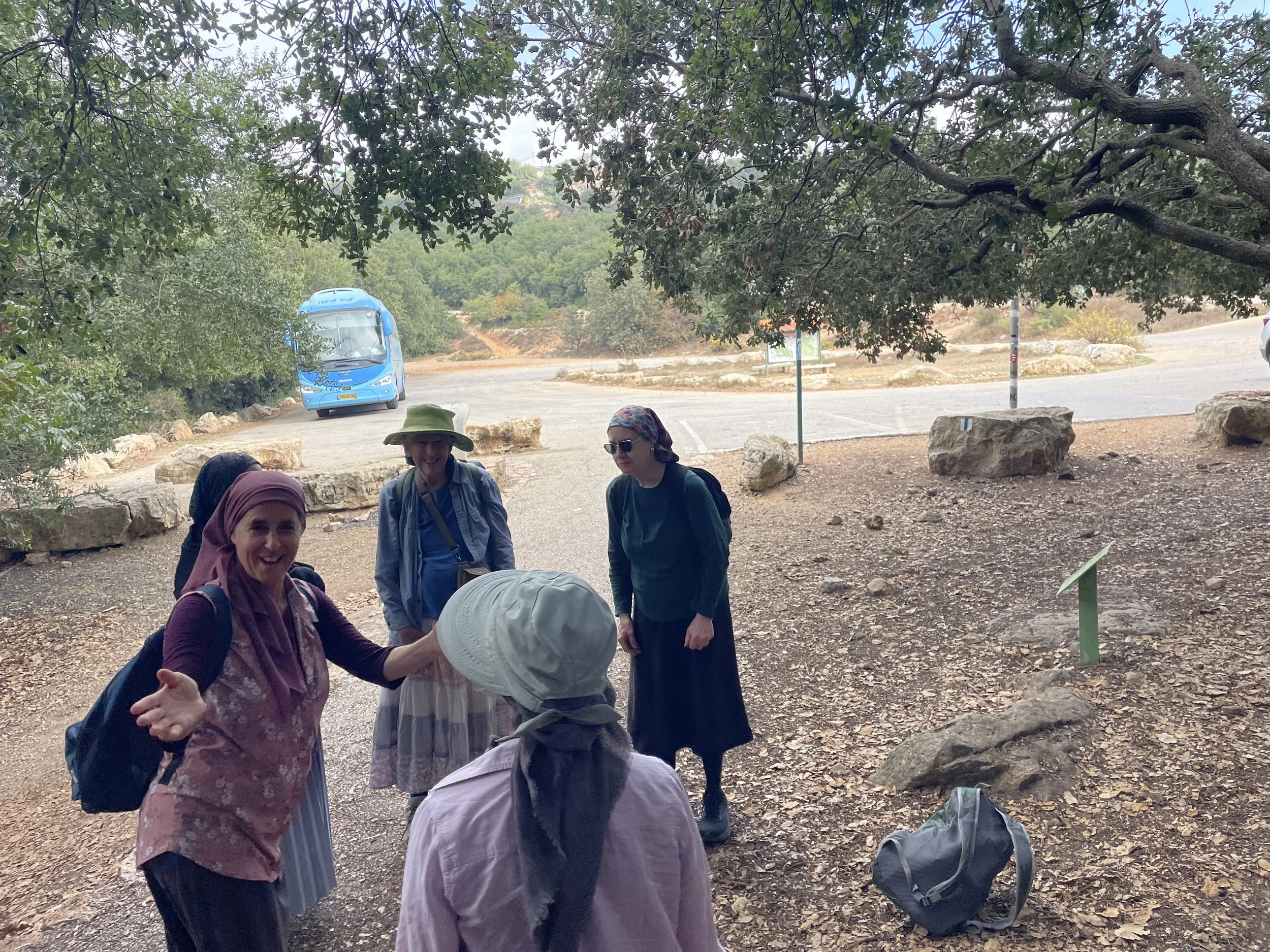
Rachel Leah and Maskit created a journey through both the visible and invisible mountain. We did not simply move from one point to another. We stopped, touched, listened and allowed what surrounded us to enter our awareness.
See Article below: The Path The Soul Remembers; A journey through Mount Meron, memory, revelation and the hidden Light within
by Leah Friedman
WHAT DO YOU DO WITH ALL THAT LIGHT?
The Day After Rosh Chodesh Cheshvan,
We Walk Forward
By Rachel Leah Weiman
This morning, as the first light of sunrise washes over Mount Meron, I look out from my window, as I do every morning. The mountains are familiar, their silhouettes etched into the horizon I have come to love. But this morning, something has changed. The mountain looks different. Or perhaps it is I who have changed. Yesterday, I walked through those forests, rested beneath those ancient trees, touched the weathered stones, and discovered little worlds of life hidden beneath the grasses. I followed winding paths and stood in places that, until now, I had only gazed toward from a distance. And now, looking out at Meron, I feel a new intimacy, a familiarity born not simply from seeing, but from encountering. The mountain is no longer only a magnificent view. It has become a place I know from within. Baruch Hashem.
And it all began with a simple question.
The day after Rosh Chodesh Cheshvan, what do you do? The shofar has fallen silent. The sukkah has been taken down. The dancing has stopped. The extraordinary illumination of Tishrei has given way to the ordinary rhythms of life. No more chagim waiting around the corner, no prescribed rituals carrying us from one revelation to the next. So what do we do with all that light?
We walk.
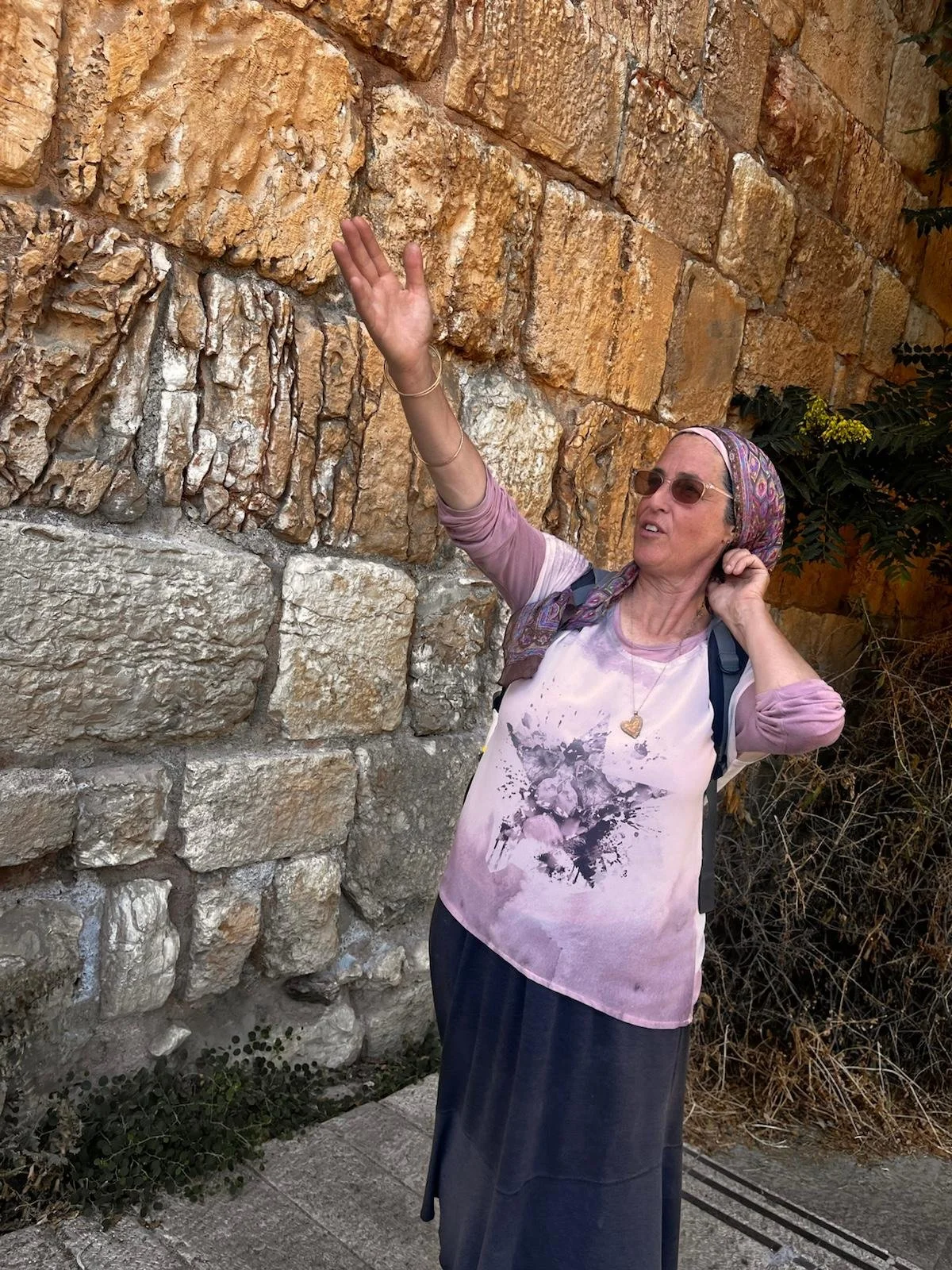
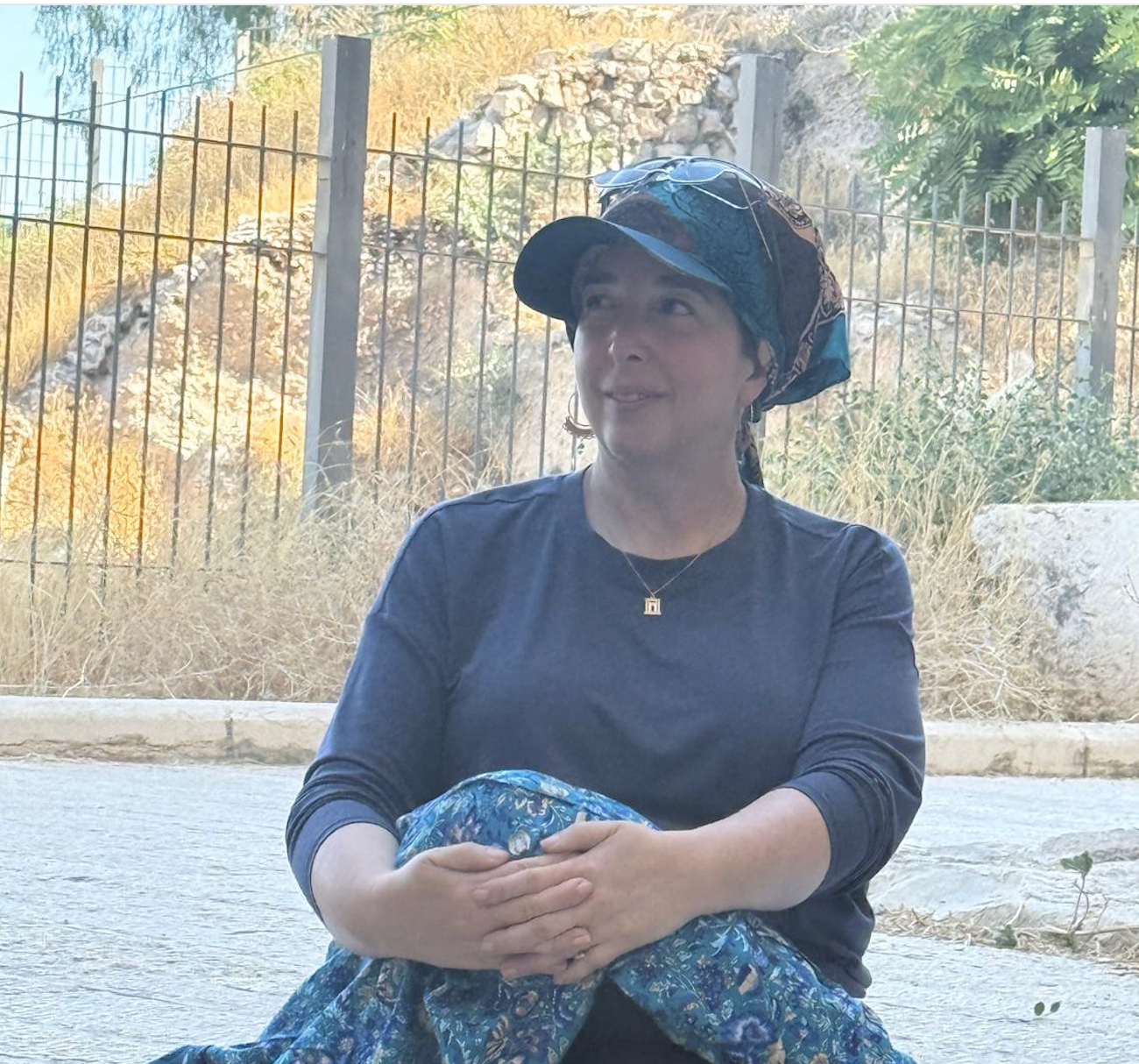
And so, a group of women gathered at the summit of Mount Meron for a journey through ancient woodlands, hidden springs, forgotten ruins, and the traditional resting places of Shammai and Hillel, continuing toward the inner light of Rabbi Shimon bar Yochai. Our wonderful nature guide, Maskit Ben-Moshe, brought the mountain alive through her intimate knowledge of its history, geology, and extraordinary botanical life. I brought teachings and embodied practices exploring the relationship between Boundary / גבול, Spaciousness / מרחב, Inner Light / אור פנימי, and Repair / תיקון.
But the mountain had prepared its own Torah, and as the day unfolded, we discovered that some of its most profound revelations were hidden in the smallest things.
A Constellation Hidden in the Earth
We opened our circle at the summit, feeling the firmness of the mountain beneath our feet and the immense spaciousness of the sky above us. The earth was holding us, while the horizon invited us beyond the boundaries of our familiar perception. We began with the relationship between Light and Vessel / אור וכלי, the essential movement through which light becomes receivable. The vastness of Ohr Ein Sof is beyond our capacity to contain, yet every particular vessel allows something of that light to become present within creation.
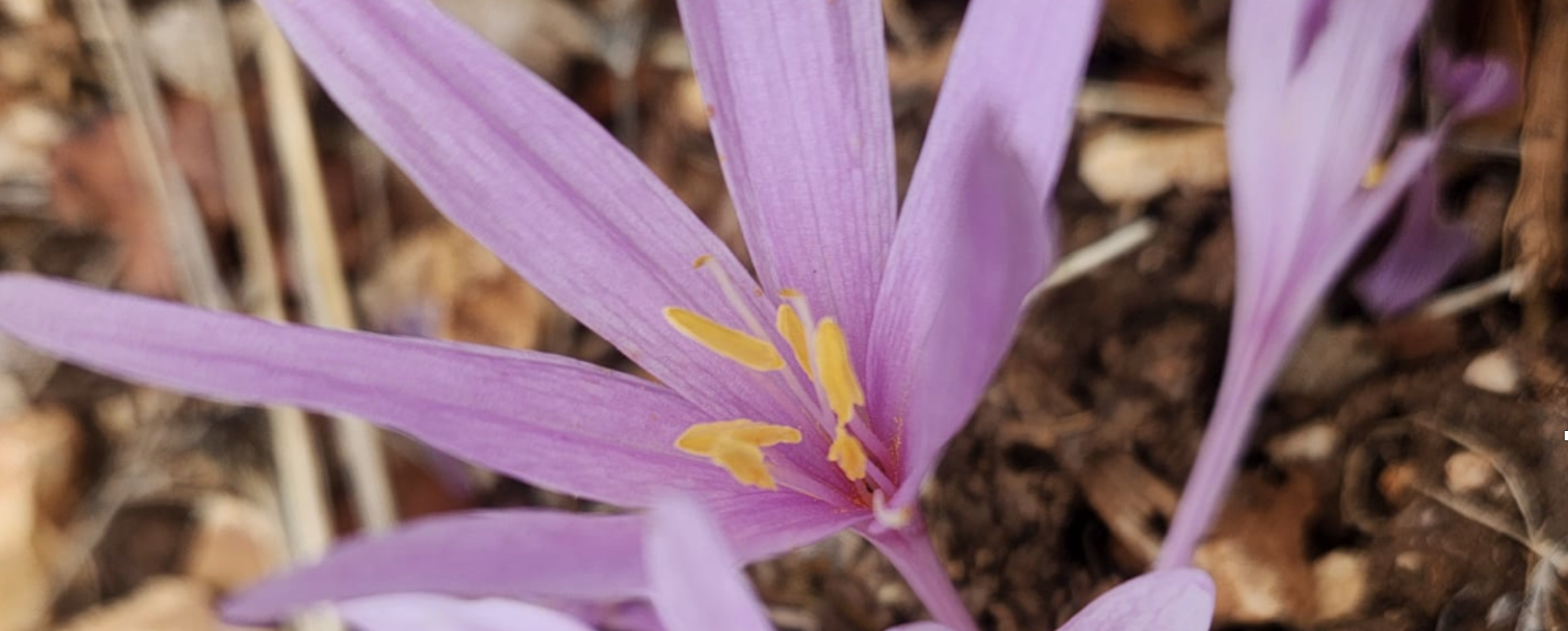
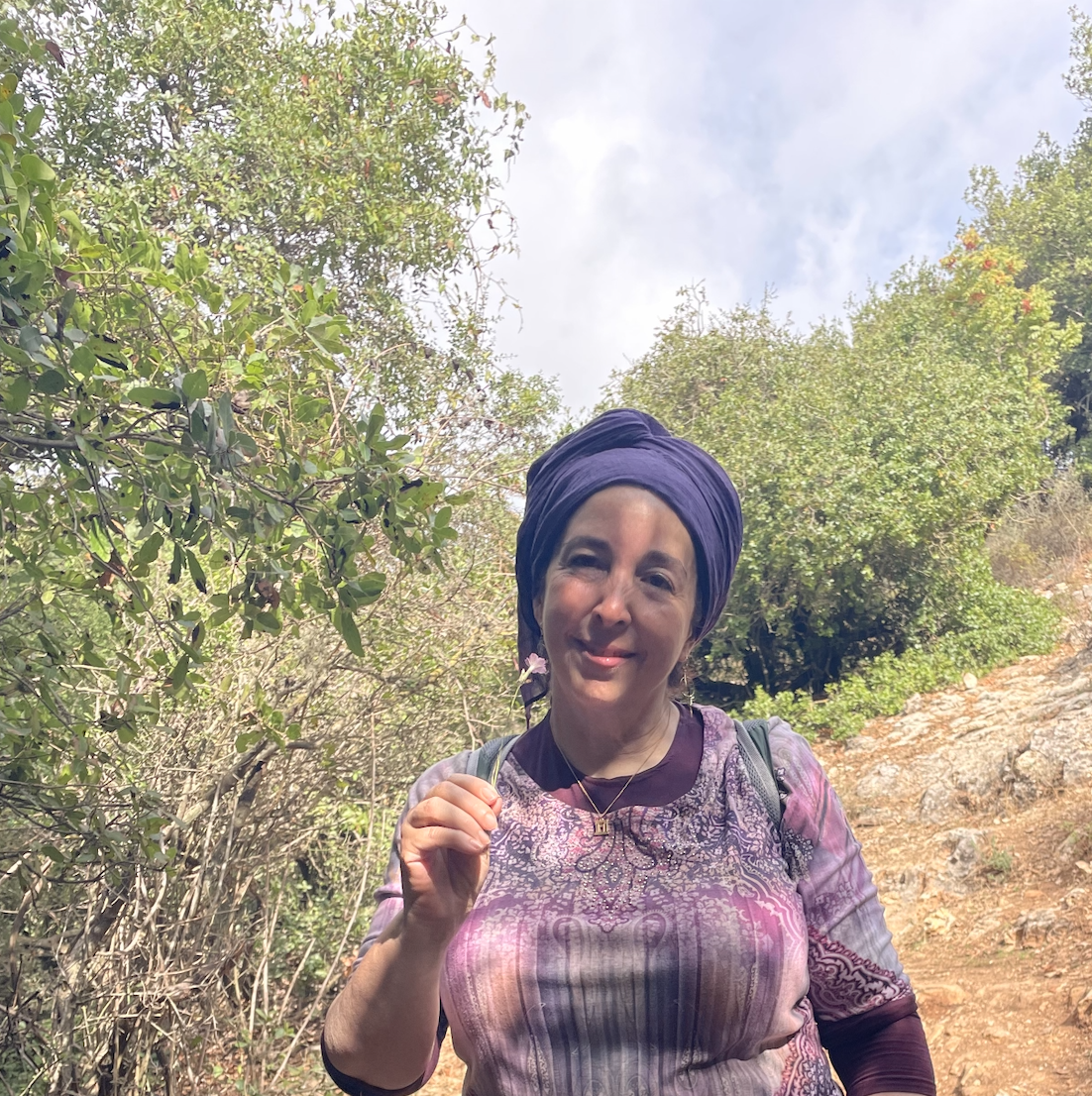
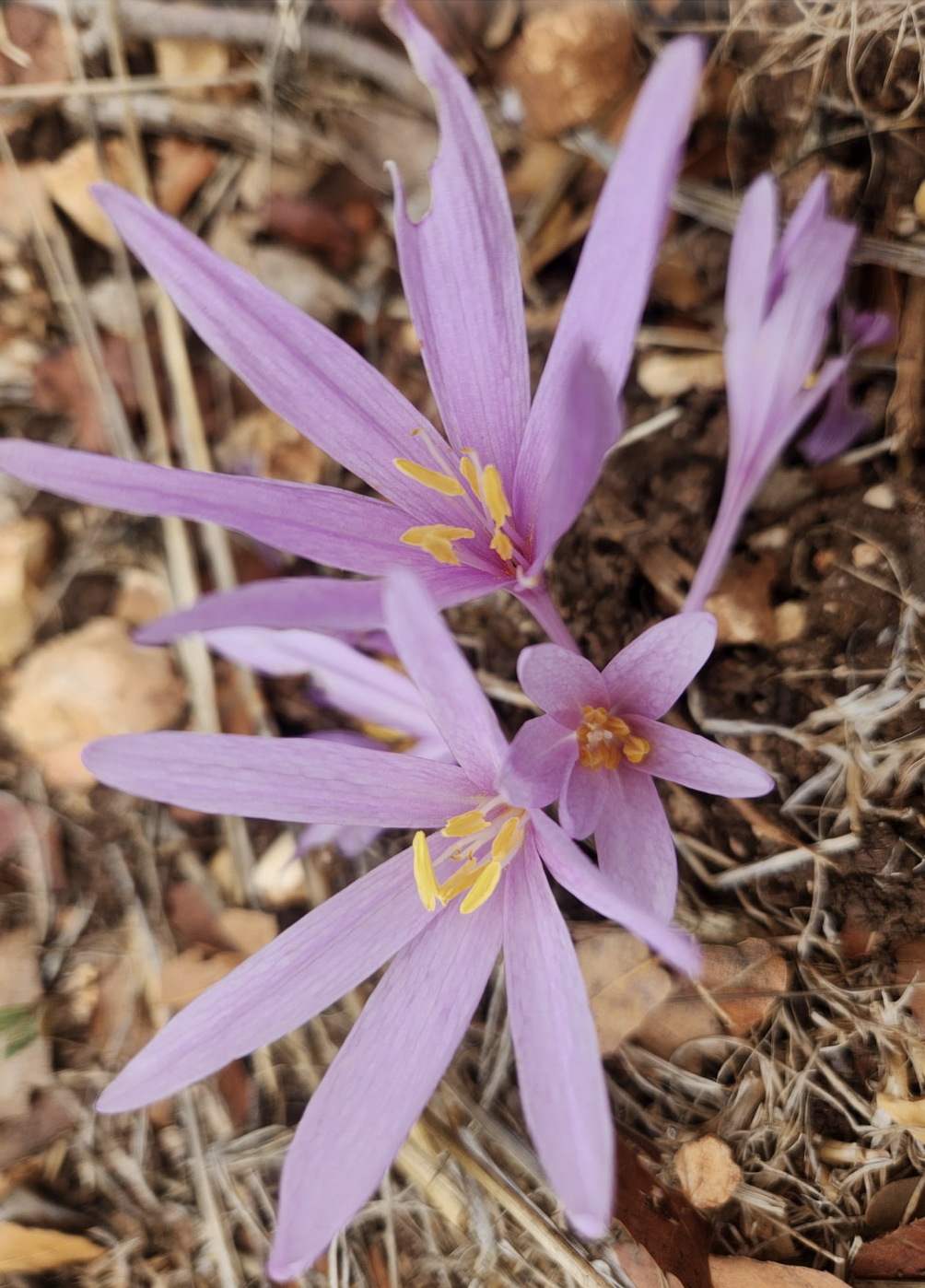
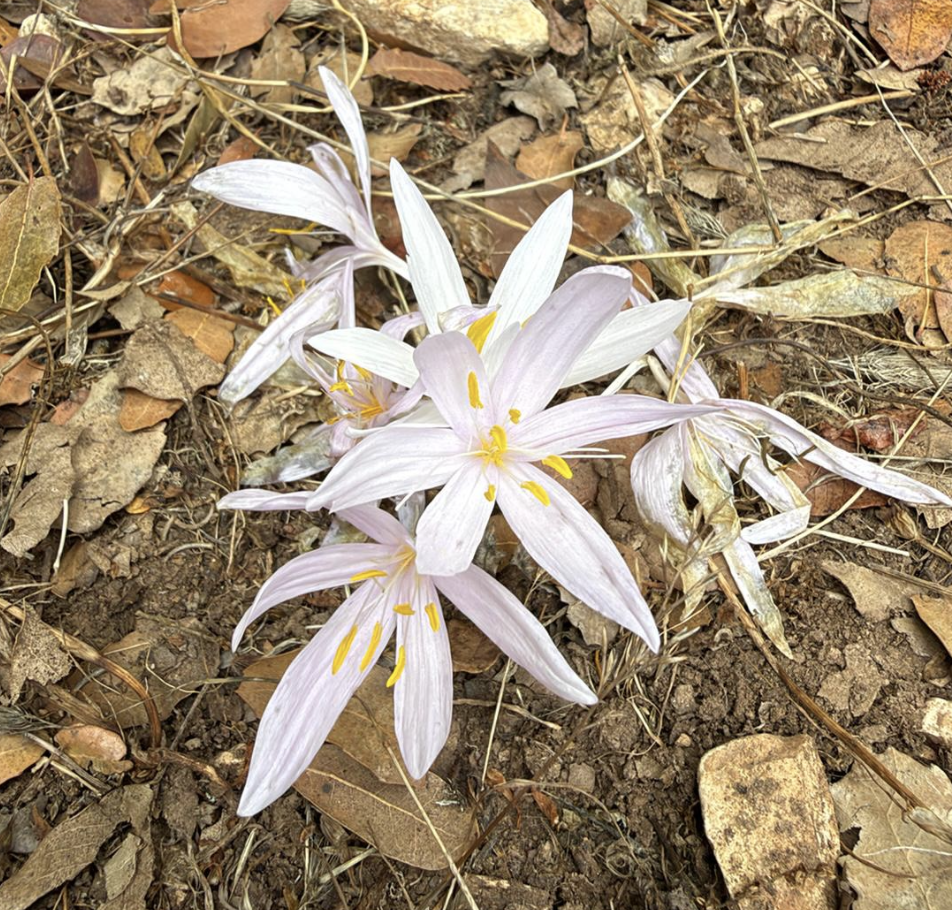
Then Maskit invited us to look down… Emerging from the dry autumn earth were delicate lilac-pink flowers, their six slender petals opening around golden centers. We had a close encounter with the autumn crocus / סִתְוָנִית הַיּוֹרֶה, sitvanit ha-yoreh. Its Hebrew name means “the autumn crocus of the first rain.” Hidden beneath the earth, its corm sends a long floral tube upward through the soil, and the flower appears before its leaves. It is a living image of Cheshvan: concealed life responding to the first rain, quietly emerging from beneath the surface.
The crocuses scattered across the forest floor, resembled a constellation of tiny flames, as though the heavens had deposited their stars upon the earth with their star-like forms, scattered across the forest floor like a constellation of tiny flames. Not in the heavens, but beneath our feet.
Their six petals brought to mind the Six Directions / ששת הקצוות, the dimensions through which the light of creation unfolds, while the golden center suggested the Inner Point / נְקֻדָּה פְּנִימִית, where multiplicity gathers around a single source.
And here was their remarkable secret. These flowers emerge from underground corms that have stored the nourishment required for flowering, often blossoming before their leaves appear. The apparently barren ground had been preparing this revelation all along.
Rachel Leah opened our circle we stood as a constellation of a crocus feeling our individual and collective malchut rising from the earth, feeling the firmness of the mountain beneath our feet and the immense spaciousness of the sky above us.
Revelation within Concealment / גילוי בתוך ההעלם.
What a remarkable introduction to Cheshvan, the month that appears to have lost the revealed light of Tishrei, yet is already holding another expression of life beneath the surface.
The flowers had appeared before the leaves, just as understanding sometimes comes before we can see the structures that will eventually support it. There is a concealed ripening, a quiet accumulation of Life Force / חיות, long before the first visible sign of transformation.
What appears empty may actually be gestating.
The Terebinth and the Secret of Shedding
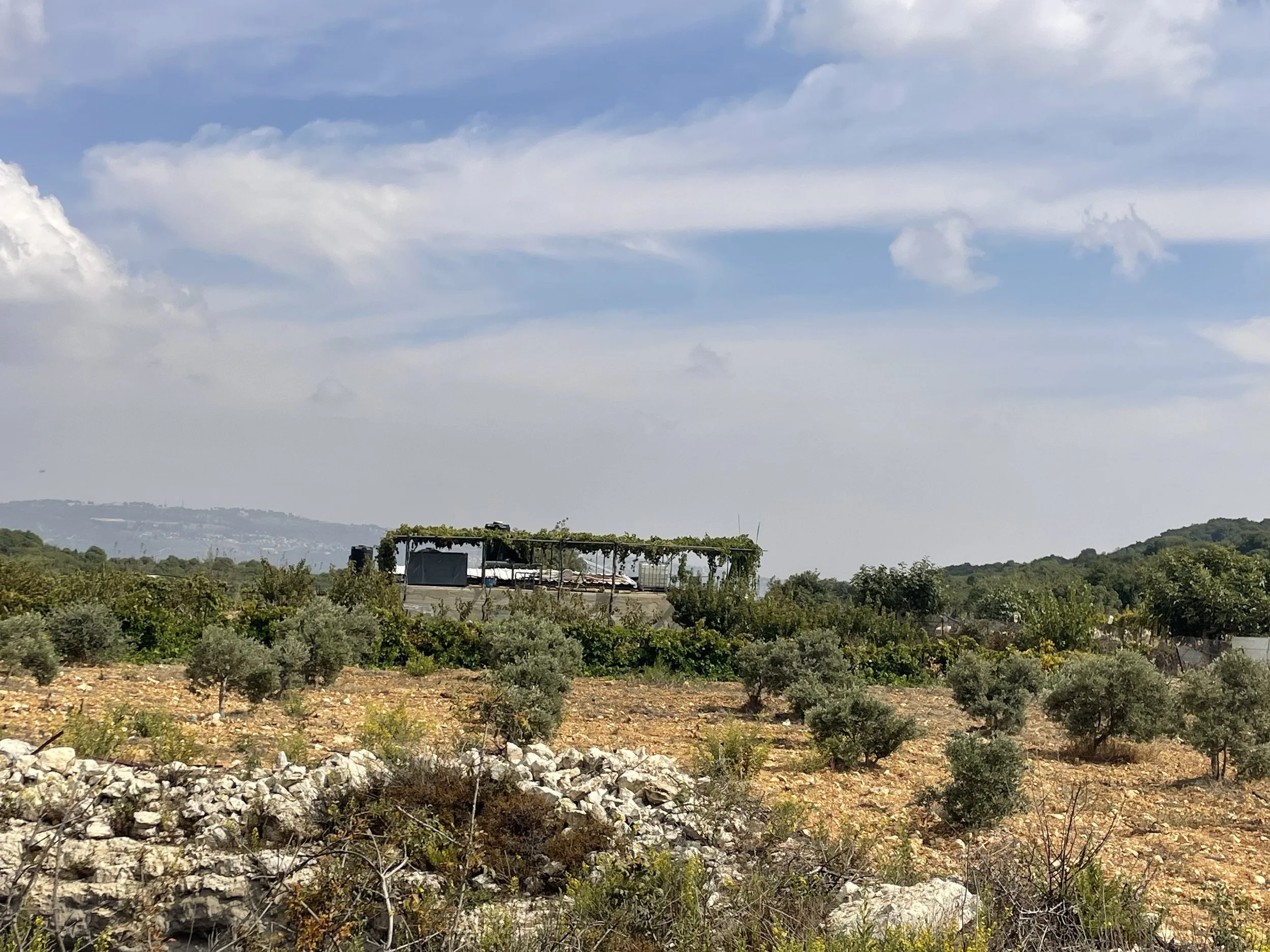
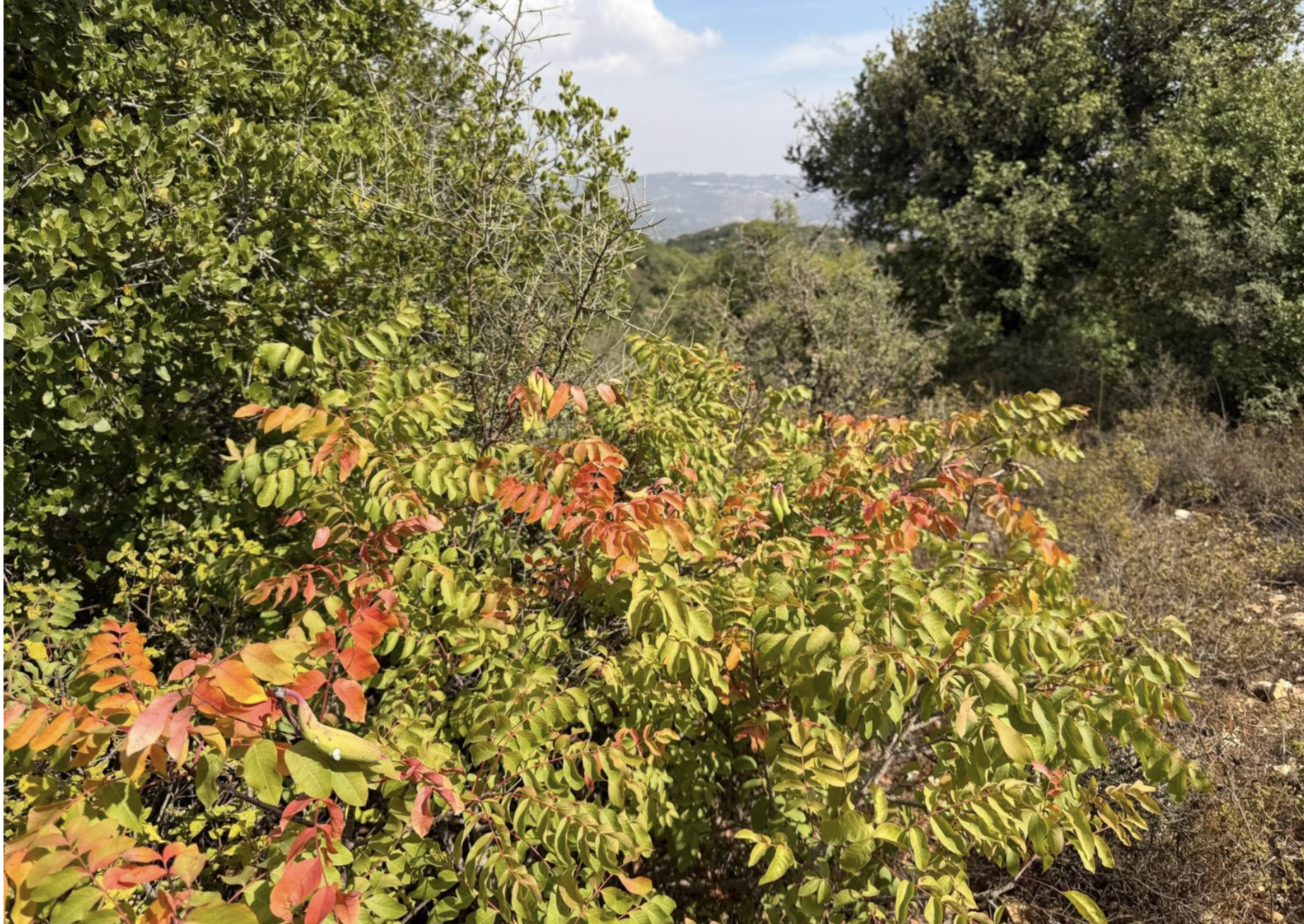
Autumn on Mount Meron is astonishing. Pale golden grasses cover the hillsides, ancient limestone formations rise from the earth, and deep-green oak forests frame extraordinary views across the Galilee. Then suddenly, amid the predominantly evergreen landscape, we encountered an explosion of copper, crimson, orange, and gold.
The Terebinth / אֵלָה (Elah) was beginning its autumn transformation.
The Elah and the Oak / אַלּוֹן (Alon) are deeply woven into the ancient landscape of Eretz Yisrael and the language of Tanach. Avraham arrives at Elon Moreh (Bereishit 12:6), and later Hashem appears to him among the Elonei Mamre (Bereishit 18:1). Yaakov buries the foreign objects surrendered by his household beneath an Elah near Shechem before continuing toward Beit El (Bereishit 35:4).
There is an extraordinary movement concealed within Yaakov's encounter with the tree. Before his household can ascend toward Beit El, something must be surrendered. The ascent requires a preceding Separation and Discernment / הבדלה ובירור. Not everything that has accompanied us belongs in the next stage of our journey.
The Elah and Alon are botanically distinct trees, although the precise identification of these names in Tanach varies by context. Yet together, they evoke the endurance of ancient roots and the mystery of life sustained through changing seasons.
On Meron, they offered us two expressions of rootedness. The evergreen oak retains its foliage, while the terebinth releases its leaves in preparation for winter, turning brilliant shades of red and gold before standing bare. One remains green, the other lets go, yet both remain deeply rooted.
As we examined the terebinth's leaves, some still green and others already ablaze with autumn colors, I was struck by the beauty of a tree simultaneously holding what is passing and what remains. Nothing about the transition was uniform, yet the entire tree was magnificent. It did not need to preserve every leaf to remain fully itself.
How much of our own growth requires this same willingness to release what has completed its purpose without losing our connection to our Root / שורש?
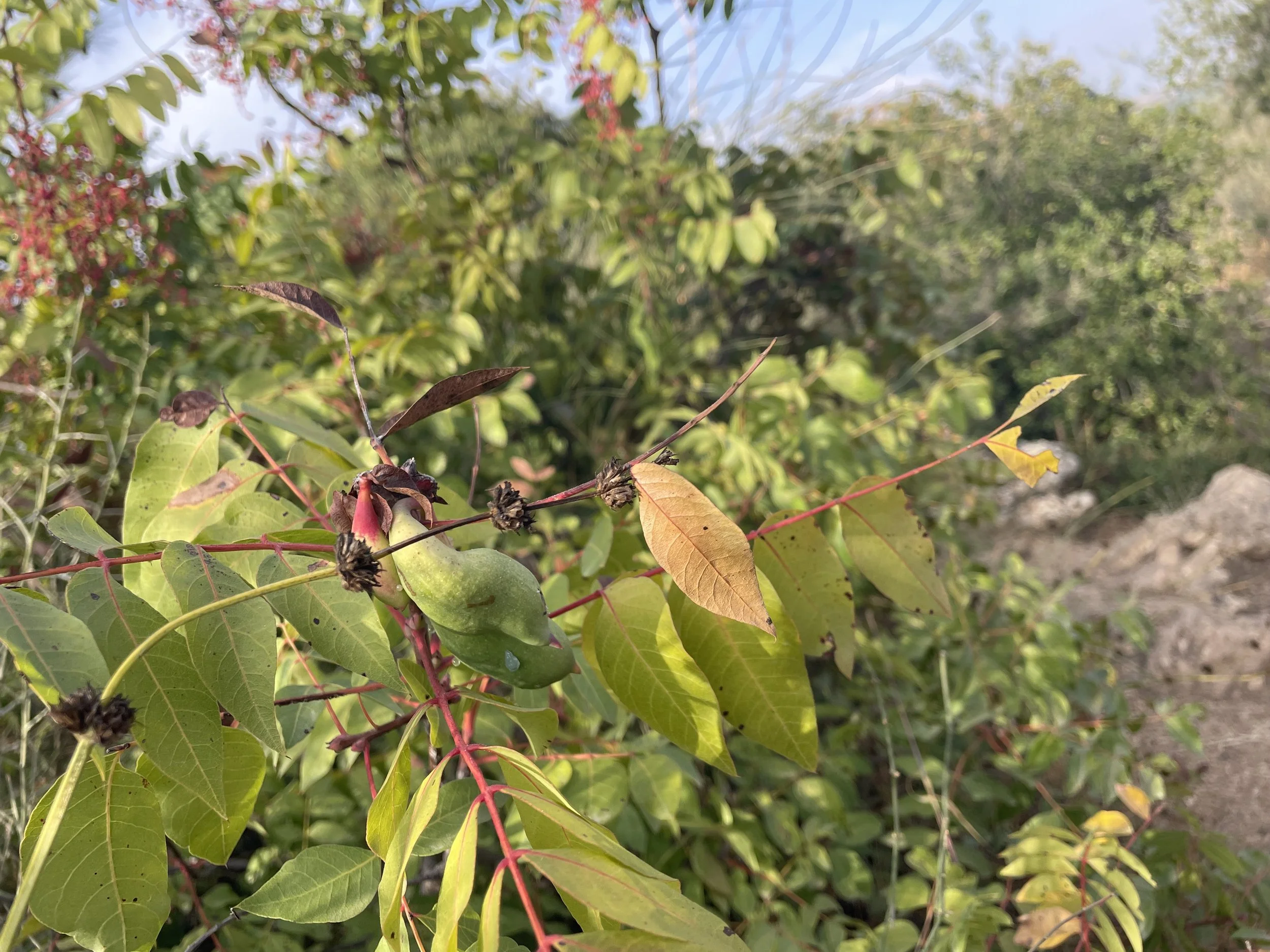
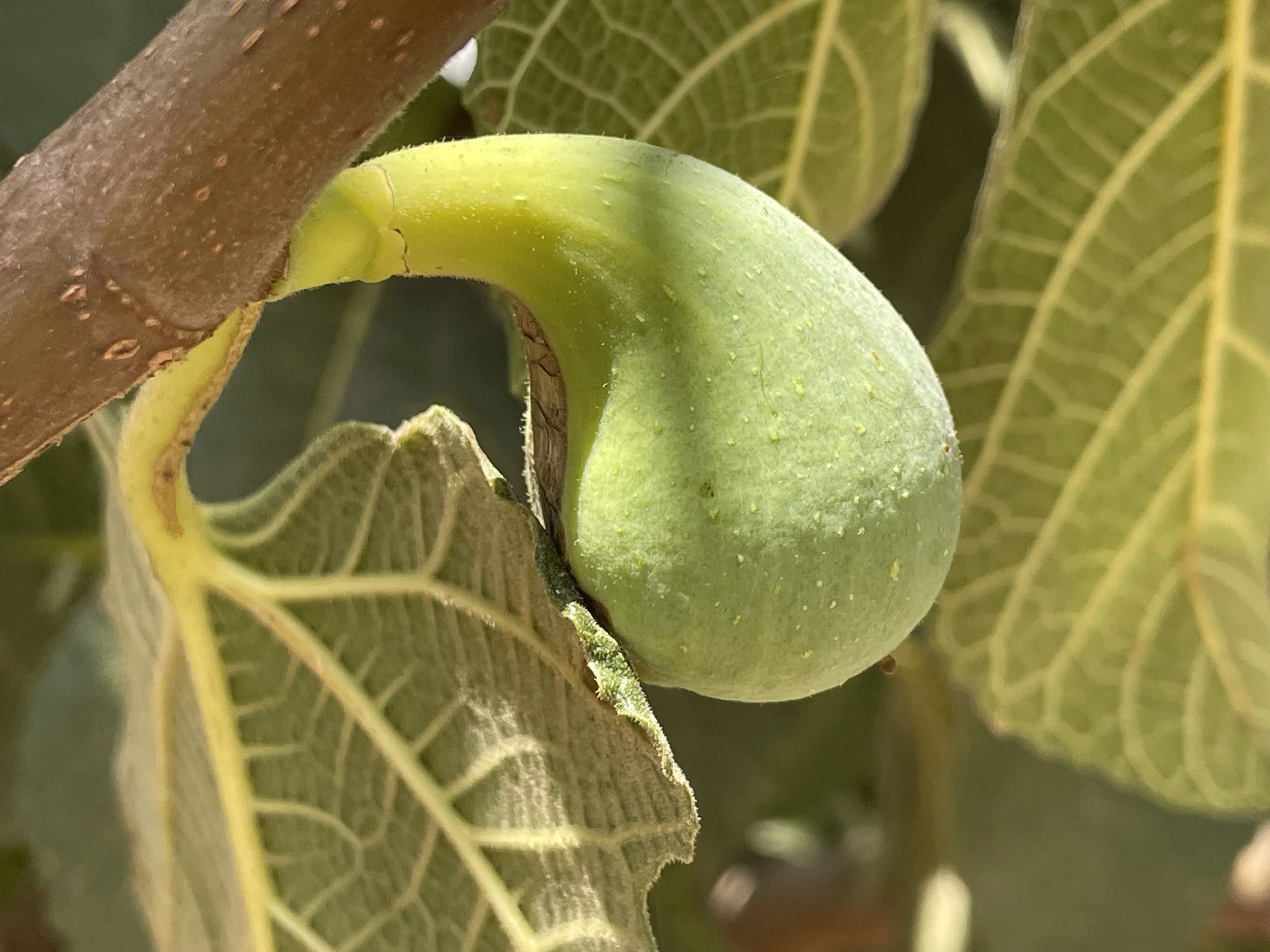
Then Maskit opened what appeared to be a small fruit growing on the terebinth, and to our amazement, a cloud of pale, fluffy, powdery material burst outward! We had apparently encountered one of the remarkable insect galls that develop on these trees, structures formed through the interaction between the tree and tiny insects. What looks like an ordinary growth can conceal an entire miniature world.
We stood astonished. Something hidden had suddenly become visible, almost theatrically, right before our eyes.
Again, Revelation within Concealment / גילוי מתוך ההעלם.
We thought we were examining a fruit. Instead, we had opened a mystery.
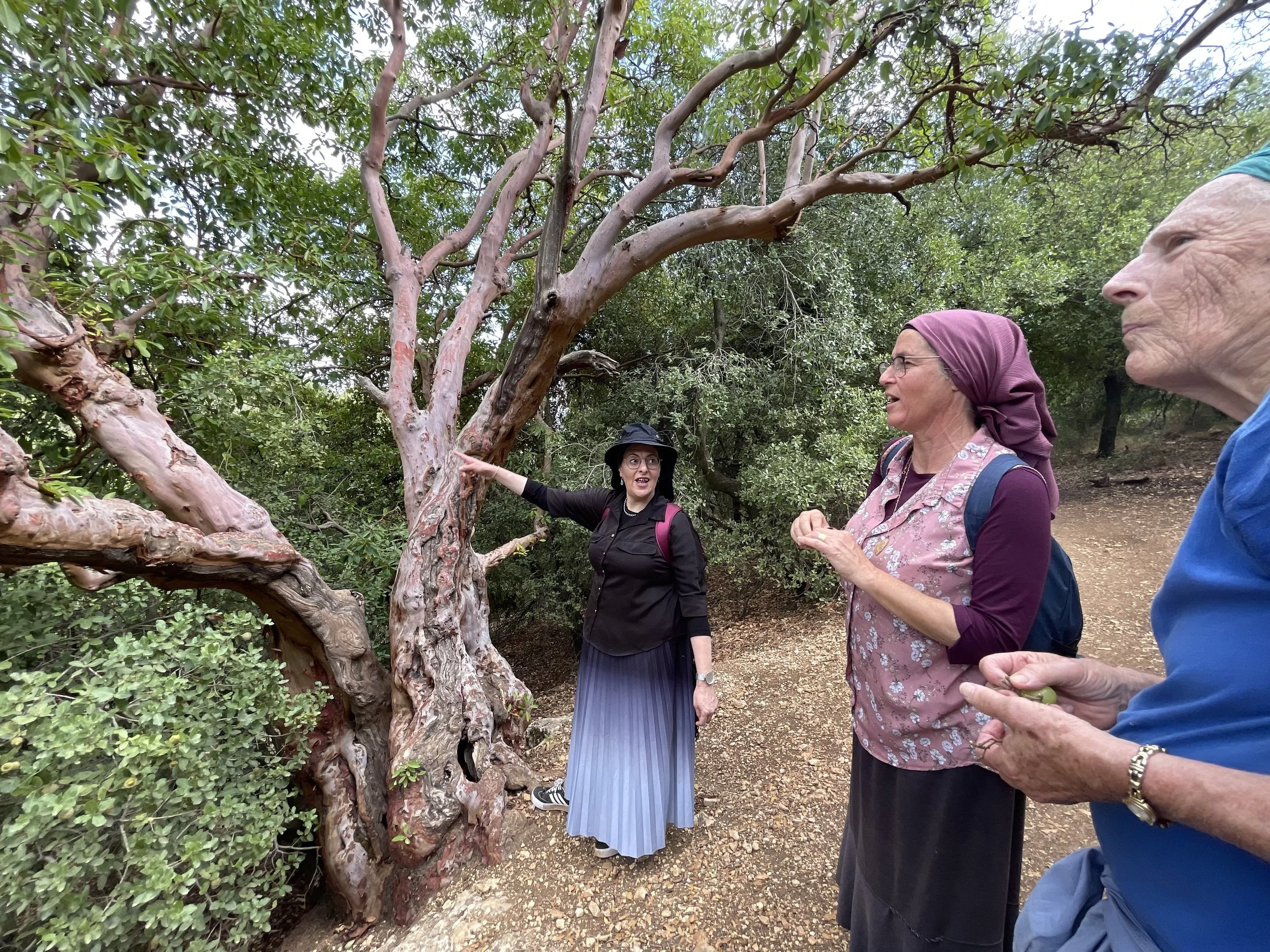
Not far away, another tree offered an entirely different lesson. The Katlav / קְטָלָב, the Eastern Strawberry Tree, reveals its extraordinary copper-red trunk as layers of outer bark naturally peel away. Its striking color has inspired a dramatic folk legend connecting its name with katal av, the killing of a father, the reddish bark imagined as blood. This is folklore rather than an established linguistic explanation, but the tree itself offered us another understanding.
The terebinth releases its leaves. The Katlav sheds its bark. Neither loses its essential life.
How much of our identity becomes attached to the outer garments through which we have learned to inhabit the world? The roles we assume, the expectations we fulfill, the protective patterns developed over years of living. These Garments / לבושים can serve us faithfully, yet they are not the essence of the neshama.
Sometimes what appears to be a loss of protection is actually the revelation of another layer of life.
The tree does not need to invent a new essence. It reveals what was already alive beneath the surface.
Even Wonder Requires Gevurah
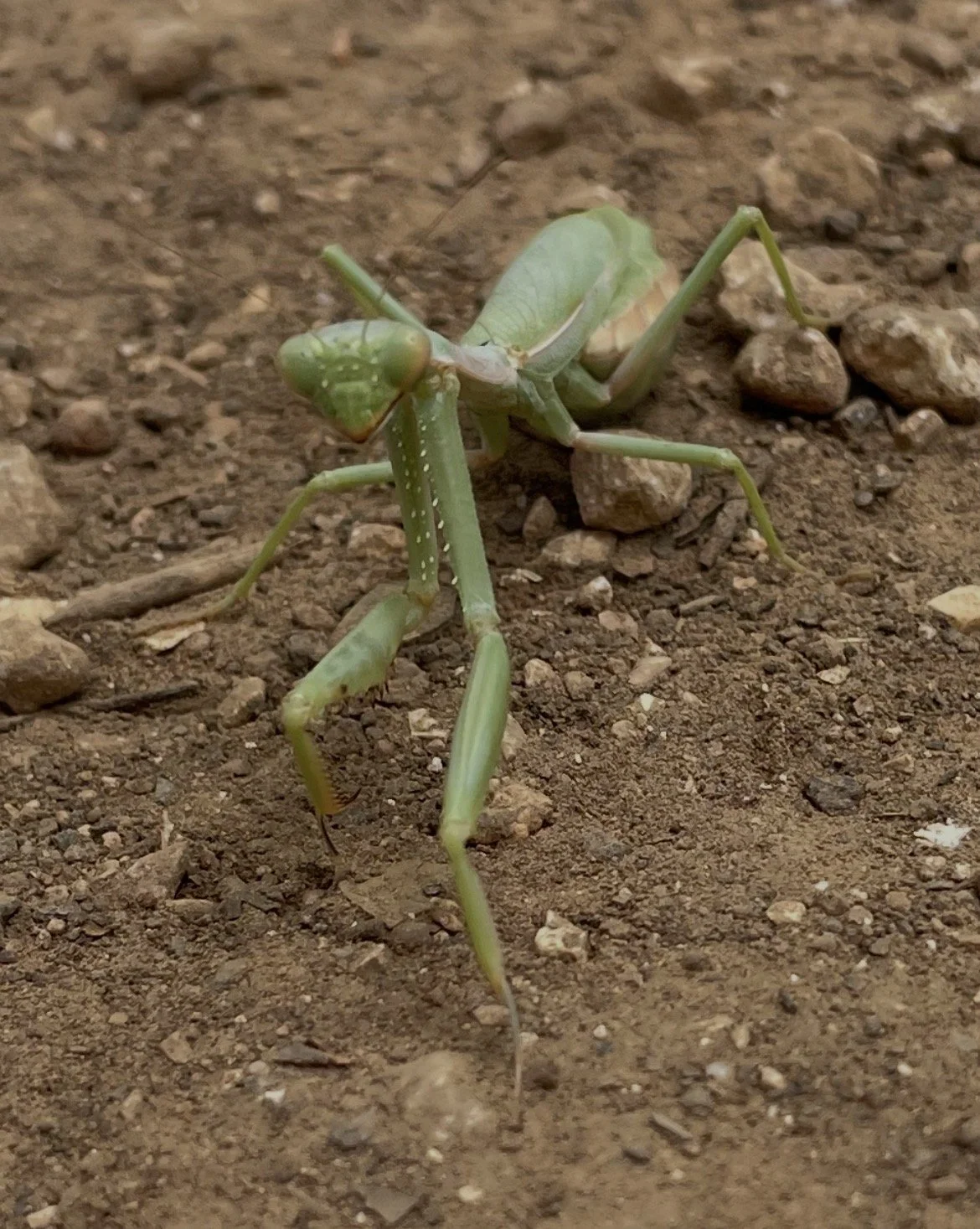
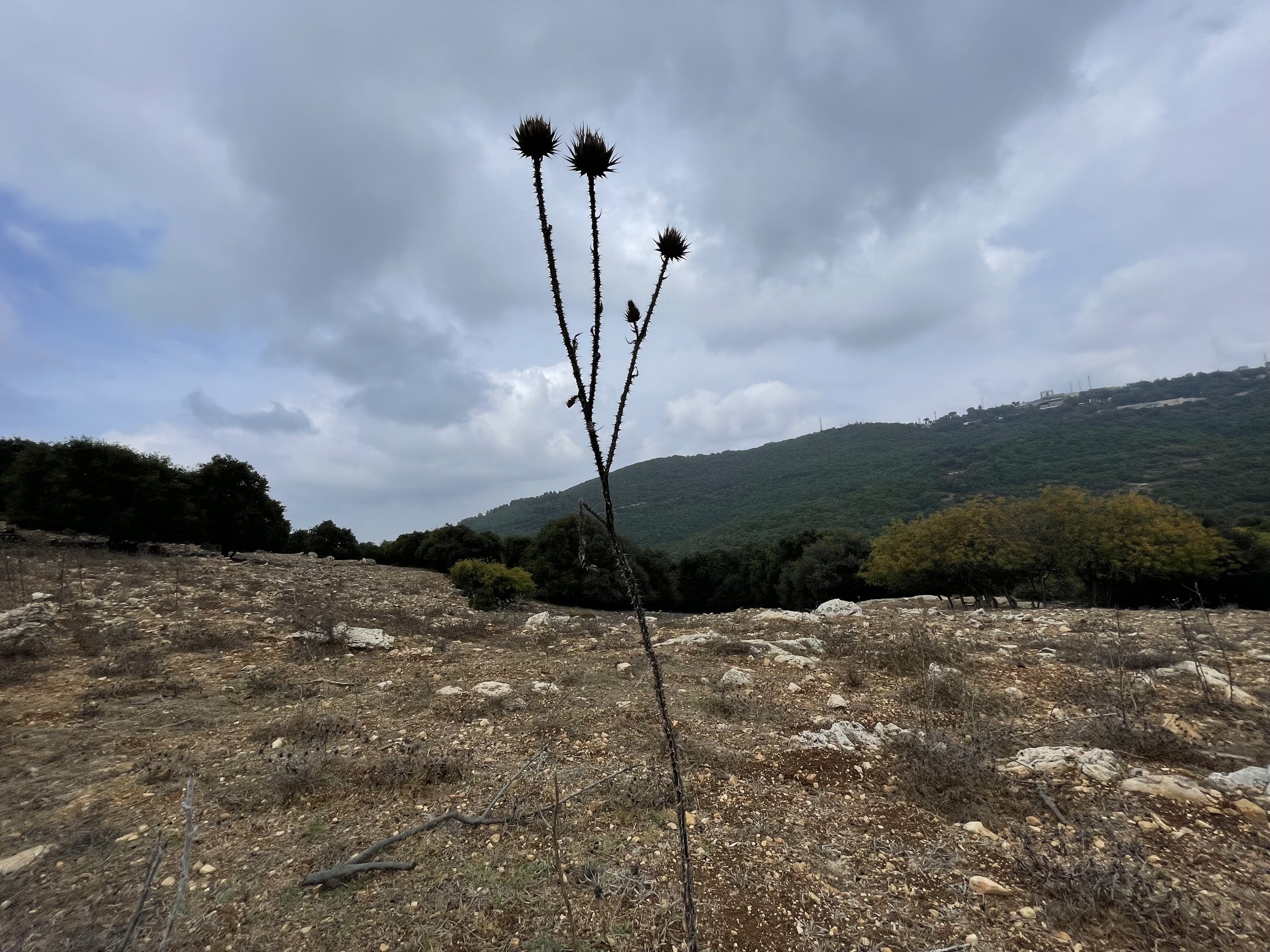
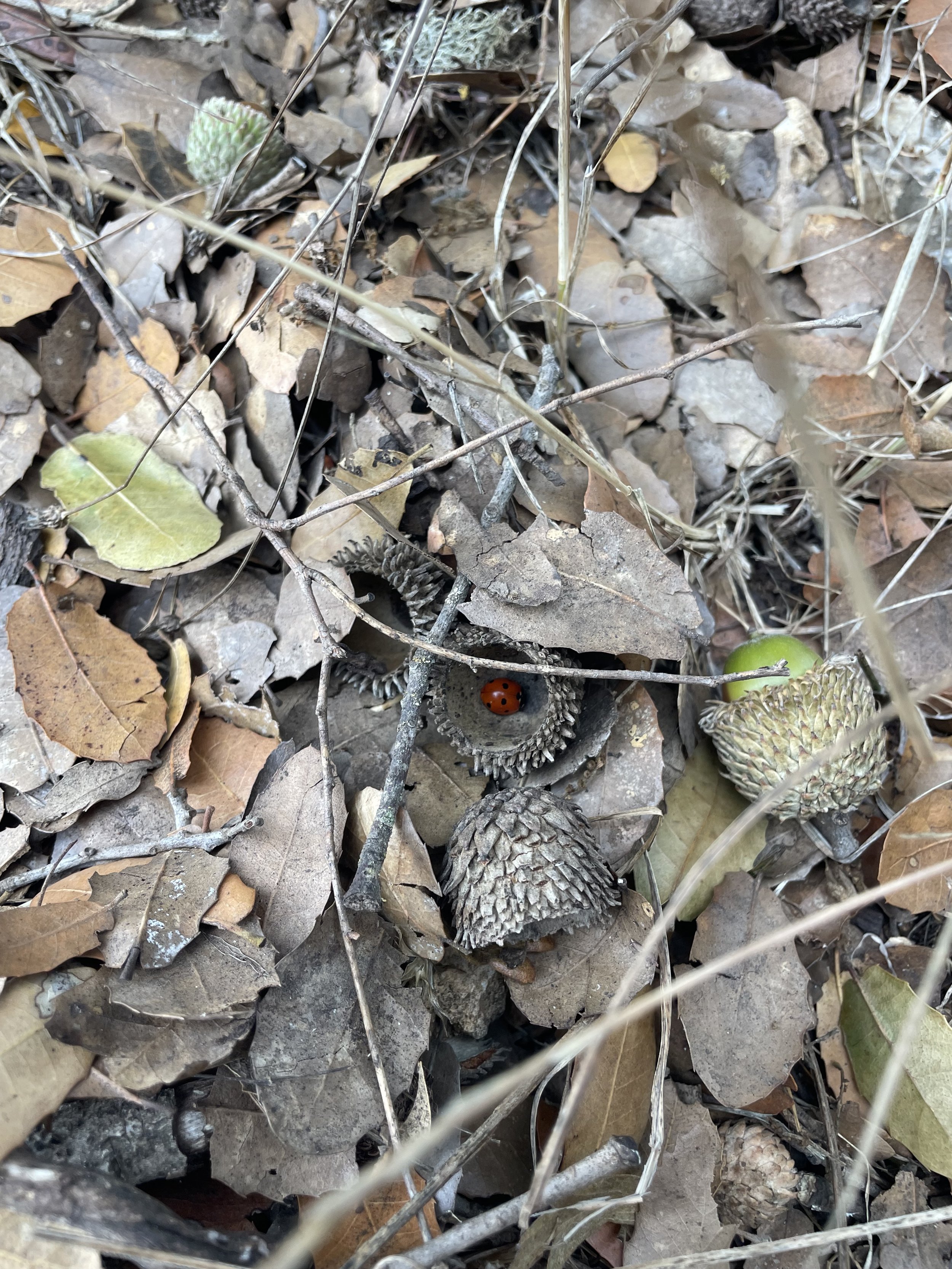
Our fascination with the mountain was becoming an adventure in itself. Every few steps, someone discovered something else. A green praying mantis standing almost motionless on the rocky earth. A ladybug tucked into an acorn. Delicate seed heads rising against the sky like miniature constellations. Extraordinary rock formations, ancient stones, unexpected colors, and flowers emerging from apparently lifeless ground.
Around every bend, we were being showered with Hashem's surprises.
At one point, someone laughingly observed that if we had been walking through the Yam Suf, we would never have reached the other side! We would have been so overwhelmed by the wonders of Ma'asecha Hashem, the works of Hashem, that we would have stopped every few feet to admire them!
We laughed because it was entirely true. We were so enchanted by creation that moving forward required genuine intention.
And there was our next Torah lesson.
Even wonder requires Gevurah / גבורה.
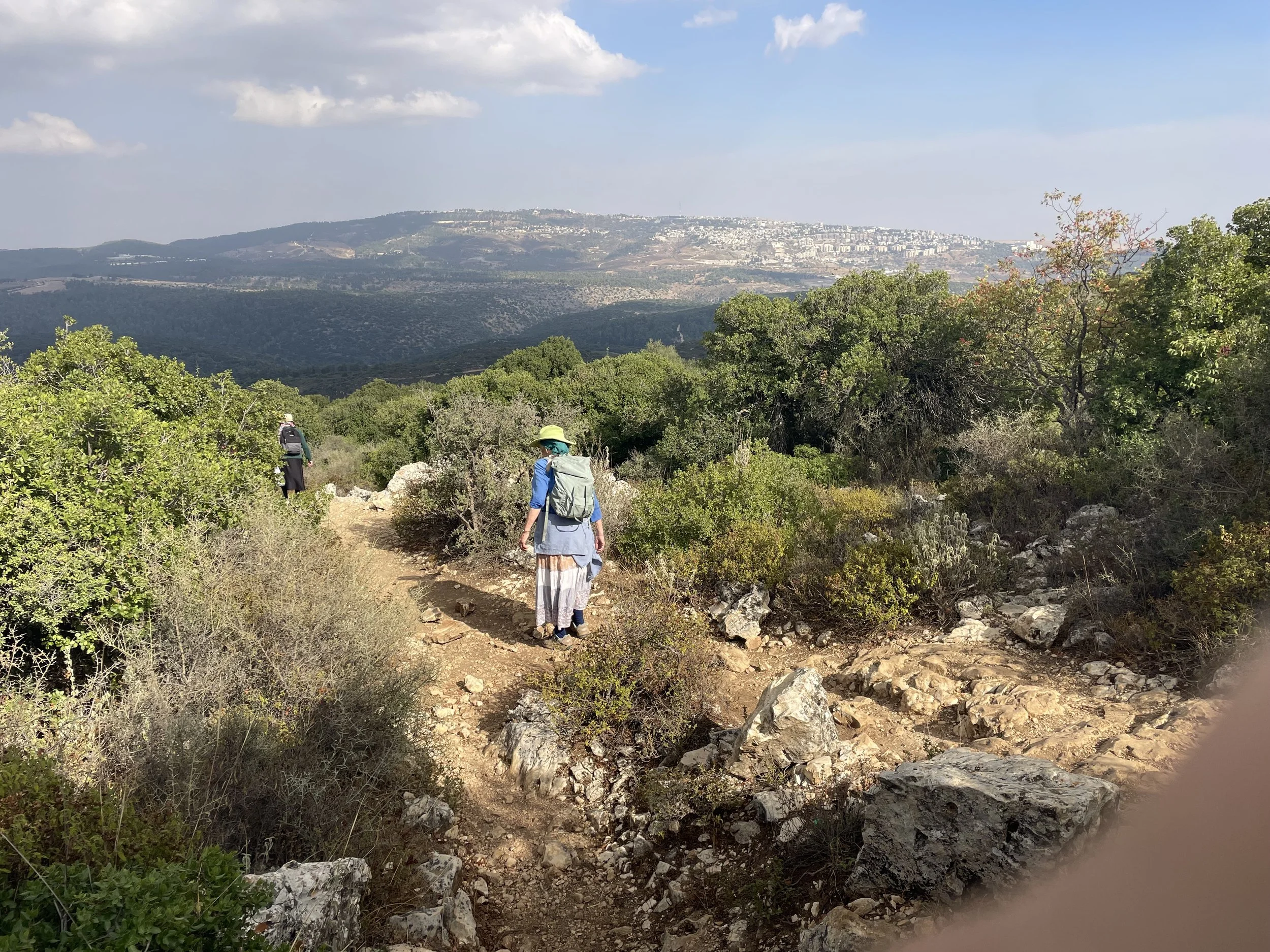
There is a time to stop, observe, marvel, and receive, and there is a time to continue moving, remain within the boundaries of the trail, and make our way toward the next destination. The narrow path itself became our teacher. Its boundaries were not restricting our freedom; they were making the journey possible.
This is the beauty of Constriction / צמצום when it serves life. The vessel gives light a form through which it can enter the world. Without the banks of a river, its waters lose their direction. Without a path, our expansive curiosity might have kept us wandering endlessly through the forest.
And so our walk became a living dance between Gevurah / גבורה, the capacity to contain and direct, and Chesed / חסד, the expansive movement of receiving and opening.
We needed both to arrive.
Shammai: The Path of Holy Boundaries
Our stop at the traditional resting place of Shammai brought this experience of Gevurah into sharper focus. Shammai teaches in Pirkei Avot 1:15:
עֲשֵׂה תוֹרָתְךָ קֶבַע, אֱמֹר מְעַט וַעֲשֵׂה הַרְבֵּה, וֶהֱוֵי מְקַבֵּל אֶת כָּל הָאָדָם בְּסֵבֶר פָּנִים יָפוֹת.
“Make your Torah a fixed practice. Say little and do much. Receive every person with a beautiful countenance.”
How extraordinary that the teacher most associated with boundaries concludes by insisting upon the beauty of our countenance toward another human being. Shammai's Gevurah is not simply strictness. It is the capacity to create a vessel strong enough to hold what matters without closing the heart.
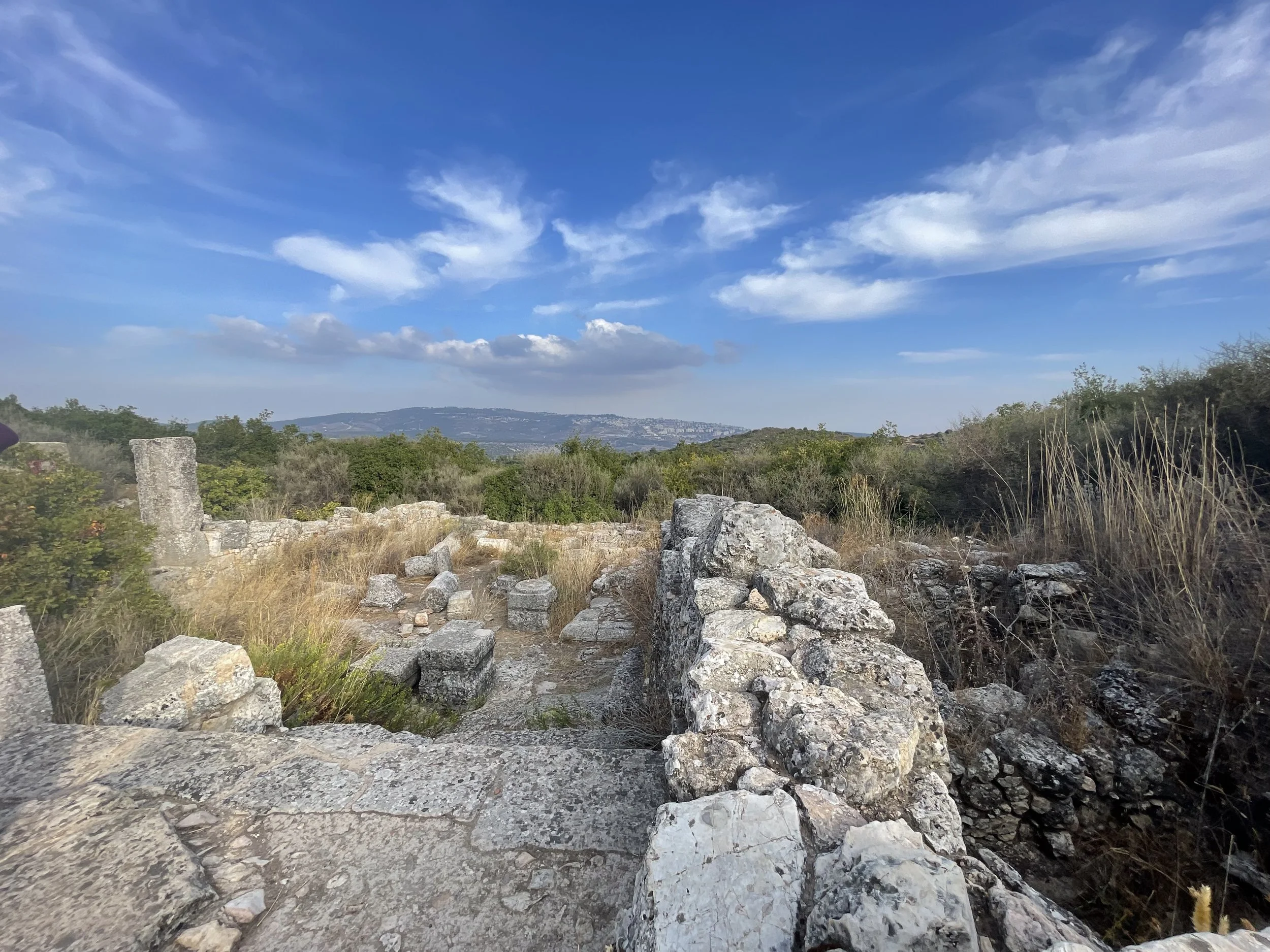
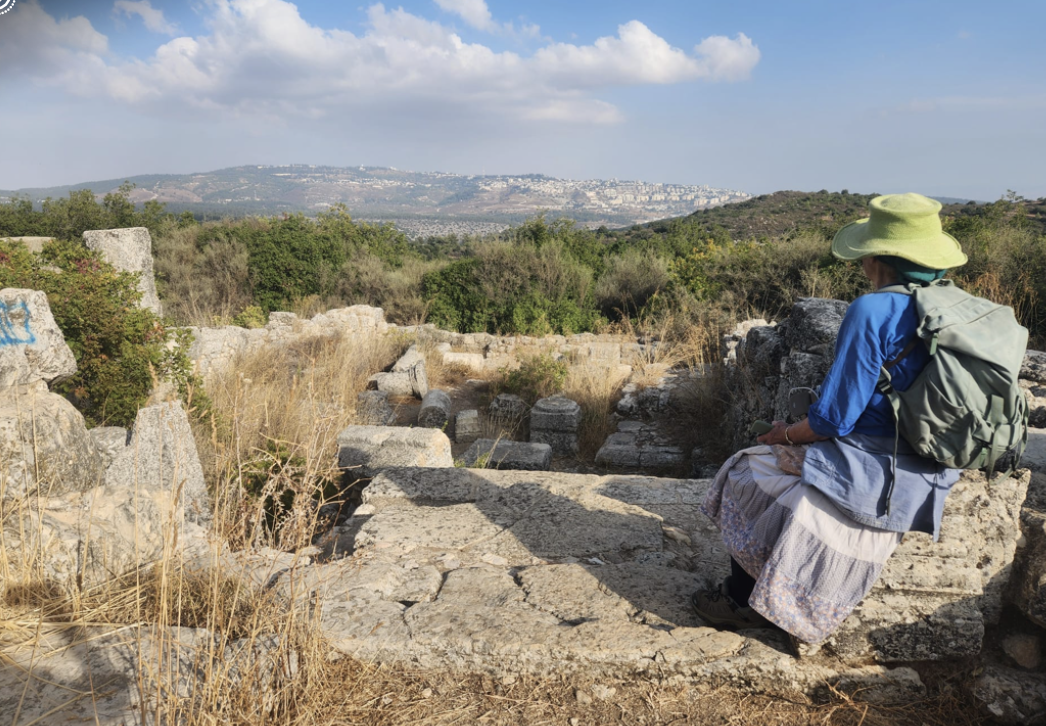
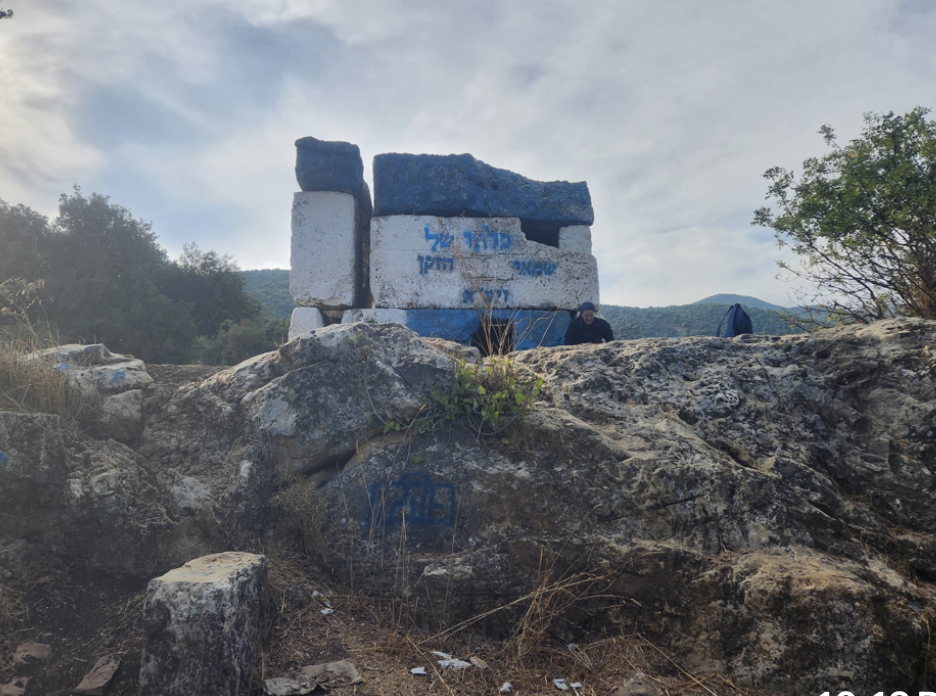
The ancient synagogue ruins nearby made this teaching tangible. We stood among weathered stones, remnants of walls and structures that had once enclosed the gatherings, prayers, and learning of Jewish communities who lived on this mountain centuries before us. The ruins associated with the ancient settlement at Churvat Shema preserve traces of a world whose inhabitants once knew these pathways as intimately as we know our own neighborhoods.
Looking out across the mountains from among the fallen stones, I found myself thinking about the relationship between a structure and the life it is created to contain. A synagogue is not merely an arrangement of stones. It is a vessel for Torah, tefillah, and the presence of a community gathered before Hashem. Its walls create an interior, and the interior makes gathering possible.
This is the purpose of Boundary / גבול: to create a place where Indwelling Presence / השראה can rest.
A boundary becomes an expression of holiness when it protects what is precious. But when it becomes a rigid wall that excludes the very life it was intended to shelter, it has lost its purpose. True Gevurah is always seeking its Sweetening / המתקה, the transformation of severity into strength that serves love.
And Shammai himself gives us the key: receive every person with a beautiful face.
The firmness of the path and the softness of the face belong together.
Hillel: The Spaciousness of the Heart
As we continued along the mountain, Shammai's measured path opened toward Hillel's Spaciousness / מרחב. Hillel teaches in Pirkei Avot 1:14:
אִם אֵין אֲנִי לִי מִי לִי, וּכְשֶׁאֲנִי לְעַצְמִי מָה אֲנִי.
“If I am not for myself, who will be for me? And if I am only for myself, what am I?”
First, I must inhabit my own life. I must recognize the neshama entrusted to me, its particular shoresh, its boundaries, its responsibilities, and its gifts. Only then can I genuinely make room for another.
Hillel's Chesed is not the dissolution of self. It is an expansion that grows from an established center.
Unity / אַחְדוּת is not Uniformity / אֲחִידוּת.
The Elah does not need to become the Alon. Shammai does not need to become Hillel. And two women do not need identical histories, personalities, or ways of encountering Hashem to create genuine connection.
At one moment beneath the trees, two women sat back-to-back, their eyes closed, allowing the weight of their bodies to rest against one another. Each remained entirely herself, yet each became a support for the other. Neither needed to surrender her center for the connection to exist.
The more deeply we inhabit our own inner ground, the more spaciously we can receive another.
This is the beginning of Interinclusion / התכללות, when the qualities of Chesed and Gevurah no longer compete but begin to illuminate and complete one another.
The Ancient Oak and the Hidden Spring
At Ein Zeved, beside the maayan, we reached a magnificent oak whose spreading branches created an immense canopy of shade. It was here that we stopped for lunch, and after the concentrated attention of the morning, there was something wonderfully simple about sitting beneath that ancient tree, opening our food, resting our feet, and allowing conversation to flow.
The oak had established its place long before any of us arrived. Its roots descended into hidden depths while its branches opened generously in every direction. Beside the spring, the entire scene seemed to embody the relationship between containment and flow.
כִּי עִמְּךָ מְקוֹר חַיִּים, בְּאוֹרְךָ נִרְאֶה אוֹר.
“For with You is the Source of life; in Your light we see light.” (Tehillim 36:10)
A spring reveals only a little of the water sustained beneath the earth. How much of Hashem's Life Force / חיות remains hidden from our awareness? We see one kindness, one opening, one unexpected moment of nourishment, while beneath it is a Source far greater than the portion we can perceive.
The maayan does not manufacture its own water. It receives and reveals. The oak offers shade through the fullness of its own nature.
And there, beneath the branches, we were invited into Receptivity / קבלה, the capacity to receive without needing to produce or control.
We had spent the morning moving, discovering, exerting ourselves, and marveling. Now we were simply receiving nourishment from our food, from the shade, from the mountain, and from one another.
Sometimes the deepest experience of Bitul / ביטול comes when the separate self loosens its insistence upon being the source of everything.
We can allow ourselves to be held.
Kisei Eliyahu: Preparing a Place for What Has Not Yet Arrived
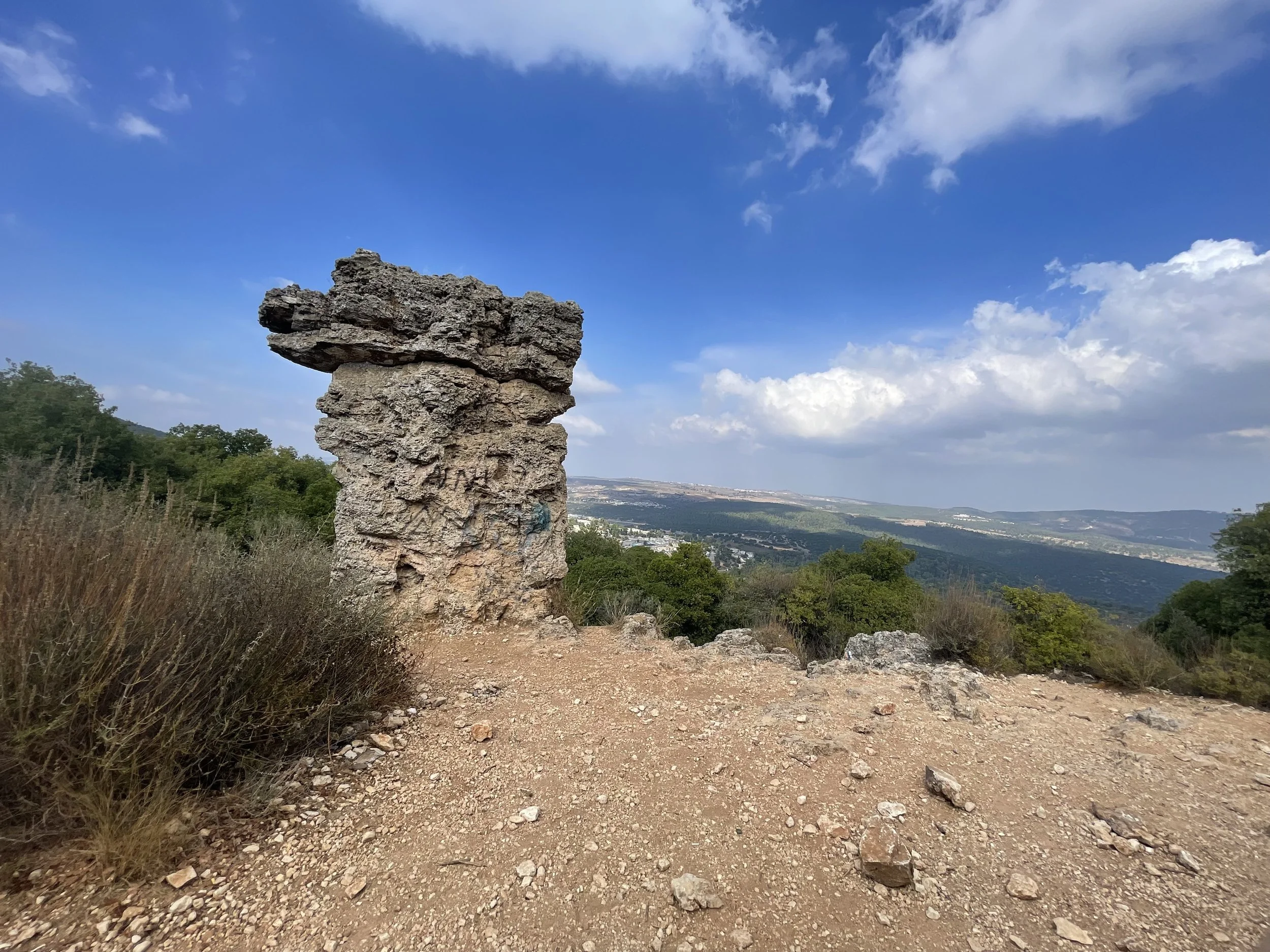
The mountain continued to surprise us. At Kisei Eliyahu, a remarkable limestone formation rises from the landscape like an enormous ancient chair, its sculptural form appearing almost deliberately prepared for someone who has not yet arrived.
A chair is an extraordinary vessel. Its purpose is to receive. Its emptiness need not signify absence; it can signify readiness.
Here I guided the women through a meditation on the relationship between Rootedness / שורשיות, Spaciousness / מרחב, and the preparation of an inner vessel for a presence that has not yet become visible.
We brought awareness into our feet, allowing the mountain to support us. We softened our knees and felt the body preparing itself to sit, discovering how much trust is required to release our weight into something capable of holding us. Facing one another, we explored support through the body, the delicate balance between offering strength and allowing ourselves to receive it.
Then we turned inward toward the empty chair within the heart.
What are we being asked to prepare a place for? A relationship not yet healed? A capacity for forgiveness? A new understanding? A possibility we cannot yet imagine?
Eliyahu HaNavi is promised as the one who will turn the hearts of parents toward children and children toward parents (Malachi 3:23–24). Notice that the hearts are not commanded to become identical. They are invited to turn toward one another.
This is the movement of Return / שיבה, the restoration of connection without the erasure of distinction.
Sometimes we cannot force healing, reconciliation, or transformation. We cannot command another heart to open. But we can prepare a place, creating a vessel in which something new may become possible.
And as we breathed together beside the ancient rock, the relationship between Ohr and Kli became more intimate. The empty vessel was not demanding immediate fulfillment. It was becoming ready for Hashra'ah / השראה, for the resting of a presence that cannot be manufactured through force.
Rabbi Shimon: When Fire Becomes Healing Light
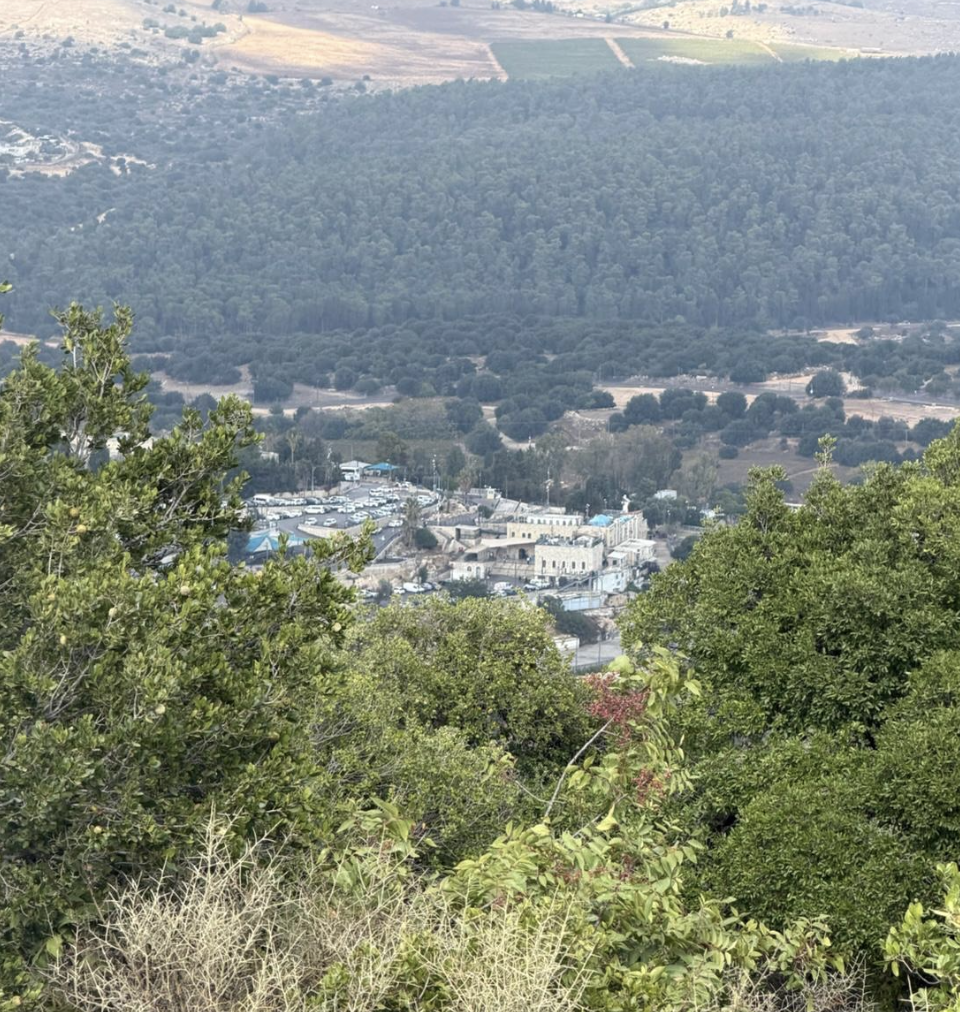
From the heights of Meron, looking down toward the resting place of Rabbi Shimon bar Yochai, the teachings of our entire journey began to converge.
Shammai had taught us the necessity of Gevurah, the holy boundary that allows light to be contained. Hillel had opened the spaciousness of Chesed, the movement toward another. Now Rabbi Shimon revealed the mystery of the Middle Line / הקו האמצעי, where these seemingly opposite qualities are joined through Tiferet / תפארת and Compassion / רחמים.
Rabbi Shimon's emergence from the cave contains one of the deepest teachings about spiritual illumination. After twelve years immersed in Torah, Rabbi Shimon and his son emerge with such intensity that their gaze consumes whatever it encounters. They are sent back into the cave. Only after another twelve months does Rabbi Shimon emerge with a transformed capacity.
Where Rabbi Elazar wounds, Rabbi Shimon heals (Shabbat 33b).
The fire has not disappeared. It has learned to heal.
The very same fire that once overwhelmed the world has now found a vessel of Rachamim. This is not the weakening of truth but its sweetening, Hamtakah / המתקה, allowing the intensity of Gevurah to become integrated with the expansiveness of Chesed.
The light has become Ohr Pnimi / אור פנימי, illumination that can dwell within the world rather than consume it.
And Rabbi Shimon's concern upon returning to the world becomes whether there is something that needs repair (Shabbat 34a).
What a remarkable culmination.
The purpose of spiritual illumination is not to remain above the world, but to enter the world as Tikkun / תיקון.
The Mountain Comes Home
By late afternoon, our bodies were tired, our senses filled with the extraordinary abundance of what we had encountered. We had walked through ancient forests and ruins, discovered tiny flowers emerging from hidden reserves, witnessed the changing colors of the terebinth, and opened a mysterious growth that released an unexpected cloud of white. We had rested beneath an ancient oak beside the maayan, supported one another, laughed at our inability to stop marveling, and repeatedly called ourselves back to the path.
The mountain had revealed itself through contrast: dry grasses and hidden water, ancient ruins and living forests, trees releasing their leaves and trees remaining green, enormous limestone formations and the most delicate creatures.
Even our own movement contained its apparent opposites. We needed the spaciousness to stop and receive, and the boundaries to continue walking.
We had descended through the mountain, yet something within us had become more deeply integrated.
This is the particular avodah of Cheshvan. The first Beit HaMikdash was completed in the month of Bul, identified with Cheshvan (Melachim I 6:38). After the extraordinary revelations of Tishrei, we are invited to build a Home / בית for the light. Not to reproduce the intensity of the festivals, but to allow their illumination to enter the ordinary structures of our lives.
To bring what was revealed above into the vessels below.
This is the movement from Concealed Understanding / בינה toward Revealed Presence / מלכות, from the hidden light of Leah into the living expression of Rachel. What is received in the upper worlds must eventually descend into the lower worlds, into our bodies, our relationships, our speech, and the smallest actions of ordinary life.
And perhaps this was why the tiny autumn flower had been such a perfect beginning. Its delicate constellation emerged from a source concealed beneath the earth.
Revelation within Concealment / גילוי מתוך ההעלם.
The mountain was not asking us to search for another extraordinary experience. It was teaching us how to recognize the extraordinary concealed within the ordinary.
The terebinth knows when to release. The oak knows how to remain rooted. The Katlav reveals another layer of beauty as its bark falls away. The hidden spring continues receiving from a Source beyond its visible opening.
And the women walking together remind us that genuine unity does not require sameness. Each of us carries a distinct light, each requires a vessel capable of receiving it, and together, through the integration of Gevurah and Chesed, our light can become a source of healing in the world.
When I finally arrived home, I went to my window and looked out toward Meron. There it was, the mountain we had spent the day discovering, now settling into the deepening blue of evening. And just above its silhouette, a slender crescent moon was smiling.
The new moon of Cheshvan.
I stood there for a while, taking in the quiet beauty of it. How fitting that the first delicate light of the new month should appear above the very mountain that had spent the day teaching us about hidden light.
The moon does not generate its own light. It receives and reflects. And at the beginning of the month, only a slender crescent becomes visible to us, while the fullness of its illuminated surface remains beyond our view.
The moon is the great image of Malchut / מלכות, the vessel that receives and reveals. Its light is not diminished by the fact that it is received. On the contrary, receiving is precisely how it illuminates the night.
Like the tiny autumn flowers emerging before their leaves, the spring whose waters originate deep beneath the earth, and the unexpected life concealed within the terebinth, so much can be present before it becomes visible.
I thought of the women who had walked together, each carrying her own inner world, each discovering something of Hashem's presence through the landscape and through one another.
We had returned with something more than memories. The mountain had entered us. Its pathways had become inner pathways. Its boundaries had taught us how to move. Its ancient trees had given form to truths we were learning to inhabit.
And now, looking toward Meron beneath that smiling crescent, I understood that the journey had not ended when we came down from the mountain. It was continuing here, in the quiet of my own home.
Moadim LaShigra / מועדים לשגרה.
The return to routine. The return to the very places where the light of Tishrei is waiting to become a lived reality.
May we carry the wonder of Mount Meron into the ordinary days of Cheshvan. May our Gevurah be sweetened by Chesed, our Chesed strengthened by Gevurah, and both joined through the healing beauty of Tiferet. May our boundaries protect what is precious, our hearts remain spacious enough to receive one another, and our eyes continue to discover Hashem's astonishing presence in the smallest details of creation.
May we recognize the hidden springs beneath the dry places of our lives, and may we know when to stand firm and when to release, when to move forward and when to pause long enough for the beauty surrounding us to enter.
And may the hidden light of Tishrei become the healing light of our everyday lives.
This morning, as the sun rises over Meron, I look again at the mountain. The same slopes, the same forests, the same ancient stones. Yet I can no longer see them as I did before. There is an intimacy now, a recognition that comes from having walked among its trees, touched its earth, and discovered something of the life concealed within it.
Yesterday, I walked through the mountain. Today, the mountain lives a little more deeply within me.
The festivals have ended. The light has not.
And the light of Cheshvan is only beginning to reveal itself.
With love and brachot from Tzfat, overlooking Mount Meron,
Rachel Leah Weiman
The Path The Soul Remembers
A journey through Mount Meron, memory, revelation and the hidden Light within
by Leah Friedman
Thank you, Rochel Leah and Maskit, for guiding and facilitating a hike that turned out to be so much more. 🌿
Here is a little taste of what it opened for me, from the chapter that grew out of our journey:
“Before we had even properly begun walking, while we were still gathered at that first elah, Maskit opened one of its strange, thick, elongated growths and handed it to me. This was how our journey into the mountain began: not simply as a hike, but as a discovery, an adventure into worlds concealed within what appeared ordinary.
Inside I saw what appeared to be hundreds upon hundreds of tiny seeds. Then I realised they were moving. They were alive. The chamber was filled with minute insects. I did not know what they were. I knew only that what had looked sealed and almost lifeless held an entire hidden world.”
What happens when we slow down enough to discover what we would usually walk past? And what might that awaken within us?
My walk through Mount Meron continued unfolding long after I came home. Through the trees, stones, encounters and moments of tefillah, something deep within me began to surface. Eventually, it became a chapter.
I’m sharing it as a glimpse into what these journeys can open: wonder, reflection, closeness to Hashem, and a growing awareness of the Light within His creation and within ourselves.
If you’d like to walk a little of that path with me, I invite you to read “The Path the Soul Remembers.” 🌿
___
I came home close to midnight, my body exhausted and something inside me intensely awake. There were stones and acorns in my backpack, photographs on my phone and dust from the trail still clinging to my shoes. Yet none of these could contain what I had brought home from Mount Meron. The mountain had entered me in a way I did not yet understand.
When I saw the advertisement for the next journey created by Rochel Leah Weinman of Ohr Pnimi Tours together with Maskit Ben-Moshe, I knew that I had to be there. I had met Maskit previously on our journey across the suspension bridge over Gei Ben Hinnom—the experience that became an earlier chapter in this book. Something had opened for me on that bridge, and when this new journey appeared, I felt the same unmistakable inner pull.
Before I knew how I could possibly reach Mount Meron so early in the morning, something within me had already said yes. It felt less like making a decision and more like recognising where Hashem was leading me next.
The event was an Ohr Pnimi Women’s Nature Hike called “From Hillel and Shammai to the Inner Light of Rabbi Shimon”: approximately six and a half kilometres through Mount Meron with a small, intimate group of women.
These journeys bring together two remarkable women and two ways of entering the landscape. Maskit is a certified Israeli tour guide and nature therapist, deeply knowledgeable about the land, its stones, trees, plants and hidden life. Rochel Leah, the founder of Ohr Pnimi Tours, creates the inner journey through pnimius haTorah, meditation and the deeper spiritual meaning concealed within what we encounter.
Rochel Leah is difficult to describe because she carries so much depth. She is like a fountain whose waters keep rising from somewhere beneath the visible surface—Torah, insight and an ability to open what lies within an experience. Together, she and Maskit created a journey through both the visible and invisible mountain. We did not simply move from one point to another. We stopped, touched, listened and allowed what surrounded us to enter our awareness.
Even reaching the mountain had required a path to open. I live in Elad, and there was no public transport that could have brought me to Mount Meron in time for our nine-thirty morning meeting. Maskit offered to open her home to me the night before so that I could sleep there and travel with her in the morning. Without her generosity, I could not have been there.
Even in her house, before we set out, I noticed unusual and beautiful stones. They did not feel like objects placed there for decoration alone. They seemed to belong to the way she lived—to her instinct for recognising form, colour and wonder in the natural world. Looking back, I can see that the journey had already begun inside her home. I remain deeply grateful to her, not only for guiding us through the mountain, but for making it possible for me to reach it at all.
In truth, the sightings had begun even before the hike. As Maskit drove us towards the meeting point, she kept noticing things through the car window. “Look at this. Look at this.” I was sitting beside her, travelling through the same landscape, yet I could not always see what she was seeing. Even while driving, her eyes were awake to details mine had passed over. She had spent years studying nature and guiding people through it. The landscape was not scenery to her; it was a language she knew how to read.
I remembered first seeing her unusual name written in a group before we had met. Maskit. I had asked her where it came from, and she explained its connection to an even maskit, a beautifully formed or decorated stone. Now the woman whose name itself held the image of a stone was teaching me to see the colours within the stones beneath our feet. She would lift one, turn it in her hand and reveal bands of colour and formation I might otherwise have walked over without a second glance. Once she showed them to me, the ordinary ground opened into intricacy.
Maskit once said that the creature she most identifies with is a deer.
Watching her move across the mountain, I understood. She seemed to prance over the uneven ground, light and instinctive, while the rest of us carefully negotiated the rocks. Nature did not feel like somewhere she visited. It felt like somewhere she belonged.
At the beginning of the trail, we gathered beside an elah, a terebinth tree. Rochel Leah spoke about its strength, endurance and deep roots, and about its association with covenant, significant encounters and revelation.
That word entered me: revelation.
The instant she said it, I felt something land in a place deeper than thought. I did not know what would be revealed, but I sensed that I had been brought there to receive something. It was as though an unseen door had opened before I knew what stood behind it.
Hashem, what are You going to reveal to me here?
I had imagined that I had chosen this hike. I had made the booking and arranged the journey. Yet standing beneath the elah, I felt that the decision had not begun with me. Hashem had been leading me through the choice, the journey and every circumstance that placed me with these particular women on this particular day.
For a long time, I have been asking Hashem to guide me. I make a place for Him every day through hitbodedut, speaking to Him personally and honestly. There are days when words pour out and days when I have almost nothing to say. There are days when I do not feel like talking at all. Still, I show up. I keep the time. I remain in the relationship.
For many years, some of my deepest hitbodedut has taken place outdoors. I have gone alone for hours into fields and forests in different parts of the world, away from traffic, telephones, technology and the relentless busyness of doing, so that I could return to being. At times, sitting there, I could almost hear the song of the field.
Rabbeinu Nachman teaches that when a person prays in a field, the grasses enter her prayer, help it and give it strength. He also teaches that every blade of grass has its own song. This was not only a beautiful idea to me. Sometimes I could feel it: the trees moving in the wind, the grasses, flowers and growing things surrounding me, all singing their praise to Hashem, and my own words being lifted together with theirs.
Again and again, I would ask: Hashem, if every blade of grass has its song, what is mine? What is the praise that I was created to sing to You? What did You bring me into this world to be and to do?
That had been my prayer for many years. Only now was its answer beginning to become more apparent.
I am beginning to see what this constancy has created. The more I turn towards Hashem, the more able I become to recognise where He has already been present. The more space I make for His Presence, the more the apparently separate pieces of my life reveal their connection. What had looked like my own decision to take a hike began to feel like another step in a conversation unfolding for years.
Before we had even properly begun walking, while we were still gathered at that first elah, Maskit opened one of its strange, thick, elongated growths and handed it to me. This was how our journey into the mountain began: not simply as a hike, but as a discovery, an adventure into worlds concealed within what appeared ordinary.
Inside I saw what appeared to be hundreds upon hundreds of tiny seeds. Then I realised they were moving. They were alive. The chamber was filled with minute insects. I did not know what they were. I knew only that what had looked sealed and almost lifeless held an entire hidden world.
Only later, while writing this chapter and searching for the name of what we had seen, did the next layer open. It was not a seed pod but a horn gall, and the tiny creatures were aphids. More astonishing still, the insects had not merely discovered a shelter. Their presence had induced the terebinth to produce living tissue around them. The tree had formed the chamber that became both their home and their food.
The revelation began when Maskit placed the gall in my hand, but it did not end on the mountain. It followed me home and waited inside the writing until I searched deeply enough to understand what I had been shown.
As we began walking, the elah appeared again and again. The entire trail seemed filled with these trees. Revelation was not marked by one dramatic encounter and then left behind. Tree after tree repeated its message: Hashem does not reveal Himself only once. His revelation surrounds us continuously. It is our seeing that becomes dulled.
Maskit embodied the opposite. Although she had seen these trees and their strange galls many times, familiarity had not robbed her of wonder. There was a childlike purity in the way she met each discovery as though creation had only just placed it before her.
How much is taking place beneath the surface of this world? How many realities are forming within things that appear closed, still or ordinary? We see an outer shape and assume we have seen the thing itself. Then the vessel opens, and another dimension is revealed.
Are we not also such vessels?
From the outside, a human being appears to be a physical body. Yet hidden within is the neshama, the soul—a dimension we cannot see or measure. We are not bodies that happen to contain souls. We are souls clothed in bodies. The body is the vehicle through which the neshama enters this physical world, makes choices, draws close to Hashem, performs mitzvos—the commandments Hashem has given us—and fulfils its mission.
A soul without a body cannot light Shabbos candles, give tzedakah—charity—comfort another person or choose to turn towards Hashem from within concealment. These possibilities belong to the mysterious meeting between body and soul. What the neshama achieves through the body here is what it carries onward. This is why those who remain perform mitzvos, learn Torah, pray and give tzedakah for an ilui neshama, the elevation of a departed soul.
The neshama knows far more than the conscious mind remembers. Before entering this world, it is shown its mission and chooses the circumstances through which that mission will unfold: its parents, siblings, financial reality, challenges, gifts and opportunities. Then it enters a body and forgets. If we arrived remembering everything, there would be little room for free choice. Instead, we enter a life whose meaning is concealed. We meet situations, people, gifts and difficulties that bring hidden parts of us to the surface. We keep mitzvos, learn, grow, try to do Hashem’s ratzon—His desire and will—and deepen our relationship with Him. Slowly, we begin to recognise the direction in which our soul has been travelling all along.
The ways of Hashem remain hidden. The Zohar, Kabbalah and the great mystical teachings offer glimpses, yet what we comprehend is no more than a drop within an ocean, one grain of sand within a world beyond measure. The neshama is described as Hashem’s breath within us, a chelek Eloka mimaal, a part of the Divine from Above. We speak these words, but can we grasp what they contain? We receive flashes, tastes, moments when the veil thins—and then stand before the Awesomeness of Hashem.
The elah also carried the echo of Emek HaElah, where David confronted Goliath. I thought about the giants we meet: difficult circumstances, old experiences whose voices continue after the event has passed, and beliefs that tell us we are small. Sometimes the giants are our doubts—about our abilities, Hashem’s gifts within us and even whether He is truly guiding us.
Doubt can tower over inner knowing until we forget what lives beneath it. Yet its presence does not mean emunah—faith—has disappeared. A part of us may tremble while a deeper part still knows. David did not become larger than Goliath. He stood rooted in a truth larger than the giant before him.
Experiences and mistaken beliefs may form layers around the heart, but they cannot extinguish the chelek Eloka mimaal within us. The Light remains. Our work is not to manufacture it, but to uncover what has never ceased to be there.
This uncovering was not mine alone. We were a small, intimate group, and each woman brought her own way of seeing. Maskit would point something out; another woman would call us to something she had noticed. “Look at this.” “Come and see this.” One person’s attention opened another person’s eyes.
We met female hikers descending, people walking quietly in solitude, and several groups of high-school boys with their teachers. They, too, were hiking and may have been moved by the views. Yet our group was engaged in something different.
They were hiking the mountain. We were living it.
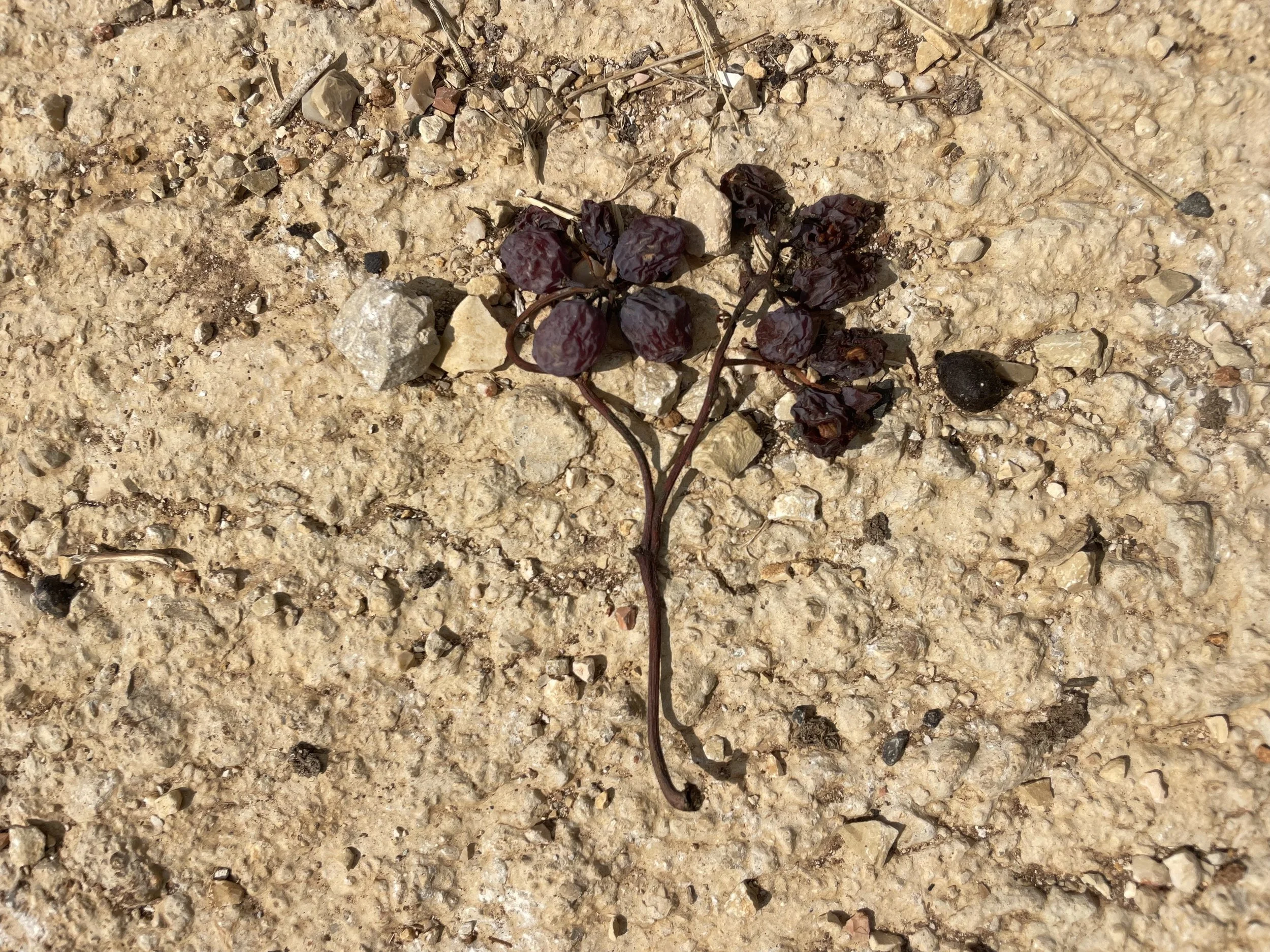
We were touching, smelling, listening and allowing ourselves to be affected. Every woman was living a private inner journey, yet something collective formed. No one person saw everything. Together we entered a wider field of perception, as though each woman held another fragment of the revelation. Maskit showed us a dry-looking plant whose branches formed the three arms of the Hebrew letter shin. The shape opened a reflection on the Shechinah, Hashem’s indwelling Presence. It led me to Elokim and hateva, nature—two words with the same numerical value. What we call nature, what we dismiss as simply the way the world works, is one of the places where Hashem can be seen most clearly. Creation is so constant that we mistake constancy for ordinariness. Yet it is miraculous, brought into being anew at every moment. The more closely we looked, the more the mountain disclosed: the first sitvanit hayoreh, an autumn crocus emerging among stones; a mushroom beneath dried leaves; a green praying mantis resembling a leaf; berries hidden among foliage; caves within rock; and stones carrying colours visible only once they were lifted towards the light.
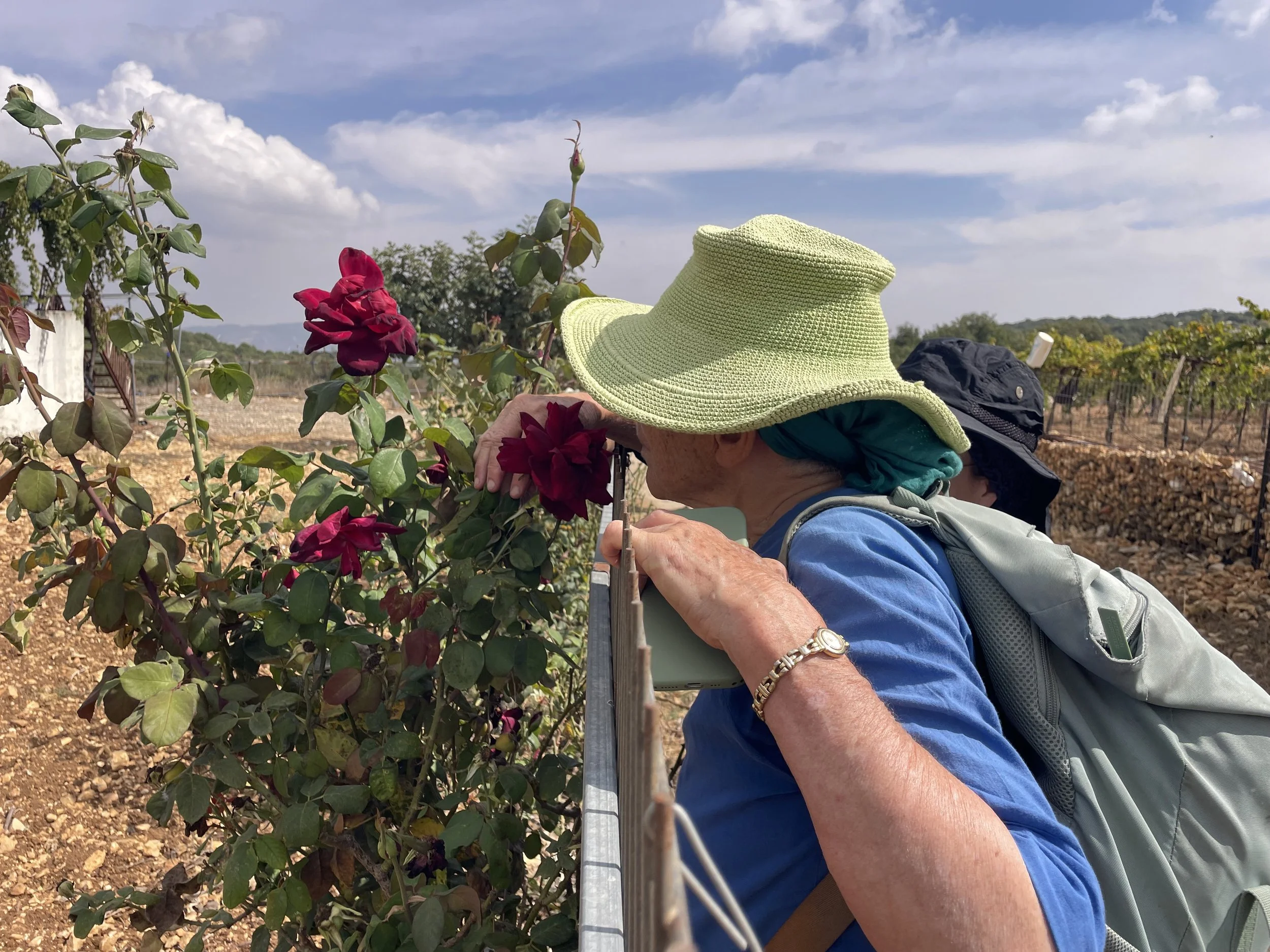
Some trees I could not merely observe. I had to place my hands on their bark. I wanted to move from looking at nature as an object outside me into relationship with it. The photographs show my hands on the trunks, but cannot hold the feeling of wanting to enter the life I was witnessing.
Among all the elah trees, we met one katlav that could not be passed. Its sculptural trunk twisted upward in rose, salmon, copper, reddish-brown, silver-grey and charcoal. Green leaves surrounded it, with red berries among them. Maskit told us that she had once picked and eaten katlav berries elsewhere and that they were delicious. The berries on this tree were too far beyond our reach; otherwise, we might have tasted them ourselves.
The katlav continually sheds its outer bark, revealing new colour and vitality beneath. I went close and touched it. What might look like exposure or vulnerability is the tree’s natural renewal. The peeling is not evidence that it is falling apart. It is how the next surface emerges.
We were only days into Cheshvan, commonly called Mar Cheshvan—bitter Cheshvan—because it contains no festivals. Rochel Leah had read about the katlav and opened its meaning for us through the movement from Tishrei into Cheshvan. After Tishrei’s radiance, Cheshvan can feel empty. Yet she showed us that the letters of mar can be reversed into ram: elevated, uplifted. What surfaced within me was that the apparent emptiness can become a time of rooting. Tishrei’s Light does not have to disappear. It can descend beneath the surface and grow roots within us.
The katlav carried that teaching in its body. A layer falls away. A tender surface is exposed. What appears vulnerable is the passage into hitchadshut, renewal. Hashem renews creation at every moment, and He renews us within it. No moment is sealed by the one before it. Beneath what is peeling away, colour is already waiting.
We descended through steep, rocky sections where some of us literally held out our hands to one another. Maskit showed us where to place our feet, and we tried to follow her steps across the trickier places. The mountain was teaching us through our bodies as well: none of us had to find every foothold alone.
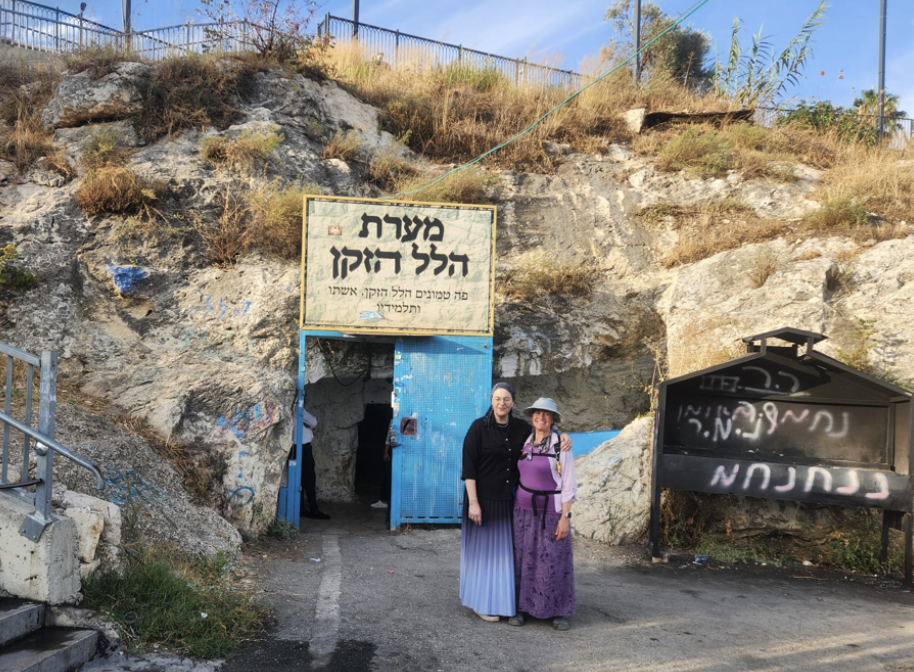
Eventually we reached a more level, open area containing the remains of an ancient synagogue associated with Shammai. One of the women discovered the burial cave that Rochel Leah remembered visiting before. The other women remained above while Maskit and I made our way down and entered.
When Maskit began to leave, I told her, “I want to stay here alone for a while and pray.” From outside, the cave had appeared completely dark. Inside, I sat on a low stone and became quiet. Then I noticed the ner tamid—the eternal olive-oil flame—burning inside a glass vessel on the cave wall. I davened. I spoke to Hashem.
From within, the cave no longer felt dark. It seemed filled with light.
Ein od milvado—there is nothing besides Him. Even what we call darkness cannot exist outside Hashem. The Light may be concealed from us, but darkness itself is held within His Presence. We may stand outside an experience, see loss, fear or uncertainty and call it darkness. Yet when we enter it, bring Hashem into our awareness and meet Him there, the difficulty can become an opportunity to expand our vessel. The challenge may remain. The cave remains a cave. But the expanded vessel can receive more of the Light that was present all along. What had surrounded us as Or Makif—surrounding Light not yet fully received—can begin to enter as Or Pnimi, inner Light that becomes part of how we live and experience the world. That darkness containing Light carried me back to the week in which this book truly began: the final seven days of my mother’s life.
I sat beside her in South Africa as her body weakened, remaining through the mysterious pull between the body appearing to surrender and the neshama seeming to hold on for one more day, one more breath, one more moment. I was present with her when her neshama—her soul—left her body. Afterwards, I watched over her through the night until morning, when her body was taken to be prepared for burial.
I think of that week not as accompanying my mother through her death, but into another birth. This physical world is called the alma deshikra, the world of falsity; when the soul leaves it, it is born into Olam HaEmet, the World of Truth. Yet I do not claim to understand what I witnessed, or even what those words truly mean. What is the neshama? What is the passage from this world into the next? What remains when the body can no longer hold the soul it carried?
During those seven days, I felt that the veil was removed. It was as though Hashem was revealing Himself to me and allowing me to taste something that might be called Elokus—Divinity itself. It was not knowledge I could organise or explain, but an encounter at the boundary between worlds, something far greater than the mind can contain. Her body, which had carried her through a lifetime, was becoming weaker; yet the essence of who she was felt more present, not less. The body was never the whole person. It had been the sacred vessel through which her soul loved, chose, struggled, gave and fulfilled what it came here to do.
Since then, through grief, learning, prayer, inner work and writing, what was revealed beside her bed has continued unfolding. On Mount Meron the same mystery spoke through different forms: a closed gall holding a moving world, a dark cave containing Light, bark falling away to expose renewed colour, stones revealing formations beneath dust. Again and again, the outer form opened, whispering that what we see is never the whole story.
The last part of our journey brought these threads together in a way I could never have planned.
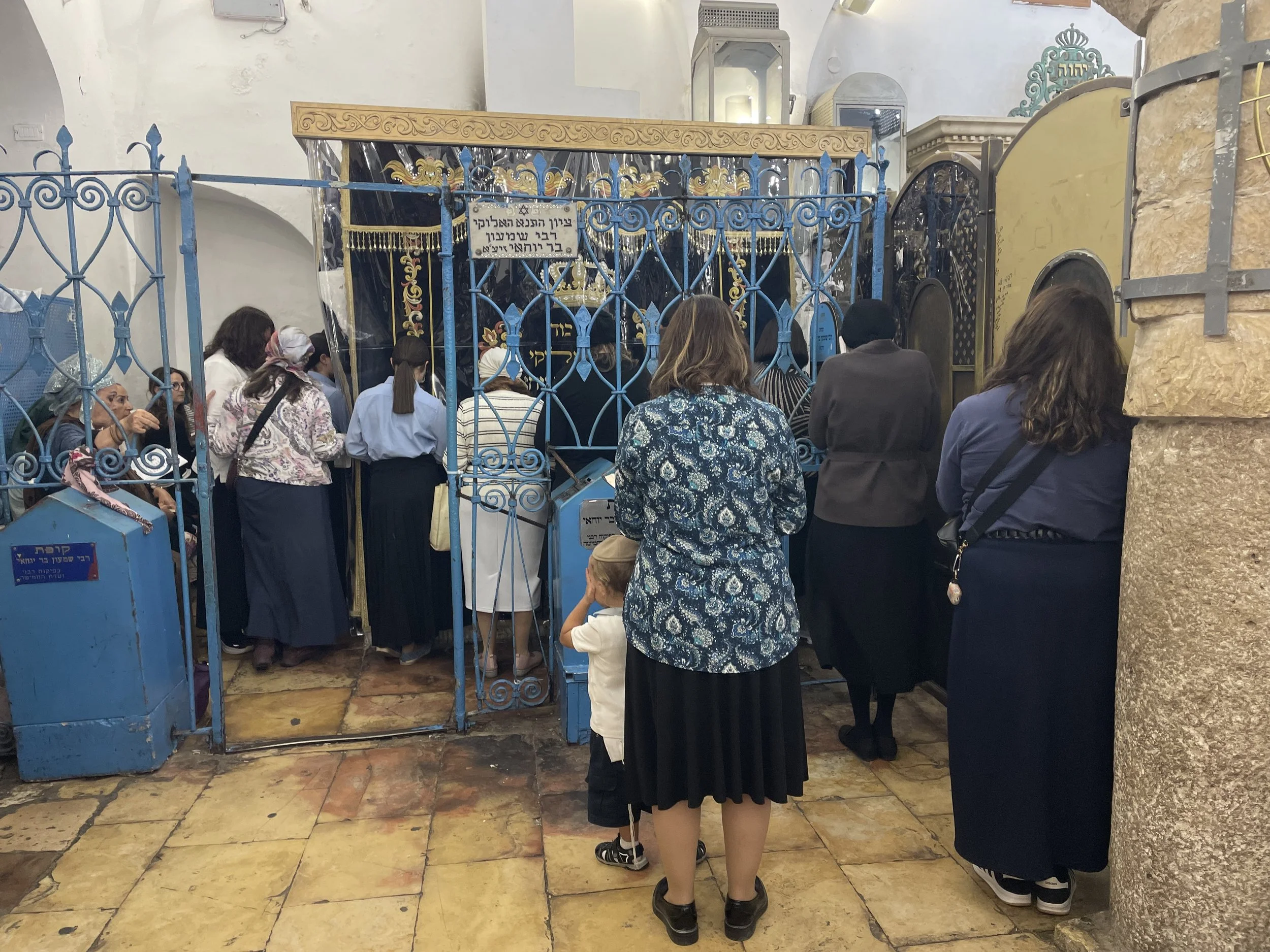
After descending Mount Meron over difficult terrain, the route turned upward towards Rabbi Shimon bar Yochai—Rashbi—the holy Tanna, one of the early rabbinic sages whose teachings form the Mishnah. He is the great revealer of the Zohar’s hidden Light and spent years concealed in a cave with his son. Rashbi has long been where I feel most alive, most at home and most connected to myself. Something in the air there brings me an inner calm, a shalvat hanefesh—a tranquillity of the soul—that I experience nowhere else. For years, approximately once a month, I have taken a day to go alone. Other women may restore themselves through shopping, a restaurant or friends. My gift to myself has been a day alone with Rashbi.
It has become my monthly vitamin, almost an infusion of spiritual strength. No matter what I may be experiencing in my life, being there restores my sense that I am held: that Hashem is guiding me, protecting me and loving me, and that His Presence surrounds me. It is not only a place where I believe in Hashem. It is a place where I experience Him.
On those monthly visits, I spend some time inside the building above his burial place. I daven—Shacharis, the morning prayer; Mincha, the afternoon prayer; or Maariv, the evening prayer. I say Tehillim—Psalms—and pour out my heart. But where I feel most at home is outside, sitting for hours on a rock surrounded by trees in the valley below the kever, the burial place, going only as far as feels safe for a woman alone.
Sitting in that valley, watching the sunset through the trees and listening to the birds, I would feel the teaching of Rabbeinu Nachman come alive: when a person prays in a field, the grasses enter the prayer, help it and give it strength. Every blade of grass has its own song. Surrounded by that living praise, feeling such closeness and yichud—a deep sense of unity—with Hashem, I would almost beg Him: Please guide me. Show me my song. What did You create me to bring into this world? What is my purpose? What is the mission for which You sent me here?
From that familiar place, I would look down. The valley appeared vast, distant and full of terrain. I imagined exploring it, but never felt it wise to descend alone. For years I looked towards it and wondered what was there.
Now, after six and a half kilometres down the mountain, I was standing at the bottom of the landscape I had always seen from above.
Some women were exhausted and waited to be collected. I was tired too.
Maskit asked whether I wanted to remain or make the final ascent.
“Obviously I’m going up,” I answered. “This is what I’ve been dreaming of doing for years.”
One other woman and I followed her uphill. As we climbed, I suddenly saw my rock, my trees, the exact space where I had sat and spoken to Hashem month after month.
“I can see my space,” I told them. “That is where I’ve been sitting all these years.”
I knew where to walk because I knew the place intimately, but I had never known it from this direction. From above, the distance had seemed enormous. From below, it was almost nothing—perhaps ten or fifteen minutes. The immense valley of my imagination was only a short ascent away.
How often had I sat above looking towards something that felt impossibly far, when all along I had been so close?
For years, I held a similar picture of my life. One day I would become someone. One day I would contribute something meaningful. One day I would use my voice and bring what I had learned into the world. That future seemed real, beautiful and far away.
On the mountain, the distance collapsed. I had been waiting to arrive in a life that had already begun. Rashbi reveals the hidden Light, the pnimius—the inner dimension concealed beneath the surface of the world. And now, in the landscape surrounding his burial place, I was being shown that truth through my own life.
Sometimes we can spend years praying for a miracle without recognising the moment when the prayer begins to take form around us. I had spent years asking Hashem to reveal my song, my purpose and what I had been brought into this world to do. Yet I was no longer standing outside that prayer, waiting for its answer. Somewhere along the way, the answer had begun to form around me. I was already living in the middle of the miracle I had been praying for.
The prayers I was sharing, the women I was teaching, the meditations through which people told me they had felt healing, the workshops and the book itself were not merely preparations for a distant day when my contribution would become real. They were the path beneath my feet. The woman I imagined in the future was not waiting at the end of the climb. She was already walking.
The revelation was not about becoming greater. It was about coming closer to the person Hashem had created beneath the layers around my heart. Those layers had not appeared without reason. They had helped me protect myself, survive and become the woman I was. They did not deserve judgment; they deserved compassion, understanding and gratitude for the way they had carried me.
But there comes a moment when what once protected us begins to distance us from who we truly are. As healing creates greater safety and wholeness within us, we can hold those layers tenderly, embrace the parts of ourselves that needed them, and begin releasing what no longer serves its purpose.
Awakening the Light within is not forcing ourselves to become someone new. It is returning to our deepest self, drawing closer to the neshama Hashem placed within us and aligning our lives more truthfully with Him.
The dots began joining with an intensity difficult to hold. Teachers, courses, retreats, friendships, relationships, prayers, losses and choices that had seemed separate revealed one movement. The seven days beside my mother.
Her soul leaving her body. The veil removed. The garden created in her memory. The book emerging. Years of speaking to Hashem. The elah. The hidden chamber alive with movement. The cave full of Light. The valley seen from its other side.
This was what it had all been about—not because I had reached a final understanding, but because for one moment I could see that I was already inside the unfolding.
Only after the hike, when I read the full invitation to the Princess of Dan retreat that Rochel Leah had created for the following week in Tzfat, did another thread become visible. It centred on meeting the woman one is becoming and stepping into geulah not only as an idea, but as an experience. I had not read those words before the mountain gave me its teaching. The retreat had not created my realisation. It named something I had already begun to live.
The hike felt like Hashem’s gift after Tishrei, preparing its great Light to take root within ordinary life. Before Princess of Dan, I would first attend a retreat with Chava centred on speaking to Hashem—another deepening of the conversation that carried me here. Then I would travel to Tzfat, not knowing what would meet me there.
My personal movement is one small current within something greater. We are living through upheaval and revelation as the world moves towards its final geulah. Redemption is not only an event for which we wait. Its consciousness begins to enter us when concealment loosens, when the layers no longer have the final word and when we recognise the Divine Light present even inside what we called darkness.
I am writing from within that movement. I do not want to wait until I have reached some imagined destination and then describe the journey from a safe distance. I do not know whether there is such a final arrival in this life. The journey itself is where the soul is revealed. I want to write while I am still inside the transition—while one form is loosening, another has not yet fully emerged, and each discovery continues to transform me.
My mother and I shared a deep love of butterflies. They surround me still; an entire wall of my bedroom is covered with them. In her final letter to me, she wrote that she would always be with me—that the touch of the wind against my cheek or the sight of a beautiful butterfly would remind me of her presence, her love and her energy. She told me that she would be holding me and healing me from Above.
A butterfly does not enter the world with wings. It begins as a caterpillar and then withdraws into the darkness of the chrysalis, where its familiar form can no longer remain as it was. Yet it does not become the darkness it enters. The darkness is not its identity; it is the protected place in which its wings are being formed.
And when the transformation is complete—when the time is right—the chrysalis splits, and the butterfly slowly works its way free. Even then, it cannot fly immediately. Its new wings emerge soft, folded and crumpled. It must pump fluid through their delicate veins, allowing them to expand, and then remain still while they dry and strengthen. Only then can it open them and take flight.
Maybe that is why butterflies have always seemed to me so free and so real. Their freedom has not come from escaping transformation, but from passing through it. The lonely darkness did not erase the butterfly or become its final home. It held a hidden process that could not yet be seen from the outside. Within that darkness, colour was being created. Delicate beauty was taking shape. The capacity for flight was growing in silence.
This chapter belongs within such a passage: not the finished butterfly, and no longer the earlier form, but inside the sacred transition itself. I am writing while the chrysalis is beginning to open—while the questions are still alive, while the next step remains concealed, and while something within me is gathering the strength to spread wings I could not see being formed.
The stones and acorns from Mount Meron have already found their place in my balcony garden, my garden of hitbodedut, where I speak to Hashem each day. They rest beside stones gathered on other journeys and beside crystals, rocks and shells my mother loved and gave to me while she was alive, some of which I brought home from South Africa. They surround the pond and its flowing water in the garden I created in her memory.
There, the separate parts have become one landscape: my mother’s love of gardens, stones and shells; the water; my conversations with Hashem; objects gathered from moments that changed me; and now the stones and acorns from the mountain. The garden holds memory, prayer and becoming. It holds what has left this world and what is still unfolding within it.
The following morning, I stepped onto the balcony to pray and water my plants, and it seemed that everything had opened overnight. The white and red bougainvillea were in full bloom. My rose bush, which had always offered only one or two buds at a time, suddenly held six beginning to open together. It was not one isolated flower appearing, but the whole bush coming into bloom. The greenery looked abundant and intensely alive. What I had once thought of as a balcony had become a garden, almost a miniature forest, with life unfolding before my eyes.
As I stood there, I felt that the garden was growing with me. As I was opening, transitioning and beginning to recognise the abilities Hashem had placed within me, the space I had planted in my mother’s memory was also coming into its fullness. Its blossoming felt like another language of the same revelation: inner life, given room and tended with love, eventually becomes visible.
I looked at the flowers, the stones, the shells and the water, and felt myself speaking to her: This is the life you planted in me, Mommy. This is your garden still growing through mine.
I began beneath the elah asking, “Hashem, what are You going to reveal to me here?”
I thought here meant the mountain. By the end of the journey, the question had opened into my entire life: this body carrying a neshama whose mission I am not remembering all at once, but slowly beginning to live; darkness in which His Light had never been absent; grief opening into writing; prayer becoming a path; and a distant future revealing itself only a few steps away. My life was not waiting beyond the next ascent. It was opening beneath and within the steps I was already taking.
I did not leave the mountain understanding the mystery.
I left knowing that I had entered it.
And somewhere beyond what I could yet see, the next revelation had already begun.
As I place the final words into this chapter, it is almost four o’clock in the morning. I am sitting in my balcony garden, reading and correcting, still inside everything the mountain opened within me. And then I feel it: the first gentle drops of rain beginning to fall.
Immediately, my mother comes to mind. She used to bless me with words I can still almost hear: “May Hashem’s blessings and abundance fall upon you as gentle raindrops.” We both loved the rain.
For a moment, I do not move. I simply breathe it in—the cool drops, the early-morning darkness, the garden alive around me, and her presence woven through it all. I have just written of butterflies, transformation, hidden Light and the life she planted within me, and now the rain is falling upon the garden I created in her memory. It feels as though the chapter is no longer ending on the page. It is being answered from the sky.
The rain begins to fall more strongly, the drops gathering closer together until they are wetting my face. At last, I rise to go inside and sleep for a few hours before waking my children and beginning another ordinary day. And as I leave the balcony, I feel my own eyes begin to rain. The raindrops merge with a tear upon my face—a tear of longing and closeness at the same time.
Before night gives way to morning, I carry that moment inside with me: the blessing falling, the garden receiving it, and my mother very close. Holding me. Healing me from Above.
Meet Your Guides
-
![]()
Maskit Ben Moshe
Official Israeli Tour Guide
With a vision for building something meaningful, Maskit brings a blend of big-picture thinking and hands-on experience. -
![]()
Rachel Leah Weiman
Torah Guide
Rachel Leah is all about building strong relationships and helping women connect to the Land, Hashem, each other and them selves.