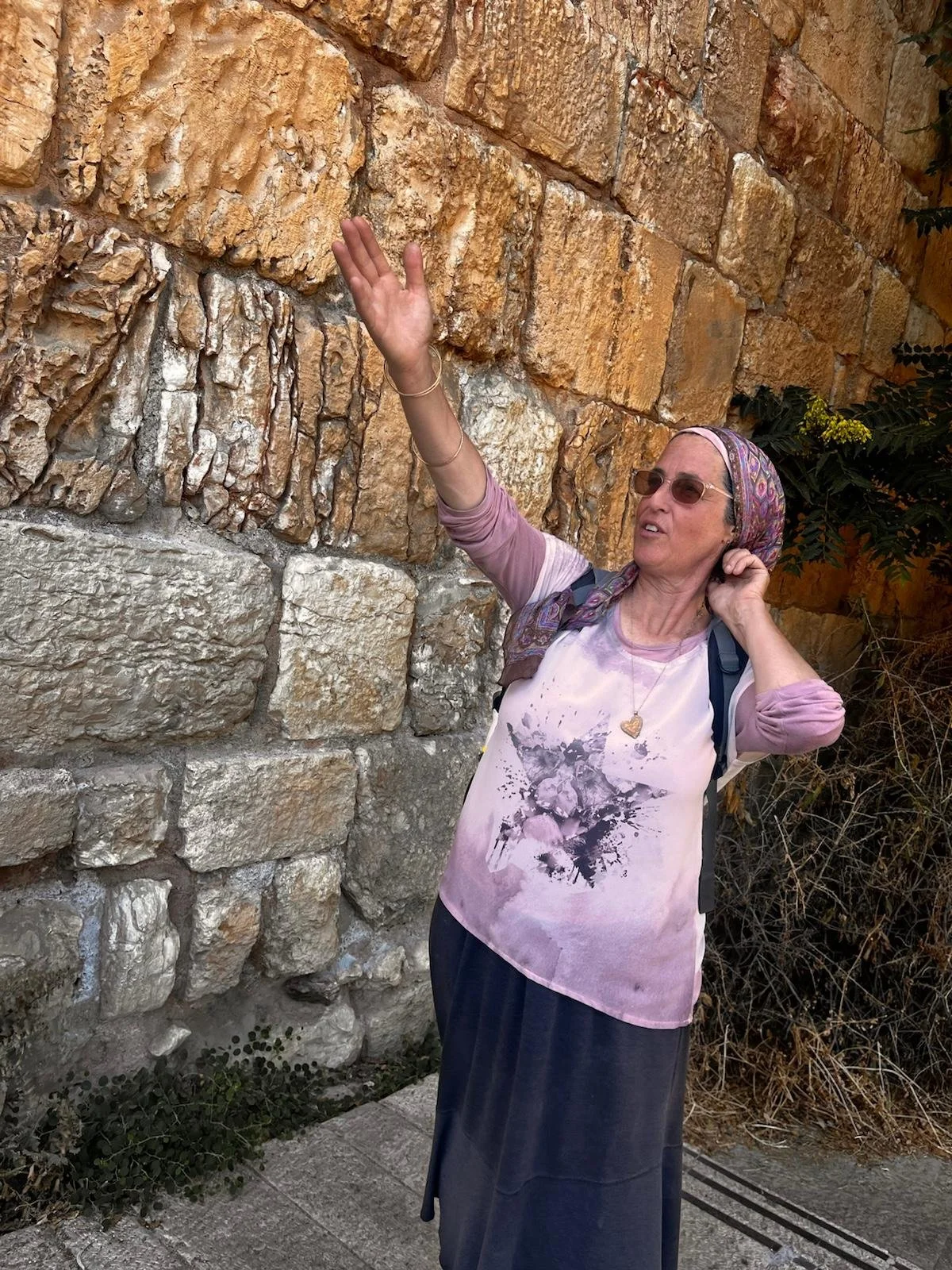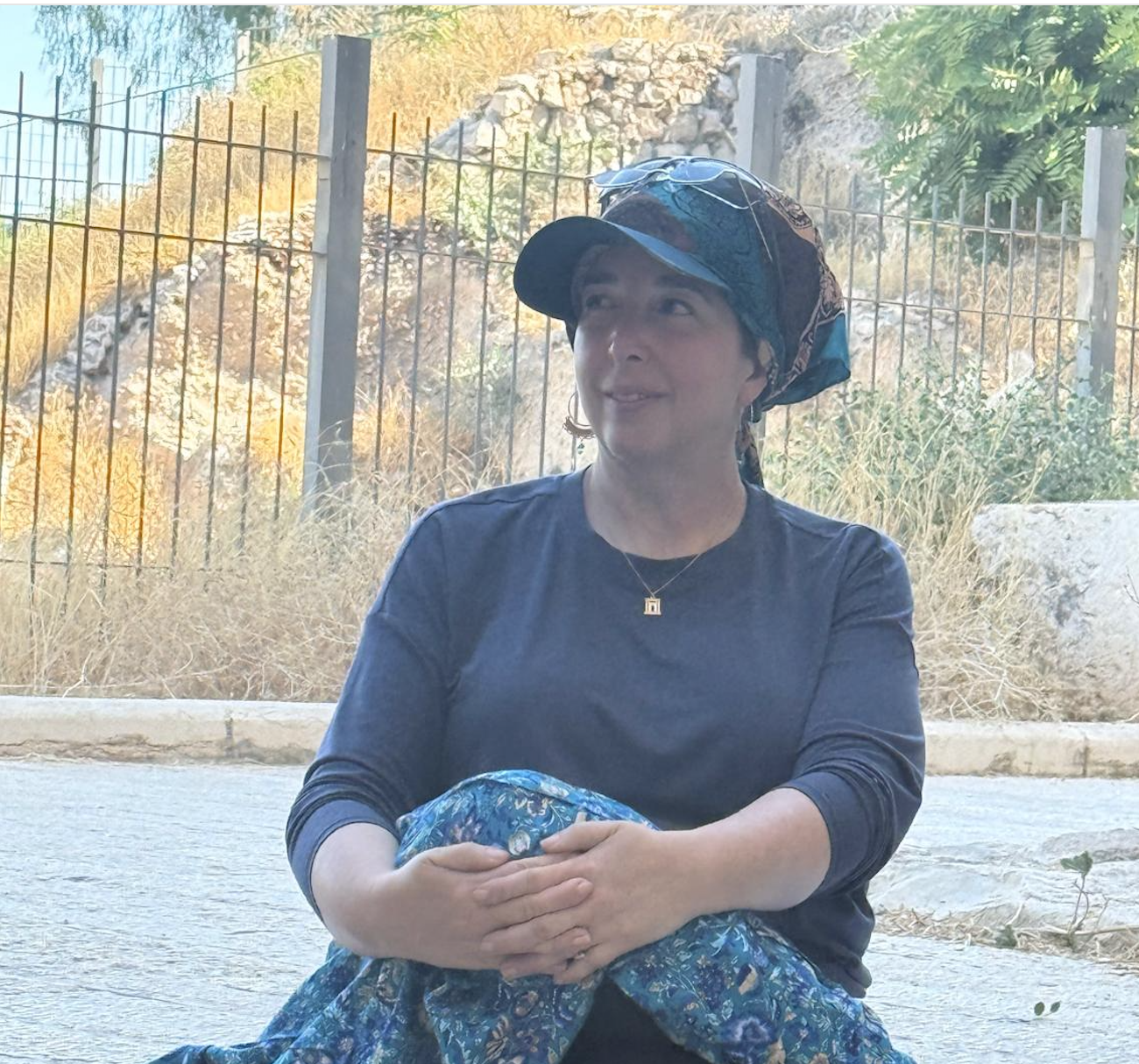
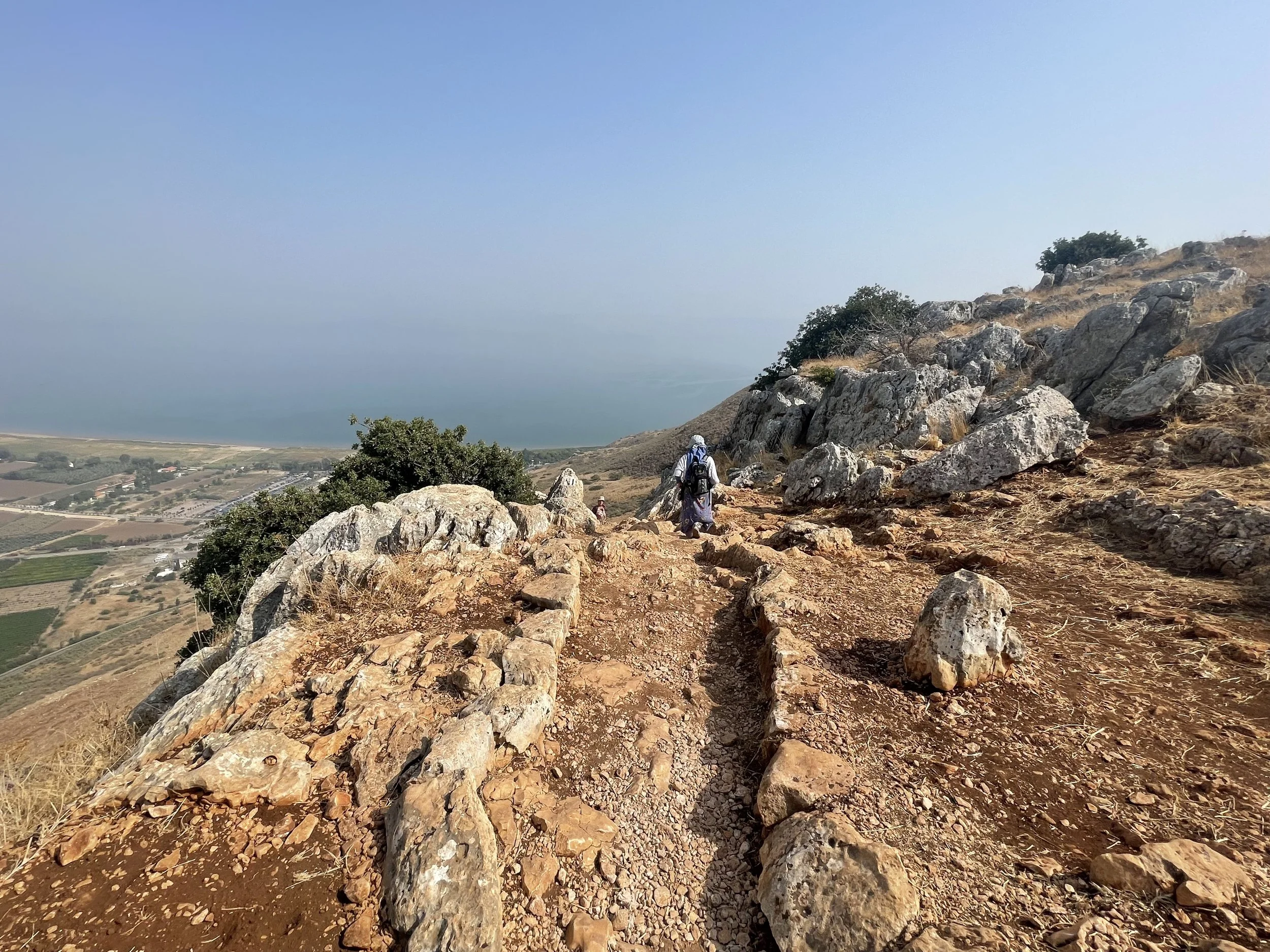
Notice. What is the eye staying with?
What is the body staying with?
Let it form in its own time / ניתן לזה להיווצר בזמנו.
A thread from the wider Arbel landscape
Awakening the Dawn: קִמְעָא קִמְעָא
More Than a Tour
Arbel: A Walk Into Widening Light
An embodied journey through memory, courage, Pnimiut HaTorah, and the awakening light of Geula
14 Cheshvan 5787 | October 25, 2026
Rachel Leah Weiman
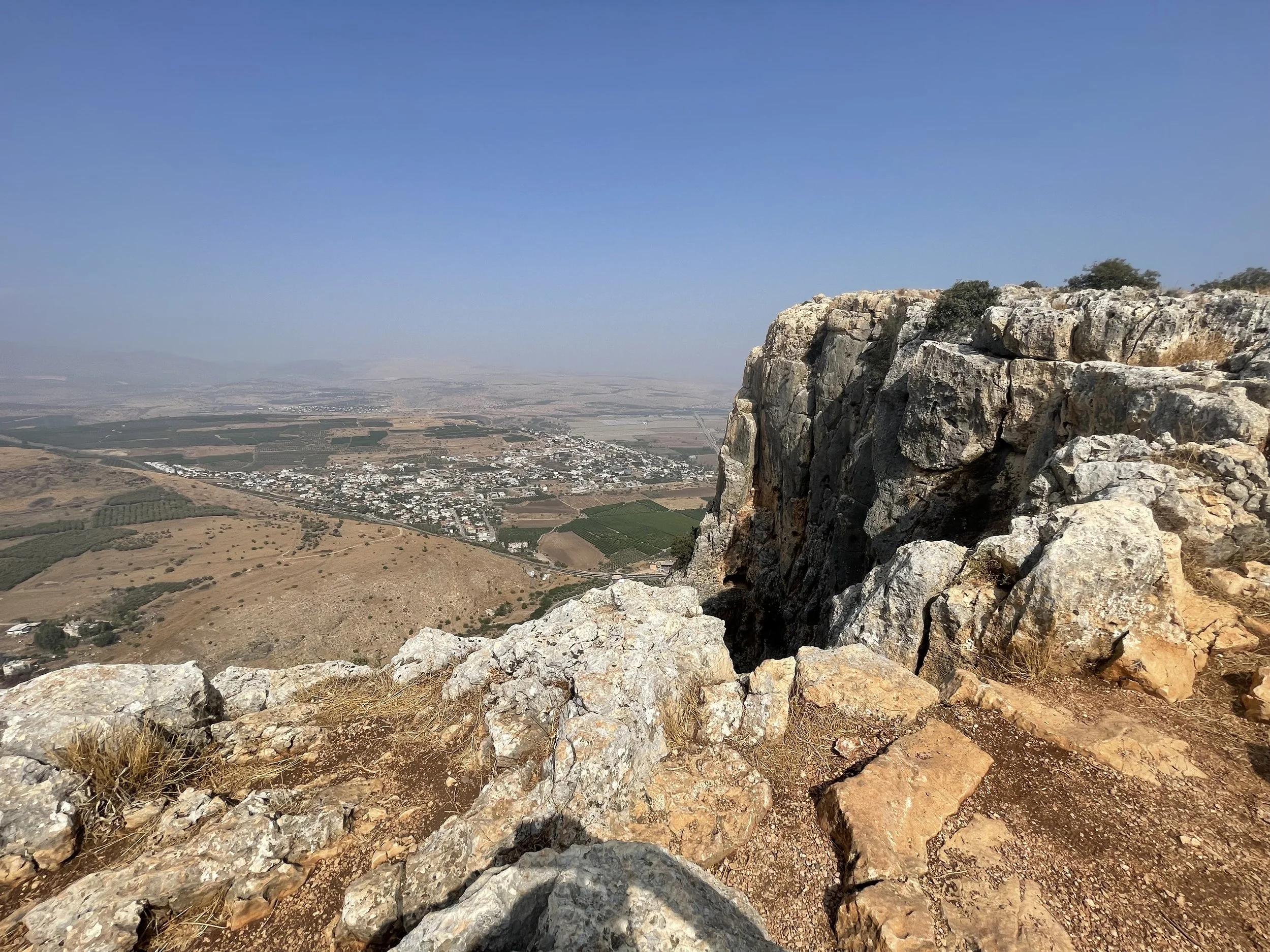
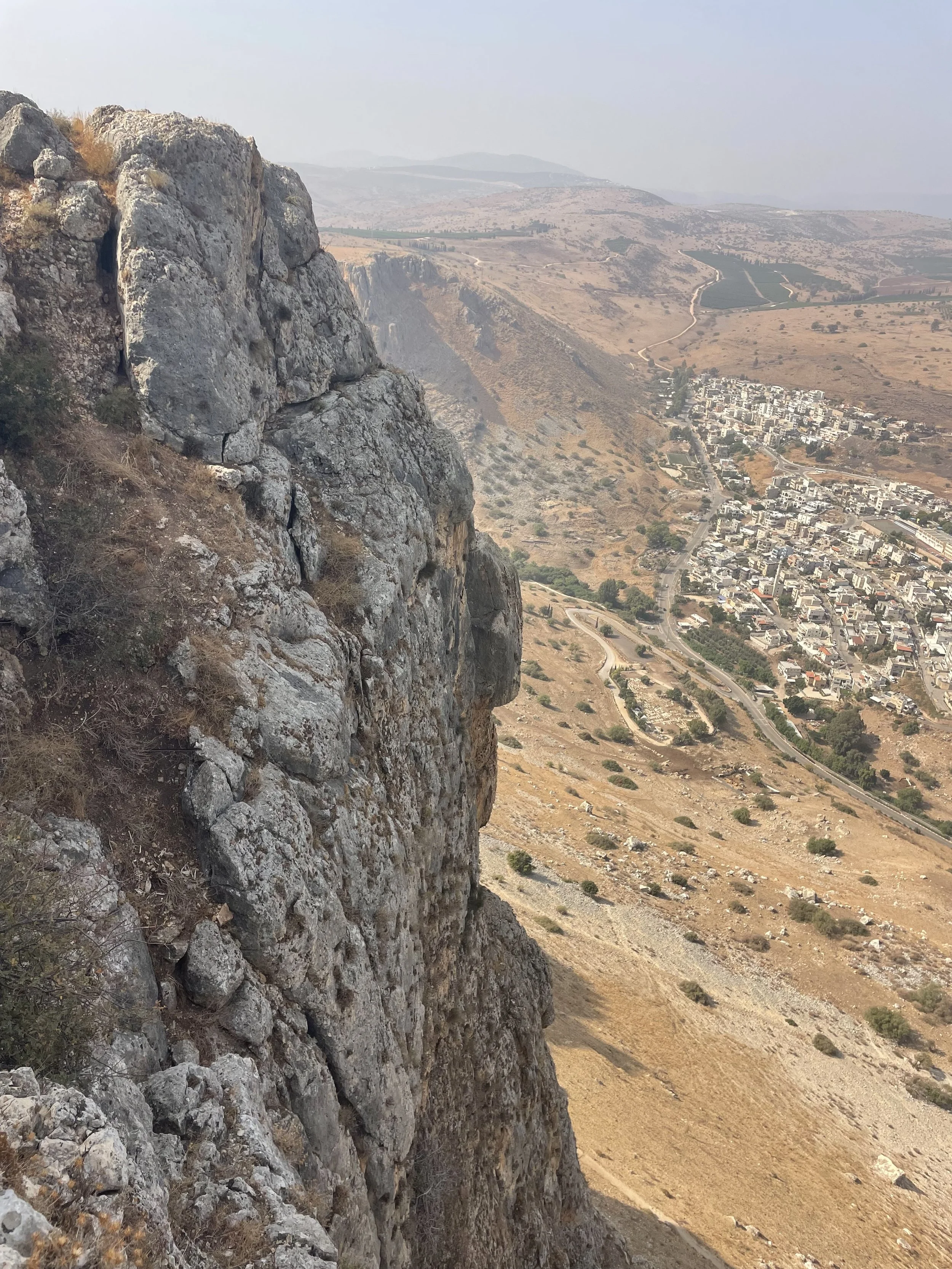
There are places in Eretz Yisrael where the earth seems to remember, where stones carry the impressions of ancient seas, caves hold the memory of Jewish resistance, and the light falling across the mountains awakens something within us that has been waiting, sometimes for decades, to be seen. Mount Arbel is such a place. Rising dramatically above the Kinneret, its limestone cliffs descend into deep valleys, their sheer faces interrupted by caves, narrow passages, and ancient fortifications. From above, the landscape opens in every direction. Below, winding roads, cultivated fields, and villages appear almost miniature against the immense scale of the mountains.
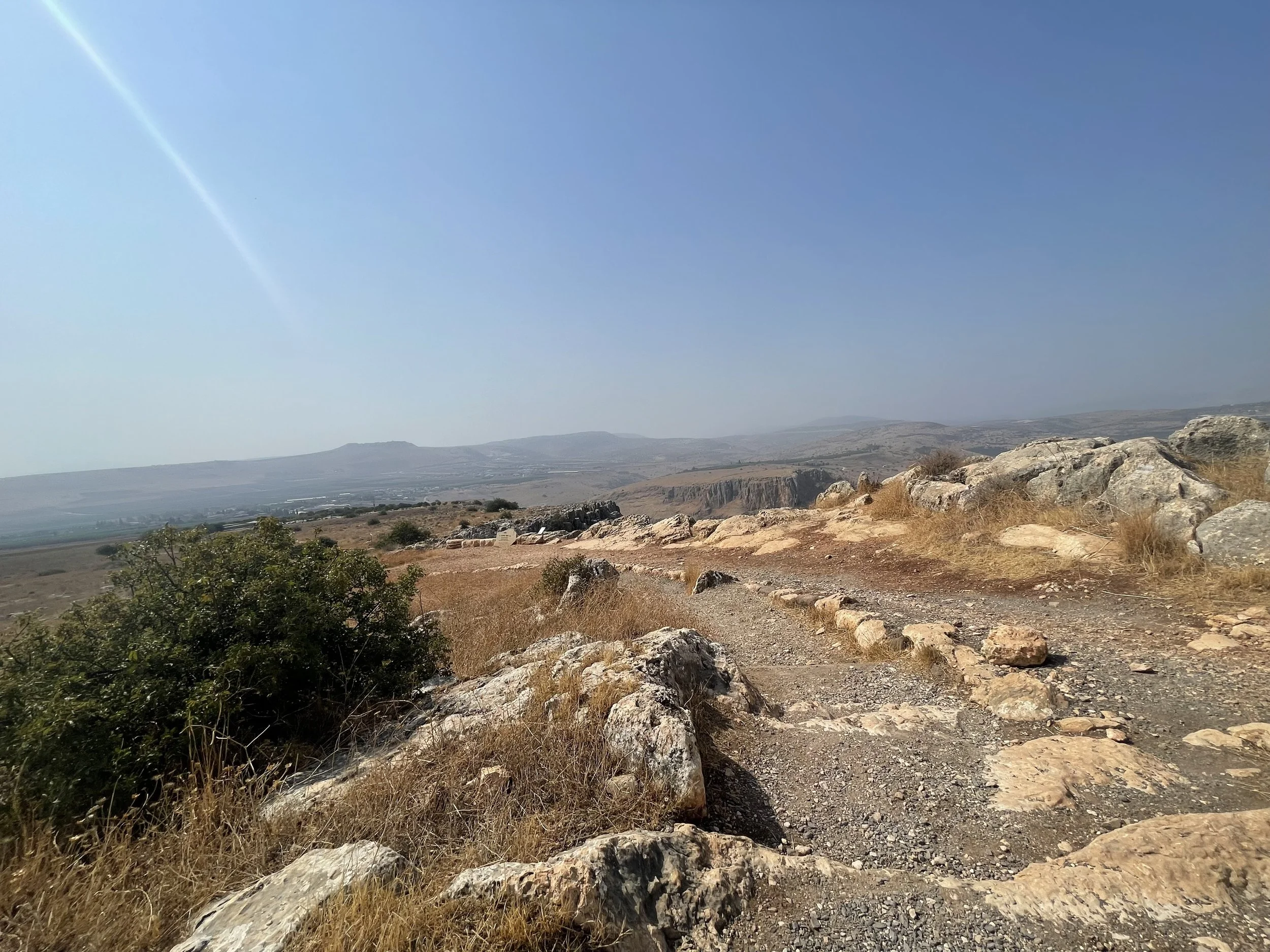
There is something extraordinary about approaching Arbel from the surrounding Galilean hills. At first, the mountain appears as part of a continuous landscape of golden grasses, pale stones, and gently rolling terrain. Then, almost without warning, the earth falls away. What seemed to be a broad plateau becomes the edge of a tremendous escarpment. The familiar horizontal world gives way to verticality, to depth, to an encounter with space that the body cannot ignore. It is a landscape that asks us to change the way we see. From a distance, the cliffs appear solid and continuous, but as we approach, they reveal an intricate world of openings, fissures, ledges, and passages. The rock that seems impenetrable contains caves. The slopes that appear barren contain trees and flowers. The mountain that seems motionless holds the evidence of immense geological movement. And the human being who arrives believing she knows the limits of her own body may discover that there is more within her than she has yet encountered.
On Sunday, 14 Cheshvan, I returned to Arbel with a small circle of women, guided by our extraordinary nature therapist and tour guide, Maskit Ben-Moshe. We came to walk, learn, breathe, listen, and encounter the land through our bodies. I had no idea how deeply this mountain would enter me, nor did I anticipate that the most profound teaching of the day would arrive through my own trembling hands, gripping iron handles embedded in a nearly vertical cliff. Our journey would take us through ancient Jewish ruins, beneath the shade of a carob tree, into enormous caves, along narrow ledges, past the remnants of fortresses, and finally upward through an ascent I was convinced I could not make. But the story begins long before that climb. It begins with listening, and with a light that widens little by little.
The Ancient Synagogue: Listening With the 3rd Ear
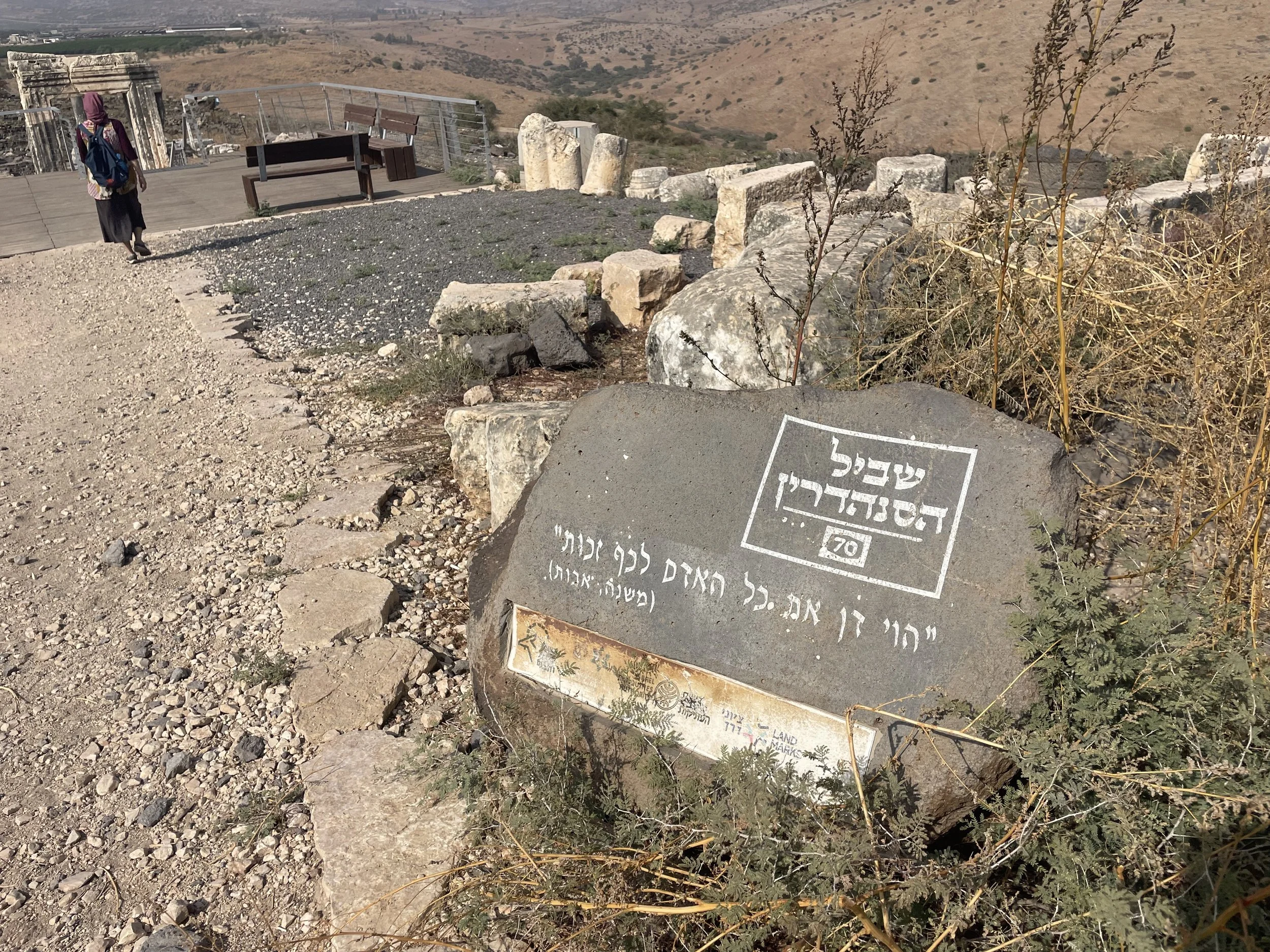
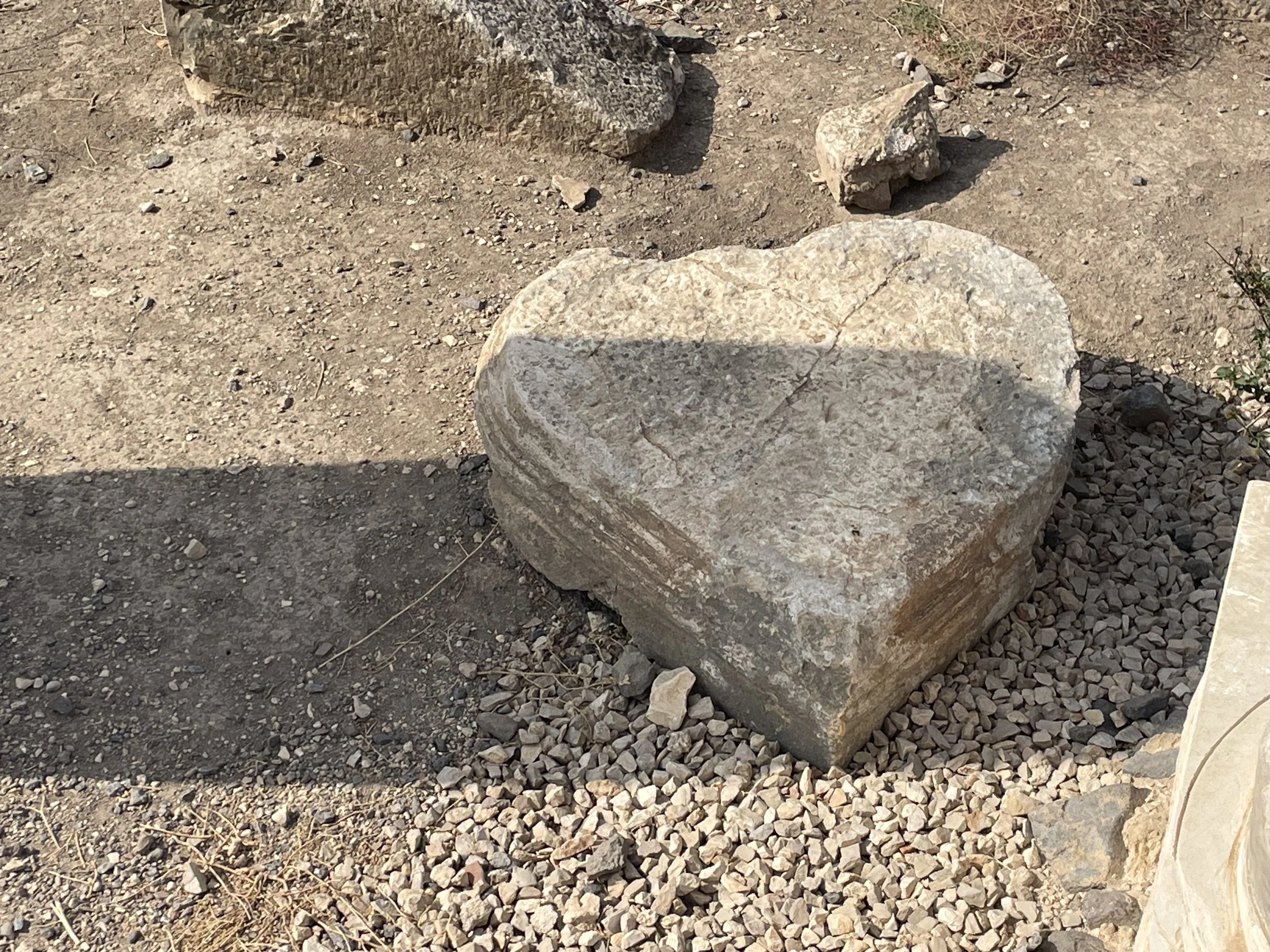
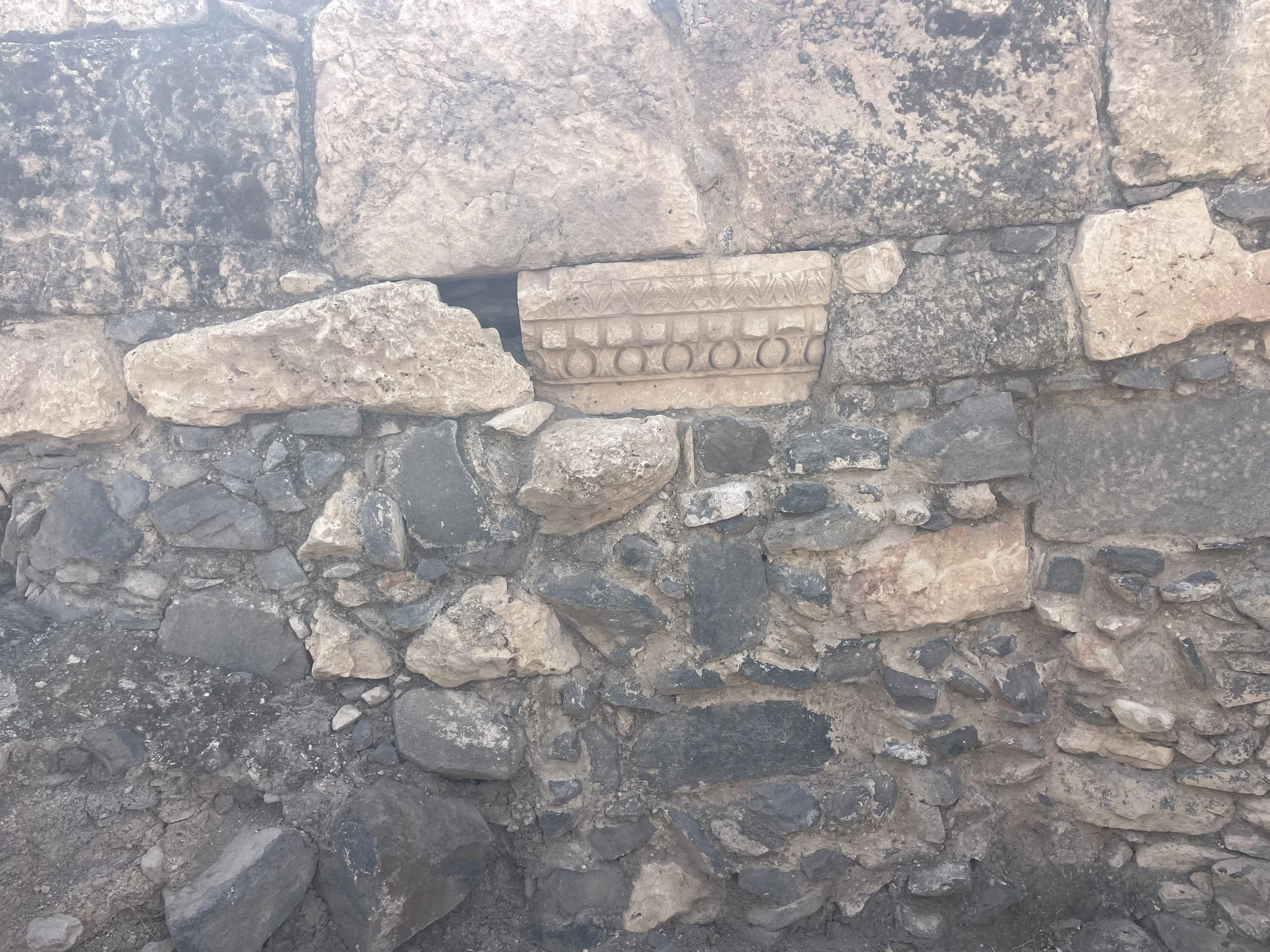
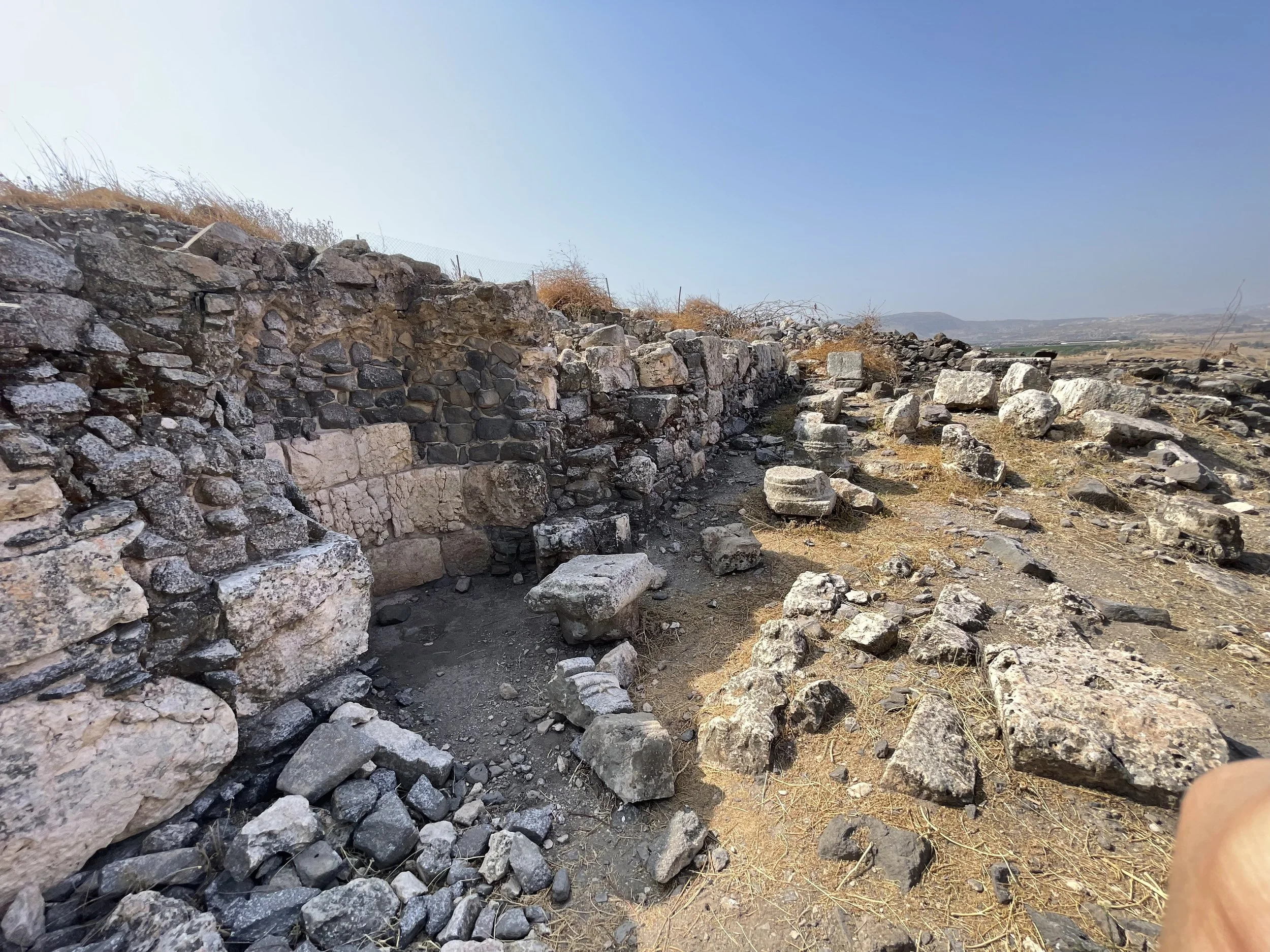
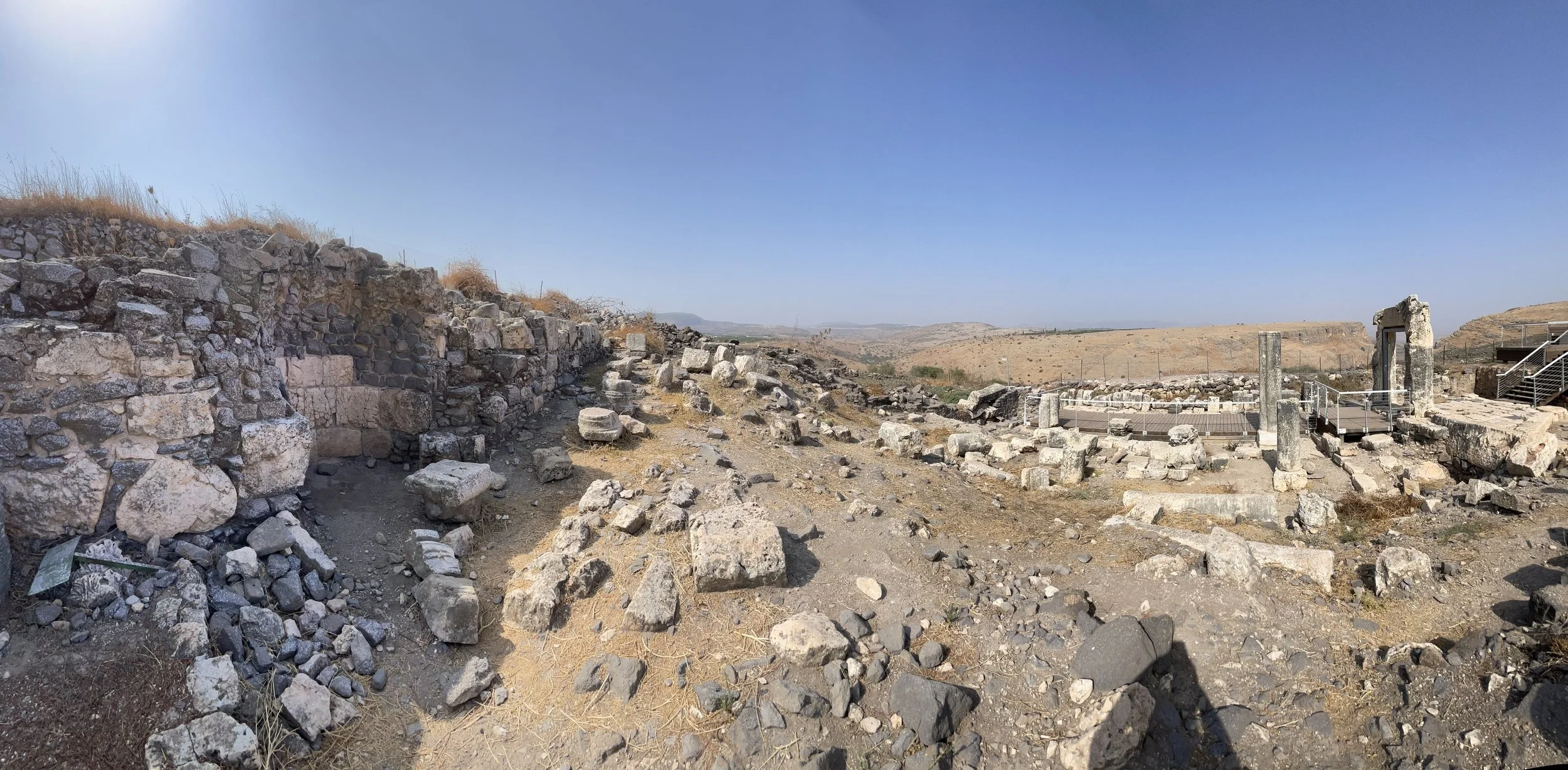
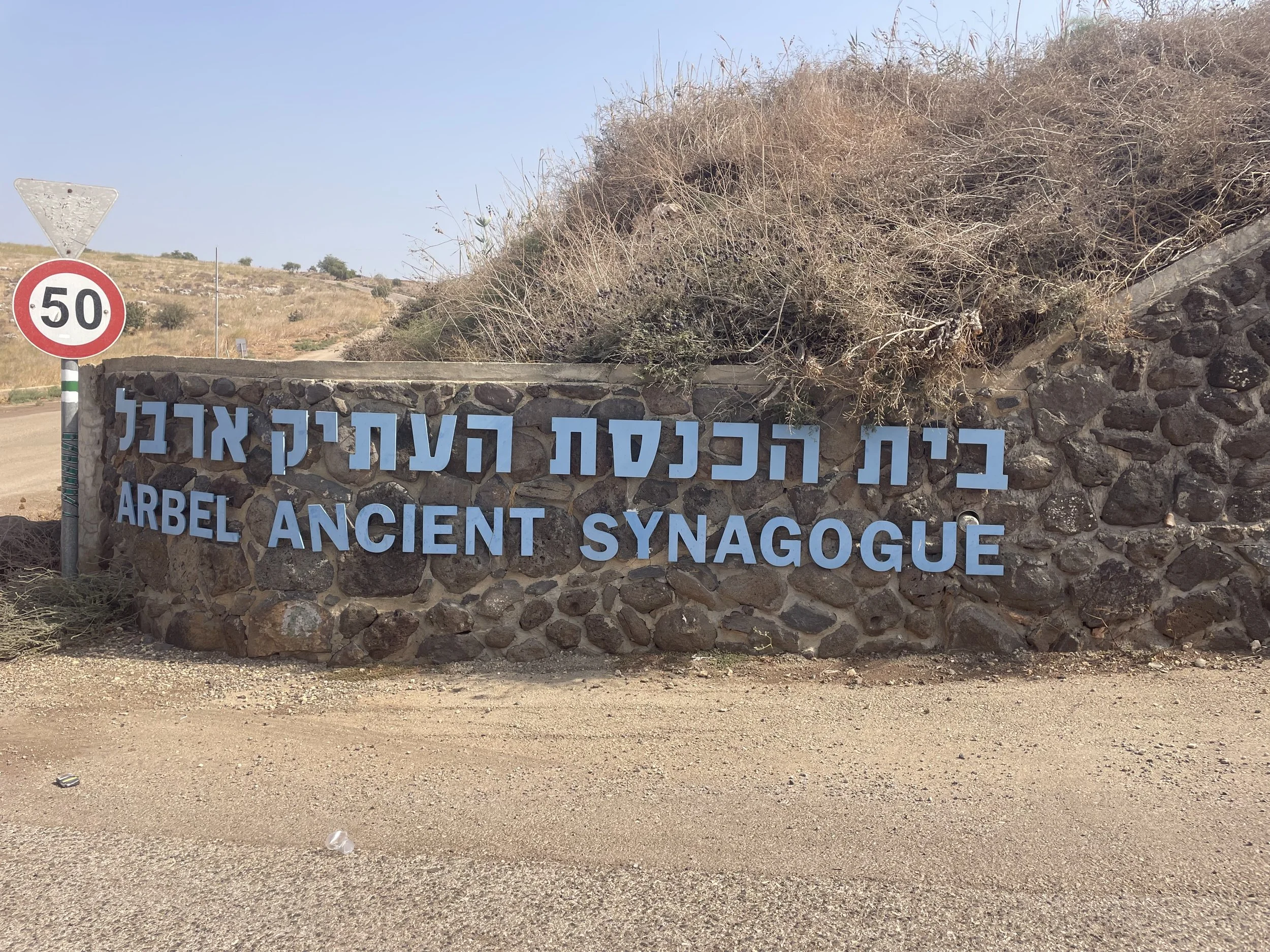
Our first stop was the ancient synagogue near Moshav Arbel. Its surviving stones stood exposed beneath the Galilean sky, pale limestone contrasting with darker local stone. Columns and architectural fragments marked the space where generations of Jews had gathered to daven, learn Torah, and live as a kehila / קהילה, a community. The entrance, fashioned from an enormous single stone, was particularly striking, and then there were the corner columns, shaped like hearts. I found myself staring at those hearts. Stone, the substance we associate with hardness and permanence, had been carved into the unmistakable suggestion of a heart. The ancient builders had brought form to something deeply human, and after centuries of exposure to sun, wind, and rain, those hearts were still standing.
I wondered about the hands that had shaped them, the artisans who had worked patiently with their tools, removing stone until a form emerged, the community that had commissioned such a building, and the people who had passed through its entrance carrying the concerns and hopes of ordinary Jewish life. The synagogue was not built for future visitors to contemplate its ruins. It was built for a living community. People entered this space carrying children, responsibilities, disagreements, gratitude, illness, longing, and Tefilla. They came to hear words of Torah and to stand together before Hashem. The doorway framed an opening into a world that no longer existed in its original form. Beyond it lay scattered columns, fragments of walls, and the open Galilean sky. The roof had disappeared and the voices had fallen silent, yet the architecture still invited us to enter.
In the photograph taken at the entrance, the carved stone doorway rises between us, its decorative bands and weathered ornamentation still remarkably distinct. Beyond it, a solitary column stands among the ruins. The doorway itself becomes a threshold between two worlds. Behind us is the present-day landscape of Arbel, with its paths, railings, and distant hills. Before us is the entrance through which earlier generations passed. We are standing in the same physical place, yet separated from those generations by centuries of history. And still, the doorway remains open.
There is a particular experience that comes from standing within an ancient structure whose walls no longer enclose it. The sky has become its ceiling, and the wind moves freely through spaces once defined by stone. What was formerly an interior has become part of the surrounding landscape, yet the memory of an interior remains. The architecture still tells the body where to enter, where to stand, and where the center of attention once lay. I sat within the recessed niche where the Aron HaKodesh had stood. Here, where the Torah had been honored and received, I became aware of my own body, my breath, and the women beside me. The stones were no longer merely objects of archaeological interest. They were inviting us into zechira / זכירה, remembrance, a living relationship with what came before us.
I invited the women to arrive, to feel the ground beneath their feet, to notice the air against their skin, and to look at the doorway, the stones, and the space between what remained and the open sky. And then I invited them to listen. Not with the third eye, but with the third ear! The petach eynayim. the place between the eyes! There is a quality of listening that begins when we stop trying to hear something and become receptive to what is present beneath the ordinary sounds of the world. We know how readily the mind fills silence with its own interpretations. We look at a ruin and immediately begin constructing a story. We see an ancient stone and imagine the people who touched it. We hear a historical account and begin assigning identities, motives, and meanings. But there is another possibility. We can become quiet enough to recognize the distance between what we know and what we do not know. We can listen without claiming possession of the lives we are remembering.
Inviting us into silence, to listen for the women who had lived in this ancient Jewish landscape. Women who remained faithful to Torah through difficult generations. Women who entered the mikvah, prepared for Shabbat, raised children, and carried the responsibilities of their homes and communities. Women who lived through persecution and violence, and women who gave their lives rather than abandon their connection to Hashem. And other Jewish women, women drawn toward Hellenistic and Roman culture, toward its aesthetics, romanticism, and celebration of the physical body. Women who may have felt confused, divided between the Jewish world they inherited and the powerful attractions of the surrounding civilization.
Creating Makom / room for them, too. Not to flatten the differences between their choices, nor to romanticize the suffering of earlier generations, but to acknowledge the complexity of Jewish life. How many women had stood in this landscape carrying questions they could not speak aloud? How many had longed to be understood? How many had struggled between the expectations of the surrounding world and the quiet insistence of their own neshama? We could not know their individual stories, but we could make room for them. There is a difference between imagining that we can recover the private thoughts of women who lived centuries ago and allowing their historical presence to deepen our awareness of the complexity of human experience. We did not need to know their names to recognize that their lives mattered, nor did we need to decide which women would have resembled us.
Our listening to become wide enough to acknowledge that Jewish history was lived by real people, with all the contradictions, aspirations, loyalties, and vulnerabilities of human life. This is a dimension of hakhala / הַכָּלָה, the capacity to contain, related to kli / כְּלִי, a vessel: to become spacious enough to acknowledge lives and experiences without needing to erase their contradictions. I felt that we were bearing witness to the women who remained, to those who struggled, to those who suffered, to those whose names have disappeared from history, and to the continuity of Am Yisrael.
Binah / בינה is associated with Leah, the concealed feminine world, the capacity to receive and develop what has not yet become fully revealed. Sometimes we must listen before we can see. Before the light becomes a recognizable form, something within us must become capable of receiving it. This was the first movement of our journey: making space. Not yet moving toward the edge of the mountain, but opening an interior space within ourselves, a place where memory could be received without being forced into a simple narrative, where the lives of other women could be acknowledged without judgment, and where the past could enter the present and deepen our responsibility to one another. The widening of light begins with the widening of our listening.
Nittai HaArbeli: The Company We Keep
Arbel is connected to one of the early teachers whose words are preserved in Pirkei Avot. Nittai HaArbeli teaches:
הַרְחֵק מִשָּׁכֵן רָע
Keep your distance from a harmful neighbor.
וְאַל תִּתְחַבֵּר לָרָשָׁע
Do not associate yourself with a wicked person.
וְאַל תִּתְיָאֵשׁ מִן הַפֻּרְעָנוּת
Do not despair of calamity or retribution.
(Pirkei Avot 1:7)
We paused over the final word, puranut / פֻּרְעָנוּת. It can refer to calamity, affliction, punishment, or the consequences of wrongdoing. It is not the Hebrew word for justice. Yet Nittai’s teaching also asks us to remain awake to moral consequence, to remember that wrongdoing does not disappear simply because its consequences have not yet become visible. In this sense, we spoke about not abandoning our trust in Hashem’s justice, even when history appears bewildering.
With elections taking place this week, the question felt especially immediate. Whose voices do we allow to shape our consciousness? What do we attach ourselves to? How do we remain connected to what is good when the surrounding world is filled with conflict and confusion? And what does it mean to remember that Hashem has not abandoned Am Yisrael, even in times of judgment?
The teaching is particularly striking because it joins the intimate world of relationships with the larger world of moral consequence. The neighbor is close. The person with whom we choose to associate may become part of our daily life, and these relationships shape the atmosphere in which our thoughts, emotions, and choices develop. We are not isolated beings. The people we welcome into our lives influence what we begin to regard as normal, desirable, possible, and true. Yet this does not mean withdrawing from the complexity of human relationships or refusing to recognize another person’s struggle. There is a difference between bearing witness to another human being and attaching ourselves to what is harmful. There is a difference between compassion and surrendering our own discernment. The challenge is to remain openhearted without losing our inner direction.
We asked: מִי הוֹלֶכֶת לְצִדִּי? Who is walking beside me? What kind of presence do I offer the women walking beside me? The question would accompany us throughout the day. We had not yet begun the demanding part of our hike, but already the mountain was teaching us about companionship and about the importance of choosing whose voices we carry within us.
Later, when I stood beneath the final cliff, the significance of this teaching would become intensely physical. The women beside me would not be abstract companions. Their presence would help create the conditions in which I could approach something that frightened me. And within myself, I would encounter another question about companionship: Which of my own inner voices would I follow? The many voices of fear, or the one small voice that quietly insisted I could continue?
The Tree: Between Leah & Rachel
Before beginning our descent, we stopped beside a tree. We stretched against its trunk, leaning into the bark, extending our arms along its branches, allowing the body to awaken. The tree offered resistance without pushing us away. Its trunk was firm enough to support us, its branches gave our arms somewhere to reach, and its roots disappeared beneath the ground, drawing nourishment from a world we could not see. I contemplated the relationship between shoresh / שורש, root, and anaf / ענף, branch. The branch reaches toward the light precisely because the root remains connected to the earth.
We observed the tree growing from an astonishing foundation of stone. Its trunk rises between massive pale rocks, twisting upward into a dense canopy of green leaves. The rock appears to embrace the tree, and the tree appears to emerge from the rock. Beneath its branches, there is enough shade for a woman to rest. What a remarkable image of containment. The tree does not wait for ideal conditions before growing. Its roots find their way through the stone, drawing life from whatever the earth makes available.
The contrast between the rough, pale limestone and the living green canopy is extraordinary. The stone is fractured and irregular, marked by hollows and crevices. The trunk bends and twists through the space available to it, then opens into branches that spread outward. Nothing about the tree’s growth appears geometrically perfect. Its beauty emerges through adaptation. Its strength is inseparable from the particular conditions in which it has grown, and its shade becomes a gift to those who come beneath it.
In the language of the 4 levels of creation, we encounter domem / דומם, the still or mineral world, and tzomeach / צומח, the growing world. The rocks beneath our feet and the living tree before us offered different expressions of existence. We considered their relationship to the inner dimensions of life, including nefesh / נפש, our embodied vitality, and ruach / רוח, the movement of spirit and feeling.
We sensed the relationship between Leah and Rachel. Leah, associated with the upper ה of Shem Havayah, with Binah and the concealed world of understanding. Rachel, associated with the lower ה, with Malchut / מלכות and the revealed world in which understanding must become embodied. Our arms reached toward the branches while our feet remained upon the earth. The upper and lower worlds were not separate destinations. They were meeting within our bodies.
הַמַּבָּט עוֹלֶה וְהָרַגְלַיִם נִשְׁאָרוֹת עַל הָאֲדָמָה.
Our gaze rises while our feet remain upon the earth.
The light of Leah must eventually descend into Rachel. It must enter the body, the choices we make, the relationships we cultivate, and the actual ground upon which we stand. As we leaned into the tree, I became aware that support does not necessarily make us passive. The firmness of the trunk allowed us to stretch more fully. Because there was something stable against which to lean, the body could explore a greater range of movement. The tree did not move toward us. It remained rooted, yet its rootedness made our movement possible.
I would remember this later, when my hands reached for iron handles embedded in the rock. The mountain would offer a different kind of support, harder, colder, less forgiving, but the relationship would be similar. I would need to trust something outside myself while discovering a movement that could only come from within my own body.
The Carob Tree: Returning to My 21-Year-Old Self
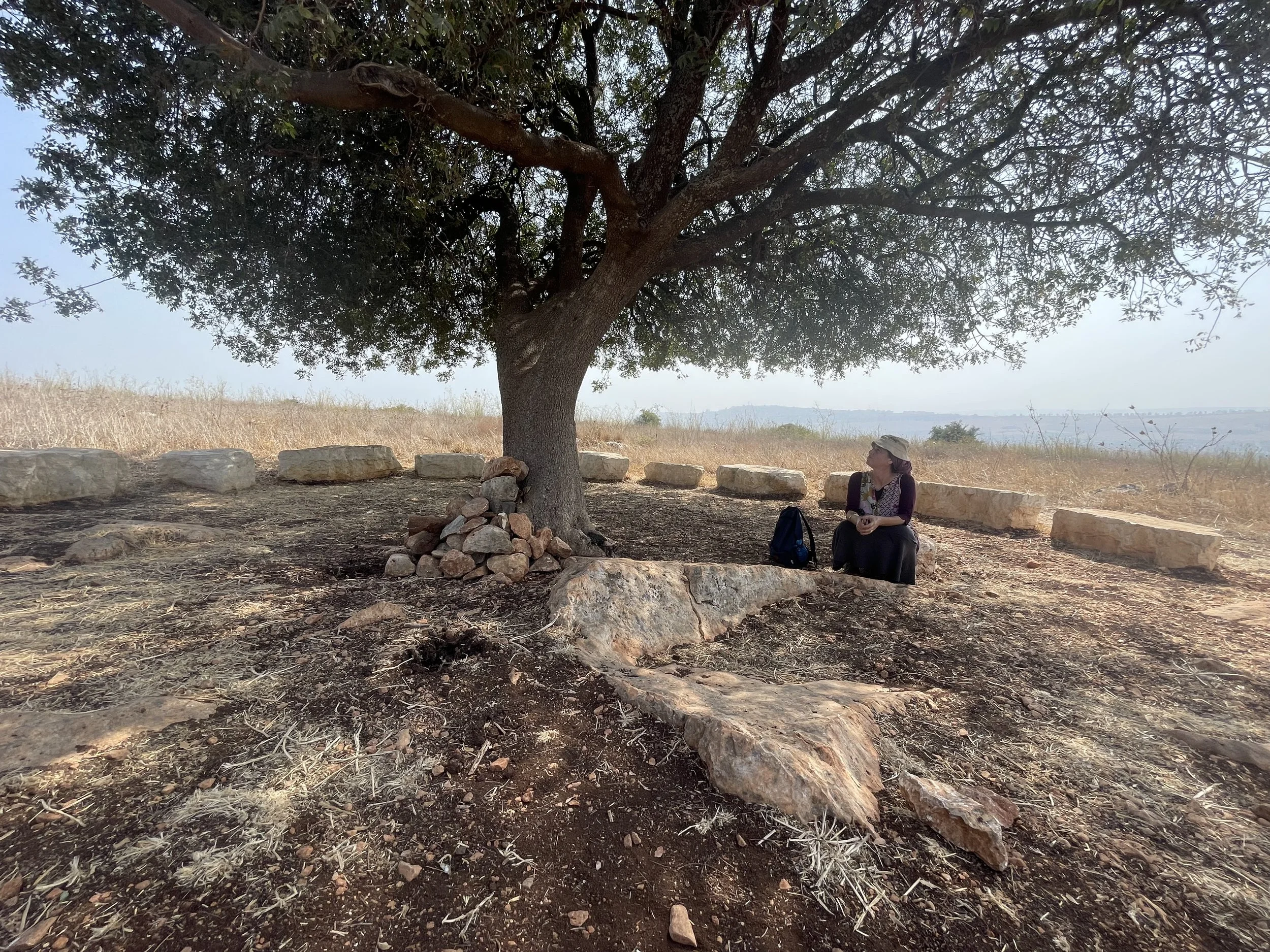
Our next stop brought me into an entirely different dimension of time. Beneath a broad carob tree overlooking the valley, I suddenly found myself remembering another young woman who had stood on this mountain. She was twenty-one, and she was me.
Decades earlier, during my years of kibbutz life and adventures in Eretz Yisrael, I had stayed at Moshav Arbel and made my way toward this very lookout. I remembered the exhilaration of climbing the mountain, devouring watermelon from a patch along the way, and the extraordinary appetite I had for life, for love, for light, for adventure, and for experiences that would awaken something within me. I was searching so intensely, and I was confused. I wanted to experience everything, to discover who I was, to find something that would satisfy the longing moving through my neshama.
There is something remarkable about returning to a place where we once stood at a very different stage of life. The landscape may have changed in countless small ways, yet the encounter with it can awaken memories that have remained almost untouched. The young woman I remembered was not simply an earlier version of the person I am today. She inhabited a different world of possibilities. She did not know where her search would lead, could not see the decades that lay ahead, and had not yet lived through the experiences that would shape my present understanding. And yet her longing was familiar. I could still recognize its intensity, the energy with which she had moved through the world, her desire to discover something real, her willingness to enter unfamiliar experiences, and her hunger for life.
Now, reaching סג as a mature savta, I had returned. The weather was scorching, close to 90 degrees F. Our bodies were hot from the sun and the exertion of walking, and beneath the carob tree lay a broad stone, cool in the shade. We lowered ourselves onto it, three women lying face down across the rock, our arms resting outward, our faces turned toward the stone. Above us, sunlight filtered through the leaves, scattering patches of brightness and shadow.
I felt: the startling coolness against my overheated skin, the contact of my cheek with the rock, the weight of my chest resting upon something utterly solid, the subtle vibration I sensed through the stone, and the sensation of being supported without having to hold myself upright. For a few moments, I did not need to climb, search, teach, or become. We could simply lie there. The rock held my weight, and within that physical experience, something softened. I felt as though I were resting within a womb, a place of containment, a place where I could return to what had been without needing to change it.
The contrast between the scorching air and the cool stone intensified the experience. My body had been carrying the heat of the day, the effort of walking, and the anticipation of the demanding trail ahead. Then, through direct contact with the rock, it received something entirely different: coolness, stillness, support. I was not imagining containment. I was physically experiencing it. The rock beneath me was bearing my weight, and within that experience, I found room to encounter a memory that had carried its own emotional weight for more than four decades.
My younger self was there, not as a distant memory, but as a living presence within me. The young woman who had searched for love and exhilarating experiences, who wanted so desperately to discover the light. And now I could meet her differently. I did not need to judge her confusion or dismiss her longing. I could bring the understanding of my present life to the experience of my younger self. This was a tikkun / תיקון, a movement of repair and integration. Not erasing what had happened, not rewriting the past, but allowing the light of my present consciousness to enter a place that had once been filled with uncertainty.
There was no need to tell the younger woman that her searching had been foolish. Her longing had been real. The problem was not that she wanted light. It was that she did not yet know how to recognize it, how to receive it, or how to remain connected to herself while searching for it. I could acknowledge the courage within her desire for experience while also recognizing the confusion that had accompanied it. The years between us were no longer merely a distance. They had become a source of understanding.
I was deeply grateful to my soul sisters for caring, listening, and bearing witness with me. Their presence allowed me to remain with the experience rather than retreat from it. The young woman who had wanted to experience everything was being received by the older woman who had learned that presence itself can be an extraordinary experience.
I thought about how often we imagine that healing requires a dramatic new event. Yet here, the most meaningful movement was almost imperceptible: a woman lying upon a stone, remembering, breathing, allowing an earlier part of her life to be received within a wider consciousness. No external circumstances from the past had changed, but the relationship between my present self and my younger self had changed, and that change was real.
The light did not erase the past. It entered it.
And then we rose from the rock. Our circle hike was beginning.
The Descent: One Step at a Time
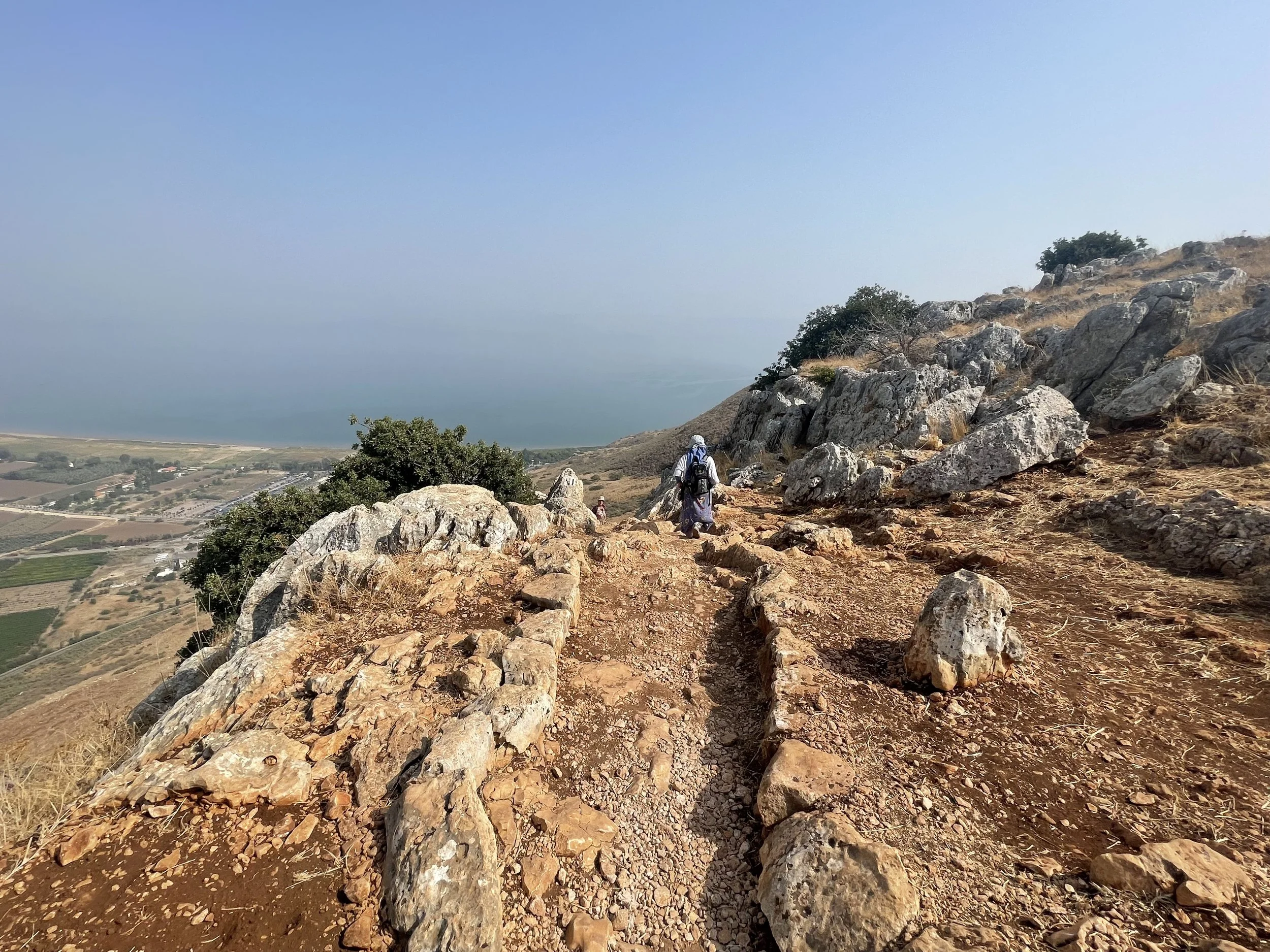
The trail soon became steep, very steep. Jagged limestone interrupted the narrow path, stones projected at unexpected angles, and iron handles appeared along sections where the descent required additional support. I looked down and wondered how I was going to do this. I had not worn real hiking boots since my twenties, and my body was no longer the body I remembered from those earlier adventures.
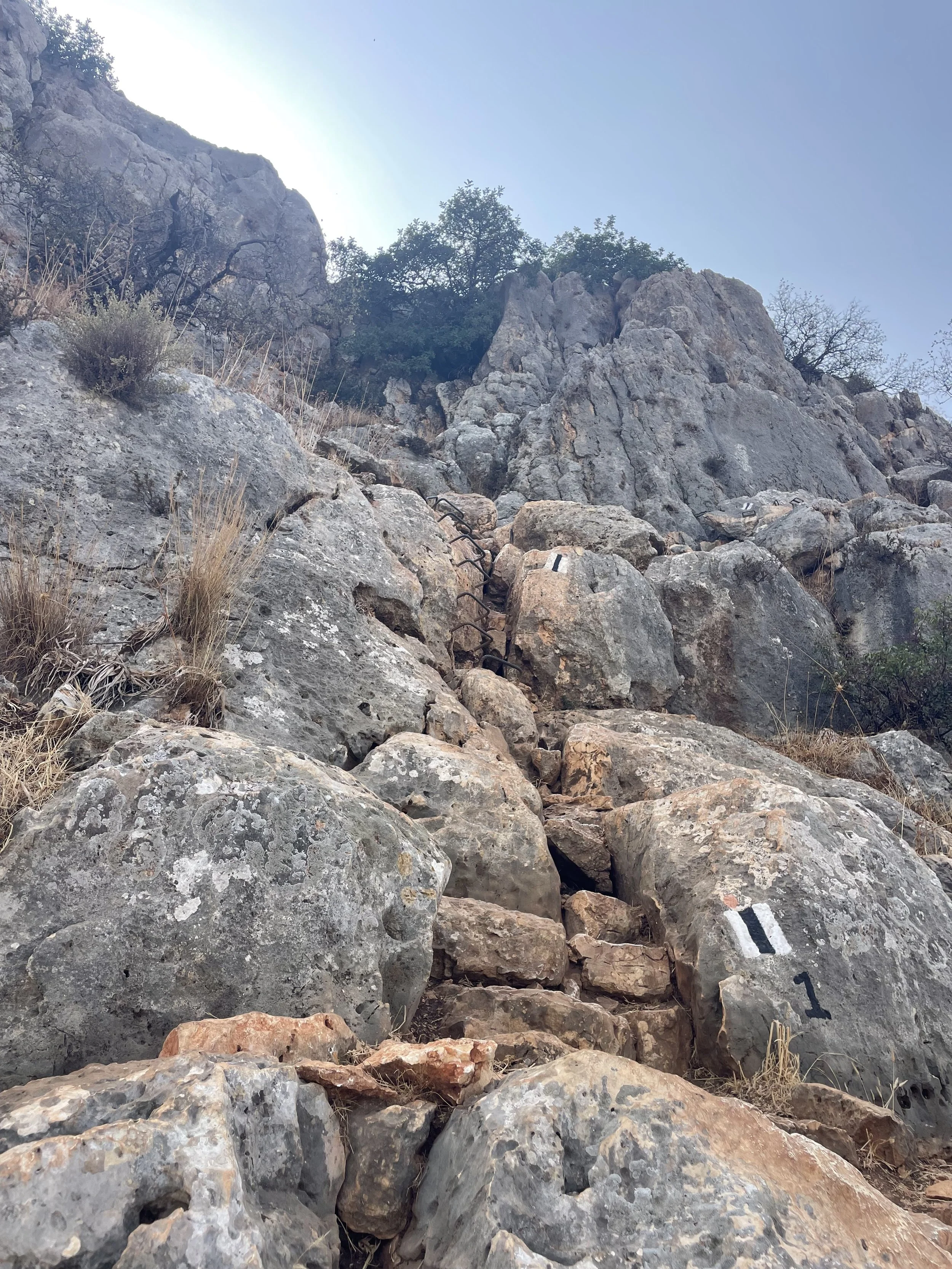
The cliffs reveal how sharply the mountain falls away. The trail is not a smooth ribbon winding gently downward, but a succession of angular stones, fractured ledges, and abrupt changes in elevation. One photograph captures a particularly demanding passage. The trail climbs through a narrow channel between enormous boulders, black-and-white trail markers painted directly onto the limestone. Above them, a series of iron handles disappears into the rocky passage. From below, the route resembles a natural staircase whose steps have been scattered and rearranged. The stone itself determines the movement of the body. There is no way to walk this passage without paying attention.
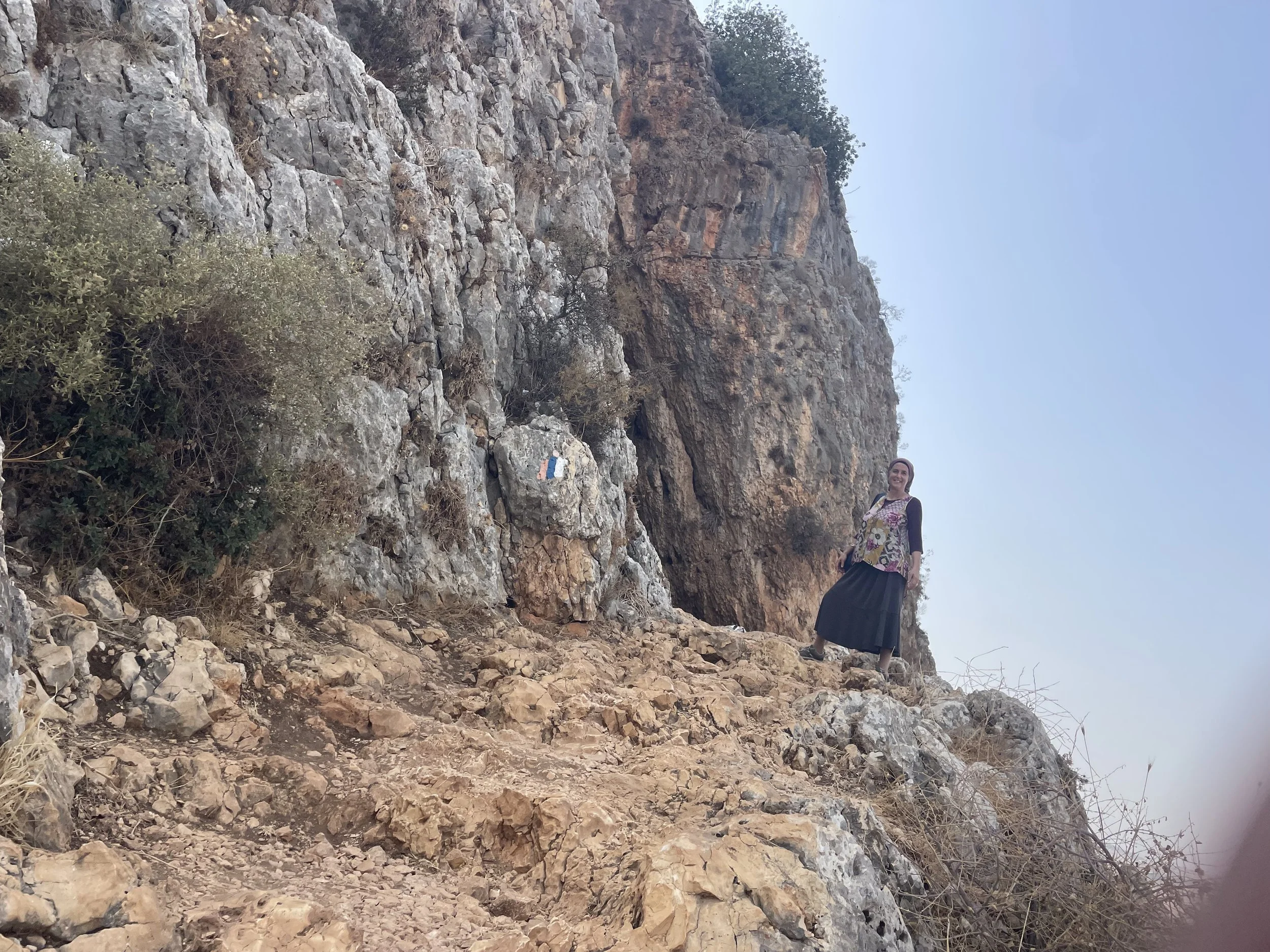
The cliffs rise in immense vertical planes, their surfaces broken by crevices and dark openings. Far below, the valley stretches outward, its cultivated fields reduced to small patches of color. There was a continual movement between two ways of seeing. When I looked outward, I encountered vastness. When I looked downward, I encountered the immediate demand of the next foothold. The eye wanted to take in the magnificent landscape, while the body insisted that I attend to the few inches of stone beneath my feet.
It was like the opening and closing of a camera lens. Hitrachavut / התרחבות, expansion, and hitkavtzut / התכווצות, contraction. The lens opens to receive the horizon, then narrows to bring one small detail into focus. I began to understand that widening consciousness does not mean remaining in an expanded state at every moment. Sometimes wisdom is knowing when to narrow our attention so that we can remain present.
The mountain was teaching this lesson through the most ordinary movements. I could not place my foot carelessly or move according to the rhythm I might choose on a level path. Each step required a fresh relationship with the ground. Sometimes I needed to shift my weight backward, bend my knees, or turn my body sideways and use my hands. I began noticing how much intelligence is involved in a movement we ordinarily take for granted: walking.
The feet are constantly receiving information, the ankles respond to changing surfaces, the eyes assess distance, and the hands reach instinctively for support. The body coordinates these actions before the mind can explain them. On level ground, we rarely notice this remarkable cooperation. On Arbel, I could not ignore it.
צַעַד וְעוֹד צַעַד. One step and then another. I did not need to see the entire trail. I needed to see where to place my foot, and then the next, and then the next. As we descended, I realized that this was not merely a technique for negotiating difficult terrain. It was a way of relating to uncertainty. The mind wants the whole journey revealed before it agrees to begin. The body often needs something much simpler: enough stability for the next movement, enough attention to remain present, and enough trust to continue.
The Cave: Life Emerging From the Rock
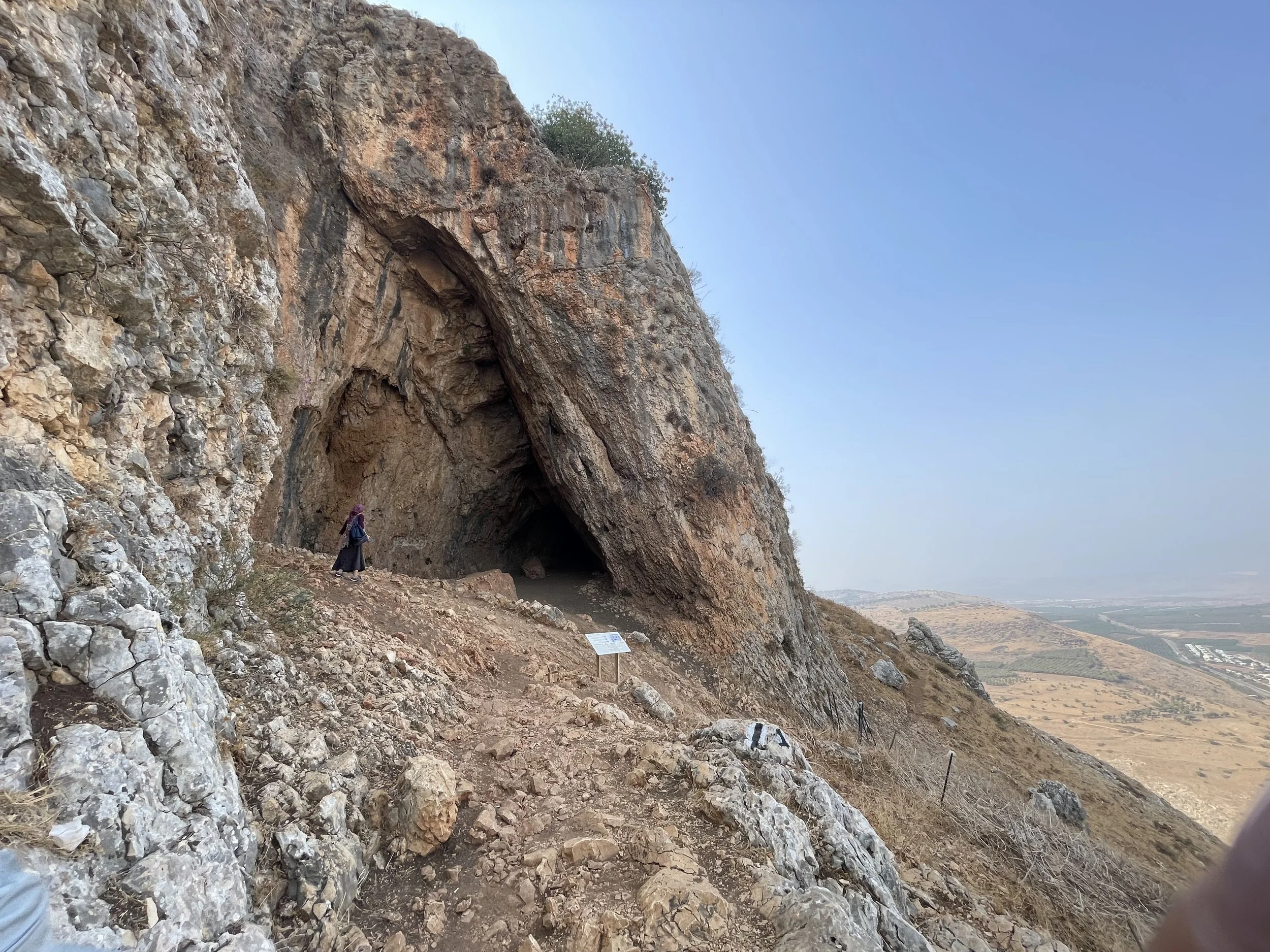
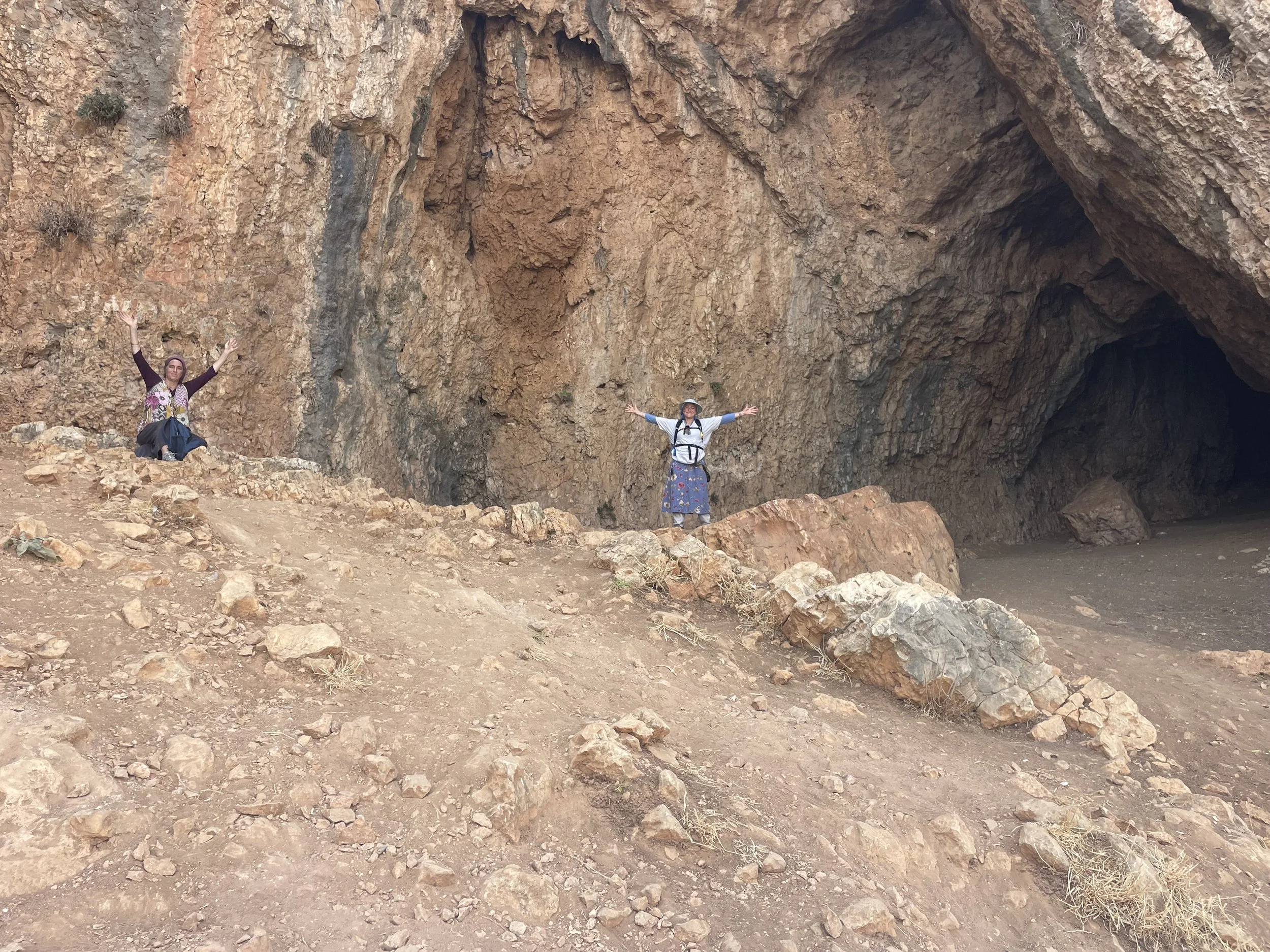
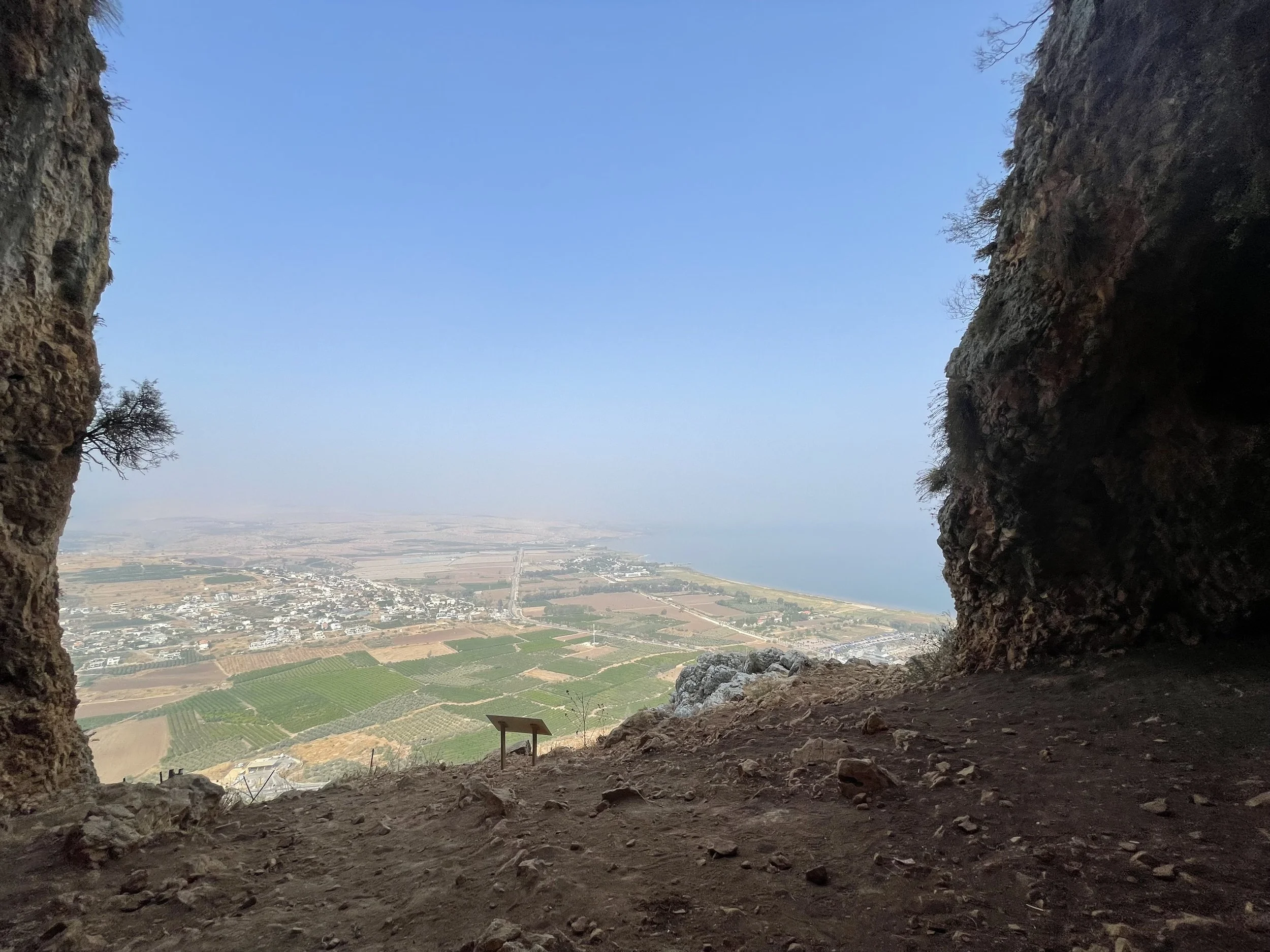
Eventually we entered an enormous cave. The rock curved overhead, creating a vast shadowed shelter beneath the cliff, and from within, the landscape opened toward the Kinneret and the cultivated valley far below. One of the photographs captures the extraordinary scale of this place: a woman standing beneath the massive overhang, extending her arm upward toward the rough ceiling. Her body appears small against the immense surface of the mountain.
The geological explanation displayed along the trail deepened my appreciation of what we were seeing. Arbel’s dramatic cliffs are composed of limestone and dolomite. They form part of the landscape shaped by the great Syrian-African Rift and related geological movements. Water penetrated the rock, gradually dissolving portions of the limestone and creating cavities, passages, and caves. Over time, some of these cavities enlarged until sections of their ceilings collapsed. The cliff faces continued changing as parts of the rock broke away. What appears from a distance to be an unbroken wall of stone is actually a landscape shaped by movement, dissolution, pressure, and collapse.
There are approximately 350 caves in the Arbel cliffs, some later adapted by people for shelter and habitation. I found this fascinating. The caves were not simply empty spaces waiting to be occupied. They had emerged through processes of transformation within the rock itself. Water, moving patiently through limestone, had created openings where there had once been solid stone, and within those openings, human beings eventually found refuge.
The geological process itself invited contemplation. Water appears soft beside stone. We can pass our hands through it or pour it into a vessel. Yet over immense periods of time, water can reshape the very structure of a mountain. Its influence is not always visible in the moment. It works through contact, movement, and repetition. What seems immovable gradually becomes permeable, and what appears closed begins to open.
I thought about the ways understanding enters us. Sometimes a teaching does not immediately transform our experience. It enters quietly, returns, encounters resistance, and over time, a new opening begins to form. Yet what captured my attention was something almost impossibly delicate: purple flowers growing directly from the rock. Their slender stems emerged from narrow fissures in the limestone, carrying clusters of tiny lavender blossoms against the dry, weathered surface.
The mountain appeared immovable, and the flowers appeared fragile, yet the flowers had found a way to grow. They did not need the entire cliff to open, only a small place through which life could emerge.
נְקֻדָּה אַחַת שֶׁל אוֹר. One point of light.
I thought about how often we wait for the whole landscape of our lives to change before allowing ourselves to grow. And here, in the rock, was another teaching: growth can begin within the very conditions that seem to prevent it. Neivita / נביטה, germination, a seed beginning to awaken, a small emergence of life where the eye might expect only stone. The flowers were not an interruption of the mountain’s reality. They belonged to it. Their roots entered the fissures that the rock itself provided. The very cracks that revealed the mountain’s vulnerability also created places where new life could emerge.
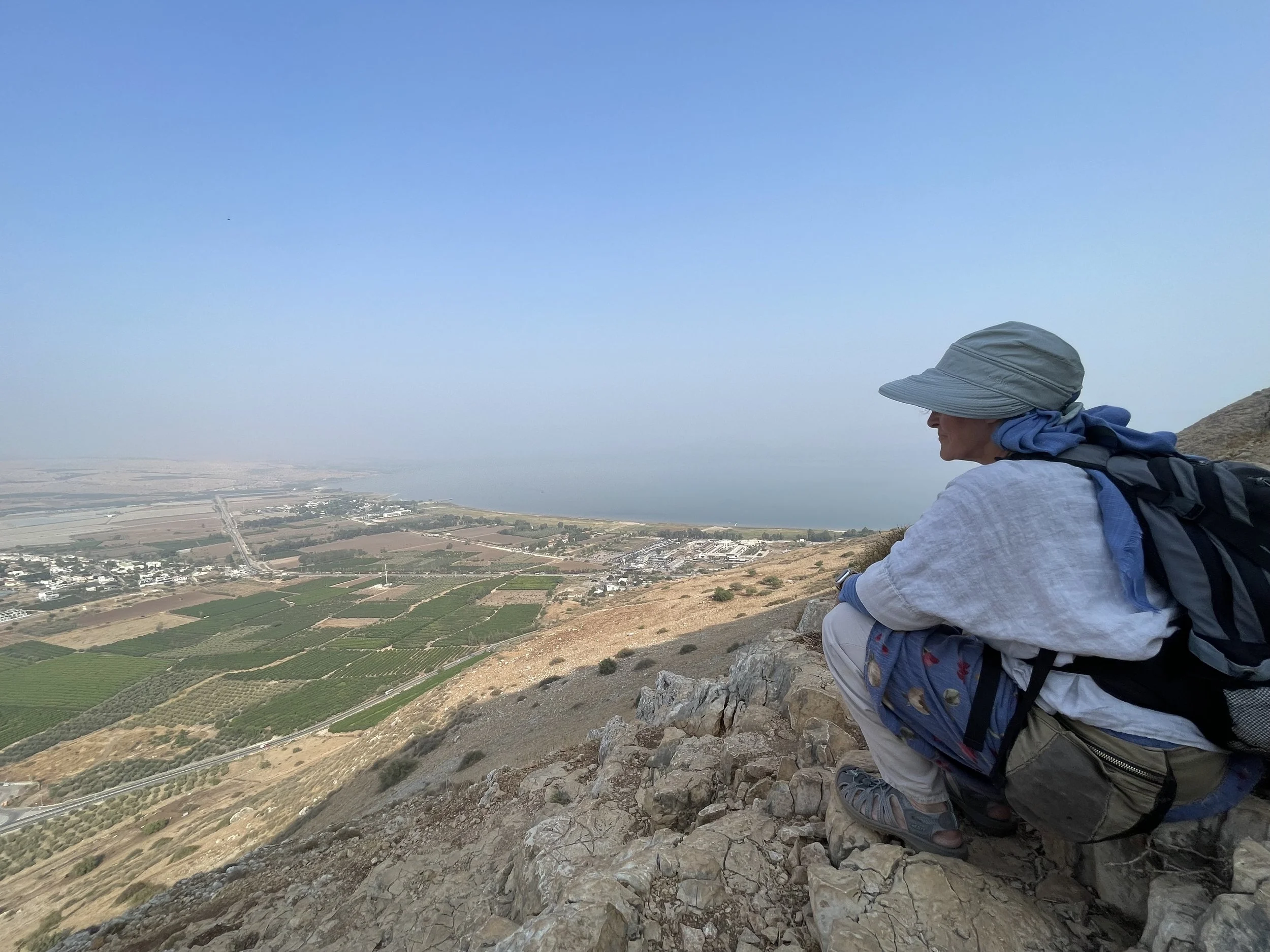
We snacked on the fruits of Eretz Yisrael and looked outward. Exhilarated. The Kinneret lay far below, beyond the cultivated fields and the descending slopes. The view was magnificent, but my body registered the height before it could fully receive the beauty. I felt the pull of the open space beneath me and the instinctive need to find something stable. So I brought my gaze back to the rock, its texture, its edges, and the small variations in color. Only then did I look outward again, a little farther and a little longer.
I was discovering that even seeing requires a vessel. The eye may be capable of receiving the entire horizon, but the nervous system must also be able to remain present with what the eye reveals. I began to recognize a rhythm: look outward, feel the intensity, return to the immediate physical world, find stability, and then look outward again. There was no need to force myself to receive more than I could hold, and there was no need to abandon the magnificent view because it initially overwhelmed me. The relationship could develop gradually. The widening of light requires a widening of our capacity to receive it.
The Caves of Resistance: Remembering What Happened Here
As we continued along the cliffside, we passed ancient caves and remnants of fortifications. The landscape that had offered us such breathtaking beauty had also witnessed terrible suffering.
Arbel appears in the historical record during the struggles of the Hasmonean period. In the account preserved in 1 Maccabees 9:2, the Seleucid general Bacchides traveled through the region and camped at the passes of Arbela. The Hebrew translation by Avraham Kahana reads:
וַיַּחֲנוּ עַל מְסִלּוֹת אֲשֶׁר בָּאַרְבֵּל
They camped at the passes in Arbela.
וַיִּלְכְּדֻהָ וַיַּהַרְגוּ נְפָשׁוֹת אָדָם רַבּוֹת
They captured it and killed many people.
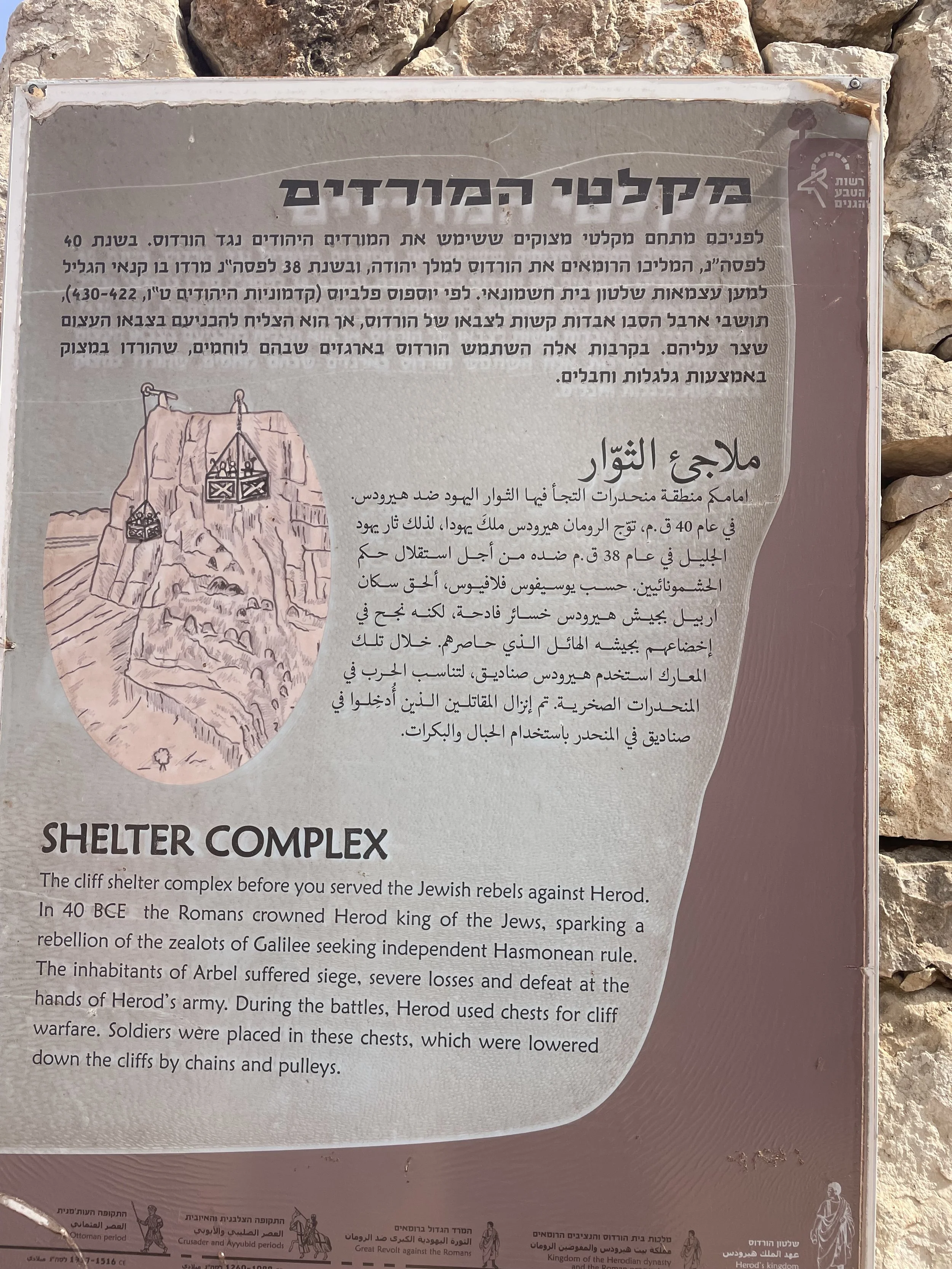
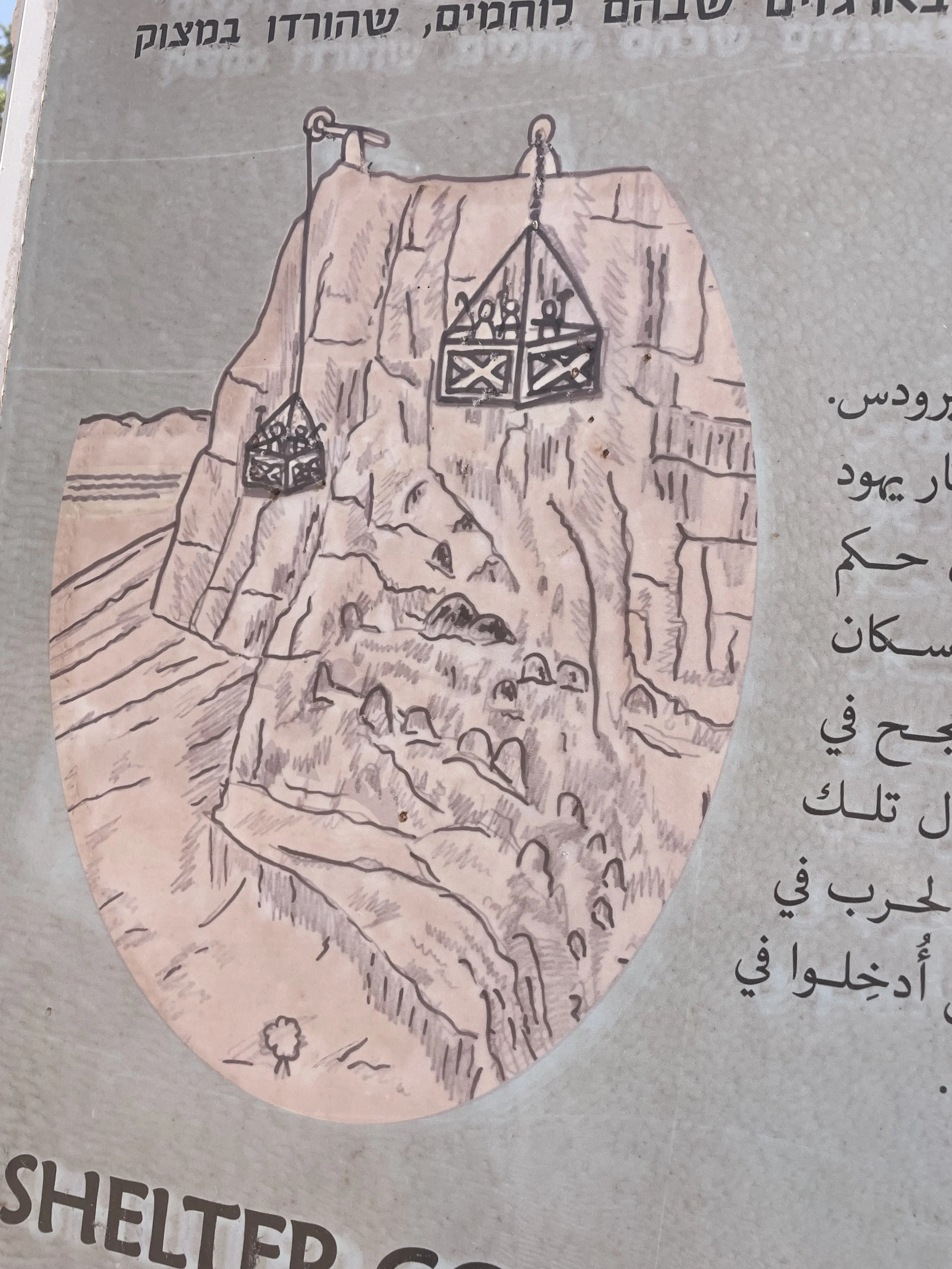
The precise identification of the place mentioned in this account remains uncertain, but the passage places Arbela within the geography of violent struggle. Later, Josephus describes Herod’s campaign against Jewish fighters sheltering in caves among the steep cliffs of the Galil. In The Jewish War, he recounts the extraordinary difficulty of reaching the cave entrances, accessible only by narrow and winding passages. Herod’s soldiers were lowered in suspended boxes by ropes to attack those inside.
Josephus / Yosef ben Mattityahu describes the killing of cave inhabitants, including families, and recounts the horrifying story of a man who killed his own wife and seven sons before throwing himself into the ravine rather than surrender. The story is almost unbearable. Standing beneath these cliffs, seeing the sheer drops and the caves opening into the mountainside, I could understand something of the physical geography that shaped those events. The rock itself had offered refuge, and the same rock had become the setting of terrible violence.
These historical episodes belong to different periods, and the ancient synagogue where we began our day should not be confused with the specific locations of the earlier conflicts. Yet together they reveal the layers of Jewish life held within this landscape: community and danger, shelter and exposure, faithfulness and fear, resistance and loss. We stood within a geography that had witnessed the vulnerability and courage of earlier generations.
The cave entrances are difficult to comprehend from a distance. They appear as dark openings scattered across a vast vertical wall. Only when we approach the cliff do we begin to appreciate the physical challenge of reaching them. A cave may offer concealment and protection, yet its position can also create terrible isolation. The same steep terrain that makes access difficult for an attacker can make escape almost impossible for those inside.
Standing there, the historical accounts ceased to feel like distant descriptions of military strategy. The geography brought the human vulnerability into focus. These were places where people had sought to survive, where families had faced impossible circumstances, and where decisions were made under conditions of fear that we cannot fully reconstruct. I did not want to turn their suffering into a simple metaphor for our personal struggles. The historical reality deserved its own weight. Yet standing within the landscape, we could allow that history to deepen our awareness of the lives we are privileged to live and the responsibility of carrying Jewish memory.
I thought again of the women whose voices we had invited into our listening at the synagogue: the mothers, the daughters, the women waiting for loved ones, and the women who had lived through events they could never have imagined. I felt the weight of our own generation’s history. The suffering of Am Yisrael is not an abstraction, nor is our continuing presence in Eretz Yisrael. We were walking through the same land, breathing its air, placing our feet upon its stones, and carrying the lives of those who came before us within our own.
The mountain was teaching us to hold more than one truth. Its beauty was real. Its history of suffering was real. Its living trees, flowers, and animals were real. And our presence there, as Jewish women learning Torah in Eretz Yisrael, was also real. None of these truths needed to erase the others. They belonged to the same landscape.
Awakening the Dawn: קִמְעָא קִמְעָא
At another point along the trail, we stopped to learn a teaching that belongs intimately to Arbel. The Talmud Yerushalmi tells of Rabbi Chiya Rabbah and Rabbi Shimon ben Chalafta walking in the valley of Arbel at daybreak.
רַבִּי חִיָּא רַבָּה וְרַבִּי שִׁמְעוֹן בֶּן חֲלַפְתָּא הֲווֹן מְהַלְּכִין בְּבִקְעַת אַרְבֵּל בַּשַּׁחַר
Rabbi Chiya Rabbah and Rabbi Shimon ben Chalafta were walking in the valley of Arbel at dawn.
They witnessed the first light beginning to emerge, and Rabbi Chiya taught:
כָּךְ הִיא גְּאֻלָּתָן שֶׁל יִשְׂרָאֵל
This is how the Geula of Israel unfolds.
בַּתְּחִלָּה קִמְעָא קִמְעָא
At first, little by little.
כָּל מַה שֶׁהִיא הוֹלֶכֶת, הִיא רַבָּה וְהוֹלֶכֶת
As it continues, it grows and continues to grow.
(Talmud Yerushalmi, Berakhot 1:1)
This teaching speaks about the national Geula of Am Yisrael. It does not promise that every private difficulty will resolve according to our desired timetable. It reveals a way of understanding the gradual unfolding of national light. Dawn does not arrive all at once. At first, the light may be barely perceptible, and then, little by little, it becomes more visible.
קִמְעָא קִמְעָא.
The teaching does not ask us to call darkness good or pretend that suffering has already passed. It asks us to recognize that a process may be real before it is complete. Standing above the valley where these words were first spoken, I felt their extraordinary immediacy. We were living through momentous times, times of confusion, conflict, upheaval, and extraordinary possibility. The Geula of Am Yisrael was not merely an idea we were discussing in a classroom. We were standing in Eretz Yisrael, looking across the very landscape where Chazal had described its awakening.
I tried to imagine the experience of those two Chachamim walking in the early morning. Before the full light of day, the landscape would have been difficult to distinguish. The mountains would have appeared as dark forms against the horizon. Then a faint illumination would begin to reveal their outlines. Gradually, the valley would become visible: the trees, the rocks, the pathways, the familiar world emerging from darkness. The light would not create the landscape. It would reveal what had already been present.
This distinction moved me deeply. Sometimes the beginning of Geula is not yet the arrival of a completely transformed world. It is the gradual revelation of what has been concealed, a widening of perception, a growing ability to recognize Hashem’s movement within history. The process is not necessarily comfortable. Dawn can reveal devastation as well as beauty. It can illuminate wounds that were previously hidden. Yet the growing light allows us to see more clearly, and clarity brings responsibility. What do we do with what we are beginning to see? How do we participate in the unfolding Geula of Am Yisrael? How do we become capable of receiving its light within the actual circumstances of our lives?
The Meditation: A Point, a Line, a Circle
I invited the women into a meditation through seeing. In Torat HaTzeva, we begin with what actually catches the eye, not by deciding in advance what something must symbolize or assigning a fixed meaning to every color, but by allowing attention to discover what is present: a nekudah / נְקֻדָּה, a point; a kav / קַו, a line; an igul / עִגּוּל, a circle; a color, an angle, a relationship between forms.
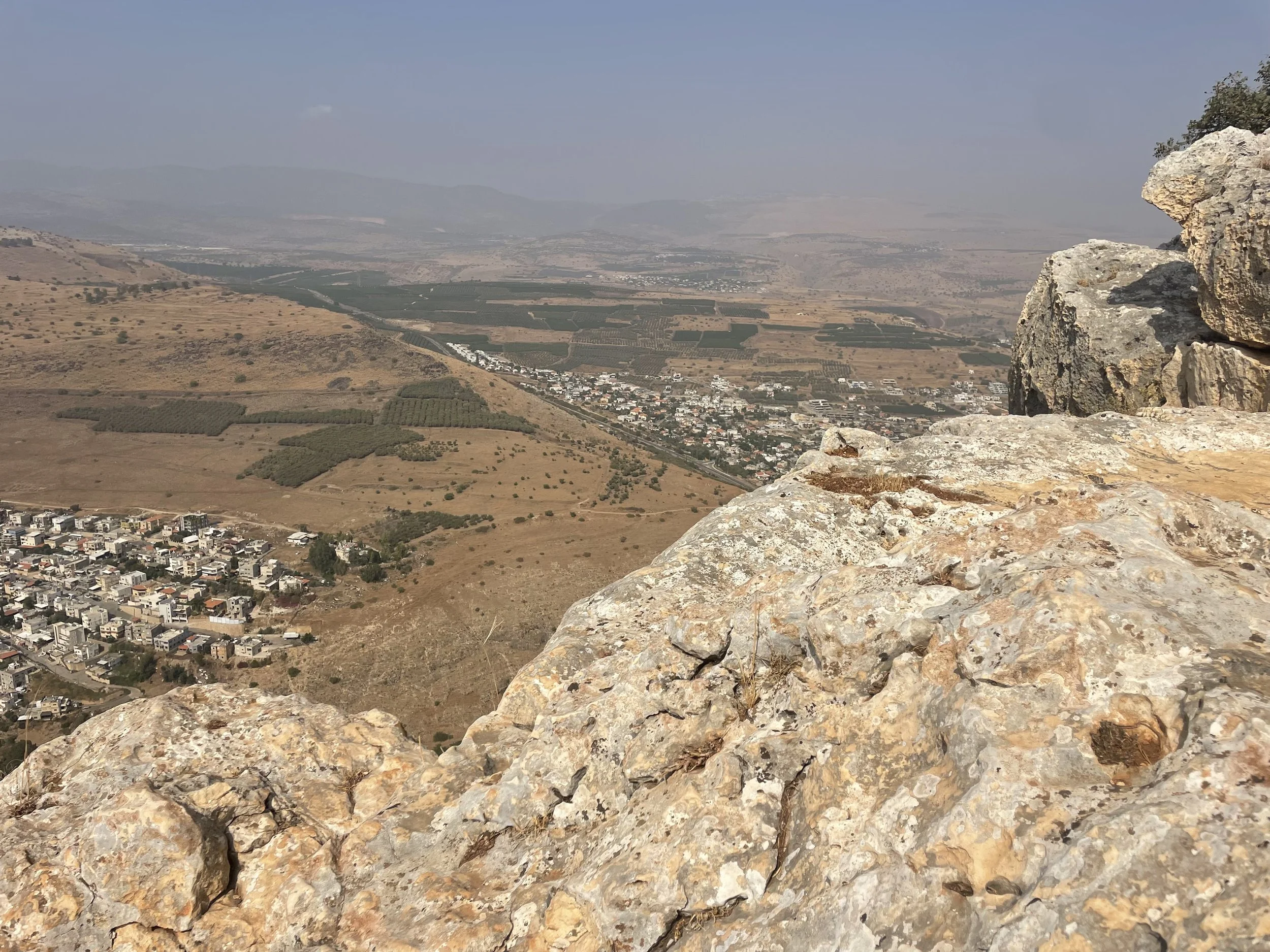
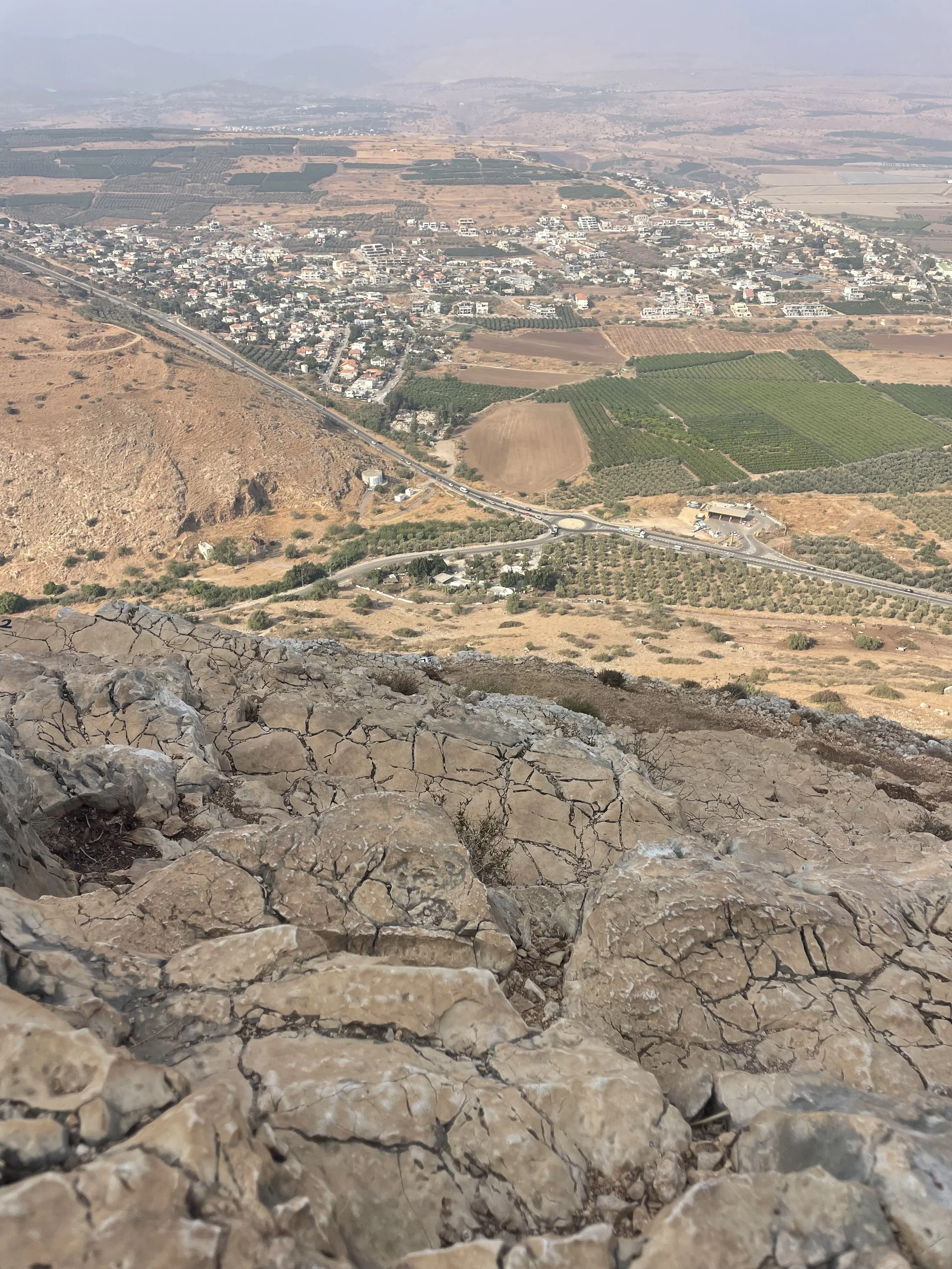
The landscape spread beneath us in extraordinary geometry. Golden fields stretched across the valley, interrupted by vivid green patches of mango orchards. Their ordered rows and carefully defined boundaries stood out against the surrounding dry hills. Some of the women were drawn toward those green fields. Their eyes found life and cultivation within the parched landscape. My own attention kept returning to something else: a kikar / כִּכָּר, a roundabout, a small circle in the road far below.
I was fascinated by how my eye could settle upon that one form while the immense landscape remained present around it. The circle was tiny within the larger view, yet it had captured my attention. One photograph shows the very roundabout below us, set among roads that converge and separate across the valley. Beyond it, cultivated fields form long green rectangles against the dry earth. The village spreads outward in pale clusters of buildings, and farther still, the landscape dissolves into the hazy distance.
From our height, the roundabout is no more than a small circle, yet its function is to receive movement from several directions and guide it onward. I found myself contemplating the relationship between the circle and the paths entering and leaving it: a circle that receives, a circle that redirects, a point of connection within a much larger network of movement.
I contemplated the movement from the point to the line, from the line to the circle, and from the circle toward a wider field of vision. The first light of dawn begins as something small, but the point belongs to the same unfolding as the full illumination of day. The point does not need to become the entire horizon in order to be real.
We spoke about the opening and closing of a camera lens, how the eye moves inward and outward, how we can focus upon one detail and then widen our field of perception, and how the light changes as our capacity to receive it changes.
I thought about the opening words of Parashat Lech Lecha:
לֶךְ־לְךָ
Go toward yourself.
Hashem tells Avraham:
לֶךְ־לְךָ מֵאַרְצְךָ וּמִמּוֹלַדְתְּךָ וּמִבֵּית אָבִיךָ אֶל־הָאָרֶץ אֲשֶׁר אַרְאֶךָּ
Go forth from your land, from your birthplace, and from your father’s house, to the land that I will show you.
(Bereshit 12:1, Parashat Lech Lecha)
The word אַרְאֶךָּ, “I will show you,” suddenly resonated with our experience. What does it mean to see Eretz Yisrael? Not only to look upon its mountains, valleys, and cities, but to develop the inner capacity to receive what Hashem is showing us. The journey of Lech Lecha can also be understood as a movement inward, toward the shoresh of who we are. As our inner vision changes, the land itself becomes visible in new ways.
We were standing upon Arbel, looking outward across Eretz Yisrael. Yet the journey was also moving inward. The light was widening in both directions.
Descending Toward the Village
We continued along the trail, descending toward the village below. The photographs show the extraordinary contrast between the immense rock faces and the narrow paths that wind beneath them. Golden grasses leaned over the edges, loose stones scattered across the earth, and the mountain rose in pale, fractured walls, its surfaces marked by deep crevices and angular formations. Across the valley, the buildings of the village gathered closely together, their pale rooftops forming a dense pattern against the surrounding dry hills. From above, the roads curved through the landscape like fine lines. The village seemed both close and impossibly far away.
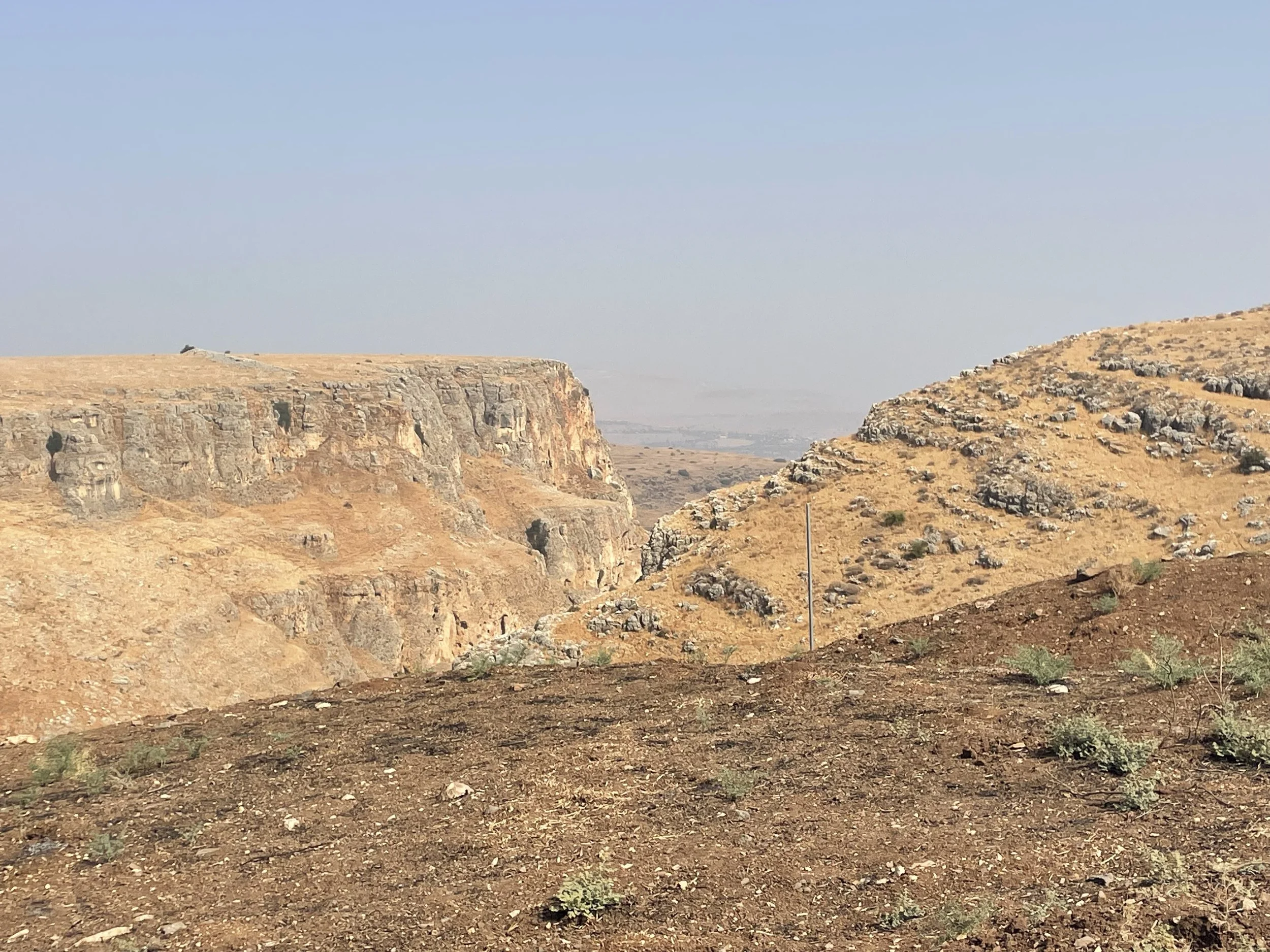
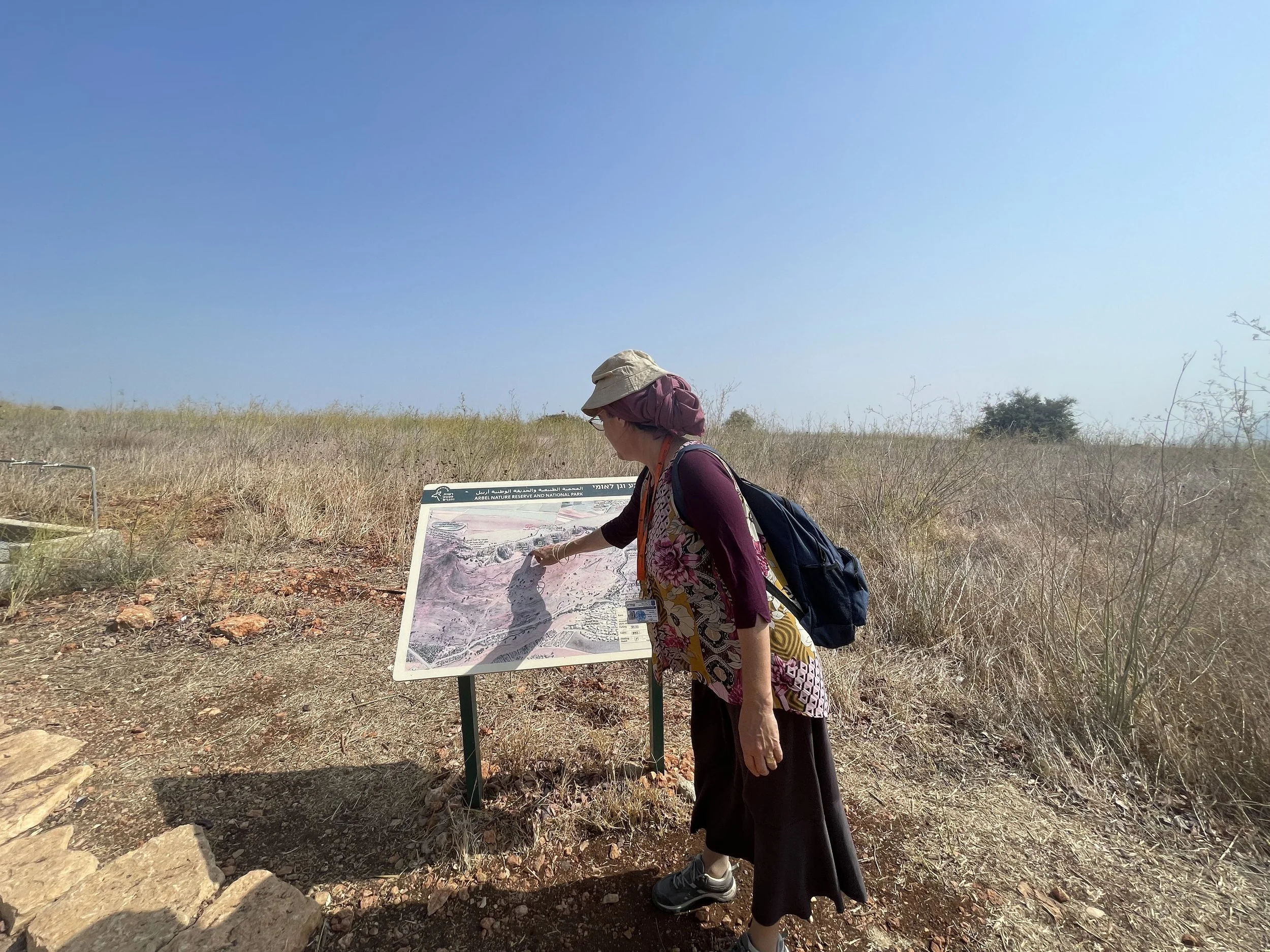
The trail map reveals the larger shape of our journey. The marked route follows the upper reaches of Mount Arbel, descends along the cliffs, and connects with the paths that lead toward the Arbel Stream and the ruins of Wadi Hamam. Across the valley rises Mount Nitai, its steep face forming a dramatic counterpart to Arbel. The two mountains stand on opposite sides of the valley, their cliffs bearing witness to the immense geological forces that shaped the landscape. From the trail, the valley appears as a deep opening between them.
The path we were following was part of a much larger network of routes connecting the mountain, the stream, the ruins, and the surrounding settlements. Yet the map, viewed from above, cannot convey the experience of walking it. A line on paper becomes a narrow passage beneath a cliff. A change in elevation becomes the effort of lifting one’s body from one rock to another. A marked trail becomes a sequence of decisions made through the feet.
At one point, two small rock hyraxes appeared among the jagged limestone. One stood higher on the rocks, looking toward us, while another rested on a lower ledge. Their compact brown bodies seemed perfectly at home upon surfaces that required such concentration from us. I was struck by the ease with which these creatures inhabited the mountain. They belonged to its narrow ledges and sharp edges. For them, the rocks were home. For me, they were becoming an extraordinary lesson in vulnerability.
We turned and began ascending again. The path narrowed, the cliffs rose, and eventually we approached the final ascent.
The Final Ascent: “Maskit, No. I Can’t Do That.”
I remember asking our guide, “Maskit, where’s the trail?”
She pointed straight up.
I followed the direction of her hand, and there it was: a series of metal handles embedded in the limestone, rising almost vertically toward the top of the cliff. I stared.
“Maskit, no. I can’t do that.”
I was certain. My body was not in shape for this. I had already descended steep rocky passages, negotiated narrow footholds, and walked along exposed sections of the mountain, but this was something else.
The photographs of those handles still make my body react. They emerge from the limestone like enormous iron staples, one above another, following the steep angle of the cliff. Between them are stretches of exposed rock, irregular surfaces, and narrow places where a foot might find purchase. From below, there is no reassuring staircase, no continuous ladder, only individual pieces of metal embedded in the mountain, separated by gaps that must somehow be negotiated.
Another photograph shows the ascent from farther below. The rocky passage rises between massive boulders, its route marked by black-and-white stripes painted on the stone. The iron handles form a narrow line upward, disappearing among the rocks. Above them, the mountain continues rising toward the sky. From that perspective, the climb seems almost hidden within the cliff itself. The route is there, but it does not reveal itself all at once.
I could see where the climb began, but I could not see how my body would move through every part of it. The distance between what I could perceive and what I would have to do felt enormous. I wanted certainty. The mountain offered me the next handle.
Secretly, I began considering another possibility. I could turn around. I could go back down the trail toward the village. I did not say this aloud, but the thought was there.
My whole being, all my parts, were Fear. I felt it everywhere, in my body, in my thoughts, in the way I looked at the cliff. Every part seemed to be telling me that this was beyond my capacity.
Except one.
One tiny part, almost inaudible beneath the others, whispered:
You can do it.
That was all. It did not offer a detailed plan or remove the fear. It simply spoke, and somehow, that tiny voice kept me quiet.
I began walking slowly toward the base of the climb. My hiking companions watched as I approached, almost in slow motion. I examined the handles, looked upward, and attempted to calculate where my feet would go. I tried to plan the entire ascent, but I couldn’t. The gaps between the metal holds prevented me from seeing the whole sequence. There was no way to solve the climb from below. I would have to enter it.
Lunch Beneath the Cliff
Then Maskit suggested that we stop for lunch before completing the ascent. I was not hungry, which for me was highly unusual. I was so preoccupied with the climb that even the thought of eating seemed burdensome. I imagined that more food would mean more weight, and more weight would make it harder to haul my body up the cliff.
Nevertheless, I sat and ate my quinoa and vegetables. Maskit began sharing a story about the Essenes and the practice of eating with intention, describing the relationship between chewing, water, breath, and air. I was only half listening. My attention remained fixed upon the climb, yet something in the rhythm of her voice began soothing my nervous system.
Her words offered a gentle continuity, a reminder of breath, of the body, of nourishment, and of the ordinary human act of eating. I was still afraid, but I was no longer standing alone beneath the enormous demand of the mountain. I was sitting with women, eating lunch, listening, breathing, and preparing to move.
One Iron Handle at a Time
Then we began, one woman at a time, hands gripping the iron, feet searching for the narrow spaces between the rocks. The mountain rose immediately before us. There was no room for distraction, no room for imagining every possible outcome, no room for standing outside the experience and evaluating my performance. My attention became completely absorbed in the next movement: one hand, one foothold, one shift of weight, another handle.
And then something extraordinary happened. I was no longer standing below the mountain imagining myself climbing it. I was climbing.
The distinction was enormous. My hands were no longer abstract possibilities. They were gripping the iron. My feet were no longer objects of worry. They were searching, pressing, balancing, and pushing. My shoulders, arms, legs, and torso began working together in a way I had not experienced for decades.
My whole body seemed to know what to do. It was lifting me, miraculously lifting me, and I could not understand how. The body I had doubted was moving with an intelligence that my frightened thoughts had been unable to access.
I held the handles and cables for dear life, and yet, as the climb continued, I began feeling something beyond fear: exhilaration, joy, a remarkable sense of aliveness. It was not that the climb had suddenly become easy. It was that I had become completely present within it.
There was no longer a separation between the woman who was afraid and the woman who was climbing. Both were here, and the body was moving.
Daat Entering the Body
In Pnimiut HaTorah, daat / דעת is more than intellectual knowledge. It is the capacity for knowledge to become inwardly integrated, connected, and lived. Standing below the cliff, I had known many things about myself. I knew my age, my physical limitations, and how long it had been since I had undertaken such a demanding climb. But those forms of knowledge had not told the whole story.
As my body moved upward, another kind of knowing emerged. Not merely knowing that I could climb, but discovering the capacity through the act of climbing. The body was no longer something I needed to overcome. It had become my partner.
The understanding was descending into action. Leah into Rachel. The concealed into the revealed. Machshava / מחשבה, thought, becoming maaseh / מעשה, action. The light was no longer something I contemplated from a distance. It was entering my muscles, my hands, my feet, my breath.
I was living it.
מִן הַמֵּצַר אֶל הַמֶּרְחָב
From Constriction Into Expansiveness
The words of Tehillim began illuminating the experience:
מִן הַמֵּצַר קָרָאתִי יָּהּ עָנָנִי בַמֶּרְחָב יָהּ
From the narrow place I called to Hashem; He answered me with expansiveness.
(Tehillim 118:5)
Meitzar / מֵצַר is a narrow place, a place of constriction, where movement feels limited and possibility seems small. Merchav / מֶרְחָב is expansiveness, room, a widening of what can be received and contained.
I had experienced the meitzar in the most literal way. My body pressed close to the cliff, my hands gripping narrow iron handles, my feet searching for small spaces in the rock. Yet through that very narrowness, something within me was expanding.
There is a particular kind of expansiveness that cannot be imagined from below. It comes after the hand has released the final iron hold, after the foot has found level ground, after the body realizes that the climb is over. The same mountain that had appeared impossible now lay beneath us.
I had not conquered it. I had entered into relationship with it.
The cliffs had not become less steep. The iron handles had not moved closer together. My physical limitations had not magically disappeared. Yet something fundamental had changed. I now knew, through lived experience, that my fear did not define the full extent of my capacity.
The meitzar had not simply vanished. It had become the passage through which I encountered a new merchav.
Expanding the Kelim
The following day, I wrote to Maskit:
“My whole body is aching especially upper body… hasn’t worked like that for years at the same time I’m feeling very elevated from the experience yesterday of extreme fear and exhilaration… such a widening of daat BH.”
My upper body was aching. Muscles I had barely used for years had been called into action, and at the same time, I felt elevated. Something had opened.
A dear friend later reflected upon the experience and spoke about the expansion of our kelim / כלים, our inner vessels. Her words helped me recognize another dimension of what had happened.
In the teachings of Pnimiut HaTorah, we encounter the distinction between Ohr Makif / אור מקיף, surrounding light, and Ohr Pnimi / אור פנימי, inner light. Ohr Makif refers to illumination that remains beyond our present capacity for internalization. Ohr Pnimi is light that can be received within the vessel.
I began contemplating whether the experience on Arbel had expanded my capacity to receive something that had previously remained beyond me. Not because the fear disappeared. It did not. I climbed while feeling afraid, but I discovered that I could hold the fear without being governed by it.
My vessel had become capable of containing more: more uncertainty, more vulnerability, more physical intensity, more trust, and more light.
And I thought about Ohr HaGanuz / אור הגנוז, the hidden light, the light that is not always visible to our ordinary perception. Sometimes what is hidden does not need to be created anew. It needs a vessel capable of receiving it. And sometimes that vessel expands through the very experience we most wish to avoid.
The Fossils: The Sea Within the Mountain
After the climb, we encountered another extraordinary detail: fossil-like markings embedded within the limestone. Rounded impressions and spiral-like forms interrupted the rough surface of the rock. They were small enough that we might easily have walked past them, yet after the immense physical drama of the ascent, these quiet markings drew us toward an entirely different scale of time.
We had been measuring our progress in individual footsteps. The stone invited us to contemplate millions of years. We had struggled to move upward through a few meters of rock, while the mountain itself had emerged through geological transformations extending far beyond human memory. We had seen how water gradually dissolved limestone, creating the caves through which generations of people would later pass. Now we were encountering another relationship between water and stone.
The limestone of Arbel was formed from ancient marine sediments. And now, high above the Kinneret, the rock carried traces of a world once beneath the sea. I found this astonishing. Our feet stood upon the mountain, while our eyes discovered the memory of water within its stones.
The physical world was revealing something concealed within itself. The nistar / נסתר, the hidden, becoming nigleh / נגלה, revealed. The ancient sea had not disappeared without leaving a trace. Its memory remained within the mountain.
And I thought again of the young woman I had encountered beneath the carob tree. The past does not always disappear. Sometimes it remains within us, waiting for the conditions through which it can become visible in a new light.
The Hyraxes, the Village, and the Living Mountain
Throughout the hike, the mountain continually reminded us that it was not merely a backdrop for our inner experiences. It was alive. Among the jagged rocks, the hyraxes moved and rested upon narrow ledges with a familiarity that seemed effortless. Below us, the village spread across the valley, its closely gathered buildings following the contours of the land. The roads curved through the hills, green orchards interrupted the dry earth, and the tiny purple flowers continued growing from fissures in the stone.
Everywhere, different forms of life were finding their place: the rock, the tree, the flowers, the animals, the cultivated fields, and the women walking. Each existed within its own conditions. Each revealed another dimension of Hashem’s world.
The mountain did not need to become a symbol before it could touch us. Its physical reality was already astonishing, and the more attentively we looked, the more it revealed.
The Closing Circle: Bringing the Light Home
At the end of our journey, we gathered in a closing circle. The late-afternoon light had softened. Across the mountain, golden grasses glowed beneath a sky filled with delicate clouds. The sun hung above the distant hills, its light spreading outward through the haze. The cliffs that had demanded so much of our attention now formed part of a vast, quiet horizon.
One of the photographs captures us standing together upon the rocky summit. Behind us, the valley opens into a sweeping panorama of fields, villages, and distant hills. The stone beneath our feet is rough and uneven, yet our bodies stand close together, arms resting around one another, smiling. The mountain rises behind us, and the land stretches outward below.
I find myself looking at that photograph with a particular sense of wonder. Only a short time earlier, I had stood beneath the final ascent, certain that I could not climb. Now here we were, standing together above the valley. The photograph does not show the fear. It does not show the trembling hands or the effort required to reach the top. It shows what became possible when we continued, and it shows the women who accompanied one another through the experience.
I looked at the women beside me. We had walked through history, listened to the voices of earlier generations, rested upon the cool stone beneath the carob tree, descended narrow paths, entered caves, studied the awakening of Geula, and climbed through fear.
Each woman had encountered the mountain differently. Our eyes had been drawn toward different points in the landscape, our bodies had experienced different challenges, and our inner journeys had not been identical. Yet we had walked one path.
There is an intimacy that develops when women accompany one another through physical challenge, when we witness not only one another’s strength, but also the moments when that strength feels uncertain. We had seen one another pause, seen one another continue, and offered our presence without needing to remove every difficulty. And now, gathered together, I felt how much of the journey had been carried not only by our individual bodies, but by the relationships between us.
In Pnimiut HaTorah, hitkalelut / התכללות describes the inclusion of distinct qualities within one another. Each woman remains herself, yet something of her experience becomes part of the others. Our circle was not simply the conclusion of the hike. It was the place where the many points of our experience could begin finding relationship, where the light encountered along the trail could begin becoming Ohr Pnimi, light received and integrated within us.
I felt deep gratitude to Maskit, whose knowledge of the land and steady presence had guided us through its most demanding passages; to my soul sisters, whose care and companionship had allowed me to revisit my younger self and move through fear; and to Hashem, who had brought me back to this mountain after more than forty years.
A Walk Into Widening Light
When I think about Arbel now, I do not see only its cliffs. I see the ancient synagogue doorway, the heart-shaped columns, the recessed niche where I sat and listened for women whose names have disappeared from history. I see the tree growing from stone, its roots hidden and its branches reaching toward the light. I feel the cool limestone beneath the carob tree and remember the twenty-one-year-old woman who had once stood on this mountain searching for love, adventure, and something she could not yet name.
I see the narrow path descending beneath the cliffs, the purple flowers growing from fissures in the rock, and the caves that sheltered generations of people through times of danger. I remember the valley of Arbel and the words of the Talmud Yerushalmi, describing the Geula of Am Yisrael as the gradual awakening of dawn, קִמְעָא קִמְעָא, little by little.
I see the tiny roundabout far below, the green orchards, the ancient marine impressions within the limestone, and the extraordinary landscape that kept inviting my eye to move between a single point and the widening horizon.
And I see the iron handles.
I remember standing beneath the final cliff, hearing the many voices of fear and the one small voice that said, You can do it. I remember how impossible the climb appeared from below, how completely my body entered the movement once I began, and how the very narrowness of the ascent became the passage into a greater expansiveness.
The young woman who searched for light and the older woman who climbed through fear were not separate people. They belonged to one unfolding life. The longing of my younger self had not been extinguished. It had matured. The body I had doubted had not ceased to carry wisdom. It had revealed a capacity that could only become known through movement.
This is how the light of Leah descends into Rachel. What is concealed within understanding must eventually enter the revealed world of embodied life. The insights we receive must find expression in our hands, our feet, our relationships, and the choices we make. The widening of consciousness becomes real when it changes how we inhabit the world.
Arbel taught me that expansion does not always arrive through ease. Sometimes the vessel widens through contact with what frightens us, through the patience of one small movement after another, through the willingness to remain present while our bodies discover what our thoughts cannot yet imagine.
The mountain also taught me that widening does not mean losing the ability to focus. The eye must sometimes return from the horizon to the next foothold. The heart must sometimes return from the immensity of history to the woman standing beside us. The light becomes receivable through the vessel that is here, in this moment, within these actual conditions.
And so I return to the dawn of Arbel, to the two Chachamim walking in the valley and watching the first light emerge. The Geula of Am Yisrael unfolds קִמְעָא קִמְעָא, little by little. We do not need to confuse the beginning with the completion, nor deny the darkness that remains. We are called to recognize the growing light, to expand our capacity to receive it, and to bring what we have received into the life unfolding before us.
I came to Arbel believing I knew something about the limits of my body. I left having encountered a wider understanding of what it means to be present within it.
The mountain had not changed to accommodate me. Its cliffs remained steep, its rocks hard, its caves deep, and its horizon immense. Yet I had changed in relationship to it.
The young woman who once searched for light had returned to the mountain, and the light she had been seeking was no longer somewhere beyond her reach. It was entering the life she was living, through memory, through companionship, through the soles of her feet and the strength of her hands.
The light widens.
And we are walking into it.
Together.
1
At the Gates: Becoming Dorshot Tzion / דּוֹרְשׁוֹת צִיּוֹן
There are countless ways to experience Yerushalayim. One can spend days wandering her alleyways, exploring archaeological sites, standing before the Kotel, and leaving with a camera full of photographs and a head full of history. Yet there is another way to encounter this city—one that asks us to slow our pace, soften our attention, and allow the Land itself to become our teacher. That was the intention behind our recent Women’s Yerushalayim Journey, an immersive day of walking, learning, breathwork, somatic awareness, history, and Torah as we prepared to enter בֵּין הַמְּצָרִים / Bein HaMetzarim.
Women arrived from across Israel and beyond, each carrying a different story. Some came seeking inspiration, others healing, others simply a day of connection. Many had never met before. Yet beneath our different backgrounds and life experiences was a shared longing: to encounter Yerushalayim not only as a city of stone, but as a living landscape that continues to shape the heart of Am Yisrael.
Our journey began at Sha’ar Yafo / שַׁעַר יָפוֹ (Jaffa Gate), where veteran Israeli tour guide and holistic healing therapist Maskit Ben-Moshe welcomed us into the story of the city. Rather than presenting history as something confined to the past, Maskit invited us to see every wall, pathway, and stone as part of an unfolding conversation spanning thousands of years. Here, archaeology is not separated from memory, nor history from hope. Every layer of Yerushalayim bears witness to destruction and rebuilding, exile and return, longing and Geula.
Before taking even a single step along the ancient walls, we gathered in a circle. There would be time later for walking, climbing, and discovering hidden corners of the city. First, we needed to arrive. Rachel Leah invited the women to place both feet firmly upon the Jerusalem stone, to become aware of the women standing beside them, to notice the warmth of the morning sun upon the walls, and to recognize that before entering the Yerushalayim of stone, we were first being invited to enter the Yerushalayim of the heart.
The timing itself gave the gathering a quiet depth. It was י״ד בתמוז / 14 Tammuz. The moon would be completely full that evening, radiating wholeness and completion. Yet only days later we would enter the narrowing days of בֵּין הַמְּצָרִים / Bein HaMetzarim, when Am Yisrael remembers the breaches in the walls of Yerushalayim and the destruction of the Beit HaMikdash. Fullness and brokenness stood side by side. Light and longing occupied the same moment. The day itself became an invitation to discover that these apparent opposites often live together within our own lives.
Drawing upon the teaching of Chazal that Tzion must be sought, Rachel Leah invited the group to become דּוֹרְשׁוֹת צִיּוֹן / Dorshot Tzion—women who actively seek Tzion. Not tourists passing through a holy city, but seekers willing to enter into relationship with her. Seeking, she suggested, is not simply looking for something that has been lost. Seeking is an expression of love. It is the willingness to continue turning toward that which continues to call us.
As the women stood quietly beneath the ancient walls, the atmosphere shifted almost imperceptibly. Conversations softened. The noise of the city receded. The walls that had watched generations of pilgrims, conquerors, dreamers, and mourners seemed once again to receive another circle of women arriving with open hearts.
No one yet knew that before the day was over we would descend into the ancient valley of Gei Ben Hinnom, cross Israel’s longest suspension bridge while singing the words of Rebbe Nachman, wander through hidden gardens bursting with new life, stand overlooking Har HaBayit from Har Tzion, rest our foreheads against the stones of the Kotel, and close beneath the full moon in a circle of song, Torah, and meditation.
For now, we simply stood together at the gate.
Because every meaningful journey begins long before the first step is taken.
It begins with the willingness to arrive.
2
אֶבֶן / Even — Stone: Building the Wall Together
As we began walking alongside the outer walls of the Old City, it became increasingly clear that this would not be a day of simply listening to history. Every stop would invite participation. Every landscape would ask something of us. Every encounter with Yerushalayim would become an encounter with ourselves.
Our first somatic practice began with something remarkably simple.
A stone.
Rachel Leah invited each woman to imagine herself as one of the stones of Yerushalayim.
Not an idealized stone.
A real one.
A stone shaped by years of sun and rain.
A stone that had endured seasons of rebuilding.
A stone that carried its own unique beauty precisely because of its imperfections.
One by one, the women stepped into the center of the circle.
“My name is…”
“I am a stone of Yerushalayim…”
One woman described herself as a smooth cream-colored stone that had been softened by years of weather. Another saw herself as a rough stone tucked quietly into the middle of the wall, unnoticed yet essential. One woman spoke of visible cracks that had become places where light now entered. Another felt herself to be a warm golden stone, carrying generations of tefillot within her.
After each woman shared, she added one simple movement that expressed how she was arriving that morning.
There was no choreography.
No performance.
Only presence.
Each sharing was received by the circle with the words:
“בְּרוּכָה הַבָּאָה דּוֹרֶשֶׁת צִיּוֹן.”
“Welcome, Seeker of Tzion.”
Slowly, something beautiful began unfolding.
Without discussion, without planning, the women naturally stepped beside one another until the circle had quietly transformed into a living wall.
Looking across the group, it became impossible not to notice the diversity before us. Different ages. Different life stories. Different personalities. Different journeys. Like the stones surrounding us, no two women were alike.
And yet, standing together, they formed something entirely new.
Rachel Leah invited us to notice that Yerushalayim has never been built from identical stones. Some are smooth, others weathered. Some are hidden deep within the wall, while others catch the morning light. Some have remained intact for centuries, while others bear the visible marks of earthquakes, exile, and rebuilding.
Each one belongs.
That realization carried its own quiet power.
How often do we imagine that spiritual growth requires becoming someone else? Yet the walls of Yerushalayim suggest something very different. They are beautiful not because every stone is the same, but because every stone offers its own strength to the whole.
Standing there, the verse from Tehillim came alive in a completely new way:
“יְרוּשָׁלַיִם הַבְּנוּיָה כְּעִיר שֶׁחֻבְּרָה לָּהּ יַחְדָּו.”
“Yerushalayim is built as a city joined together.” (Tehillim 122:3)
“עִיר שֶׁמְּחַבֶּרֶת אֶת יִשְׂרָאֵל זֶה לָזֶה”
“the city that joins Israel one to another.” (Chagigah 3b)
Rather than merely studying those words, we were beginning to experience them.
The wall was no longer an ancient structure surrounding the Old City.
The wall had become us.
From there, the practice deepened.
Working in pairs, each woman stood facing another. At first, we embodied a wall. We explored what it felt like to offer steadiness, to lean gently into one another, to feel both support and resistance. There was an invitation to notice our own boundaries—not as barriers that separate us, but as healthy structures that allow relationship to flourish.
Then something unexpected happened.
The wall softened.
Without losing its strength, it began to change shape.
Two women slowly opened space between them.
The wall became a bridge.
The bridge widened into an archway.
The archway became a שַׁעַר / Sha’ar—a gateway.
It was one of those rare moments when a teaching moved beyond words and settled directly into the body.
Later that evening, several women would say that this simple exercise remained with them throughout the entire journey. Every wall we encountered for the rest of the day—the ancient city walls, the supporting walls of Har HaBayit, even the walls we carry within ourselves—was now seen differently.
Perhaps, we reflected together, the purpose of a healthy wall is not to remain permanently closed.
Perhaps every wall carries within it the possibility of becoming a gateway.
It was a fitting way to begin our preparation for בֵּין הַמְּצָרִים / Bein HaMetzarim. During these weeks we remember breached walls and destroyed buildings, yet we are also invited to ask what is waiting to be rebuilt. Before we explored the walls of Yerushalayim, we first allowed the walls within us to soften—not by abandoning their strength, but by discovering how strength itself can become an opening.
Only then did we continue walking.
Ahead of us lay one of the city’s hidden treasures: a passageway carved through stone where the many names of Yerushalayim would illuminate our next stage of the journey.
3
מַעֲבָר / Ma’avar — Entering the Hidden
Leaving the openness of the outer walls, we stepped into one of Yerushalayim’s hidden passageways. It was as though the city herself was inviting us to move inward. Throughout the morning we had walked beside her walls, learning to see them not only as ancient fortifications but as symbols of belonging, protection, and relationship. Now the landscape shifted. We were no longer walking beside Yerushalayim. We were entering within her.
Maskit paused before we entered the passage and shared its history. During times of siege, this trench served as a protected route through which food, medicine, and hope could continue reaching the city. What had once been carved out of necessity has since been transformed into a place of beauty and remembrance. Today, natural light pours through carefully designed openings above, illuminating the many names of Yerushalayim carved into the stone walls.
The transformation itself became part of the teaching.
A place once associated with survival had become a place of illumination.
A passage once shaped by darkness now welcomed light.
We instinctively slowed our pace.
No one hurried ahead.
The sounds of the city faded behind us as shafts of sunlight danced across ancient limestone, bringing each carved Hebrew name gently into view. Hands reached out to touch the cool stone. Some women paused in silence before a particular name. Others simply stood and allowed themselves to receive the quiet that filled the passage.
Maskit reminded us throughout the day that the landscapes of Eretz Yisrael are never merely places to visit. They are living chapters in the unfolding story of Am Yisrael. Every pathway, every valley, every stone remembers. Every generation enters into an ongoing conversation that began long before us and, with Hashem’s help, will continue long after us.
The many names of Yerushalayim revealed something similar.
No single name can contain her.
She is צִיּוֹן / Tzion.
עִיר דָּוִד / Ir David.
עִיר הַקֹּדֶשׁ / Ir HaKodesh.
עִיר הַשָּׁלוֹם / Ir HaShalom.
Each name reflects another relationship, another פנים / panim, another way of encountering the city. Like the women walking together that day, Yerushalayim cannot be reduced to a single story. She continues revealing herself according to the openness of the one who seeks her.
שְׂדֵי יַעַר / Sedei Ya’ar.
Before there was a city crowned with walls…
before kings…
before the Beit HaMikdash…
there was simply a field.
A landscape carrying within it a future that had not yet become visible.
Standing there, surrounded by names that have accompanied Yerushalayim throughout her long history, it was impossible not to reflect on our own lives. How often do we find ourselves in seasons that seem unfinished? Seasons when the next chapter has not yet revealed itself? We long to understand where we are going, while the soul quietly continues its work beneath the surface.
Perhaps becoming always begins in hidden places.
Perhaps what appears incomplete is simply still unfolding.
Later, one of our participants, Leah Friedman, found words that beautifully expressed what many of us had been experiencing.
“The walls carried something ancient. Not only history. Presence. Something rebuilt again and again. Breakage and rebuilding. And still it stands.”
Her reflection captured something essential about Yerushalayim.
She does not erase her history.
She carries it.
Every conquest.
Every return.
Every destruction.
Every rebuilding.
Stone upon stone.
Generation upon generation.
The light filtering through those carved names did not hide what the passage had once been. Instead, it revealed one of the deepest qualities of Yerushalayim herself: the capacity to transform places once marked by constriction into places that reveal new light.
As we emerged once again into the bright morning air, we sensed that we had crossed more than a physical passageway.
Without realizing it, we had begun moving from the outer landscape into the inner one.
Ahead of us lay גֵּיא בֶן הִנֹּם / Gei Ben Hinnom, a valley whose name has long been associated with darkness and idolatry. Yet, as Maskit had gently hinted, we were about to discover that one of the greatest teachings of Eretz Yisrael is that even the places carrying the deepest memories of concealment can become places where new life quietly begins to grow.
4
גֵּיא בֶן הִנֹּם / Gei Ben Hinnom — Where the Valley Blossoms
Emerging from the quiet intimacy of the tunnel, we found ourselves standing once again beneath the expansive sky of Yerushalayim. The ancient walls that had accompanied us throughout the morning now receded gently behind us, while before us the landscape opened into one of the city’s oldest and most evocative valleys. The path curved downward toward גֵּיא בֶן הִנֹּם / Gei Ben Hinnom, inviting us to descend gradually into a place whose name has echoed through Tanach, Midrash, and the collective memory of Am Yisrael for millennia.
There is something profoundly different about learning history while standing within the landscape where it unfolded. The contours of the hills, the terraces carved into the slopes, the limestone cliffs catching the morning light, even the silence that settled naturally over our group—all of it seemed to dissolve the distance between past and present. Here, history is never merely remembered. It remains embedded within the earth itself, waiting patiently for those willing to slow their pace and listen.
Gathering beneath the generous canopy of an old tree, we formed another circle around Maskit. Throughout the day she possessed the rare gift of allowing the Land to speak before she did. Rather than overwhelming us with dates or historical details, she opened gentle windows through which the landscape gradually revealed its own story. Standing there, overlooking the valley below, she shared how this place had once become synonymous with one of the darkest periods in the spiritual history of Yerushalayim. Here, during the days of the First Beit HaMikdash, children were offered to Molech. Here, covenant gave way to idolatry. Here, a valley became a symbol of what can happen when a people lose sight of the relationship that has always defined them.
As we listened, our eyes continued wandering across the landscape before us.
Nothing we saw matched the images our minds had imagined.
Instead of desolation, there was abundance.
Instead of emptiness, there was movement.
Instead of silence born of abandonment, the valley pulsed gently with life.
The contrast was almost startling.
Children’s voices drifted upward on the breeze. Birds moved effortlessly between ancient olive trees whose roots had quietly embraced these hillsides for generations. Wildflowers emerged from the cracks between limestone rocks, while terraces that once lay neglected now overflowed with cultivated gardens. Every direction we turned revealed another expression of renewal, as though the valley itself had been patiently waiting to tell a different story.
Rachel Leah invited us simply to remain with what we were seeing.
“There is no need to rush toward an interpretation,” she said softly. “Just allow yourselves to notice.”
Sometimes the deepest teachings do not arrive through explanation.
Sometimes they arise when we are willing to let the landscape speak first.
Continuing our descent, we entered a flourishing ecological garden nestled within the valley. Rows of vibrant strawberry plants stretched before us, their brilliant red fruit glowing against rich green leaves. Towering sunflowers turned gracefully toward the morning sun, while herbs, fruit trees, and ancient olive presses reminded us that this valley has always held the possibility of nourishment. Water flowed quietly through carefully restored channels, and shaded pathways invited us to linger rather than continue onward.
It was impossible not to marvel at the extraordinary juxtaposition unfolding before our eyes.
The very place that generations had associated with darkness had become a place overflowing with life.
Maskit paused again, this time not to recount ancient history but to share a memory of her own. Years ago, when she lived overlooking this valley from near Kever David HaMelech, Gei Ben Hinnom was almost unrecognizable from what stood before us today. Dense weeds covered the hillsides. The area felt neglected and unsafe, and few people chose to walk through it. Crossing the valley required both determination and caution, and it was difficult to imagine families ever wandering here for enjoyment.
As she spoke, many of us instinctively looked back across the landscape.
Children now wandered freely through the gardens.
Families explored the walking paths.
The hillsides had been lovingly restored.
And spanning the valley in elegant simplicity stood the suspension bridge we would soon cross together.
It was impossible not to feel that we were witnessing far more than urban renewal.
We were witnessing one expression of Geula.
Not as an abstract theological concept.
Not as a distant hope. But as something quietly unfolding within the very landscape of Eretz Yisrael.
One of the women turned toward the group, her eyes filled with wonder.
“We’re standing inside the story,” she whispered.
Her words settled over us with surprising depth. For a long moment, no one responded.
Nothing needed to be added. The valley itself had already become the teacher.
Rachel Leah gently offer one final reflection before we continued our walk.
“So often,” she said, “we imagine that healing means leaving our valleys behind. There is another possibility. The deepest transformations do not happen by escaping the valley, but by allowing Hashem to bring forth new life within it.”
Standing together in Gei Ben Hinnom, surrounded by gardens, flowing water, ancient stone, and the unmistakable signs of renewal, those words no longer felt like an idea.
They felt visible. Almost tangible.
Preparation for בֵּין הַמְּצָרִים / Bein HaMetzarim suddenly took on a different texture. We were not only remembering places that had once known destruction. We were standing in one such place, witnessing with our own eyes how Hashem continues to draw צְמִיחַת חַיִּים / Tzemichat Chayim, new life, from the very places where darkness once seemed to have the final word.
As we resumed walking, our eyes were gradually drawn upward. High above the valley, suspended gracefully between two hillsides, stretched Israel’s longest suspension bridge.
Some women smiled with anticipation. Others instinctively grew quiet. Without a word being spoken, we sensed that the next stage of our journey would not simply ask us to cross a bridge.
It would invite each of us to cross something within ourselves.
5
גֶּשֶׁר / Gesher — Between Heaven and Earth
The suspension bridge did not suddenly appear before us. Long before we reached it, we found ourselves looking toward it, almost unconsciously. Suspended gracefully above גֵּיא בֶן הִנֹּם / Gei Ben Hinnom, it stretched from one hillside to the other with a remarkable lightness, as though floating between earth and sky. From a distance it seemed delicate, almost effortless. Only as we drew closer did its true scale become apparent. Nearly two hundred and twenty metres in length, Israel’s longest suspension bridge stood quietly before us, inviting each woman into a journey that would prove to be far more than a physical crossing.
The atmosphere within the group began to change almost imperceptibly. Conversation softened. Some women gazed ahead with excitement, eager to step onto the bridge, while others instinctively slowed their pace. A few admitted they had never crossed a suspension bridge before. Others quietly acknowledged that heights awakened something deep within them. Without anyone naming it, the bridge had already begun revealing what each woman carried long before she set foot upon it.
Rather than continuing straight ahead, Rachel Leah invited us to pause. Throughout the day, these moments of stopping became as important as the walking itself. Before every major transition, we first learned how to arrive. Standing together at the entrance to the bridge, we turned and looked back over the path we had already travelled. Behind us lay the ancient walls of Yerushalayim, the hidden passageway of the city’s many names, and the valley that had surprised us with its flourishing gardens and unmistakable signs of renewal. Ahead lay only the bridge, stretching into open space.
“We spend so much of life here,” Rachel Leah reflected gently, “between where we have been and where we are going.”
Her words settled naturally into the silence.
The bridge was no longer simply a structure connecting two hillsides. It had become a סַף / saf, a threshold. A place of מַעֲבָר / ma’avar, transition. The place where one chapter has ended, another has not yet begun, and we are asked to trust the space in between.
Rachel Leah then shared a memory from her freshman year as an art student in New York City. One of her professors had brought the class to the Brooklyn Bridge, asking them to cross it while reading Walt Whitman’s Crossing Brooklyn Ferry. More than forty years had passed, yet she still remembered the experience vividly. Certain crossings, she reflected, remain with us long after we have forgotten the details. Something becomes written into the body. The crossing itself quietly continues its work for years to come.
That memory opened the space for a different conversation.
“What happens,” she asked, “when fear appears?”
Not as a problem to solve.
Not as an obstacle to overcome.
Simply as another companion on the journey.
There was something profoundly liberating in the invitation. No one was asked to suppress fear in order to continue. No one needed to pretend to be courageous. Instead, we were encouraged to acknowledge whatever was present with tenderness and curiosity. If a fearful part of ourselves appeared, it too was welcome to cross the bridge.
Only then did we begin to walk.
Our footsteps settled into a gentle rhythm as the bridge responded almost imperceptibly beneath us. Suspended high above the valley, surrounded by the sweeping hills of Yerushalayim, we began singing together the familiar words of Rebbe Nachman:
“כָּל הָעוֹלָם כֻּלּוֹ גֶּשֶׁר צַר מְאֹד, וְהָעִקָּר לֹא לְפַחֵד כְּלָל.”
“The whole world is a very narrow bridge, and the essential thing is not to fear.”
How differently those words sounded while standing upon an actual bridge. They were no longer an inspiring teaching remembered from childhood. They became the cadence of our footsteps, the rhythm of our breathing, and the quiet reassurance we offered one another with every step forward.
Halfway across, the bridge offered us one of the day’s most unforgettable moments.
One of the women was working on facing her fear of bridges. Instantly, without discussion or instruction, the group responded. Women gathered gently around her, forming a close circle in the middle of the bridge itself. Arms reached toward one another. Voices continued singing softly. No one urged her to hurry. No one encouraged her simply to push through. Together we breathed. Together we stood. Together we waited until she herself felt ready to continue.
It was an extraordinary expression of what had been quietly growing among us since the opening circle beside the city walls. Earlier that morning we had learned that Yerushalayim is built from many different stones, each supporting the other. Now that teaching had become embodied. No woman crossed the bridge alone. The strength of the group became the strength of each individual within it.
Later, participant Leah Friedman would describe that moment with remarkable clarity.
“Perhaps,” she wrote, “I have never been afraid of bridges. Perhaps I have been afraid of transition. Of not knowing what holds me when the ground disappears.”
Her insight resonated deeply with the women who shared the journey. She continued:
“Sometimes Hashem’s help does not remove the fear. It holds us inside it.”
Those words captured something that no teaching could have conveyed so completely. The bridge had not eliminated uncertainty. It had revealed another possibility altogether—that fear and trust are not always opposites. Sometimes they walk together. Sometimes the deepest expression of emunah is not the absence of fear, but the willingness to continue taking the next step while discovering that we are being held.
As we reached the opposite side, almost everyone instinctively turned around. The valley had not changed. The bridge remained suspended exactly where it had always been. Yet something within us had shifted. We had crossed far more than the distance between two hillsides. Somewhere between our first tentative steps and our final ones, the bridge had quietly become our teacher, revealing that some journeys are measured not by the ground we cover, but by the consciousness we carry when we arrive on the other side.
6
הַר צִיּוֹן / Har Tzion — Looking Toward the Future
Stepping off the bridge, we did not leave the experience behind us. If anything, the crossing had quieted something within each of us. Conversation resumed gradually as we began the steady ascent toward הַר צִיּוֹן / Har Tzion, our footsteps following ancient pathways that have carried countless generations of pilgrims making their way toward one of Yerushalayim’s most cherished places.
The climb invited a different rhythm.
No longer suspended between earth and sky, we felt the firmness of the stone beneath our feet once again. Every few moments someone would pause, not from exhaustion, but because another breathtaking view demanded our attention. Behind us, the suspension bridge now seemed impossibly delicate, tracing a graceful line across the valley we had just crossed together. Before us, the rooftops of the Old City rose higher with every step, drawing our eyes toward the skyline that has shaped the dreams and tefillot of Am Yisrael for centuries.
Har Tzion has always occupied a unique place within the story of Yerushalayim. Maskit lead our jouney here with history and longing, side by side. Here, kings once walked, people coming for Shalosh Regalim ascended, and generations continued to face toward a place they could not always reach. The stones themselves seem to carry that quiet longing with remarkable dignity, never hurried, never diminished, simply waiting with the patience that only Yerushalayim seems to possess.
Standing near Kever David HaMelech, our attention naturally turned toward Har HaBayit. From this vantage point, the relationship between the two mountains becomes almost tangible. One does not simply look across a valley. One looks across history.
Rachel Leah shared a conversation she had once had with several elderly women of Yerushalayim. As young girls, they told her, their fathers and grandfathers would bring them to this very place. During the years when Har HaBayit remained beyond Jewish hands, they would stand here quietly, gazing across the distance toward the place their hearts never ceased yearning for. They could not enter. They could only look. Yet that looking itself became an act of emunah, an expression of hope passed faithfully from one generation to the next.
Then came 1967. Some women spoke of the overwhelming emotion they experienced when the Old City was reunited and Har HaBayit once again returned to the hands of Am Yisrael. Their memories were not told as historical milestones. They were shared as deeply personal moments, stories carried within families, where the dreams of grandparents became the lived reality of their children and grandchildren.
As we listened, the view before us changed.It was no longer simply beautiful. It became deeply personal.
Standing there, it was impossible not to feel ourselves woven into a story far larger than our own individual lives. We were looking upon the same hills, the same valleys, the same skyline that generations before us had looked toward with longing. The difference was that we stood there today able to witness what so many had only dreamed of.
One of the women quietly broke the silence. “I feel so grateful to be living in this generation.”
Several others nodded. Nothing more needed to be said. Gratitude has a way of silencing unnecessary words.
Throughout the day, Maskit had gently drawn our attention not only to what had happened in these places, but to what is continuing to happen. Geula is not experienced only through dramatic historical moments. It unfolds quietly, almost imperceptibly, in restored pathways, renewed neighbourhoods, flourishing gardens, children playing where previous generations feared to walk, and women from around the world gathering to study Torah while overlooking Har HaBayit.
Seen through those eyes, every step became an invitation to notice. Not only what has been rebuilt. But what continues to be rebuilt.
This, perhaps, is one of the quiet gifts of walking through Yerushalayim rather than simply visiting her. The city gently expands our field of vision. She teaches us to look beyond isolated moments and begin noticing the larger movement unfolding across generations. The view from Har Tzion is therefore not merely geographical. It offers perspective. It reminds us that Hashem’s story with Am Yisrael has always unfolded over time, inviting patience alongside hope, and longing alongside gratitude.
Before continuing, we remained there together for several more moments. No one reached immediately for a camera. No one hurried to the next destination. The view itself invited stillness.
It was as though Yerushalayim was quietly asking us to remember that Geula is not only something we anticipate.
Sometimes, if we are willing to pause long enough, we discover that we are already standing within it
7
אֶבֶן / Even — When the Stones Begin to Breathe
By the time we arrived at the Western and Southern supporting walls of Har HaBayit, something within us had already begun to slow. We were no longer moving through Yerushalayim as visitors making our way from one landmark to the next. The city herself had gradually become our guide. The walls, the tunnel, the valley, the bridge, and the ascent to Har Tzion had quietly reshaped the rhythm of the day, preparing us for this final encounter. Standing before these ancient stones, it became almost impossible to distinguish between archaeology and memory, between history and the living present. The supporting walls of Har HaBayit have borne witness to the unfolding story of Am Yisrael for thousands of years. They have watched kings and pilgrims, destruction and rebuilding, exile and return. They have absorbed whispered tefillot, silent tears, songs of gratitude, and the unwavering hope of generations who never ceased turning toward Yerushalayim. Standing before them, history no longer felt distant. It felt astonishingly alive.
Maskit’s extraordinary gift throughout the day had been her ability to allow the landscape to speak before offering explanation. Every stone, every pathway, every overlook became another layer in Yerushalayim’s unfolding story. Nothing felt like a lecture. Instead, the Land itself became the teacher, and we simply learned how to listen. Rachel Leah continued that same invitation, gathering the women together before speaking only a few quiet words. “There is nowhere else you need to be,” she said. “Allow the stones to introduce themselves.” It was such a simple suggestion, yet in one of the busiest places in the world it felt almost revolutionary. Rather than rushing toward the Kotel or reaching instinctively for our cameras, each woman wandered quietly until a single stone seemed to draw her attention. There was no need to choose the smoothest stone or the oldest one. Simply notice which stone seemed to be waiting.
Some found their stone almost immediately, while others wandered slowly until something within them settled. Touching the stone gently with our hands, we began noticing details that would ordinarily escape our attention: their surprising weight, the coolness they retained despite the warmth of the afternoon sun, the subtle textures worn smooth by centuries of wind and rain, and the delicate shades of cream, honey, rose, and pale gold unique to the limestone of Yerushalayim. Tiny fossils rested quietly within the rock, reminders that these hills have carried memory far longer than any human lifetime. The longer we remained with them, the less these stones appeared ordinary. Each one possessed its own character, patiently shaped by time and faithfully remaining where it had always belonged.
Rachel Leah had shared a reflection:
“The stones remember. Not in the sechel / intellect. They remember differently. They remember within the guf / body.” Standing there, those words no longer felt poetic. Stones do not remember because they think. They remember because they remain. They witness what generations cannot. They endure where kingdoms rise and disappear. They receive without resistance and continue carrying the prayers entrusted to them. Perhaps this is why stones appear throughout Torah with such remarkable consistency.
Yaakov Avinu rested his head upon stones that became the place where heaven and earth met. Yehoshua raised stones as enduring witnesses to brit.
The Kohen Gadol carried precious stones over his heart, each engraved with the name of one of the tribes of Israel.
The world itself emerged from אֶבֶן הַשְּׁתִיָּה / Even HaShtiyah, the Foundation Stone. Again and again, Torah reveals that stone is never merely matter. It is memory. Covenant. Witness. Presence.
Rachel Leah then invited us to bring our stone gently toward our hearts. Smiling, she said,
“Perhaps the stone doesn’t need your heart. Perhaps your heart needs the stone.”
The invitation required nothing of us except presence. The stone simply remained what it had always been: steady, patient, enduring, utterly without pretence.
What had begun as an exercise in observation quietly became a conversation without words. One woman discovered resilience reflected in the stone she held. Another encountered hidden tenderness. Another recognized the quiet strength that had carried her through difficult years without ever drawing attention to itself. The stone had become less an object than a mirror, faithfully reflecting qualities that had been present all along.
Maskit then shared a stone that had long accompanied her own relationship with Yerushalayim. Rich veins of deep red flowed through soft white limestone, and she reflected on how those colours had become a teaching in themselves. The white spoke to her of the continual purification of the lev / לֵב, the heart. The red carried the courage to remain fully alive, fully feeling, fully present. Then she smiled as she uncovered another treasure hidden within the Hebrew language itself. אָב / Av and בֵּן / Ben together form אֶבֶן / Even. Father. Son. Stone.
Generation resting upon generation. Continuity becoming something solid enough to build upon. Standing before the supporting walls of Har HaBayit, the insight seemed to expand beyond language. We were no longer simply holding stones. We ourselves had become part of the living architecture of Am Yisrael, receiving from those who came before us and quietly carrying something forward for those who would come after us.
“Now let us receive from the living stones of Yerushalayim.” Together we approached the Walls of Yerushalayim, not hurriedly, not as visitors eager to arrive, but almost instinctively more slowly than before, allowing each step to complete everything the day had quietly been teaching us. Before anyone reached out to touch the Wall, Rachel Leah invited us to pause. “There is nothing you need to ask for right now. There is nowhere else you need to be. Simply arrive.” It was an unexpected invitation. So often we approach the Kotel carrying lists of names, hopes, worries, and requests. Today we were first invited simply to receive. To notice our breath. To feel our feet resting upon the stones of Yerushalayim. Everything had quietly led us to this moment.
Rachel Leah pointed out that the Hebrew words נְשִׁימָה / neshimah, breath, and נְשִׁיקָה / neshikah, kiss, emerge from the same Hebrew root. The women instinctively drew a deeper breath. “What if every breath has always been a kiss?” Not something we first offer, but something we first receive.”
Slowly, each woman stepped closer to the Wall. Some rested their foreheads against the ancient stones. Others placed gentle hands upon them. Some quietly pressed their lips against the limestone polished smooth by generations before us. There was no prescribed way to enter the moment. Only relationship.
Softly, Rachel Leah recited the opening words of Shir HaShirim:
יִשָּׁקֵנִי מִנְּשִׁיקוֹת פִּיהוּ
“Let Him kiss me with the kisses of His mouth.”
This kiss is רוּחַ בְּרוּחַ / ruach b’ruach, spirit meeting spirit, the breath Hashem first breathed into Adam continuing to meet the breath that sustains each of us in every moment.
As we breathed quietly beside the Wall, the gentle moisture carried upon every exhale resembled טַל / tal, dew. The Zohar associates dew with renewal, resurrection, and the promise of life continually returning. How extraordinary to realise that every breath we exhale carries its own hidden dew. Every inhale is a gift. Every exhale a kiss. Every breath a meeting between heaven and earth.
For several precious minutes no one moved. The city itself seemed to become still. There was nothing left to accomplish, nothing left to understand. Only breathing. Only receiving. Only returning. In that quiet, it became clear that the true pilgrimage had never been only toward the stones of Yerushalayim. It had always been toward the place within ourselves capable of meeting them. When we finally stepped back, the Wall looked exactly as it had when we first approached. The ancient stones had not changed.
We had.
8
אֶזְרַת יִשְׂרָאֵל / Ezrat Yisrael — Gathering the Journey
By the time we reached the Western and Southern supporting walls of Har HaBayit, the afternoon light had begun to soften. The brilliance of the midday sun gave way to the golden hues that seem to belong only to Yerushalayim, bathing the ancient limestone in warm shades of honey, amber, and rose. We had been walking together for many hours, yet no one appeared tired in the ordinary sense. If anything, the pace of the day had gradually slowed our inner rhythm. The conversations had become quieter. Our footsteps more intentional. Every stop along the journey had invited us not merely to learn another piece of history, but to become more deeply present to the place beneath our feet and to the women walking beside us.
Standing beside these enormous supporting walls evokes an entirely different feeling than standing before the Kotel. Here, one encounters not only the visible beauty of ancient craftsmanship but the hidden strength of foundations. Maskit explained that these immense stones, some weighing many tons, were placed with astonishing precision over two thousand years ago to support the sacred precincts of Har HaBayit above. Their sheer scale awakens a sense of awe, not only for the engineering that made such construction possible, but for the vision that first imagined building something worthy of carrying the aspirations of an entire people. Long before a structure can rise toward heaven, something unseen must first be prepared to bear its weight.
Throughout the day, Maskit had gently revealed the extraordinary relationship between landscape and memory. Here once again, archaeology became far more than the study of ancient stones. Every massive block of limestone bore silent witness to destruction and rebuilding, concealment and revelation, exile and return. Looking closely at the carefully fitted stones, one could almost sense the countless generations who had stood nearby, each carrying their own longing for Yerushalayim while adding another layer to her unfolding story. The supporting walls themselves became a quiet metaphor for the Jewish people. So much of what sustains us remains unseen. Foundations are rarely celebrated, yet without them nothing enduring can ever be built.
Rachel Leah gathered the women into one final circle before we concluded our time in the Old City. There were no lengthy teachings. No final meditation. No attempt to summarize everything we had experienced together. Instead, she offered an invitation remarkable in its simplicity.
“One word.”
“Just one word that you are carrying home from today.”
The circle grew still.
After an entire day of walking, breathing, listening, singing, touching stones, and crossing thresholds together, reducing the experience to a single word seemed almost impossible. Yet perhaps that was precisely the invitation. To listen beneath the many thoughts and discover the one word that had quietly remained.
The sharing began slowly.
One woman offered, “Belonging.”
Another said, “Trust.”
“Courage.”
“Softness.”
“Breath.”
“Home.”
“Connection.”
“Hope.”
“Presence.”
Each word emerged gently, without explanation or elaboration. There was no need to interpret what anyone meant. Somehow every woman understood. Every word carried an entire story within it. Listening around the circle, it became clear that although we had walked exactly the same paths together, no two women had experienced the same Yerushalayim. Each had encountered a different teaching. Each had crossed a different inner bridge. Each had discovered a different gateway within herself. And yet together those individual experiences formed something unexpectedly whole, like the many stones that together become a single wall.
It struck me then that this is one of Yerushalayim’s quietest miracles. She never reveals herself in exactly the same way twice. She meets each person precisely where they are, speaking through the same stones, the same streets, the same sky, while awakening something entirely unique within every heart that comes seeking her.
As the final woman shared her word, no one rushed to fill the silence that followed. The circle itself felt complete. Earlier that morning, each participant had introduced herself by saying, “I am a stone of Yerushalayim.” At the time, we stood as individuals, each carrying our own stories, hopes, and questions. Now, after a full day of walking together, something had quietly changed. Those individual stones had become a living structure. Not simply a wall, but a community. A vessel. A circle of women who had witnessed one another with tenderness, supported one another through moments of vulnerability, and discovered that the deepest journeys are rarely meant to be travelled alone.
Standing beside the supporting walls of Har HaBayit, I found myself reflecting that perhaps this, too, is part of what these ancient stones have always been teaching. Great things are never built by a single stone standing alone. Every stone supports another. Every hidden foundation carries something greater than itself. The beauty that eventually rises into view is possible only because countless unseen stones quietly remain faithful to their place.
As the afternoon slowly gave way to evening, some of us made our way to the kotel. The formal walking tour had come to an end, but no one felt as though the journey itself was over. There was a shared sense that Yerushalayim had more to say, that the experiences of the day needed space to settle more deeply into heart and body. Under the rising full moon of Tu B’Tammuz, we would gather once more—not to walk through the landscape of Yerushalayim, but to discover how profoundly the landscape had already begun walking through us.
9
ט״ו בְּתַמּוּז / Tu B’Tammuz — Full Moon Circle
As evening settled gently over Yerushalayim, the journey found its final expression not on a mountain, beside an ancient wall, or overlooking a breathtaking valley, but within the warmth of a home. After a full day immersed in the living landscape of the city, we gathered once more, this time in the home of Bracha Schoonover, where the full moon of Tu B’Tammuz shone quietly over Yerushalayim. It felt like the most natural continuation imaginable. Throughout the day we had encountered the outer Yerushalayim. Now we were invited to discover the Yerushalayim awakening within us.
There was a noticeable difference in the women who entered Bracha’s home from those who had first gathered that morning at Jaffa Gate. Faces were softer. Conversations unfolded more gently. The hesitancy that naturally accompanies a group of strangers had quietly dissolved somewhere between the walls, the tunnel, the valley, the bridge, and the stones. What remained was something rare—a circle of women who had shared not only a journey through the city but an experience of walking one another home.
Bracha welcomed us with the same warmth and generosity that filled every corner of her home. As candles flickered and the evening breeze drifted through the open windows, the city outside seemed to grow quieter, allowing another kind of listening to emerge. Before any words were spoken, she began singing Tehillim. David HaMelech’s ancient melodies, rising from the very city he loved, seemed to gather every experience of the day into a single current of longing and gratitude. There was nothing performative about the singing. Voices joined one another naturally until it was impossible to distinguish one woman’s prayer from another’s. The melodies carried us gently from the outer journey into the inner one.
Following the singing, Bracha guided us through a meditation that invited the experiences of the day to settle more deeply into heart and body. Maskit then lovingly gathered together the many threads we had been weaving since morning. The walls, the bridge, the valley, the stones, the breath, and the encounters between us gradually revealed themselves as parts of one continuous movement. Nothing had been accidental. Every place we visited had quietly prepared us for the next.
Rachel Leah then invited the women to stand once again. “This morning,” she began softly, “we became stones.”
Immediately smiles appeared throughout the circle as everyone remembered our opening exercise beside the walls of the Old City, where each woman had introduced herself as a stone of Yerushalayim before joining the others to form a living wall.
“We became a חוֹמָה / chomah.”
She paused, allowing the memory to settle.
“And now I wonder…” “What if every healthy wall carries within it the possibility of becoming a שַׁעַר / sha’ar?”
The invitation was beautifully simple.
Each woman allowed her body to become a wall. Arms gently crossed over the heart. Shoulders softened inward. Instantly, everyone recognized the wisdom held within that posture. Walls are not enemies. Walls protect what is precious. They preserve life. They allow healing to take place. Every woman could feel the intelligence of the walls she had built at different moments throughout her own life.
Then, just as gently, Rachel Leah invited us to soften. The arms slowly unfolded.
The chest opened. The gaze lifted. Without force, without striving, the wall gradually became a doorway.
The transformation was almost imperceptible, yet every woman could feel it within her own body. Protection slowly gave way to openness. Self-preservation became relationship. What had once felt like separation quietly revealed itself as the possibility of encounter.
Working in pairs, one woman embodied the wall while the other became the מְבַקֶּשֶׁת / mevakeshet, the seeker. The seeker approached one slow step at a time, pausing whenever the wall needed space. Nothing was rushed. Nothing was expected. When the moment felt right, the wall gently opened, creating a living gateway through which the other woman could pass. Then they exchanged roles, each discovering both the wisdom of healthy boundaries and the profound courage required to welcome another into the heart.
Watching the room, it became impossible not to recognize how faithfully the human body had been echoing the landscape of Yerushalayim all day long. We had begun among ancient walls. We had passed through hidden passageways. We had crossed bridges suspended above valleys once associated with darkness and now overflowing with life. We had touched stones that remembered generations. Now those same movements were revealing themselves within us. The geography of Yerushalayim had quietly become the geography of the human heart.
Gathering once more into a single circle, Rachel Leah offered one final invitation.
Complete this sentence:
“The gateway that opened for me today is…”
The answers arose…
“The gateway that opened for me today is trust.”
“For me… receiving help.”
“Softness.”
“Belonging.”
“Courage.”
“Listening.”
“Hope.”
Each response was only a few words, yet every woman recognized that behind those few words lived an entire journey. No two gateways were identical, just as no two stones had been the same that morning. Yet together they formed something remarkably complete. The individual experiences did not compete with one another. They enriched one another, becoming many colours within the same living tapestry.
As the sharing concluded, each woman turned toward the person beside her and offered a bracha. Some blessings were spoken through tears. Others through quiet smiles. Some were only a sentence long. Yet after walking side by side for an entire day, every bracha carried a depth that could never have been manufactured. They arose naturally from having witnessed one another honestly, gently, and without judgment.
Looking around the circle, it became clear that the day had quietly fulfilled its deepest intention. We had come seeking Yerushalayim. Instead, Yerushalayim had been patiently shaping us all along.
Before closing the evening, Rachel Leah offered one final reflection as we prepared to enter בֵּין הַמְּצָרִים / Bein HaMetzarim.
“So often,” she reflected, “we imagine these weeks are only about remembering what was destroyed. But perhaps they are equally about remembering what is waiting to be rebuilt.”
“The rebuilding of Yerushalayim begins long before stones are placed one upon another. It begins whenever a heart becomes capable of greater connection. Whenever fear gives way to trust. Whenever a wall becomes a gateway. Whenever we choose to truly witness another human being. Every act of connection becomes another stone in the rebuilding of Yerushalayim.”
As we stepped back into the cool Yerushalayim night, the full moon illuminated the streets with a quiet radiance. No one hurried to leave. Small conversations continued along the sidewalks. Embraces lingered. New friendships had been formed. Something of the circle remained intact even as we began walking in different directions.
The journey through Yerushalayim had come to its natural conclusion. Yet the true journey had only just begun.
The walls, the valleys, the bridges, the stones, and the songs would continue living within us long after the footsteps of that remarkable day had faded from the streets of Yerushalayim. And perhaps that is the city’s greatest gift. She never asks us simply to remember where we have been. She quietly teaches us how to walk differently wherever we go next.
10
רְשִׁימוּ / Reshimu — What We Carried Home
Some journeys end when we return home.
Others continue unfolding long after the final step has been taken.
In the days that followed our Yerushalayim Journey, messages began arriving from the women who had shared the experience. They were not simply describing a beautiful day or thanking one another for meaningful moments. Again and again, their words revealed something deeper. The journey had continued. The walls, the bridge, the valley, the stones, and the conversations had become part of an inner landscape that was still quietly unfolding.
Those words travelled through our group almost like a quiet ripple. They expressed something that no formal teaching could have conveyed. The deepest transformation had not come from eliminating uncertainty, but from discovering that uncertainty no longer needed to be carried alone. Somewhere between the singing of Rebbe Nachman’s words, the circle that formed instinctively in the middle of the bridge, and the gentle support of women walking beside one another, fear itself had become another doorway into connection.
The bridge had become a living expression of קוֹחַ הַמּוֹשֵׁךְ / koach haMoshech, drawing hidden potential gently into lived reality. What had begun as an ordinary walk across a suspension bridge had quietly become a collective experience of Hashra’at HaShechinah / השראת השכינה, not through extraordinary events, but through women choosing to remain fully present with one another.
Rachel Leah described witnessing a woman cross the bridge as resembling the avodat hakodesh, holy work, of accompanying a woman through childbirth. Anyone who has stood beside a labouring mother recognizes that there comes a moment when everything feels impossible, when the intensity reaches its greatest point. Yet experienced midwives know that this moment is not a sign that something is wrong. It is often the unmistakable sign that new life is about to emerge.
“So it was on the bridge,” she reflected.
“No one crossed alone.”
“We all crossed together.”
That image remained with many of the participants. The bridge had ceased being an individual achievement. It had become a shared birth into a different way of walking through life, one in which vulnerability was no longer something to conceal but something capable of drawing genuine connection.
Other reflections revealed how differently the same journey had been experienced.
One woman wrote with gratitude for the extraordinary way Maskit’s love of Eretz Yisrael had opened the landscape before us, allowing valleys, bridges, tunnels, and ancient stones to become living teachers rather than historical monuments.
Another thanked Rachel Leah for creating what she described as “such a gentle and safe vessel,” where breath, movement, and somatic awareness made it possible to meet whatever arose with compassion rather than judgment.
Several women reflected that what moved them most was not only the beauty of Yerushalayim itself, but the tenderness with which complete strangers had become companions, witnessing one another with remarkable generosity throughout the day.
Perhaps one of the most touching responses came from someone who had not even been physically present. Reading the reflections shared by the participants, she wrote:
“I wish I could make Aliyah this moment and join you all. What beautiful neshamot work together in this space. I am awed by your tender yet dynamic neshama rainbow. Your colours flow toward me across deserts and seas, unfurling like a shimmering sea of light.”
Her words became a reminder that authentic encounters have a way of extending far beyond those who were physically present. The circles we create continue expanding long after the gathering itself has ended.
Looking back over the journey, one realization became increasingly clear. The day had never been about visiting beautiful sites in Yerushalayim, remarkable though they were. It had been about learning how to encounter them differently. The walls had taught us belonging. The tunnel had taught us hidden possibility. The valley had revealed that places once associated with darkness can blossom with life. The bridge had invited us into trust. The stones had taught us remembrance. The Kotel had become a meeting place of breath and Presence. Each stop along the way quietly mirrored a movement already unfolding within our own lives.
This is what makes walking through Yerushalayim so different from simply seeing her. The city does not merely preserve history. She participates in our own.
She meets us where we are, gently inviting us into deeper relationship—with the Land, with Torah, with one another, and ultimately with Hashem. Long after the footsteps fade and the photographs are tucked away, something of Yerushalayim continues walking beside us.
That lingering impression is what the mekubalim call a רְשִׁימוּ / reshimu—an imprint that remains after the moment itself has passed. It cannot be measured or photographed, yet it quietly continues shaping the heart. It returns unexpectedly in the middle of an ordinary day. It rises again with a familiar melody, the touch of a stone, or the memory of women standing together on a bridge, singing above a valley that has become a garden.
And perhaps that is the greatest gift of the Yerushalayim Journey.
Not that we spent a day walking through the city.
But that, in ways we are still discovering, Yerushalayim continues walking through us.
Meet Your Guides
-
![]()
Maskit Ben Moshe
Official Israeli Tour Guide
With a vision for building something meaningful, Maskit brings a blend of big-picture thinking and hands-on experience. -
![]()
Rachel Leah Weiman
Torah Guide
Rachel Leah is all about building strong relationships and helping women connect to the Land, Hashem, each other and them selves.